
The Ultimate Guide to High-Paying Travel MRI Tech Jobs
Why MRI Tech Jobs Are One of Healthcare’s Most Rewarding Career Paths
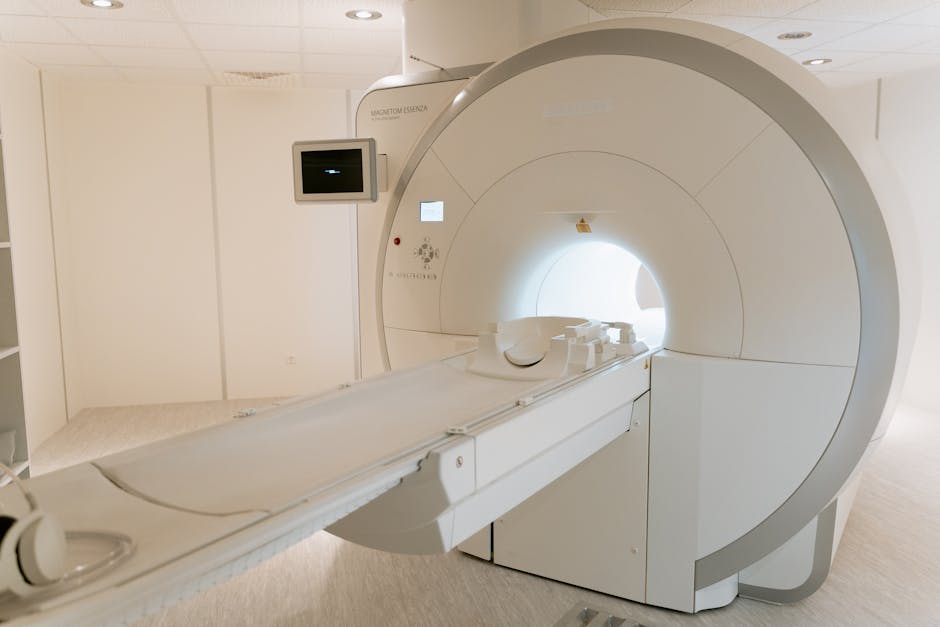
MRI tech jobs are in high demand across the United States — and if you want a quick overview of your options right now, here’s what you need to know:
| Job Type | Typical Weekly Pay | Flexibility | Benefits |
|---|---|---|---|
| Travel contract | $2,800–$3,350+ | High | Housing stipend, health insurance, CEUs |
| Permanent staff | $34–$75/hr (hourly) | Low–Medium | Full employer benefits, sign-on bonuses |
| Per diem | Varies by shift | Very high | Supplemental income, local shifts |
The MRI technologist job market is booming. Staffing platforms currently list hundreds of open roles nationwide — from short-term travel contracts paying over $3,000 per week to permanent staff positions with sign-on bonuses up to $20,000. Whether you’re a seasoned tech or just finishing your clinical rotations, there’s a path here for you.
But knowing where to look, what you need to qualify, and how to maximize your pay takes more than a quick job search.
This guide breaks it all down — clearly and quickly.
I’m Zita Ewert, and as the leader of SCRUBS Continuing Education® and a longtime resource for imaging professionals navigating certification, licensure, and career growth, I’ve spent years helping radiologic technologists make sense of the requirements behind MRI tech jobs. Let’s get into what the market looks like right now — and how you can position yourself for the best opportunities available.
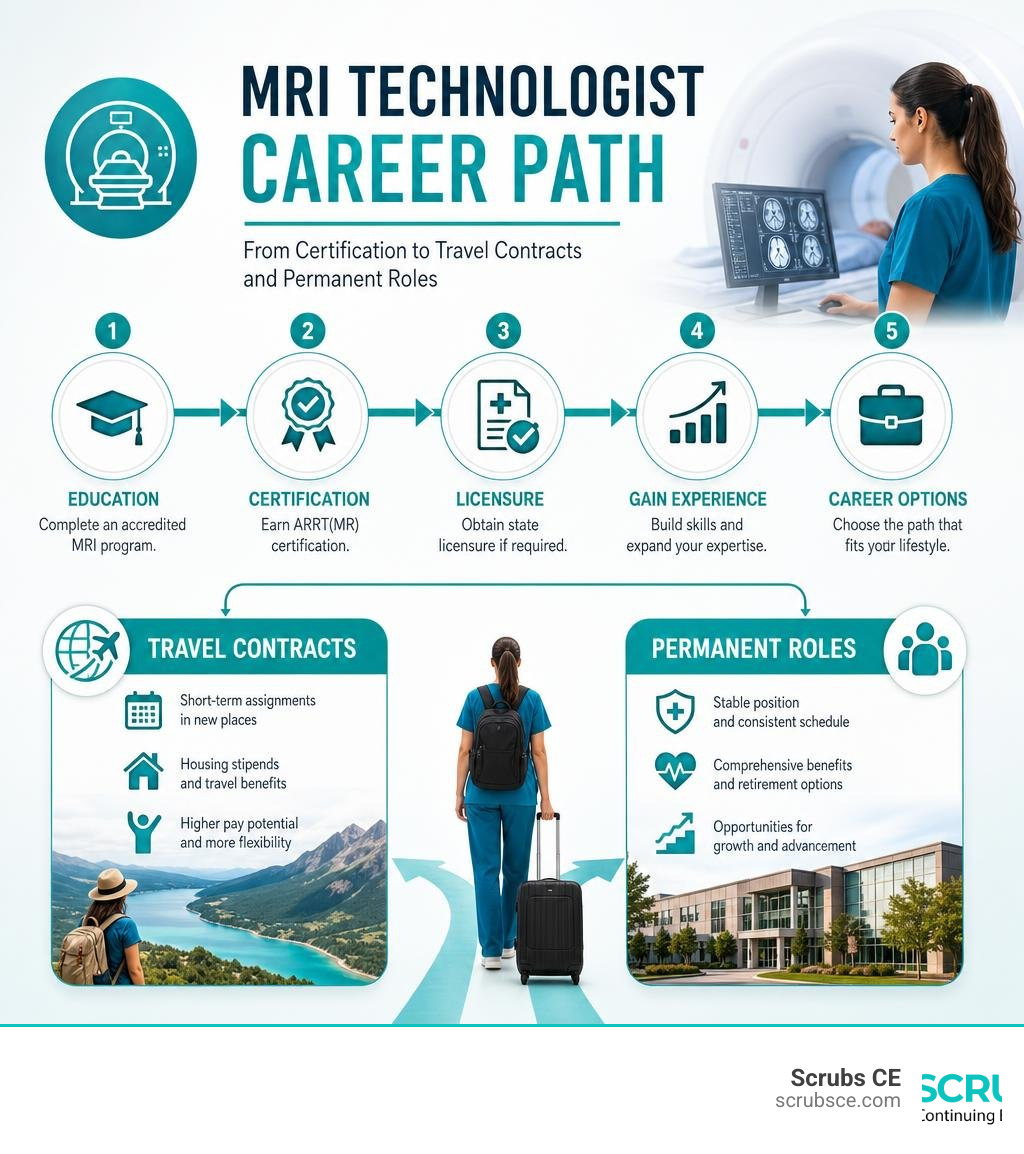
Understanding the Landscape of MRI Tech Jobs
The landscape of mri tech jobs is incredibly diverse, offering pathways that cater to different lifestyles, financial goals, and geographic preferences. As of June 2026, the job market is highly active. For instance, major staffing agencies like Aya Healthcare report around 330 total MRI Tech openings (representing 311 unique jobs) across the United States. This includes a near-even split of 148 travel contracts and 161 permanent positions, alongside flexible per diem shifts.
To help you decide which path fits your current career stage, let’s examine how these three primary employment models compare:
| Feature | Travel Contracts | Permanent Staff | Per Diem / PRN |
|---|---|---|---|
| Average Pay | $2,300 to $3,350+ per week | $34.00 to $75.00+ per hour | Premium hourly rates (varies widely) |
| Flexibility | High (choose when and where to work) | Low (fixed schedules and PTO policies) | Extremely High (work only when available) |
| Benefits | Housing stipends, travel allowances, health | Full medical, retirement match, PTO, tuition | Usually none (sometimes basic 401k) |
| Job Security | Variable (reliant on 13-week contracts) | High (stable, long-term employment) | Variable (subject to facility census) |
| Sign-On Bonuses | Rarely (sometimes completion bonuses) | Common ($7,500 to $20,000+) | None |
Pros and Cons of Travel MRI Tech Jobs
Stepping into travel imaging is an exciting move. The financial rewards are often the biggest draw. Travel MRI technologists frequently earn premium weekly pay packages, which are split between taxable hourly wages and tax-free stipends for lodging, meals, and incidentals.
- The Pros: You can explore new cities, experience different clinical environments, and build a massive professional network. Agencies often provide comprehensive health insurance, 401(k) matching, and even travel reimbursements. Additionally, working on diverse scanner models keeps your clinical skills razor-sharp. If you want to read more about how modern technology is changing our day-to-day workflow, check out our article on MRI Tech in 2025: Bigger Bores and Better Brains.
- The Cons: Travel contracts usually last 13 weeks (though they can range from 8 to 26 weeks), meaning you must be comfortable with constant change. You will have to adapt quickly to new hospital protocols, handle the logistics of moving, and occasionally manage gaps between assignments. Furthermore, most travel positions require at least one to two years of recent clinical experience, meaning new graduates must first build a foundation in permanent staff roles.
Per Diem and Interim Opportunities
If you love your local community but want more control over your schedule, per diem (PRN) work is an outstanding option. Per diem technologists fill staffing gaps caused by vacations, medical leaves, or sudden surges in patient volume.
This model offers unmatched flexibility—most agencies or hospitals only require a minimum of four days of availability per month. It is a fantastic way to secure supplemental income while holding down a full-time staff position. The trade-off is that per diem roles do not offer guaranteed hours or traditional benefits, and you must stay highly organized to manage your credentials across different hospital networks.
Qualifications and Certifications Required for Success

To land the most lucrative mri tech jobs, you must meet strict clinical and regulatory standards. Employers want to know that you can operate complex equipment safely while delivering exceptional patient care.
The gold standard for credentialing in the United States is the AMERICAN REGISTRY OF RADIOLOGIC TECHNOLOGISTS® (ARRT®) and the American Registry of Magnetic Resonance Imaging Technologists (ARMRIT®). Most reputable employers—including academic medical centers and outpatient imaging networks—require active ARRT® (MR) or ARMRIT® certification. Additionally, you must hold a current Basic Life Support (BLS) certification from the American Heart Association.
Primary and Post-Primary Pathways
There are two main routes to becoming a certified MRI technologist:
- The Primary Pathway: This is for individuals who go straight into an associate or bachelor’s degree program specifically focused on MRI technology.
- The Post-Primary Pathway: This is incredibly common for registered technologists who started in other modalities of Radiology—such as radiography (R), computed tomography (CT), nuclear medicine, or radiation therapy.
If you are transitioning from another modality, you typically need to complete structured education and document a specific number of supervised clinical scanning repetitions. For example, prominent employers like the MRI Technologist at Mayo Clinic prefer candidates with advanced certification but will often hire registry-eligible candidates on the condition that they obtain their ARRT® (MR) credential within 18 months of their start date.
To help you get started on your educational requirements from the comfort of home, we offer a comprehensive suite of Online MRI Courses designed to prepare you for clinical success.
Additionally, some states and facilities require advanced clinical competencies, such as a formal venipuncture certification for administering contrast media. For instance, UC San Diego Health requires all incoming imaging staff to secure venipuncture certification within six months of hire.
Continuing Education and Career Support
Once you secure your credentials, the learning doesn’t stop. To maintain your ARRT® or ARMRIT® registration and keep your state licenses active, you must complete continuing education (CE) credits every biennium.
At Scrubs CE, we specialize in making this process as simple and affordable as possible. We provide high-quality, self-paced courses with instant certificates to ensure you never face a lapse in compliance. Whether you need general credits or highly targeted topics, our CE for MRI Technologists and specialized MRI CE for ARMRIT ARRT packages are built to keep your career moving forward without interrupting your busy work schedule. We also offer focused resources like MRI CE for ARMRIT to help you satisfy specific registry requirements quickly.
To dive deeper into advanced imaging physics and methodology, many technologists rely on industry-standard textbooks. We offer several convenient testing options to earn CE credits using these resources, including:
- MRI in Practice 5th Ed (with options like MRI in Practice 5th Ed Test Only E-Mailed, MRI in Practice 5th Ed Test Only Mailed, and the complete MRI in Practice 5th Ed Book Test Mailed).
- Safety-focused materials like Essentials of MRI Safety (available via Essentials of MRI Safety Test Only Emailed, Essentials of MRI Safety Test Only Mailed, and Essentials of MRI Safety Book Test Mailed).
Salary Ranges, Weekly Pay, and High-Demand Locations
When it comes to compensation, mri tech jobs are among the highest-paying allied health specialties. Your earning potential is heavily influenced by your geographic location, your experience level, and whether you choose a staff or travel role.
For staff positions, hourly pay rates are exceptionally strong. For example, UC San Diego Health lists positions such as the #139662 MRI Tech with hourly pay scales ranging from $56.86 to $75.84 per hour, translating to an annual full-time equivalent of up to $147,705.
Top Cities and States for Travel Contracts
If you are looking to maximize your income through travel contracts, certain states consistently offer the highest pay packages due to local demand and cost-of-living adjustments:
- Pennsylvania: A massive hub for travel contracts. Agencies like AMN Healthcare report placing hundreds of technologists across the state, with average travel pay packages sitting around $2,495 per week and peak contracts reaching up to $3,460 per week. High-demand cities include Philadelphia, Pittsburgh, Wilkes-Barre, and Scranton.
- Colorado: Known for its incredible outdoor lifestyle and competitive healthcare wages. Systems like UCHealth list staff roles with hourly pay ranging from $40.40 to $56.56 per hour, which drives up travel contract rates in cities like Colorado Springs. You can explore these regional trends further on the MRI Technologist in Colorado Springs, CO, UCHealth (Colorado) (Updated: 2026-02-17) page.
- California & New England: These regions frequently top the charts for travel compensation, with weekly packages in coastal cities regularly exceeding $3,100 to $3,300 per week.
Factors Influencing Compensation Packages
Beyond location, several factors will shape your final compensation package:
- Sign-On and Relocation Bonuses: To attract top talent, major healthcare systems offer incredible incentives. The Mayo Clinic, for example, offers a massive $20,000 sign-on bonus for MRI technologists with advanced certification and at least one year of recent experience. Other systems, like UW Health in Madison, WI, offer a generous $15,000 sign-on bonus.
- Equipment Experience: Being proficient with multiple scanner vendors (such as Siemens, GE, or Philips) makes you highly marketable. Some specialized job postings—like those in Philadelphia—specifically look for experience with systems like the Philips Intera 1.5T.
- Shift Differentials: Working evenings, nights, or weekend rotations can add a substantial hourly premium to your base pay. You can see how these shifts are structured by reviewing the MRI Technologist in Madison, WI, UW Health (Updated: 2026-06-04) job listing.
Navigating the Hiring Process and Work Schedules
Landing your dream MRI role requires navigating a structured hiring and credentialing process. Because you will be working with strong magnetic fields and vulnerable patient populations, healthcare employers leave no stone unturned.
Once you submit your application, the hiring timeline typically takes anywhere from two to six weeks. For travel roles, this timeline can be compressed to just a few days if a facility has an urgent staffing shortage. You will undergo a thorough clinical interview, followed by comprehensive background checks, drug screenings, and credential verification.
Typical Work Schedules and Shift Lengths
Work schedules in MRI departments are highly varied, allowing you to find a routine that fits your personal life:
- 12-Hour Shifts: Extremely popular in major trauma centers. These shifts are often scheduled over weekends (e.g., Friday through Sunday), allowing you to compress your full-time hours into just three days.
- 8-Hour and 10-Hour Shifts: Common in outpatient imaging centers and community hospitals, typically running Monday through Friday.
- On-Call Requirements: Many hospital positions require technologists to participate in an on-call rotation to handle emergent cases (like stroke or spinal cord trauma protocols) overnight or on holidays.
To see an example of how a major hospital system structures its daily operations and physical requirements, take a look at the MRI Technologist (Full-Time) Jobs in Hackensack at Hackensack Meridian Health page.
Where to Find Entry-Level MRI Tech Jobs
If you are a new graduate, the job search can feel daunting since many travel roles require prior experience. However, the current demand for imaging professionals works in your favor.
The best way to start is by securing a permanent staff position at a hospital or imaging center that offers robust onboarding and mentorship. Many employers are willing to train newly registered technologists or those cross-training from other modalities. For instance, you can find excellent starting opportunities with sign-on incentives on the MRI Technologist- $7,500 Sign- On Bonus! | Hireza page.
Frequently Asked Questions about MRI Technologist Careers
What is the average weekly pay for travel MRI technologists?
Travel MRI technologists typically earn between $2,300 and $3,350+ per week. This compensation package is highly attractive because it often includes tax-free stipends for lodging and meals alongside a taxable hourly wage. The exact rate depends heavily on the facility’s location, the urgency of the contract, and your experience with specific scanner manufacturers.
Can new graduates apply for travel MRI technologist roles?
Generally, no. Most staffing agencies and hospitals require at least one to two years of recent, independent clinical experience before approving a technologist for a travel contract. This is because travel techs are expected to hit the ground running on day one with minimal orientation. New graduates should focus on securing a permanent staff role to build their clinical foundation first.
How long do travel MRI assignments typically last?
The standard duration for a travel contract is 13 weeks. However, assignments can range anywhere from 8 to 26 weeks depending on the facility’s needs. If you enjoy the location and the clinical team, facilities will very frequently offer contract extensions, allowing you to stay in one place for up to a full year.
Conclusion
The market for mri tech jobs is full of incredible opportunities for financial growth, career flexibility, and professional fulfillment. Whether you want to travel the country on high-paying contracts, settle into a stable staff role with a major health system, or pick up local per diem shifts for extra income, your skills are in high demand.
As you advance in your imaging career, staying compliant with your continuing education is vital. At Scrubs CE, we are dedicated to helping you meet your ARRT® and ARMRIT® requirements with ease. To keep your credentials active and prepare for your next big career move, explore our full catalog of convenient, self-paced courses in the MRI CE Category.
If you are looking to expand your knowledge base even further, we also recommend checking out our comprehensive programs on Magnetic Resonance Imaging and the highly detailed Fundamentals of Body MRI 2nd Ed to keep your clinical skills at the absolute cutting edge!