
ARRT MRI Registry Review: How to Pass on Your First Try
What You Need to Know About the ARRT® MRI Registry Review

An ARRT® MRI registry review is the structured preparation process that helps Radiology technologists pass the American Registry of Radiologic Technologists® certification exam in Magnetic Resonance Imaging. Here is a quick snapshot of what the exam looks like and what it takes to qualify:
ARRT® MRI Exam at a Glance:
| Factor | Details |
|---|---|
| Total questions | 230 (200 scored + 30 unscored pilot) |
| Largest exam section | Image Production (106 scored questions, 53%) |
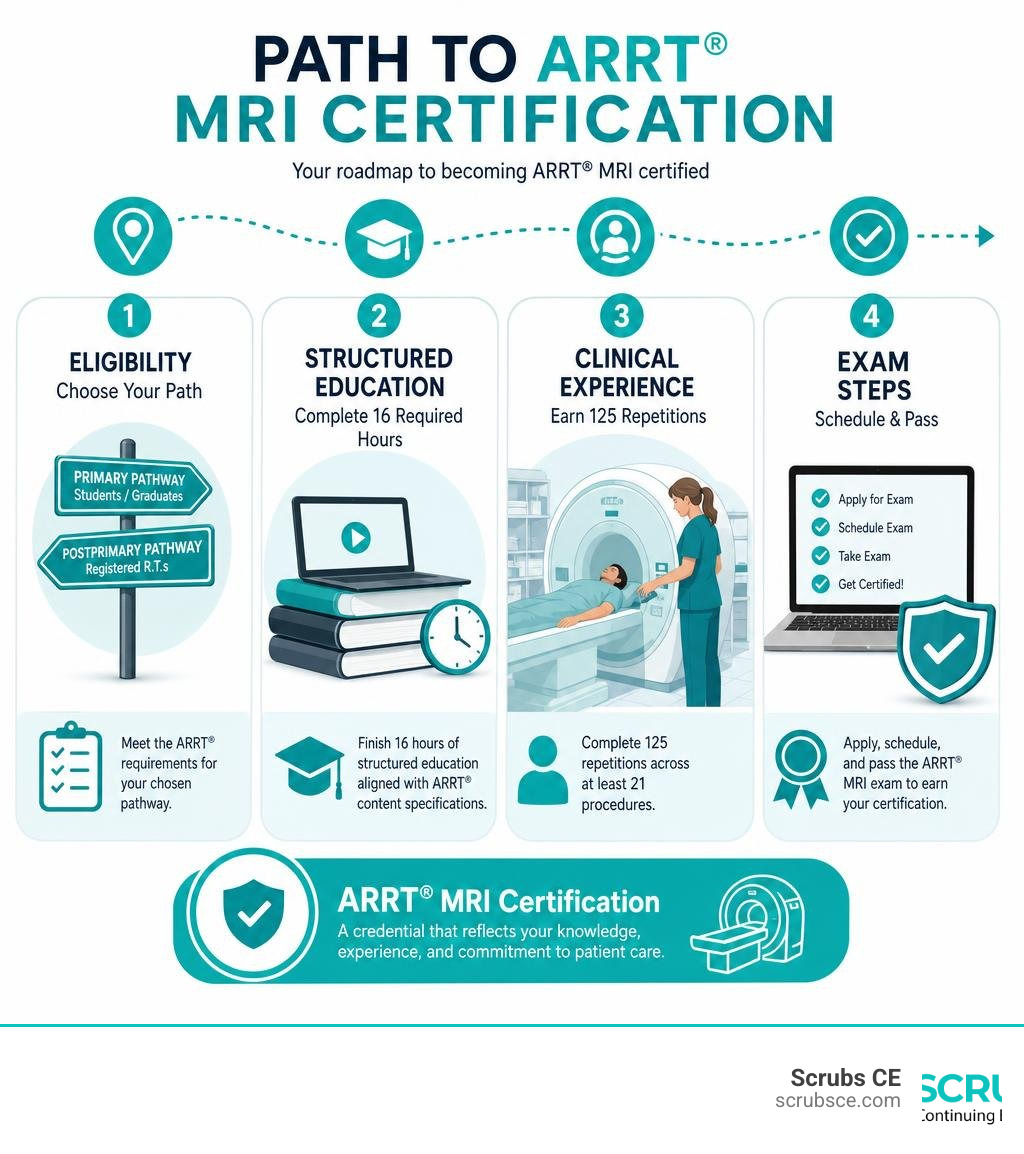
| Clinical experience required | 125 repetitions across at least 21 procedures |
| Structured education required | 16 hours aligned to ARRT® content specifications |
| Current content specifications | Effective February 1, 2025 |
| Eligibility pathways | Primary (students/graduates) or Postprimary (existing R.T.s) |
Passing the ARRT® MRI exam is genuinely challenging. The exam covers everything from MRI physics and pulse sequences to patient safety and clinical procedures. And most candidates are preparing while juggling full-time jobs, clinical rotations, and everything else life throws at them.
The good news? A focused, organized review strategy makes a real difference. This guide walks you through exactly what is on the exam, how to qualify, and how to study efficiently.
I am Zita Ewert, a leader in continuing education for imaging professionals and the driving force behind SCRUBS Continuing Education®, where I have helped thousands of Radiology technologists navigate complex credentialing requirements — including ARRT® MRI registry review preparation. In the sections below, I will break down everything you need to know to pass on your first attempt.
Mastering the ARRT MRI Registry Review: Exam Blueprint and Eligibility

To pass the registry, we have to know exactly what we are up against. The AMERICAN REGISTRY OF RADIOLOGIC TECHNOLOGISTS® updates its exam guidelines regularly to ensure they reflect modern clinical practice. The current standards are defined in the Magnetic Resonance Imaging Content Specifications 2025.
Understanding these updates is critical because studying outdated material is one of the easiest ways to set yourself up for frustration. If you want a solid starting point for your overall certification journey, check out our guide on How to Get ARRT Certified Without Losing Your Mind.
Core Content Categories and Question Breakdown
The ARRT® MRI registry exam consists of 230 total questions. Out of these, 200 are scored questions that determine your final grade, and 30 are unscored pilot questions used to test future exam items.
The exam is divided into four major content categories. Here is how those 200 scored questions are distributed:
- Image Production (106 questions — 53%): This is the heavy hitter of the exam. It covers the physical principles of image formation (39 questions), sequence parameters and options (36 questions), and data acquisition, processing, and storage (31 questions).
- Procedures (57 questions — 28.5%): This section tests your clinical knowledge across neurological imaging, body imaging, and musculoskeletal (MSK) procedures.
- Safety (21 questions — 10.5%): Covers screening, electromagnetic fields, patient safety, and equipment environment.
- Patient Care (16 questions — 8%): Focuses on patient interactions, contrast media administration, infection control, and basic monitoring.
Because Image Production accounts for more than half of the exam, your arrt mri registry review must place a massive emphasis on MRI physics and parameter manipulation.
Key Differences Between the 2020 and 2025 ARRT® MRI Content Specifications
The transition from the 2020 guidelines to the February 1, 2025 specifications introduced several key updates that you must incorporate into your study plan. The ARRT® bases these changes on a national practice analysis survey of over 4,000 practicing MRI technologists to keep the exam job-related.
Key changes to focus on include:
- Nyquist Theorem: This mathematical principle has been officially added to the Data Manipulation and processing section under Image Production.
- Wrap-Around Artifacts: Expanded guidelines under the Safety and Aliasing sections to emphasize how wrap-around works and how to prevent it.
- Musculoskeletal Soft Tissue: The Procedures section now features a heavier emphasis on soft tissue musculoskeletal procedures (such as evaluating tumors or infections).
- Clinical Communication: New additions covering patient “time-outs” and the communication of critical findings to radiologists.
- Pilot Questions: The number of unscored pilot questions increased from 20 to 30, though the scored questions remain at 200.
To see the exact clinical tasks expected of an entry-level technologist under these guidelines, you can review the official Magnetic Resonance Imaging Task Inventory 2025, which lists 122 specific job responsibilities.
Primary vs. Postprimary Pathways for ARRT® Certification
There are two distinct pathways to earn your ARRT® MRI credential, depending on where you are in your career:
- Primary Eligibility Pathway: This is for students or recent graduates of an educational program in MRI accredited by an agency recognized by the ARRT®. Candidates must complete an associate degree (or higher) and demonstrate competence in 16 mandatory procedures and 12 of 33 elective procedures.
- Postprimary Eligibility Pathway: This is designed for technologists who already hold an ARRT® credential in a supporting category (such as Radiography, Nuclear Medicine, Sonography, or Radiation Therapy).
Interestingly, individuals holding credentials from the NMTCB (Nuclear Medicine) or ARDMS (Sonography) can also pursue ARRT® MRI credentials through this pathway by submitting an online account access form, even if they are not currently ARRT® Registered Technologists.
For the postprimary pathway, you must document 16 hours of structured education and complete clinical experience requirements consisting of at least 125 repetitions across 21 different procedures. If you are starting from square one, we recommend reading MRI Training 101: Learn MRI Basics to build a solid foundation.
Structured Study Strategies for Your ARRT MRI Registry Review
Cognitive learning research shows that the human brain does not recall complex technical information through linear memorization. Instead, it processes data by breaking it down into hierarchical categories and subcategories.
To study effectively:
- Avoid Passive Reading: Simply highlighting a textbook or watching long video modules is highly inefficient.
- Use Active Recall: Test yourself constantly. Read a section on spatial encoding, then immediately take a quiz on that specific topic.
- Categorize Your Thoughts: Group your study sessions into the four main ARRT® categories. Master one domain before moving to the next.
- Simulate the Exam: Take fully timed mock exams to build your testing endurance. Sitting through a 230-question exam requires physical and mental stamina.
Core Physics, Pulse Sequences, and Parameter Optimization
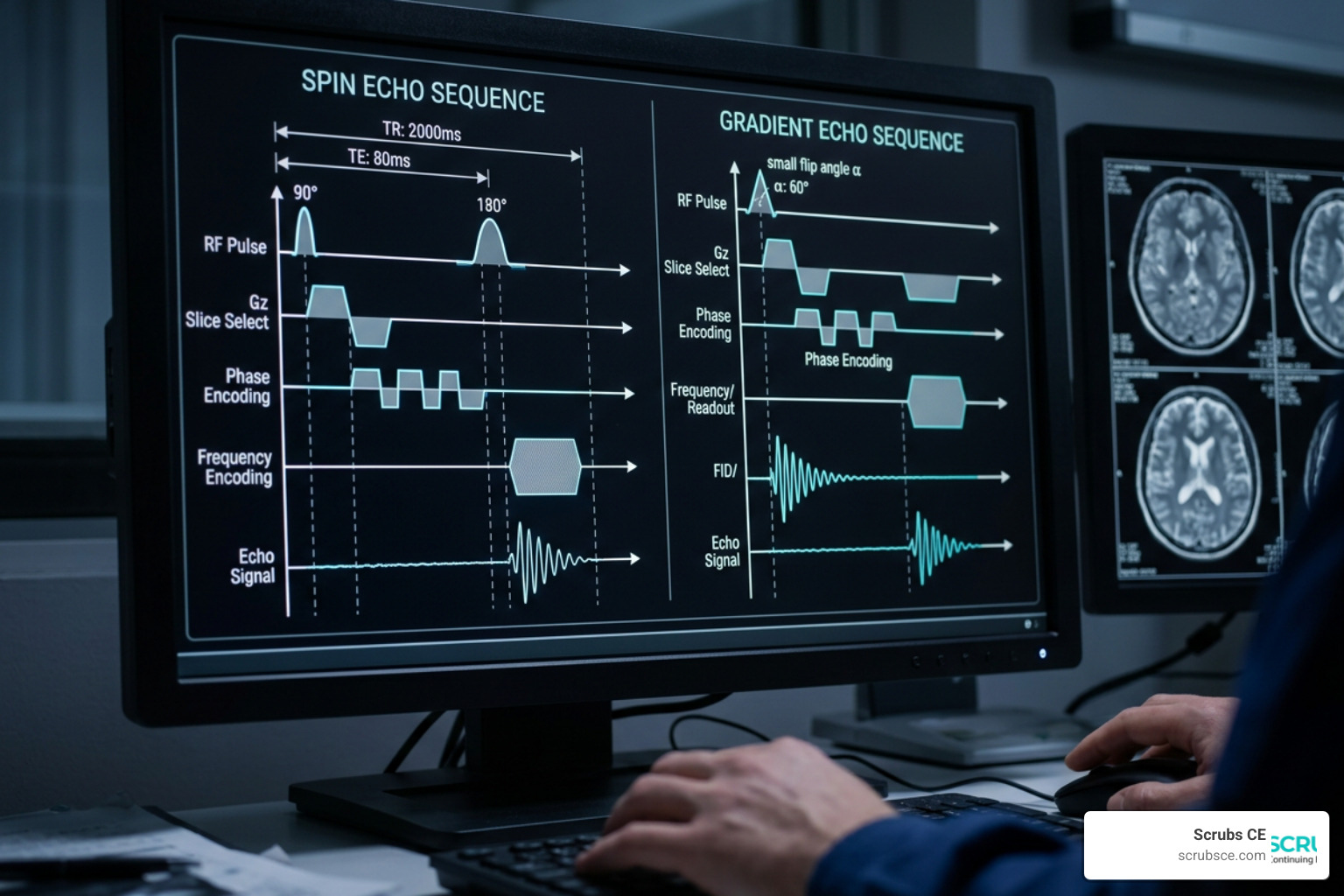
MRI physics is notorious for making even seasoned Radiology technologists sweat. However, mastering the fundamentals — like the Larmor equation ($f0 = \gamma B0$), the net magnetization vector (NMV), precession, and resonance — is entirely doable with the right resources.
A great textbook to guide you through these concepts is MRI in Practice 5th Ed Test Only E Mailed, which breaks down complex quantum mechanics into highly visual, easy-to-digest explanations.
Essential Pulse Sequences and Clinical Applications
To ace the Image Production section, you must understand the primary pulse sequences, how they work, and when they are used clinically:
- Spin Echo (SE): Uses a 90-degree excitation pulse followed by a 180-degree refocusing pulse. It is the gold standard for image quality and is highly resistant to magnetic field inhomogeneities.
- Fast Spin Echo (FSE): Uses a train of 180-degree refocusing pulses (echo train length) to fill multiple lines of K-space in a single TR, drastically reducing scan times.
- Inversion Recovery (IR): Starts with a 180-degree inversion pulse to flip the NMV into the negative z-axis, allowing tissues to recover before applying the 90-degree excitation pulse.
- STIR (Short TI Inversion Recovery): Uses a short inversion time (TI) to null the signal from fat. It is incredibly useful in musculoskeletal imaging to highlight bone marrow edema.
- FLAIR (Fluid Attenuated Inversion Recovery): Uses a long inversion time to null the signal from free fluid (CSF). It is essential in brain imaging to detect MS plaques or subtle lesions near the ventricles.
- Gradient Echo (GE): Uses a variable flip angle (typically less than 90 degrees) and gradient reversal (instead of a 180-degree RF pulse) to refocus the spins. This allows for incredibly short TRs and rapid imaging, making it ideal for MR angiography (MRA) and dynamic contrast studies.
- Echo Planar Imaging (EPI): The fastest sequence available, filling all of K-space in a single TR. It is highly sensitive to susceptibility artifacts but is the foundation for advanced techniques like Diffusion-Weighted Imaging (DWI) and functional MRI (fMRI).
How Imaging Parameters Affect Image Quality
As an MRI technologist, you are constantly balancing a trade-off between signal-to-noise ratio (SNR), spatial resolution, and scan time.

The table below summarizes how adjusting key parameters impacts your final image:
| Parameter Adjustment | SNR | Spatial Resolution | Scan Time |
|---|---|---|---|
| Increase TR (Repetition Time) | Increases | No effect | Increases |
| Increase TE (Echo Time) | Decreases | No effect | No effect |
| Increase Slice Thickness | Increases | Decreases | No effect |
| Increase Matrix Size (e.g., 256 to 512) | Decreases | Increases | Increases |
| Increase FOV (Field of View) | Increases | Decreases | No effect |
| Increase NEX/NSA (Number of Averages) | Increases | No effect | Increases |
| Increase Bandwidth (Receiver) | Decreases | No effect | Decreases |
Understanding these relationships is crucial because the registry will ask scenario-based questions, such as: “If you want to double your SNR, what is the impact on your scan time if you adjust NEX?” (Hint: Doubling SNR requires quadrupling your NEX, which quadruples your scan time!).
Recommended Study Materials and Practice Exams for Your ARRT MRI Registry Review
To satisfy the ARRT® Structured Education requirement, postprimary candidates must complete at least 16 hours of structured education. We offer a variety of approved courses that allow you to earn Category A CE credits while simultaneously preparing for your registry.
Check out our CE for MRI Technologists page to find flexible, self-paced learning modules designed to help you succeed.
MRI Safety, Artifacts, and Clinical Procedures
Patient safety is the most critical aspect of an MRI technologist’s daily job. The registry heavily tests your understanding of the American College of Radiology (ACR) safety guidelines, screening protocols, and emergency management.
For a deep dive into safety concepts, we highly recommend reviewing the Essentials of MRI Safety Test Only Emailed course.
Identifying and Compensating for Common MRI Artifacts
Artifacts can ruin diagnostic image quality. You must know how to identify them and how to fix them on the fly:
- Aliasing (Wrap-Around): Occurs when anatomy outside the selected FOV is mapped into the image.
- Compensation: Increase the FOV, or use phase oversampling (often called “No Phase Wrap”).
- Gibbs / Truncation Artifact: Appears as parallel lines or “ringing” at high-contrast interfaces (like the skull/brain boundary or CSF/spinal cord boundary). It is caused by undersampling high spatial frequencies in K-space.
- Compensation: Increase the phase matrix size.
- Chemical Shift: Appears as a dark or bright band at fat-water interfaces along the frequency-encoding axis, caused by the slight difference in precessional frequency between fat and water protons.
- Compensation: Increase the receiver bandwidth or use fat suppression.
- Magnetic Susceptibility: Causes severe distortion and signal loss around metallic implants.
- Compensation: Use Spin Echo or Fast Spin Echo sequences instead of Gradient Echo, use a high receiver bandwidth, and keep the echo spacing as short as possible.
- Partial Voluming: Occurs when multiple tissue types are included in a single voxel, leading to an averaged signal.
- Compensation: Decrease the slice thickness.
- Flow/Motion Artifacts: Present as ghosting or smearing, always along the phase-encoding axis.
- Compensation: Use spatial presaturation bands (sat bands), gradient flow compensation (rescaling), or physiological gating (respiratory or cardiac).
Anatomical Structures and Imaging Protocols
The Procedures section of the exam tests your clinical positioning and protocol knowledge across three main areas:
- Neurological: Brain, spine, pituitary, and internal auditory canals (IACs). You must understand slice angulation (e.g., aligning sagittal brain slices parallel to the interhemispheric fissure) and coil selection (multi-channel head coils).
- Body: Abdomen (liver, MRCP, kidneys) and pelvis. These protocols rely heavily on motion-compensation techniques, breath-holds, and spatial fat suppression to clearly visualize soft tissues. To master body imaging, check out our Fundamentals of Body MRI 2nd Ed E Book Test.
- MSK: Joints (knee, shoulder, hip, wrist) and long bones. MSK imaging utilizes small FOVs, high-resolution matrices, and specialized surface coils to capture fine ligamentous and cartilaginous details.
Mandatory and Elective Clinical Competency Requirements
For the postprimary pathway, candidates must document a minimum of 125 repetitions across at least 21 different procedures.
- Repetition Limits: You must document each chosen procedure between 3 and 6 times.
- In-Person Requirement: The ARRT® explicitly bans remote scanning or remote procedures for clinical competency. You must be physically present at the magnet console for every procedure you document.
- Quality Control (QC): Daily QC procedures — such as equipment inspection, monitoring cryogen levels, and documenting room temperature and humidity — are mandatory clinical competencies.
Frequently Asked Questions About the ARRT® MRI Exam
How many questions are on the ARRT® MRI registry exam?
The exam features 230 total questions. This includes 200 scored questions that determine your final grade and 30 unscored pilot questions. You will not know which questions are pilot questions, so treat every question as if it counts!
What is the passing score for the ARRT® MRI exam?
To pass, you must achieve a scaled score of 75. A scaled score is not a straight percentage (e.g., getting 75% of the questions correct). Instead, the ARRT® uses a statistical process to account for slight differences in difficulty between different versions of the exam.
Can I use remote scanning to fulfill my clinical experience requirements?
No. The ARRT® has a strict remote scanning ban for both clinical competency and clinical experience requirements. Candidates must be physically present at the facility and directly involved in the setup, positioning, and scanning of the patient.
Conclusion
Preparing for your ARRT® MRI registry review can feel overwhelming, but breaking the material down into structured categories is the key to passing on your first try. Focus on mastering MRI physics, understanding how parameters interact, and ensuring you are fully compliant with the latest 2025 content specifications.
At SCRUBS Continuing Education®, we are committed to supporting your professional development. Whether you need to fulfill your 16-hour structured education requirement or earn Category A CE credits to maintain your current credentials, we offer convenient, self-paced online courses to help you succeed.
Explore our complete catalog of Radiology Courses today and take the next step in advancing your career!