
How to Get ARRT Certified Without Losing Your Mind
How to Get ARRT® Certification: A Quick-Start Guide
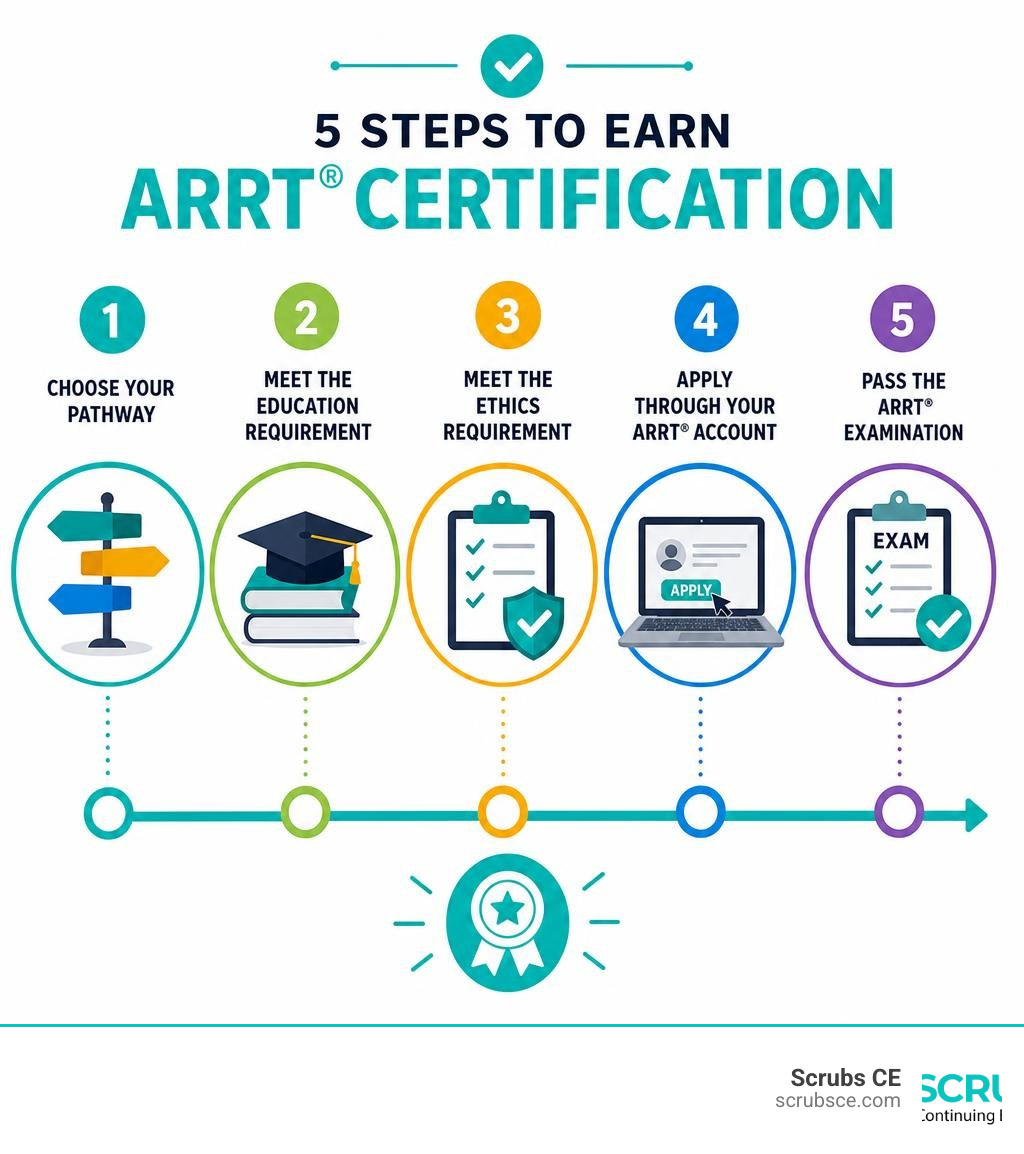
If you’re figuring out how to get a ARRT certification, here’s the short answer:
- Choose your eligibility pathway — primary, postprimary, Imaging Assistant, or R.R.A.®
- Meet the education requirement — complete an ARRT®-approved program and earn an associate degree or higher
- Meet the ethics requirement — disclose any violations and pass an ethics review if needed
- Apply through your ARRT® online account at arrt.org
- Pass the ARRT® examination — you get three attempts within a three-year window
That’s the core process. But each step has real details that trip people up — deadlines, degree rules, ethics disclosures, and exam logistics. The sections below break it all down clearly.
Earning your AMERICAN REGISTRY OF RADIOLOGIC TECHNOLOGISTS® credential is one of the most important steps in a Radiology career. It signals to employers — and to patients — that you meet a nationally recognized standard of competence and professionalism. Radiologic technologists are already the third-largest group of healthcare professionals in the country, and ARRT® certification is the benchmark that sets qualified professionals apart.
The process isn’t always simple. Between degree requirements, ethics reviews, and exam scheduling, it’s easy to feel overwhelmed — especially while you’re also working or completing clinical hours.
I’m Zita Ewert, and as the leader of SCRUBS Continuing Education®, I’ve spent years helping imaging professionals navigate exactly this kind of regulatory complexity — from understanding how to get a ARRT certification the first time, to maintaining it through every renewal cycle. Let’s walk through everything you need to know, step by step.
How to get a arrt certification glossary:
What is ARRT® Certification and Why Does It Matter?

When you are looking at how to get a ARRT certification, it helps to understand why the AMERICAN REGISTRY OF RADIOLOGIC TECHNOLOGISTS® is the gold standard. Radiologic technologists make up the third-largest group of healthcare professionals in the nation, and their daily work directly impacts patient diagnoses and treatments. Because medical imaging requires precise technical skills and strict safety protocols, employers and state regulatory boards rely on standardized qualifications to ensure public safety.
Earning your ARRT® credentials proves that you have mastered the essential clinical skills and academic knowledge necessary to deliver exceptional patient care. It is more than just a piece of paper; it is a professional milestone that unlocks competitive salary rates, leadership opportunities, and job mobility across state lines. In states with strict licensing laws, such as Florida, having this credential makes navigating local guidelines incredibly straightforward. If you plan to practice in the Sunshine State, you can read our detailed guide on ARRT Certification Florida to see how your national registry status fast-tracks your state license.
Certification shows that you are dedicated to professional standards and lifelong learning. It builds trust with your clinical team and provides peace of mind to the patients who rely on your expertise during vulnerable medical moments.
The Core Requirements: How to Get a ARRT Certification
To earn your credential, you must successfully navigate what the AMERICAN REGISTRY OF RADIOLOGIC TECHNOLOGISTS® refers to as the “Equation for Excellence.” This proven formula consists of three core components: Education, Ethics, and Examination.
If any one of these pillars is missing, you cannot earn your certification. Let’s look at how these three elements compare:
| Requirement | What It Entails | Why It Matters | Key Deadline / Rule |
|---|---|---|---|
| Education | Earn an associate degree (or higher) and complete an ARRT®-approved program. | Ensures a strong foundation in general education and clinical skills. | You must apply within 3 years of completing your educational program. |
| Ethics | Comply with the Rules of Ethics; disclose any past criminal charges or violations. | Safeguards patient trust and professional integrity. | Report any violations within 30 days of occurrence. |
| Examination | Schedule and pass the comprehensive discipline-specific exam. | Measures your technical competency and clinical readiness. | You have 3 attempts within a 3-year window. |
The Education Requirement: Degrees and Programs
Education is the first step in the equation. To qualify for certification, you must meet two distinct academic milestones:
- Complete an educational program approved by the AMERICAN REGISTRY OF RADIOLOGIC TECHNOLOGISTS® in your chosen discipline.
- Earn an associate degree or higher from an accredited institution recognized by the registry.
A common point of confusion is whether your degree has to be in the radiologic sciences. The short answer is no! Your associate, baccalaureate, or graduate degree can be in any subject—such as business, psychology, or general studies—as long as it was granted by an agency acceptable to the registry. Furthermore, you can earn your degree before, during, or after your professional Radiology program, but you must have it fully conferred before you sit for your exam.
Why is a degree so important? The general education courses required for a degree provide quantitative, communication, and human behavior skills that help you adapt to rapid technological shifts in healthcare.
The three-year rule: you must complete all application steps and establish your eligibility within three years of graduating from your professional program. For a deeper dive into these academic standards, you can review the official ARRT® Education Requirements Document.
The Ethics Requirement: Compliance and Preapplication
The registry holds its credential holders to an incredibly high standard of professional conduct. To satisfy the ethics requirement, you must comply with the ARRT® Rules of Ethics, which cover everything from patient privacy to exam integrity.
When you apply, you will be asked to answer three specific ethics questions regarding:
- Any misdemeanor or felony charges, convictions, or pleas of guilt/no contest (excluding minor traffic violations and juvenile offenses).
- Any professional license or certification denials, suspensions, or revocations by a regulatory authority.
- Any suspensions, dismissals, or honor code violations from an educational program you attended.
If you have a past violation on your record, do not panic. In 2023, the registry completed approximately 1,730 ethics reviews, and only 12 cases (less than 1%) resulted in the revocation of credentials. In 2024, they completed 1,309 ethics reviews, with about 98% of candidates successfully obtaining or keeping their certification.
The secret is transparency. If you have a potential issue, you can submit an Ethics Review Preapplication up to eight months before your graduation. This preemptive review allows the registry to evaluate your background before you spend time and money on your exam. Always report any violations proactively within 30 calendar days of their occurrence to keep your record in good standing.
The Examination Requirement: Scheduling and Attempts
Once your education and ethics requirements are verified, you will receive your Candidate Status Report (CSR). This is your official green light to schedule your exam!
The registry partners with Pearson VUE to administer its computer-based exams at professional testing centers. Once your CSR is issued, you must create an account with Pearson VUE and schedule your appointment. You can schedule your session as little as one business day in advance, depending on local test center availability.
Here are the critical rules for the exam phase:
- The Three-Year Window: You must pass your exam within three years of the date your first exam window opens.
- The Three-Attempt Limit: You are allowed a maximum of three attempts to pass the exam. If you do not pass within three attempts or within the three-year window, you will lose your eligibility and must go through a formal requalification process.
Take time to prepare thoroughly, review the official content outlines, and arrive at the test center with two valid forms of government-issued identification that match the legal name on your application exactly.
Navigating the Eligibility Pathways

When mapping out how to get a ARRT certification, you must choose the eligibility pathway that aligns with your current educational background and career goals. The registry offers structured pathways designed for both entry-level students and experienced professionals looking to add advanced specialties.
Choosing Your Pathway: How to Get a ARRT Certification
The vast majority of candidates earning their very first credential will use the Primary Eligibility Pathway. This pathway is designed for individuals who do not currently hold an active registry credential.
Disciplines available through the primary pathway include:
- Radiography
- Magnetic Resonance Imaging (MRI)
- Sonography
- Nuclear Medicine Technology
- Radiation Therapy
- Vascular Sonography
To get started, you must enroll in a program specifically approved for your chosen discipline. For detailed instructions on application forms, clinical competencies, and student guidelines, refer to the official Primary Eligibility Pathway Handbook.
Advanced Pathways: Postprimary and R.R.A.®
If you already hold an active credential, you can expand your career options through the Postprimary Eligibility Pathway or pursue advanced clinical practice as a Registered Radiologist Assistant (R.R.A.®).
- Postprimary Pathway: This is perfect for registered technologists who want to specialize in high-demand areas like Mammography, Computed Tomography (CT), MRI, or Bone Densitometry. You must complete 16 hours of structured education within the 24 months preceding your application, with at least one credit addressing each major content outline category. You also need to document specific clinical experiences verified by a registered colleague or interpreting physician. For full instructions, check out the Postprimary Eligibility Pathway Handbook and our guide on Mammography Mastery Achieving Your ARRT Certification.
- Registered Radiologist Assistant (R.R.A.®): This advanced-practice credential is for radiographers who have earned a master’s or doctoral degree, completed an approved RA educational program, and documented at least two years of full-time, professional-level patient care experience. Learn more about this prestigious path in the Registered Radiologist Assistant Handbook.
The Application and Verification Process
Submitting your application is the final bridge between your hard work in the classroom and your official seat at the testing center. Keeping track of the registration details will ensure your application moves smoothly through the system.
Step-by-Step Application: How to Get a ARRT Certification
Ready to apply? Follow these steps to submit your application without any unnecessary delays:
- Create Your Online Account: Head over to arrt.org and set up your candidate profile.
- Complete the Application: Fill out the online application for your specific discipline. Be sure to use your full legal name exactly as it appears on the two forms of ID you will bring to the test center.
- Answer the Ethics Questions: Disclose any required background information honestly.
- Pay the Application Fee: Submit your payment securely through the online portal.
- Program Director Verification: Once you submit, your Program Director will receive a notification to verify that you have successfully completed all academic and clinical competencies.
- Receive Your CSR: Once approved, your Candidate Status Report (CSR) will appear in your online account, allowing you to schedule your exam with Pearson VUE.
ARRT® Certification vs. State Licensing
A common point of confusion for new graduates is the difference between national certification and state licensing.
- ARRT® Certification and Registration: This is a national, voluntary credential. It proves that you have met the rigorous education, ethics, and examination standards of the AMERICAN REGISTRY OF RADIOLOGIC TECHNOLOGISTS®.
- State Licensing: This is legal permission granted by an individual state’s regulatory authority allowing you to work in that state.
While the registry credentials you nationally, many states use these exam scores and certification status as their primary criteria for issuing a state license. Always check with your local state department of health or regulatory board to ensure you have the proper legal license to practice before accepting a position.
Frequently Asked Questions About ARRT® Certification
Navigating the path to certification raises plenty of practical questions. Here are the answers to the most common questions candidates ask:
How long do I have to apply after completing my educational program?
You have exactly three years from your program completion date to apply for certification and registration. If you miss this three-year window, your program eligibility expires, and you will have to meet additional educational requirements to establish eligibility again.
What happens if I fail the ARRT® exam three times?
If you do not pass the exam on your third attempt, or if your three-year eligibility window expires, you must requalify. This usually involves enrolling in and completing an approved educational program again. For those whose credentials have lapsed after previously holding them, the process of regaining active status is detailed in the Reinstatement of Certification and Registration by Examination Handbook.
How do employers verify my ARRT® credentials?
Employers can verify your credential status instantly using the registry’s online directory search. The directory is updated once daily. Employers should never accept paper credential cards as official proof, as the registry no longer issues them. If formal proof is required, you can request an official verification letter on registry letterhead using your social security number, date of birth, or registry ID.
Conclusion
Earning your national credential is a monumental achievement that sets the stage for a rewarding, lifelong career in medical imaging. While the initial process of learning how to get a ARRT certification requires hard work and focus, the professional opportunities it creates are well worth the effort.
Once you pass your exam, your learning journey doesn’t stop. To maintain your active registry status, you will need to complete continuing education (CE) credits during every two-year biennium. For most radiologic technologists, this means earning 24 CE credits.
When the time comes to renew, we are here to help. At Scrubs CE, we specialize in offering convenient, self-paced online courses designed to make professional development simple and affordable. Whether you need to learn about the ARRT CE Renewal process, find flexible ARRT Continuing Education Online options, or understand the overall ARRT Renewal Process, we have you covered.
We also offer specialized resources for specific imaging fields, such as our guide to ARRT Mammography CE Requirements and our helpful breakdown on Demystifying ASRT Category A Credits for Your Next Cycle.
Take things one step at a time, keep your eyes on the prize, and remember to plan for your future professional development. When you are ready to complete your CE requirements easily, Explore Radiology Continuing Education Courses at Scrubs CE to keep your career moving forward!