
Quick and Free CNA Renewal Online Methods by State
Understanding CNA Recertification and State Registry Requirements

A Certified Nursing Assistant (CNA) provides essential hands-on care, assisting patients with daily living activities, vital signs, and mobility under the direct supervision of licensed nursing staff. Because patient safety depends on up-to-date clinical competence, maintaining an active status on your state nurse aide registry is mandatory.
To renew your CNA license online for free, log into your state nurse aide registry portal before your expiration date and verify that you completed at least 8 qualifying paid nursing hours under licensed supervision during your current 24-month cycle. States with no-fee portals, such as North Dakota, Georgia, and Michigan, allow eligible nurse aides to submit their renewal at zero cost, while other states may charge a fee that your employer can often cover.
Under federal standards established by the Omnibus Budget Reconciliation Act (OBRA), CNA certifications operate on a 24-month cycle. Every two years, nurse aides must recertify to demonstrate that they remain clinically competent and actively engaged in healthcare delivery. While federal guidelines set the baseline requirements, individual state boards of nursing or departments of health administer their own registries. Consequently, the recertification workflow, required paperwork, and fees can differ across state borders.
Eligibility Criteria for Free CNA Renewal Online
To qualify for recertification without taking a new competency evaluation, you must meet specific work experience standards during your two-year cycle. In many jurisdictions, finding nurse aide certificate renewal explained simply comes down to confirming your active employment history under licensed supervision.
The core eligibility requirements typically include:
- Qualifying Paid Nursing Hours: You must have performed paid nursing or nursing-related services within the previous 24 consecutive months. Volunteer work generally does not count toward this total.
- Minimum Work Threshold: Many states require as little as 8 hours of paid nursing work within the 24-month period, while others require 40 or more hours.
- Supervised Clinical Setting: Your duties must have been performed under the supervision of a licensed nurse (RN or LPN/LVN) in an approved facility, such as a hospital, nursing home, hospice, or home health agency.
- Active Status: You must submit your renewal before your current registry listing expires.
If you meet these standards, your application is considered a standard renewal rather than a reinstatement, allowing you to bypass costly clinical re-testing.
Standard Verification Documents and Continuing Education
Before logging into your state registry portal, having your documentation organized ensures a smooth submission. Depending on your state, you may need to provide:
- Employer Verification: Contact details for your supervising nurse or HR department to verify your paid hours, or a signed employment verification form.
- In-Service Training and Continuing Education: Many states mandate continuing education units (CEUs). For example, some jurisdictions require 12 to 24 hours of continuing education per renewal cycle covering mandatory topics such as infection control, resident rights, medical record documentation, and CPR skills.
- Identity and Background Verification: Your Social Security number, current registry number, and government-issued identification.
- Screening Clearances: Periodic background checks or updated electronic fingerprint records where required by state law.
When submitting records online, the Nurse Aide Renewal Form via Self-Service Portal guidelines recommend saving all proof of employment and continuing education certificates as clean PDF files to prevent upload errors.
State-by-State Breakdown: Zero-Cost vs. Fee-Based CNA Renewals
The administrative cost of renewing your nurse aide credential varies widely by state. Several states provide completely no-fee portals where certified assistants can recertify at zero cost, provided their employment requirements are met. Other states charge an administrative renewal fee, though employers often cover these expenses.
| State / Registry Model | Renewal Fee | Minimum Work Requirement | Continuing Education (CE) | Key Renewal Feature |
|---|---|---|---|---|
| North Dakota | $0 (Free) | 8 paid hours in 24 months | Not mandated for basic renewal | Instant online submission via self-service registry portal |
| Georgia (Alliant Health) | $0 (Free) | 8 paid hours in 24 months | Facility-dependent in-service | Online portal with secure one-time password verification |
| Michigan (MI-NATES) | $0 (Free) | 8 paid hours in 24 months | 12 hours annually recommended | Direct employer electronic verification workflow |
| Florida | $55 (Standard) / $105 (Late) | Paid nursing duties in 24 months | 24 hours per biennium | Supports employer billing via “Other Payer Code” |
Learning how to renew your CNA license in simple steps helps you determine whether your state offers direct zero-cost renewals or uses an employer-sponsored system. In fee-charging states like Florida, the Certified Nursing Assistant (CNA) Renewal – Florida Board of Nursing allows healthcare facilities to register for an “Other Payer Code.” By entering this code during your application, your facility covers the renewal cost directly on your behalf, effectively giving you a free renewal experience.
Step-by-Step Guide to Free CNA Renewal Online
Renewing through an online self-service registry eliminates mailing delays and gives you instant confirmation of your submission. Follow these steps to complete your renewal smoothly.
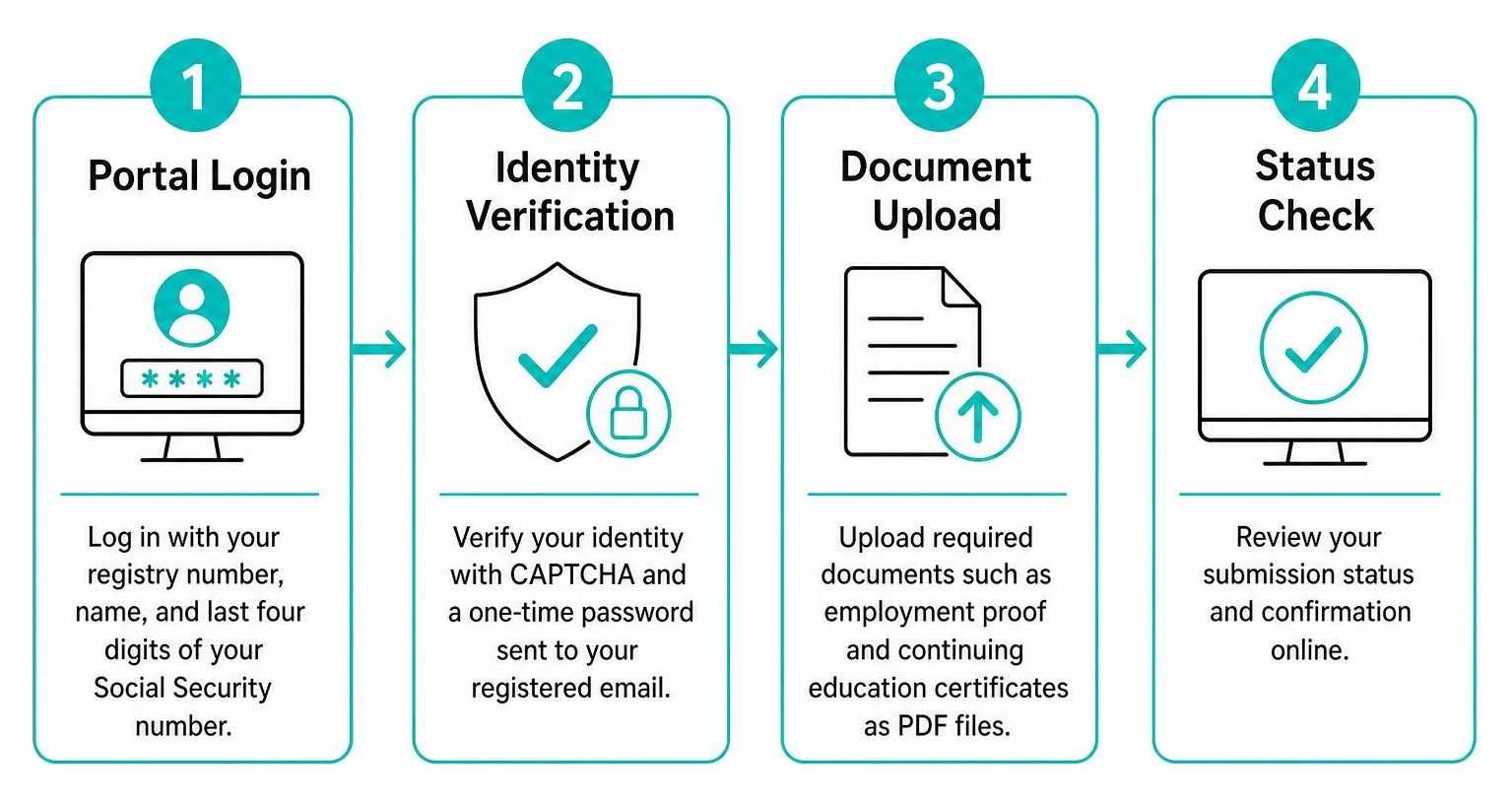
How to Complete Free CNA Renewal Online Portals Securely
- Access the Official State Registry: Navigate directly to your state department of health or licensing board self-service portal.
- Log In or Register: Enter your registry number, last name, and the last four digits of your Social Security number.
- Pass Security Authentication: Complete the CAPTCHA prompt and enter the one-time password (OTP) sent to your registered email address. That registry security tokens often expire within 15 to 20 minutes, so verify your inbox promptly.
- Update Personal Information: Review your legal name, physical address, phone number, and email. Ensuring your contact information is up to date prevents missed recertification notices.
- Input Work History: Enter your employer’s facility information, supervisor details, and the dates of your qualifying paid nursing hours. Explore our resources on CNA license renewal for state-specific navigation tips.
Uploading Supporting Documents and Tracking Application Status
Once your demographic and employment details are entered, you will need to upload your supporting documentation:
- Adhere to File Formatting Rules: Ensure all attachments are formatted as PDF, DOCX, or standard image files (JPG/PNG). Most state portals enforce a strict file limit (typically up to 20MB per attachment) and reject special symbols in filenames.
- Submit Employer Sign-Off: If your state requires electronic supervisor sign-off, double-check that your supervisor’s email address is spelled correctly so the portal can send them the verification link.
- Record Your Confirmation Number: After submitting, download or screenshot your submission summary and tracking number.
- Check Registry Verification: Processing times range from instant automatic updates to 10 business days for manual reviews. You can confirm your active status at any time using your state registry’s public lookup tool.
Managing Lapsed Credentials and Avoiding Costly Scams
Failing to submit your recertification before your expiration date results in a lapsed certification. Once lapsed, you can no longer legally work as a CNA in a certified facility.
If your certification expires, you may face late renewal penalties or enter a delinquent status. If too much time passes—frequently 120 days to 24 months, depending on the state—your credential may become null and void. In those instances, you must take a state competency re-evaluation or complete an approved training program again. If you have let your deadline pass, check out our guide on renewing an expired CNA license to evaluate your reinstatement pathway.
Protecting Yourself from Third-Party Scams
When searching for recertification resources, watch out for unauthorized third-party platforms that charge high “service fees” to submit forms that your state provides for free.
To protect your personal data and wallet:
- Always ensure you are on an official state portal ending in
.govor hosted by an authorized registry partner. - Never pay a third-party directory site for registry forms.
- Contact your state board directly using the phone number listed on their official website if you are unsure about an online prompt.
Frequently Asked Questions About CNA Renewal
How long does the online CNA renewal process take to process?
Online processing times depend on your state registry’s verification system. Automated portals that verify employment electronically can update your status to active within 24 to 48 hours. Portals requiring manual review of uploaded training logs or supervisor signatures generally take between 5 and 14 business days. We recommend submitting your application 30 to 60 days before your expiration date to ensure continuous active standing.
Can I renew my CNA license online for free if my certification has expired?
If your license has lapsed, zero-cost online renewal is rarely available. Most states impose late administrative fees or require you to pay for a competency re-evaluation exam to demonstrate clinical skill. However, if your certification expired recently and you met the required paid work hours while it was still active, some state boards allow a brief grace period for standard reinstatement without retaking the full course.
How do I find out if my state charges a CNA renewal fee?
You can check whether your state charges a fee by visiting your state’s Department of Health, Department of Human Services, or Board of Nursing website. Search for the Nurse Aide Registry division. If your state charges an administrative fee, check with your healthcare facility’s human resources department, as many long-term care facilities and hospitals reimburse or pay these renewal costs directly for their staff.
Conclusion
Keeping your CNA certification active is essential for maintaining your career and providing uninterrupted patient care. By taking advantage of no-fee state portals, tracking your 24-month recertification cycle, and obtaining employer sponsorship when available, you can easily renew your credential on time without unexpected expenses.
At Scrubs CE, we provide self-paced, flexible educational resources to help healthcare professionals stay compliant, build their skills, and advance in the medical field. Set a calendar reminder 60 days before your expiration date, organize your continuing education credits, and keep your CNA status active with online renewal to ensure your career stays on track.