
Key Requirements for Renewing an Expired CNA License
To renew an expired CNA license, start by checking your lapse duration on your state nurse aide registry portal. If your certificate has been expired for less than 24 months, you can typically submit proof of 8–40 paid work hours and required CEUs or in-service training, pay renewal and delinquency fees, and complete any required background screening. If it has been expired for more than 24 months, you will likely need to retake the state competency evaluation or complete a new nurse aide training program.

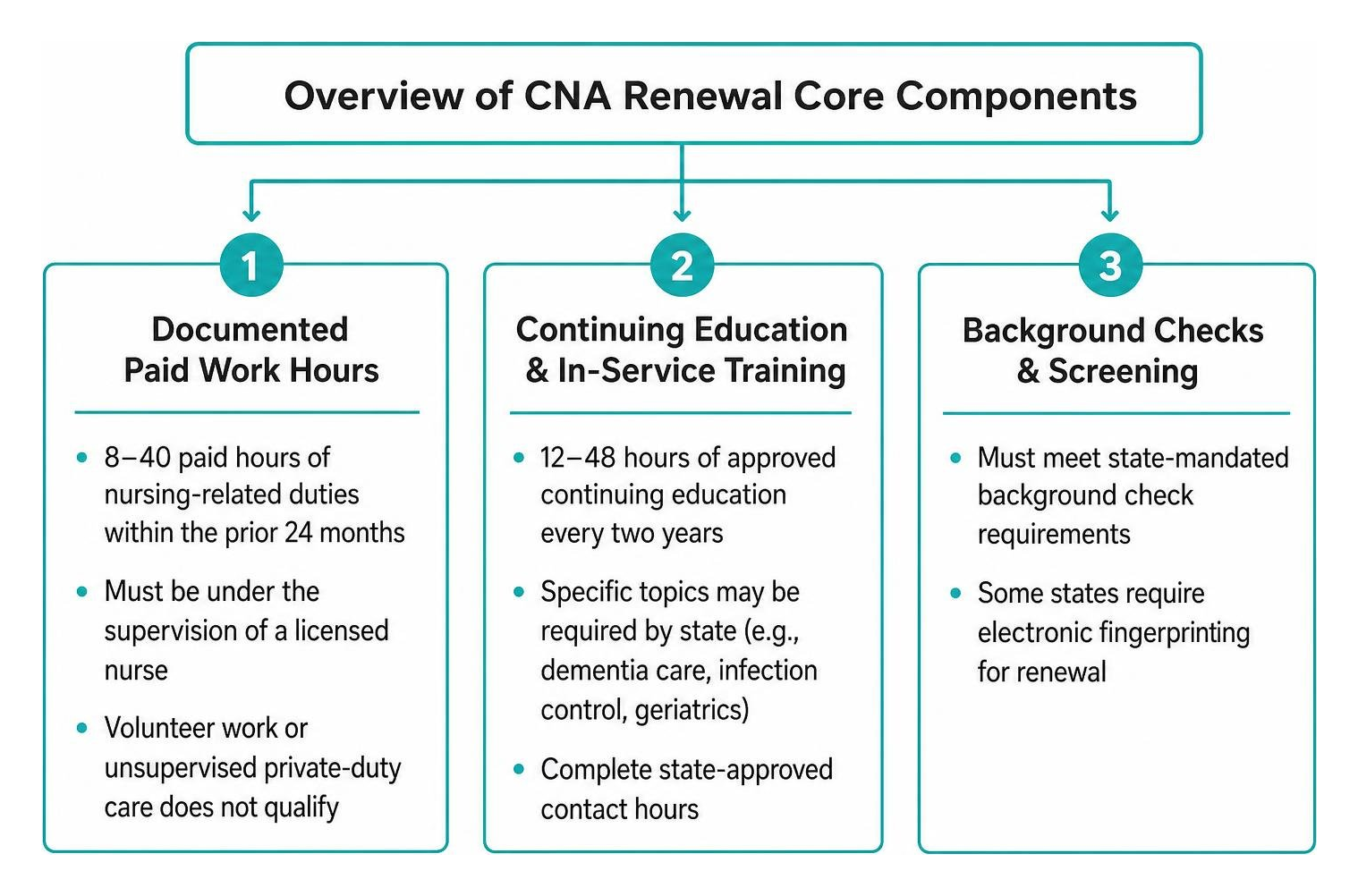
State nurse aide registries follow a baseline established by the Centers for Medicare & Medicaid Services (CMS). Under federal rules, a certified nursing assistant must perform paid nursing or nursing-related services under the supervision of a licensed nurse (such as a Registered Nurse or Licensed Practical Nurse) within a 24-month period to maintain active status. Individual states build their own specific requirements on top of this federal foundation. The process typically hinges on three primary elements: qualifying work hours, continuing education units (CEUs) or in-service training, and background clearances.
- Documented Paid Work Hours: Most states require anywhere from 8 to 40 paid hours of nursing-related duties within the prior 24 months. Volunteer work or private-duty care that lacks licensed nurse supervision generally does not qualify.
- Continuing Education and In-Service Training: Depending on where you practice, you may need between 12 and 48 hours of approved continuing education every two years. In states like Texas and Florida, specific subject areas—such as dementia care, infection control, and geriatrics—are mandatory components of this coursework. You can easily keep your CNA status active with online renewal by completing self-paced, state-approved contact hours that fit your schedule.
- Background Checks and Screening: Regulatory updates across multiple jurisdictions have introduced stricter verification protocols. For instance, recent legislation in Florida mandates electronic fingerprinting for certificate holders submitting renewal applications.
Less Than Two Years Expired vs. More Than Two Years
The amount of time that has passed since your certificate’s expiration date is the single most critical factor in determining your reinstatement path. State registries generally divide expired credentials into two distinct categories:
| Lapse Duration | General Status | Typical Requirements for Reinstatement | Retraining Required? |
|---|---|---|---|
| Less Than 2 Years (< 24 Months) | Delinquent / Lapsed | Submit proof of required work hours, verify completed CEUs/in-service training, pay renewal plus late/delinquency fees, or pass a competency evaluation examination. | Rarely; most states allow reinstatement via retesting or documentation. |
| More Than 2 Years (> 24 Months) | Null and Void / Expired | Retake the state competency evaluation (written and clinical skills) or repeat an entire state-approved nurse aide training program (60–100+ hours). | Frequently; state rules often treat the applicant as an initial candidate. |
If your certification has lapsed for less than 24 months, you can often avoid retaking the initial educational curriculum. In California, for example, an aide whose certificate has been expired for less than two years can reactivate by passing the state Competency Evaluation Examination without having to sit through a new 100+ hour training program. Conversely, once you cross the two-year mark in Florida, your license enters “Null and Void” status, meaning it cannot be reinstated through an administrative update—you must apply as a new candidate.
State-Specific Rules for Renewing an Expired CNA License
Because nursing assistant registries are managed at the state level, the rules, online systems, and documentation requirements differ significantly across borders:
- California: The California Department of Public Health (CDPH) requires 48 hours of in-service training or CEUs per two-year renewal period (with at least 12 hours completed in each year). Up to 24 of these hours may be completed through approved online programs. If your certificate is expired less than two years, you must submit the Renewal Application (CDPH 283C form) and pass the state competency exam.
- Florida: Managed by the Florida Board of Nursing renewal system, CNAs must complete 24 hours of in-service training every two years and perform paid nursing services. If you renew after your expiration date, a $50 delinquency fee is added to the standard $55 renewal fee, totaling $105 (or $160 if more than 120 days delinquent).
- Texas: The Texas Health and Human Services Commission (HHSC) uses the Texas Unemployment & Long-Term Care Integrated Platform (TULIP). Texas requires 24 hours of in-service education every two years. If your certificate has lapsed and you lack qualifying work experience, you can renew by completing Option 3 (retraining with 60 classroom and 40 clinical hours plus retesting) or Option 4 (retesting only).
- Massachusetts: According to the Massachusetts nurse aide registry guidelines, aides must have worked at least eight paid hours performing nursing duties under RN supervision within the past two years. If your certification has already expired, you can renew online via the Health Profession Licensing System provided you have maintained continuous employment without an unauthorized break.
- Michigan: Michigan utilizes the MI-NATES registry platform accessed through a MILogin account. Renewals require 24 hours of continuing education and 40 paid work hours per cycle, accompanied by a $20 renewal fee. Lapses greater than two years require completing a new training program and examination.
- Colorado: Colorado CNAs operate under Rule 3 CCR 716-1.10, which requires an 8-hour paid-work attestation rather than mandatory continuing education units. Certificates expire on January 31 of odd-numbered years. If lapsed under two years, you can file for reinstatement with an application fee and work attestation; if lapsed over two years, both written and skills exams must be retaken.
Step-by-Step Guide to Reactivating Your Lapsed Certificate

Reactivating your credential does not have to be stressful if you follow a structured plan. Here is the step-by-step roadmap to regaining your active status:
Step 1: Check Your Registry Profile
Log into your state’s nurse aide registry portal (such as TULIP in Texas, MI-NATES in Michigan, or the MQA Online Services portal in Florida). Verify your official expiration date, license number, and ensure your address-of-record is completely current. Address mismatches are among the most frequent reasons renewal reminder notices are missed.
Step 2: Gather Proof of Employment and CEUs
Collect your supporting records before opening an application. State boards routinely audit submissions for compliance.
- Employment Verification: Obtain paystubs, W-2s, or a completed employment verification form (such as Form 5506-NAR in Texas or an online RN sign-off in North Carolina). Ensure the documentation clearly shows your job title, dates of employment, and proof of supervision by a licensed nurse.
- Continuing Education Certificates: Assemble certificates of completion verifying your required training hours. Make sure your certificates come from state-approved providers and include the date, course title, approved provider number, and total contact hours.
Step 3: Complete Mandatory Background Clearances
If your state requires updated screening (such as electronic live-scan fingerprinting under Florida HB 975 or California CDPH protocols), schedule your screening appointment through an authorized vendor before submitting your final paperwork. Keep a copy of your transaction control number or receipt.
Step 4: Submitting Your Application Online or by Mail
Most state agencies strongly encourage digital submissions over postal mail to eliminate weeks of transit and manual processing delays.
- When uploading files, make sure every document is a clear, legible PDF.
- Pay the associated renewal fee and any applicable delinquency fees via debit or credit card.
- If you must submit by mail, use certified mail with tracking and retain a complete duplicate copy of every form you send.
Step 5: Monitor Application Status and Deficiency Notices
Check your registered email address and online portal account weekly. If the registry licensing team issues a deficiency notice requesting additional proof of clinical hours or CEU documentation, respond immediately to prevent your application from being closed or rejected.
How to Handle Special Circumstances and Retesting
Certain professional situations require an adjusted pathway to reinstate an expired credential:
- Military Service Waivers: Active-duty military personnel, veterans, and military spouses frequently qualify for special renewal accommodations. In states like Texas and Colorado, expedited processing, fee waivers, or extensions on continuing education requirements are available for service members who experienced a lapse during deployment or service obligations.
- Out-of-State Reciprocity and Endorsement: If your certificate expired in one state but you hold an active, unencumbered license in another state, you may be able to apply for licensure by endorsement rather than going through the lapsed-license renewal process in your previous state.
- Scheduling a Competency Evaluation Exam: If your lapse duration requires retesting, you will receive an Authorization to Test (ATT) letter once your state registry reviews your application. You must schedule and pass both the written (or oral) knowledge examination and the manual clinical skills evaluation at an approved regional testing site. Practice standard skills thoroughly—such as hand hygiene, vital signs measurement, and safe patient transfers—to ensure you pass on your first attempt.
Frequently Asked Questions About CNA Renewal
How much does renewing an expired CNA license cost?
Renewal fees vary widely by state. In states like North Carolina, nurse aide registration and renewal are entirely free. In Michigan, the standard renewal fee is $20. In Florida, renewing on time costs $55, but renewing an expired license incurs a $50 delinquency fee (totaling $105), which climbs to $160 if the license is more than 120 days delinquent. If you are required to retake the written and clinical skills competency evaluation, testing vendor fees typically range between $100 and $150.
What happens if my CNA license is null and void?
When a license is designated as “Null and Void,” it has expired beyond the maximum statutory grace period (typically two full years) and cannot be reactivated through payment or simple work attestation. To regain your credential, you must reapply to the state board as a new applicant, which generally requires completing a state-approved nurse aide training program and passing both portions of the competency examination.
Can I renew my expired CNA certification if I worked without RN supervision?
No. Federal CMS guidelines and state regulations require that nursing assistant work experience be performed under the supervision of a licensed nurse (RN or LPN/LVN) in an authorized healthcare facility, such as a hospital, skilled nursing facility, hospice agency, or licensed home health organization. Independent private-duty caregiving without formal licensed nurse oversight is not accepted by state registries for renewal or reinstatement.
Conclusion
Letting your nurse aide certificate lapse can feel overwhelming, but in most cases, regaining your active status is straightforward once you know your state’s specific guidelines. By checking your state registry early, gathering your proof of paid employment, and completing your required continuing education units, you can protect your career and get back to providing essential patient care.
At Scrubs CE, we are dedicated to helping healthcare professionals stay compliant, confident, and career-ready. Take proactive control of your professional credentials and fulfill your state training requirements today—you can easily keep your CNA status active with online renewal through our flexible, self-paced courses.