

What You Need to Know About California Fluoroscopy CE at a Glance
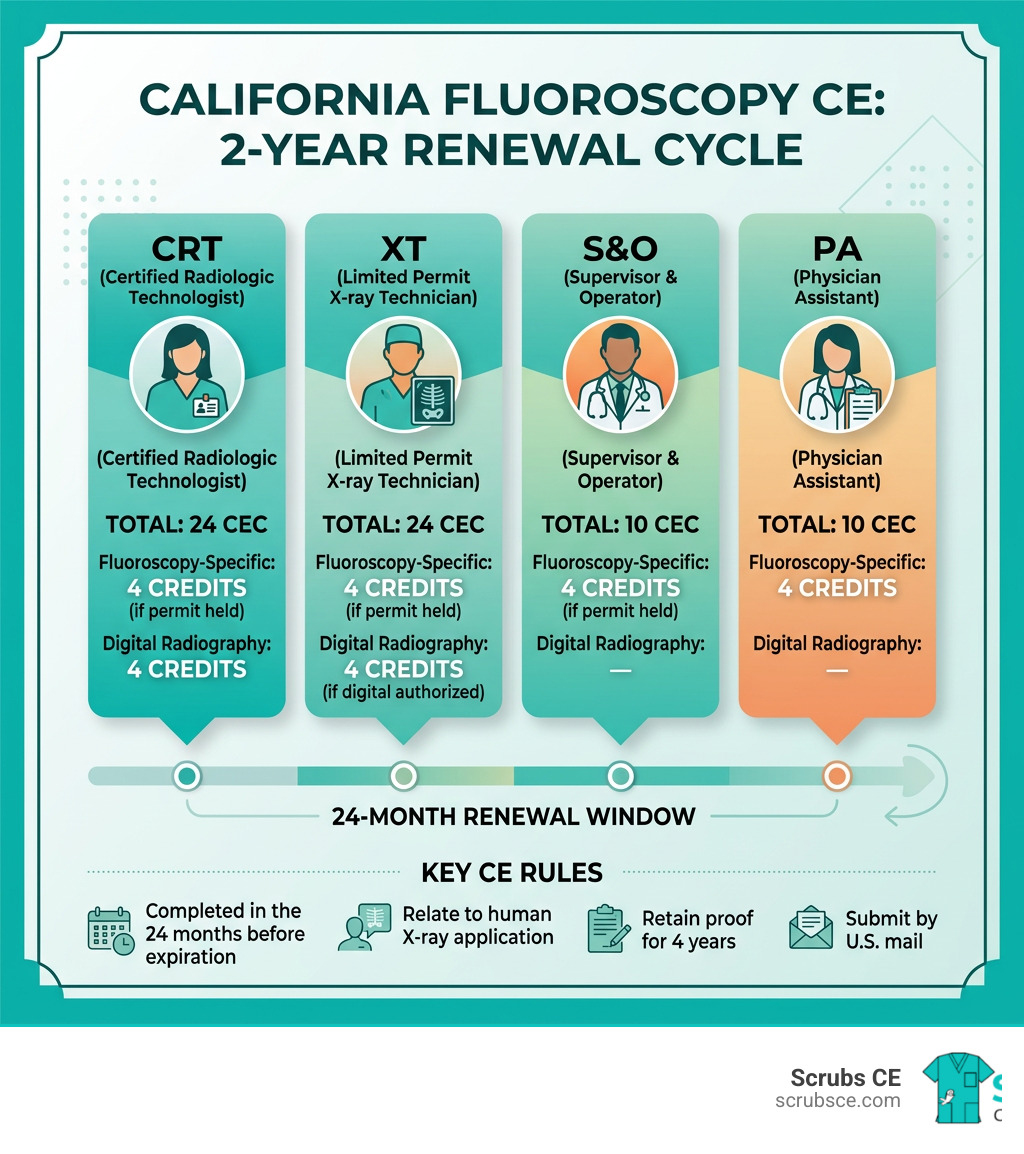
California fluoroscopy CE is required every two years for all permit and certificate holders in the state. Here’s a quick breakdown of what’s needed by role:
| Professional Role | Total CEC Required | Fluoroscopy-Specific Credits | Digital Radiography Credits |
|---|---|---|---|
| Certified Radiologic Technologist (CRT) | 24 | 4 (if fluoroscopy permit held) | 4 |
| Limited Permit X-ray Technician (XT) | 24 | 4 (if fluoroscopy permit held) | 4 (if digital authorized) |
| Supervisor & Operator (S&O) | 10 | 4 (if fluoroscopy permit held) | — |
| Physician Assistant (PA) | 10 | 4 | — |
Key rules to remember:
- All credits must be completed in the 24 months immediately before your permit expires
- Credits must relate to the application of X-ray to the human body
- You must retain proof of completed credits for 4 years
- Renewal is submitted by U.S. mail every two years
Keeping your California Radiology license current is non-negotiable — but the rules can feel like a maze. Whether you’re a CRT juggling 12-hour shifts, a physician assistant managing a packed schedule, or a supervisor trying to track down exactly which credits count, the California Radiologic Health Branch (RHB) requirements leave little room for guesswork. Miss the wrong credit type, submit the wrong form, or misread your renewal window — and you could be facing delays or a lapse in your permit.
The good news? Once you understand the system, staying compliant is entirely manageable.
I’m Zita Ewert, and I’ve spent years helping imaging professionals navigate California fluoroscopy CE requirements through accredited, affordable online courses at Scrubs CE. My experience building state-specific CE programs gives me a clear view of exactly where professionals get tripped up — and how to avoid those pitfalls entirely.
Learn more about California fluoroscopy CE:
Understanding California Fluoroscopy CE Requirements
Navigating the regulatory waters of California’s Radiologic Health Branch (RHB) requires a steady hand and an eye for detail. The foundational rule governing your professional life is Title 17, California Code of Regulations (17 CCR) section 30403. This regulation mandates that every two years, certificate and permit holders must submit evidence of completing their continuing education credits (CEC) along with their renewal application and fees.
The “24-month window” is arguably the most critical concept to grasp. All your California fluoroscopy CE must be earned within the two years immediately preceding your permit’s expiration date. If you earn credits 25 months before expiration, they won’t count toward your current renewal. This strict timeline ensures that every professional is up-to-date on the latest radiation safety protocols and technical advancements.
Why is the state so strict? It boils down to patient safety. Fluoroscopy involves real-time, dynamic X-ray imaging, which inherently carries higher radiation risks than a single static chest X-ray. By enforcing these standards, California ensures that everyone from the tech behind the console to the surgeon in the suite remains an expert in minimizing exposure. For a deeper dive into these regulations, check out our more info about California CE requirements guide.
Mandatory Credits for California Fluoroscopy CE Holders
If you hold a Fluoroscopy Permit, the RHB requires a minimum of 4 credits specifically dedicated to radiation safety for the clinical uses of fluoroscopy. This isn’t just a suggestion; it’s a hard requirement. These credits must cover topics like:
- Reducing dose to the patient and staff.
- Understanding the biological effects of radiation.
- Proper use of protective equipment (lead aprons, thyroid shields).
- Correct application of fluoroscopic equipment to minimize “beam-on” time.
We offer targeted Fluoroscopy Radiation Safety courses designed to meet this 4-hour mandate precisely, so you don’t have to guess if your chosen topic qualifies.
Digital Radiography and Radiation Safety Standards
Since July 2016, California has also enforced specific requirements for digital radiography. If you are a CRT or an XT with digital authorization, you must complete 4 credits in digital radiography. This covers the transition from film-screen to digital systems, focusing on image production, quality control, and the “dose creep” phenomenon often associated with digital imaging.
Our Digital Fluoroscopy Radiation Safety Part 3 course is an excellent way to bridge the gap between fluoroscopy safety and digital imaging standards, ensuring you hit both requirements efficiently.
Credit Breakdown by Professional Role
Different licenses come with different burdens of proof. It is essential to know exactly which category you fall into to avoid over-earning (which wastes time) or under-earning (which risks your license).
| Role | Total Credits | Fluoroscopy Safety | Digital Radiography |
|---|---|---|---|
| CRT (with Fluoro) | 24 | 4 | 4 |
| Limited XT (with Digital) | 24 | 4 (if permit held) | 4 |
| Supervisor & Operator | 10 | 4 | N/A |
| Physician Assistant | 10 | 4 | N/A |
For a more detailed breakdown, our California Rad Tech CEU Requirements Guide provides a comprehensive roadmap for every imaging professional.
Requirements for CRTs and Limited Permit XTs
For Certified Radiologic Technologists (CRTs) and Limited Permit X-ray Technicians (XTs), the magic number is 24. Every two years, you must earn 24 Category A or A+ credits. If you hold a fluoroscopy permit, 4 of those 24 must be in fluoroscopy safety. If you have digital authorization, another 4 must be in digital radiography.
Interestingly, Limited Permit XTs have the same 24-credit requirement as full CRTs. While their scope of practice is limited to specific anatomical areas, their commitment to continuing education must be just as robust. You can explore more about these nuances in our article X-ray Vision Unpacking California’s CE Requirements for Rad Techs.
Supervisor and Operator (S&O) and PA California Fluoroscopy CE
Physicians, Podiatrists, and Chiropractors holding a Supervisor and Operator permit, as well as Physician Assistants (PAs), have a lower total credit count but a higher concentration of specialized topics. These professionals need 10 total credits related to the application of X-ray to the human body.
Crucially, 4 of those 10 credits must be specific to radiation safety for the clinical uses of fluoroscopy. For PAs specifically, the credits must be accepted by the California Physician Assistant Board. Our California Fluoroscopy CME courses are tailored to meet these exact needs for “Licentiates of the Healing Arts.”
Navigating the RHB Renewal and Reporting Process
The renewal process in California is a bit old-school, but it works if you follow the steps. About 90 days before your permit expires, the RHB will mail you a renewal billing notice. This is your cue to act. You must submit your renewal application, the appropriate fee, and evidence of your completed California fluoroscopy CE via U.S. mail.
If you happen to lose your notice (it happens to the best of us!), you can find a special renewal application on the CDPH website. Do not wait until the last minute; the RHB processes thousands of renewals, and a delay in the mail could mean a delay in your ability to work. For a step-by-step checklist, visit our guide on California Fluoroscopy License Renewal.
Acceptable vs. Unacceptable CE Topics
The RHB is very particular about what counts as “continuing education.” According to 17 CCR 30400(a)(4) Topic Restrictions, all CEC must cover the application of X-ray to the human body.
This means many topics that are great for general professional development will be rejected by the RHB. Unacceptable topics include:
- CPR or ACLS (even if required by your hospital).
- MRI (since it doesn’t use ionizing radiation/X-rays).
- Ultrasound.
- Nuclear Medicine (unless specifically related to X-ray).
- Billing procedures or office management.
- Stress management or communication skills.
Stick to courses that focus on radiation protection, equipment operation, and X-ray physics to ensure your credits are accepted without issue.
Documentation and Record Retention
Once you finish a course and receive your certificate of completion, your job isn’t quite over. You are required to maintain records of your CE for four years following the date the credits were earned. The RHB can audit you at any time, and failing to produce a certificate can lead to the revocation of your permit.
It is also important to note that your ARRT biennium dates might not align perfectly with your California permit expiration. While you can often use the same credits for both, you must ensure they fall within the specific 24-month window required by the state of California. For more on this, see Everything You Need to Know About California CE Credits.
Specialized Certificates and Residency Provisions
If you hold a Mammographic CRT certificate, you have an additional layer of responsibility. You must earn 10 of your 24 credits specifically in mammography. These credits can usually overlap with the 15 credits every 3 years required by the Mammography Quality Standards Act (MQSA), but you must ensure they fit into the California biennial cycle.
For residents and fellows in ACGME-accredited programs, there is a helpful provision. If you are in a residency program (like Radiology or Orthopedics) that involves the use of X-ray, you can often fulfill your S&O CE requirements through your program participation. You will need a formal letter on department letterhead from your program director attesting to your clinical work and instruction. You can find more details on these specialized rules at California Radiation Safety.
Frequently Asked Questions about California X-Ray Renewals
How do ARRT biennium dates align with California permit expiration?
This is the number one source of confusion for techs. Your ARRT biennium is usually linked to your birth month, but your California permit might have a different expiration date depending on when it was first issued.
The Golden Rule: Always look at the expiration date printed on your California permit. Your 24-month window for California fluoroscopy CE ends on that date. If your ARRT biennium ends in June but your CA permit expires in December, you need to make sure your credits cover the specific two-year period leading up to December. For a deeper explanation, read How to Maintain Your X-ray License in California.
What happens if I receive a notice of insufficient CE credits?
If the RHB determines your credits are insufficient — perhaps because you submitted a CPR course or credits earned outside the 24-month window — they will send you a notice. You will typically have a short window to correct the deficiency. This often involves scrambling to find a valid course and submitting proof immediately. To avoid this stress, use the RHB Continuing Education Hotline at 510-255-8388 if you are ever unsure about a course’s validity.
Which organizations’ California fluoroscopy CE credits are recognized by the RHB?
The RHB recognizes credits from several major organizations, including:
- The ARRT (Category A or A+).
- The ASRT (Note: ASRT courses must be designated as “California credits” to be accepted).
- The Medical Board of California.
- Various state radiologic technology boards.
At Scrubs CE, we ensure our California Combos are fully accredited and meet these stringent requirements, so you can submit your certificates with total confidence.
Conclusion
Staying compliant with California fluoroscopy CE doesn’t have to be a headache. By understanding the 4-hour safety requirement, the 24-month completion window, and the importance of X-ray-specific topics, you can breeze through your next renewal.
At Scrubs CE, we are dedicated to making this process as smooth as possible. We offer high-quality, self-paced online courses with instant certificates that fit into your busy life. Whether you need a full 24-credit bundle or just a quick 4-hour fluoroscopy safety refresher, we have you covered.
Ready to secure your renewal? Satisfy California Fluoroscopy CME Requirements on a Budget today, or browse California fluoroscopy CE courses to find exactly what you need to keep your career moving forward.