

What Are MQSA Technologist Requirements? A Quick-Start Guide
MQSA technologist requirements set the federal standard every radiologic technologist must meet to legally perform mammography in the United States. Here is a fast summary:
| Requirement | What You Need |
|---|---|
| Licensure | ARRT® certification or state radiography license |
| Initial Training | 40 hours of mammography-specific education |
| Supervised Exams | 25 mammograms under direct supervision |
| Modality Training | 8 hours before using any new mammographic modality (e.g., digital) |
| Continuing Experience | 200 mammograms every 24 months |
| Continuing Education | 15 Category 1 CEUs in mammography every 36 months |
| ARRT® (M) Required? | No — federal MQSA does not require it, though many employers do |
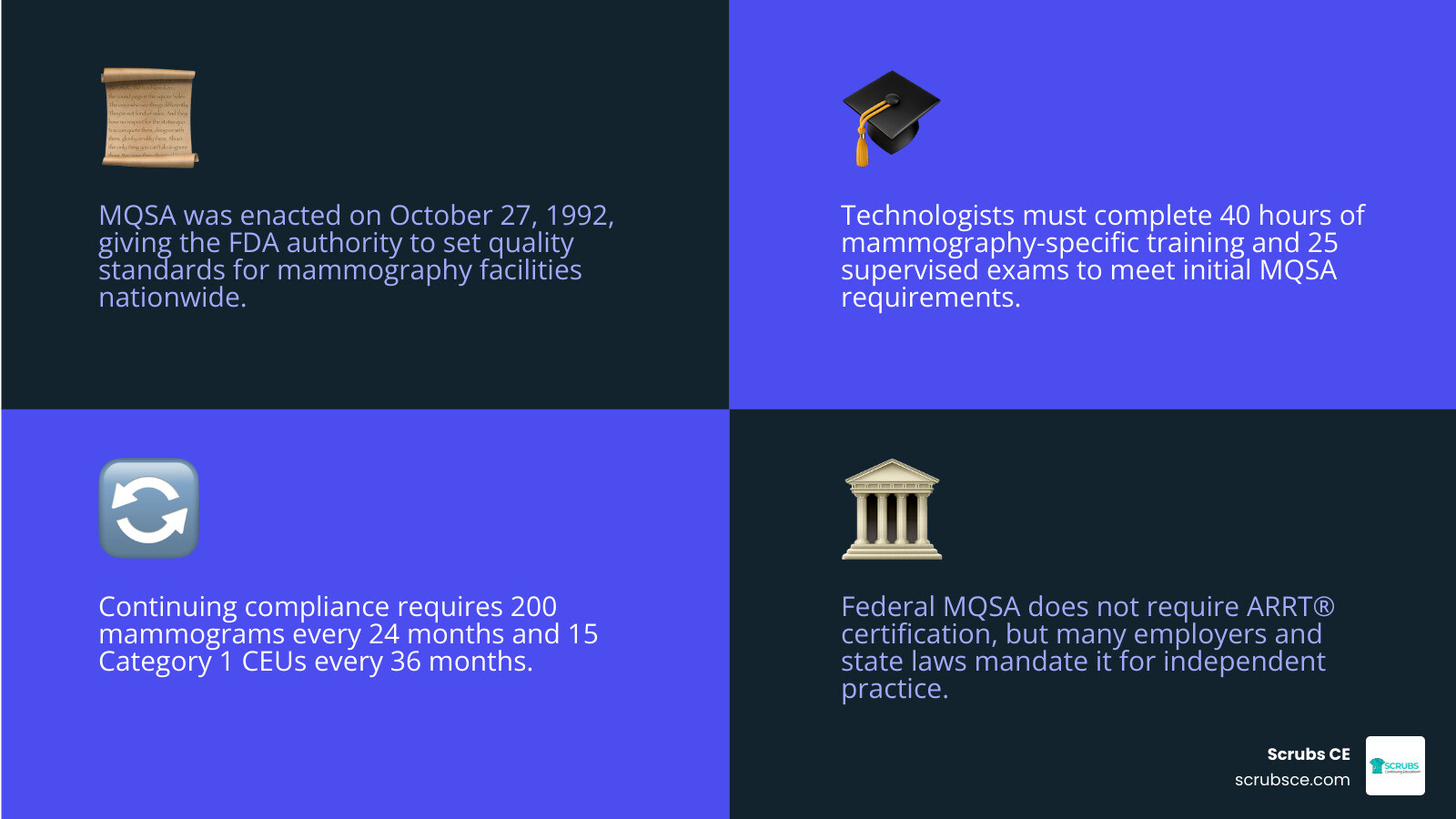
Congress enacted the Mammography Quality Standards Act (MQSA) on October 27, 1992, giving the FDA authority to set minimum quality standards for every mammography facility in the country. The goal was straightforward: protect patients by ensuring that every technologist, physician, and physicist involved in breast imaging meets a consistent, verified level of competency. Today, the FDA’s Center for Devices and Radiological Health (CDRH) oversees the program — and with the updated 2023 MQSA Final Rule taking effect on September 10, 2024, staying current matters more than ever.
For busy radiologic technologists, keeping track of training hours, supervised exams, CE deadlines, and inspection documents can feel like a second job. This guide breaks it all down clearly.
I’m Zita Ewert, and as the leader of Scrubs Continuing Education®, I’ve spent years helping radiologic technologists navigate MQSA technologist requirements through high-quality, accredited CE courses built specifically for imaging professionals. I’ll walk you through everything you need to stay compliant and confident in your practice.
Mqsa technologist requirements terms you need:
- Radiologic Technologist Requirements
- How to Get ARRT Certification
- How to Become a Radiologist Technician
Initial MQSA Technologist Requirements and Training Pathways
To begin a career in breast imaging, we must first establish a solid foundation that meets both federal and state-level guidelines. The pathway to independent practice is highly structured. Under the federal framework, a technologist cannot simply transition from general diagnostic Radiology to mammography without completing specific initial education and clinical milestones.
For those looking to transition, cracking the code on MQSA requirements is the first step toward understanding how your general radiography background translates into this specialized field. According to the FDA MQSA Final Rule, any technologist performing mammography must hold a valid general state license or be certified by an approved national registry. In the United States, this registry is typically the AMERICAN REGISTRY OF RADIOLOGIC TECHNOLOGISTS® (ARRT®).
Core Clinical and Education Standards
The core educational foundation consists of two primary requirements that must be completed before you can perform mammograms independently:
- 40 Hours of Mammography-Specific Training: This classroom or online education must cover critical topics such as breast anatomy and physiology, positioning and compression techniques, quality assurance and quality control (QA/QC) procedures, and the specific imaging challenges associated with patients who have breast implants.
- 25 Supervised Mammograms: You must perform at least 25 mammographic examinations under the direct supervision of a qualified mammography technologist or a board-certified radiologist.
If you want a step-by-step breakdown of how to map out this process, our mammography technologist training complete guide walks through these core standards in detail. These initial clinical requirements ensure you have hands-on experience with patient positioning and the physical application of breast compression before working solo.
Next Steps After Initial Training to Meet MQSA Technologist Requirements
Once you complete your 40-hour course and your 25 supervised exams, you are legally qualified under federal law to perform mammography independently. However, the work does not stop there. You must compile and maintain meticulous records of your training.
During your facility’s annual FDA inspection, you will need to produce your 40-hour training certificate and a signed log proving you completed your 25 supervised exams. It is highly recommended to record the date, facility name, and the signature of your supervising technologist for every single one of those initial 25 exams.
Additionally, we must think about how these initial training hours fit into your broader continuing education goals. Our mammography CEUs complete guide provides excellent strategies for leveraging your initial training credits to satisfy your ongoing professional development requirements.
Maintaining Compliance: Continuing Education and Experience
Once you are qualified and practicing, the FDA requires you to maintain your skills through continuous experience and ongoing education. If you fall behind on either of these parameters, you will temporarily lose your qualification to perform mammography independently.
To help you stay on track, we have created a resource on registry to reality making your mammography credits work for MQSA, which outlines how to keep your CE records organized. These maintenance standards are outlined in detail in the Federal Register, Volume 88 Issue 47 (Friday, March 10, 2023).
Tracking the 24-Month and 36-Month Compliance Windows
Maintaining your mqsa technologist requirements relies on tracking two distinct rolling windows:
- Continuing Experience (24-Month Window): You must perform at least 200 mammographic examinations over a rolling 24-month period. This is typically verified by your facility’s manager using software logs that track the examinations tied to your unique technologist ID.
- Continuing Education (36-Month Window): You must earn at least 15 Category 1 CEUs in mammography within a rolling 36-month period. At least 6 of these credits must be directly related to each specific mammographic modality you use in your daily practice.
Because these windows are calculated based on your facility’s annual inspection date rather than a fixed calendar year, you should always ask your supervisor for the date of the next scheduled inspection. To learn more about managing these credits, check out our mammography CE_credits guide 2025.
Modality-Specific Training and Digital Mammography
Under MQSA rules, a “modality” refers to the specific technology used to produce the mammographic image. Common modalities include screen-film (analog) mammography, full-field digital mammography (FFDM), and digital breast tomosynthesis (DBT, or 3D mammography).
Before you can perform mammograms independently using any new modality, you must complete 8 hours of modality-specific training. For example, if you have only ever performed 2D digital mammography and your facility introduces a 3D tomosynthesis unit, you must complete an 8-hour course on tomosynthesis before scanning patients on the new machine. To understand how these modality-specific hours align with your regular registry requirements, refer to our guide on ARRT mammography CE requirements.
ARRT® Certification vs. MQSA Technologist Requirements
A common point of confusion in our industry is the difference between federal MQSA requirements and registry credentials.
The FDA does not legally require you to hold the ARRT® Advanced Registry in Mammography—commonly known as the “M” credential—to practice mammography. Under federal law, as long as you are a state-licensed or certified general radiographer and meet the initial 40-hour training, 25 supervised exams, and continuing experience/CE standards, you can perform mammography independently.
However, many employers and state licensing boards do require the ARRT® (M) credential as a condition of employment. To transition from basic MQSA compliance to earning your advanced registry, you must complete the ARRT® post-primary pathway, which requires documenting 75 clinical examinations. Our guide on mammography mastery achieving your ARRT certification explains this transition in detail.
State-Specific Variations and California CRT Rules
While the FDA sets the national baseline, states have the authority to implement regulations that are more stringent than federal MQSA guidelines. California is a prime example. The California Radiologic Health Branch requires technologists to hold a California Mammography Certificate (CRT-M) and pass a state-approved mammography exam.
Here is a quick comparison of how federal and registry standards compare:
| Feature | MQSA Federal Standard | ARRT® (M) Registry Standard |
|---|---|---|
| Supervised Exams | 25 exams | 75 exams (clinical portfolio) |
| Continuing Education | 15 CEUs in mammography every 36 months | 24 CEUs every 2 years (general biennium) |
| Continuing Experience | 200 exams every 24 months | No specific ongoing clinical exam count |
| Exam Required? | No | Yes (ARRT® Mammography Examination) |
Preparing for Inspections and Record Keeping
Preparing for an annual FDA inspection is all about organization. If an inspector walks into your facility and you cannot produce your documentation, your clinic could face non-compliance citations.
Under the updated 2023 MQSA Final Rule (which went into effect on September 10, 2024), facilities are legally required to provide technologists with copies of their clinical and educational records upon request. This makes it much easier to maintain your professional portfolio when transitioning to a new job. Furthermore, facilities must now retain the qualification records of former employees for at least 24 months after they leave.
The updated rule also introduced standardized breast density reporting. When preparing reports, we must ensure that patient lay summaries and medical reports categorize breast density into one of four specific categories (A, B, C, or D) to maintain compliance. If you need to quickly earn credits to meet your upcoming inspection deadline, you can explore our accredited mammography CE courses to find self-paced, online options that provide instant certificates.
Frequently Asked Questions about Mammography Standards
Is ARRT® certification in mammography required under MQSA?
No. Under federal MQSA regulations, you do not need the advanced ARRT® (M) credential to perform mammography independently. You only need a general radiography license or registry certification, alongside your 40 hours of initial training and 25 supervised exams. However, individual states and employers frequently require the “M” credential for employment.
How do the 24-month and 36-month compliance periods work?
These are rolling timelines calculated backward from the date of your facility’s annual MQSA inspection. The inspector will look at the 24 months prior to the inspection date to verify you have performed at least 200 mammograms, and they will look at the 36 months prior to verify you have earned 15 Category 1 CEUs in mammography.
What documentation must be provided during an MQSA inspection?
You must provide your active state license or board certification, your initial 40-hour mammography training certificate, documentation of your 25 supervised exams, certificates for your 15 CEUs earned over the last 36 months (including modality-specific hours), and a facility log proving you performed 200 exams in the last 24 months.
Conclusion
Navigating mqsa technologist requirements is essential for protecting patient safety and maintaining your professional standing. By staying diligent with your clinical logs, tracking your rolling 24-month and 36-month windows, and completing your modality-specific training, you can approach every annual FDA inspection with absolute confidence.
At Scrubs CE®, we are committed to supporting your professional development. We offer convenient, affordable, and self-paced online continuing education courses designed to help you meet your state, registry, and MQSA requirements easily. Ready to complete your mammography credits? Advance your career with Radiology courses at Scrubs CE® today and get instant certificates to secure your compliance.