

How to Renew Your Hospice CNA Certification
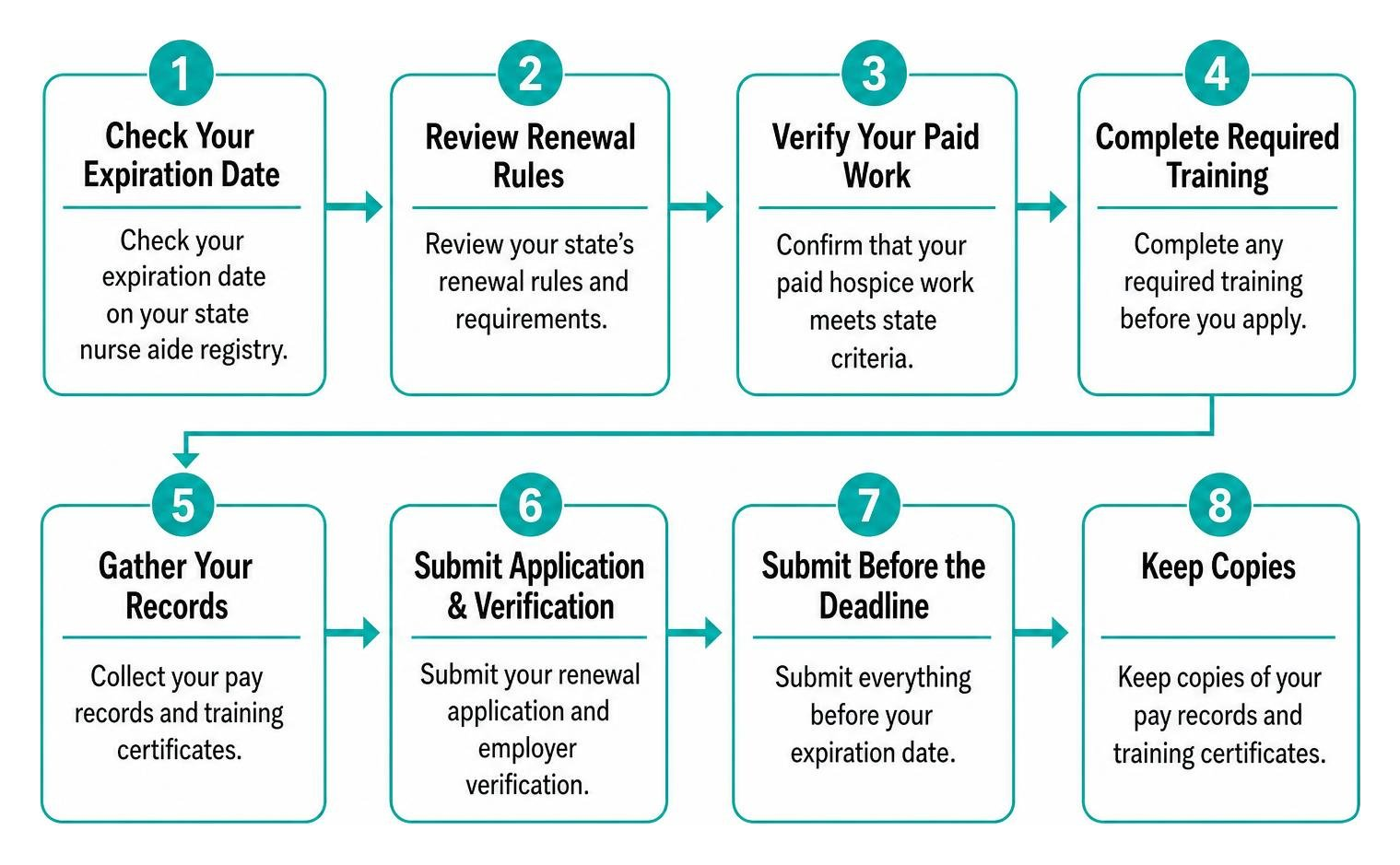
CNA renewal for hospice aides starts with your state nurse aide registry. Check your expiration date and renewal rules, confirm that your paid work qualifies, complete any required training, and submit your application and employer verification before the deadline. Keep copies of your pay records and training certificates. Hospice work does not automatically count toward renewal; states differ on which duties and care settings qualify.
I’m Zita Ewert, and I lead continuing education at Scrubs CE, where I help healthcare professionals make sense of certification requirements and track their learning. In this guide to CNA renewal for hospice aides, I’ll help you find the rules that apply to your state and avoid a missed deadline.
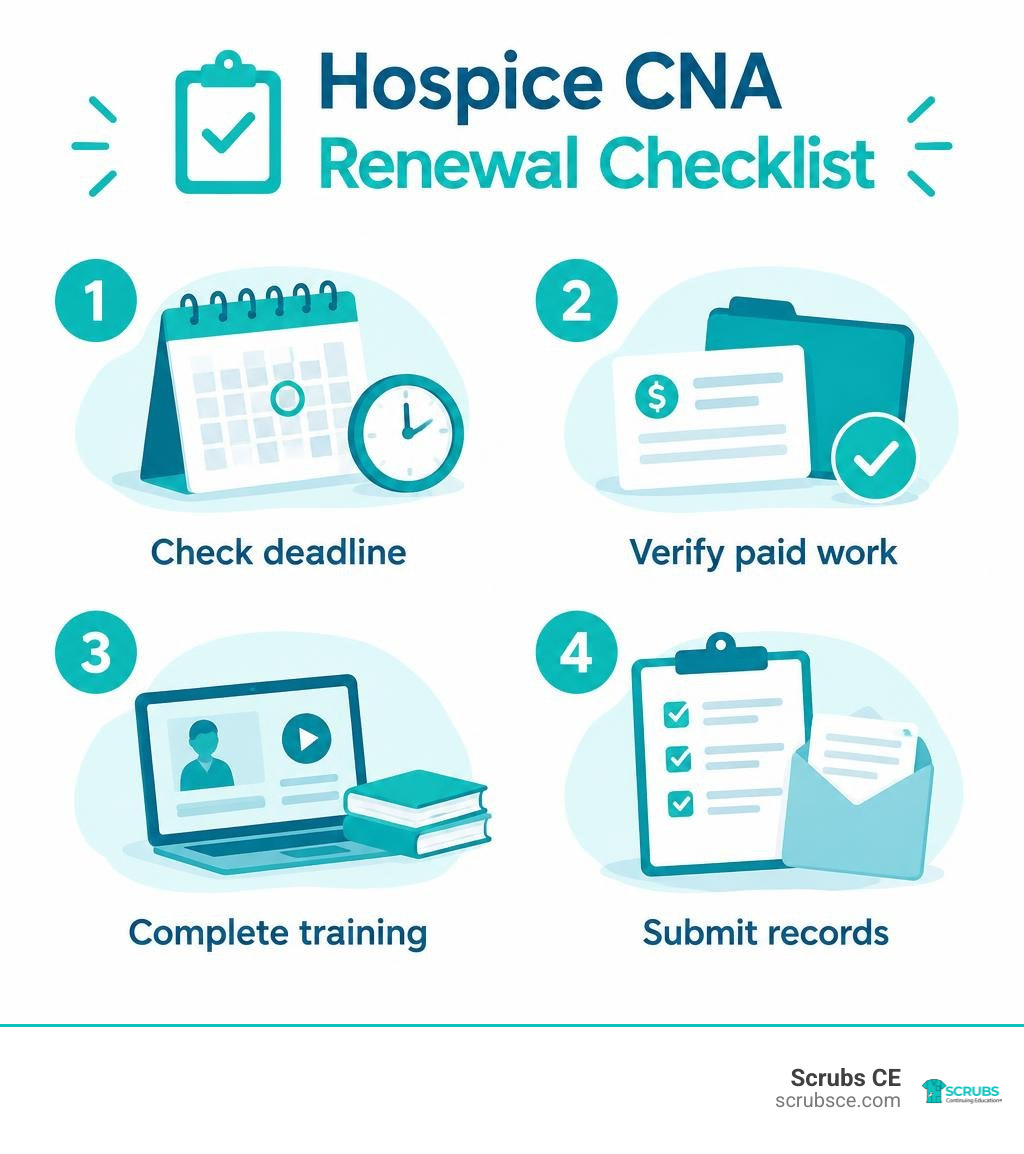
Simple guide to CNA renewal for hospice aides terms:
Step-by-Step Guide to CNA Renewal for Hospice Aides

Maintaining active status on your state nurse aide registry requires proactive planning. Most states operate on a standard 24-month renewal cycle governed by federal Omnibus Budget Reconciliation Act of 1987 (OBRA-87) guidelines, but state licensing boards introduce specific variations. Following simple steps to renew your CNA license ensures you avoid administrative lapses that could disrupt your ability to deliver end-of-life care.
Verifying Qualified Clinical Hours
To qualify for standard recertification, your clinical work must meet strict state criteria:
- Paid Employment: Volunteer hours, clinical shadowing, and unpaid internships do not count toward mandatory work minimums.
- Direct Nursing Supervision: Your duties must be supervised by a licensed professional, typically a Registered Nurse (RN) or Licensed Practical Nurse (LPN).
- Authorized Facilities: Eligible settings include Medicare-certified hospice inpatient units, licensed skilled nursing facilities, intermediate care facilities, and Medicare-approved home health agencies.
- Disqualifying Roles: Private duty care arranged directly with families, companion services, and independent sitting roles are excluded by most state registries.
Documenting Continuing Education and In-Service Credits
Continuing education units (CEUs) and in-service training reinforce essential patient care standards. When organizing your educational records:
- Track approved contact hours throughout the two-year cycle rather than cramming before expiration.
- Complete courses covering required core topics such as infection control, resident rights, and end-of-life comfort care.
- Save digital and printed completion certificates showing course titles, provider approval numbers, and completion dates.
- Learn how renewing your CNA license online in less than an hour simplifies record submission.
Navigating State-Specific Regulations and In-Service Requirements
Every state establishes unique benchmarks for paid practice hours, mandatory continuing education, and administrative fees.
| State | Paid Work Hours Required (24 Months) | In-Service / CEU Hours Required | State Renewal Fee |
|---|---|---|---|
| Texas | Documented paid nursing-related work | 24 hours (geriatrics & dementia mandates) | $0 |
| California | Documented paid nursing-related work | 48 hours (max 24 online; min 12/year) | $0 |
| Tennessee | 8 hours in a licensed facility | Facility-mandated in-service | $0 |
| North Carolina | 8 paid hours under RN supervision | Facility-mandated in-service | $0 |
| Idaho | 8 paid hours under RN supervision | Facility-mandated in-service | $0 |
| Utah | 200 paid hours under licensed nurse | Facility-mandated in-service | $0 (On-time) / $40 (Late) |
| Oregon | Documented paid nursing-related work | 2 hours cultural competency (every 48 mos) | Varies |
State Work Hour and CEU Differences: Texas, California, and Oregon
- Texas: Texas Health and Human Services requires nurse aides to complete 24 hours of approved in-service education every two years. Training must incorporate specialized modules in geriatrics and the care of residents with dementia disorders. Computer-based training modules offer 2 credit hours each, requiring a minimum score of 70% and printed documentation for state audit compliance.
- California: The California Department of Public Health (CDPH) mandates 48 total hours of continuing education or in-service training on Form CDPH 283 C. Aides must earn at least 12 hours during each year of the two-year cycle. While up to 24 hours can be completed online through approved providers, the remaining 24 hours must be obtained through live or facility-based instruction.
- Oregon: Under the Oregon State Board of Nursing : CNA Frequently Asked Questions : State of Oregon, nurse aides must complete 2 hours of cultural competency continuing education every 48 months. Oregon does not mandate Basic Life Support (BLS) certification for state renewal, though employers may require it independently.
Work Verification Models: Idaho, Utah, Tennessee, and North Carolina
- Idaho: Aides must complete at least 8 paid hours of nursing assistant duties within the 24-month period. Under the Return Completed Form To: instructions provided for Idaho registry processing, renewals require verified employer signatures submitted via mail, email, or fax during the month of expiration.
- Utah: As detailed in the Utah Nursing Assistant .pdf) handbook, candidates must verify at least 200 paid hours under the direction of an RN or LPN. Forms are managed through the digital TMU platform up to 90 days before expiration.
- Tennessee: The Tennessee Health Facilities Commission requires 8 hours of paid work within 24 months, processed online through the Credentia registry system. Private duty and sitter services do not qualify.
- North Carolina: The Division of Health Service Regulation (DHSR) enforces an 8-hour paid work minimum under RN supervision. Employers must complete digital employment verification forms. You can explore quick and free CNA renewal online methods by state to review your local portal’s specific workflow.
CHPNA® Specialty Certification and ADA Accommodations

Hospice aides seeking advanced career recognition often earn the Certified Hospice and Palliative Nursing Assistant (CHPNA®) credential, administered by the Hospice and Palliative Credentialing Center (HPCC).
Eligibility Criteria, Testing Windows, and Application Fees
- Practice Hours: Applicants must document either 500 hours of hospice and palliative nursing assistant practice in the most recent 12 months or 1,000 hours in the most recent 24 months under RN supervision.
- Examination Fees: Initial testing costs $190 for Hospice and Palliative Nurses Association (HPNA) members and $280 for non-members. Retests cost $135.
- Application Windows: Applications open quarterly (December 1, March 1, June 1, and September 1) with deadlines falling approximately two months prior to testing windows. Testing is delivered through PSI test centers or via live remote proctoring.
How Accommodations and Exam Guidelines Apply to CNA Renewal for Hospice Aides
Under the Americans with Disabilities Act (ADA), candidates with qualifying physical, visual, auditory, or cognitive conditions can request special examination accommodations:
- Submit formal requests accompanied by comprehensive documentation from a licensed healthcare provider at least 30 days prior to scheduling.
- Available accommodations include extended testing time, private testing rooms, screen-reading assistive technologies, or approved medical devices during testing.
- English as a Second Language (ESL) accommodations (such as language translation dictionaries) must be requested according to state testing agency rules.
Managing Expired Certifications and Reciprocity Protocols
Relocating across state lines or allowing a certification to expire requires specific administrative procedures.
Reciprocity Rules and Interstate License Endorsement
Transferring your certification between states involves reciprocity:
- Verify that your current out-of-state registry listing remains active and unencumbered.
- Submit state-specific reciprocity applications through platforms like Credentia or Prometric alongside official verification of employment.
- States like North Carolina and Tennessee process reciprocity endorsements within 5 to 10 business days. Tennessee excludes Florida certifications from direct reciprocity, requiring candidates to retrain and retest. Review nurse aide certificate renewal explained simply for additional registry transfer guidelines.
Preventing Lapsed Licenses in CNA Renewal for Hospice Aides
If your license lapses, recertification pathways depend on how much time has passed:
- Grace Periods and Late Fees: Utah allows late submissions between 1 day and 6 months past expiration with a $40 late fee; beyond 6 months, aides must retest under an Expired Certificate Application.
- Competency Evaluations: In California, if your certificate is expired by less than two years, you can reactivate by passing a state Competency Evaluation.
- Retraining vs. Retesting: In New York, aides trained after July 1, 1989 (Route 6) may restore lapsed credentials by passing clinical and written exams within two years, as outlined in the New York State Nurse Aide Manual and New York State Department of Health Certified Nurse Aide Manual . Review CNA renewal for reentry: a practical recertification guide if your credentials have lapsed.
Frequently Asked Questions About Hospice Aide Renewal
How do California HHA renewal rules differ from standard CNA requirements?
Under CDPH guidelines, Home Health Aide (HHA) certificates expire every four years and require 24 hours of in-service training. Unlike California CNAs—who must earn 48 CEUs every two years and can complete up to 24 hours online—HHAs are not permitted to use online courses for their renewal credits.
What types of work do not qualify for CNA registry renewal?
Registry renewal policies across states like North Carolina, Tennessee, and Idaho exclude:
- Unpaid volunteer care or family caregiving.
- Private duty sitting or companion services arranged without an agency.
- Virtual patient consultations without direct, hands-on clinical duties.
- Work in private physician offices not licensed as nursing facilities or home health agencies.
How long does state registry renewal processing typically take?
Online renewal through state registries generally processes within 3 to 5 business days after your employer submits employment verification. Reciprocity applications and paper-based submissions take roughly 10 to 14 business days.
Conclusion
Maintaining your hospice nursing assistant credentials protects your career and ensures uninterrupted, compassionate care for your patients. Stay aware of your state’s 24-month renewal cycle, document your RN-supervised clinical hours, and complete your required continuing education well before your deadline.
At Scrubs CE, we offer affordable, high-quality, self-paced online courses designed to help healthcare professionals fulfill their state licensure requirements quickly. Explore our course catalog to keep your CNA status active with online renewal and download instant completion certificates today.