
CNA Renewal for Reentry: A Practical Recertification Guide
How to Renew Your CNA Certification and Return to Work

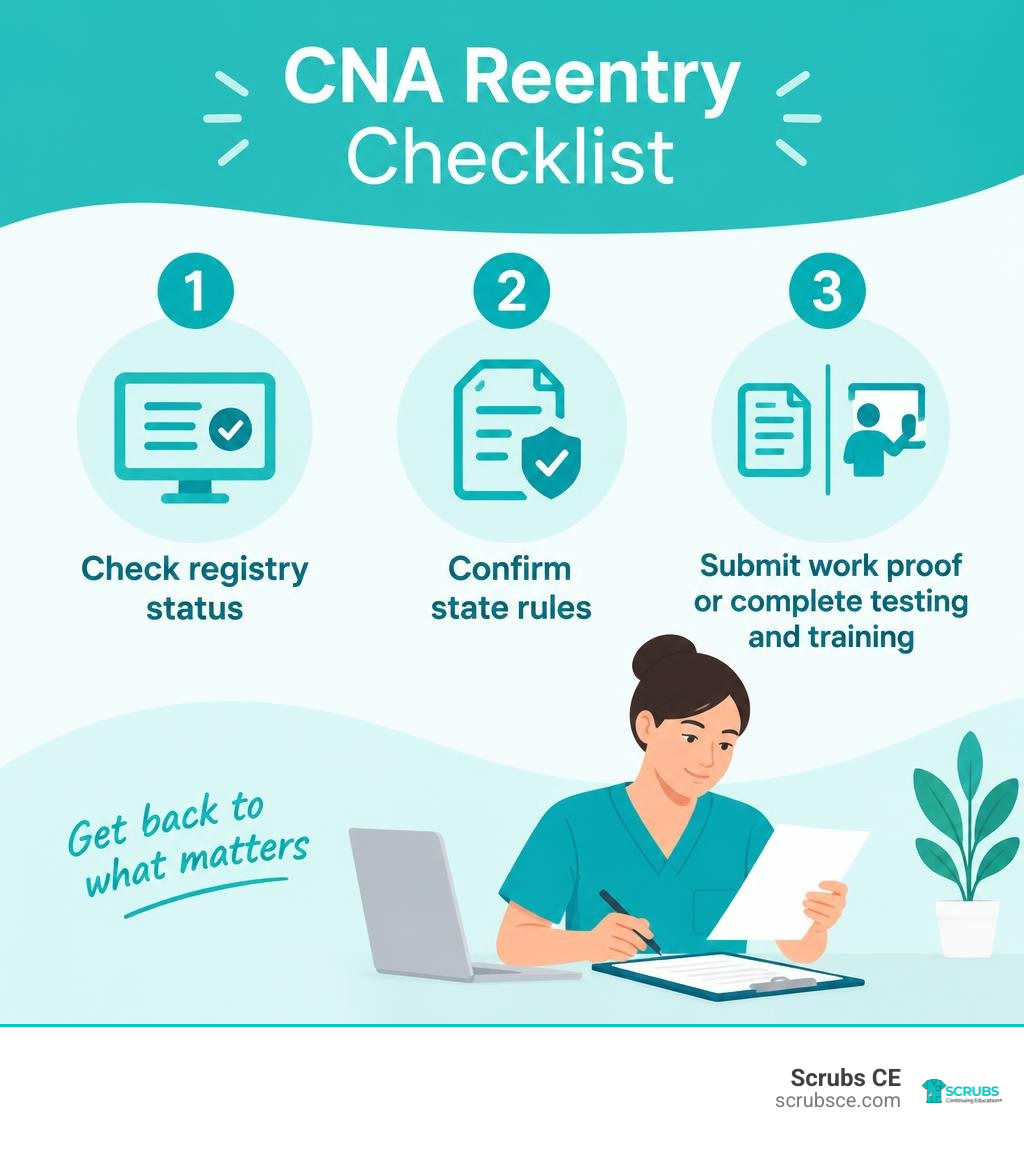
If your CNA certification has lapsed, check your status on your state’s official nurse aide registry first. Then follow the state’s reentry rules: provide proof of qualifying paid work if you are eligible to renew, apply to retest if required, or complete approved training if you have missed the retesting window. Requirements vary by state, so confirm your path before paying for an exam or course.
I’m Zita Ewert, and I lead continuing education at Scrubs CE, where I help imaging professionals make sense of credential requirements. I bring that same focus on clear, practical guidance to CNA renewal for reentry.
Helpful resources for CNA renewal for reentry:
- Understand the core process for nurse aide certificate renewal.
- Review the standard requirements to renew your CNA license.
Inactive vs. Expired Status: Understanding CNA Renewal for Reentry
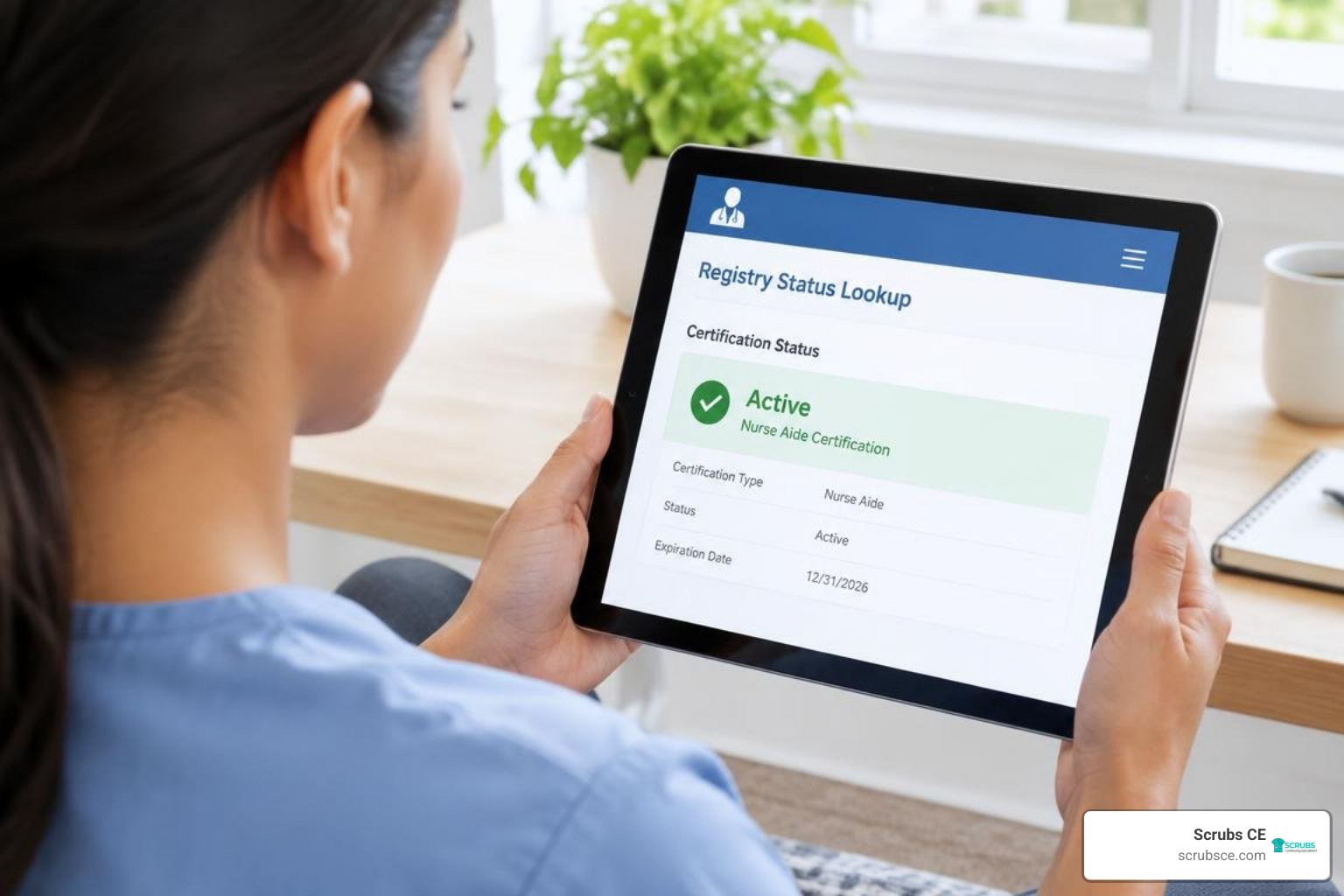
Before submitting paperwork or paying non-refundable fees, you must understand your current classification on your state’s direct care directory. While people often use “inactive” and “expired” interchangeably, state boards treat them with different legal definitions.
Under the federal Omnibus Budget Reconciliation Act of 1987 (OBRA ’87), a Certified Nursing Assistant must maintain continuous competency. In most jurisdictions, certification remains active for a 24-month cycle. If you go 24 consecutive months without performing verified, paid nursing-related duties under the supervision of a licensed nurse (RN or LPN), your credential changes:
- Inactive Status: This indicates your 24-month period ended without documented qualifying work hours, but you remain within your state’s allowable grace period for simple reinstatement or retesting. In states like Illinois, passing 24 months without paid clinical work automatically shifts your record to inactive on the Health Care Worker Registry.
- Expired Status: Your certification has surpassed the inactive threshold and passed the allowable window for quick re-activation. In states like Louisiana or Utah, an expired status means your listing is marked as “Not Certified,” and you have a finite timeline to retest before your initial training becomes void.
Qualifying work must consist of paid nursing or nursing-related services—such as personal hygiene assistance, vital sign monitoring, mobility support, and feeding. Volunteer work or private, undocumented caregiving generally does not count. Understanding these parameters helps you follow nurse aide certificate renewal guidelines properly and avoid unexpected delays.
How to Regain Active Certification: Retesting, Retraining, and Applications
Regaining an active credential involves specific administrative steps designed to ensure patient safety. If you are returning after a career break, follow a structured process to complete your reinstatement.
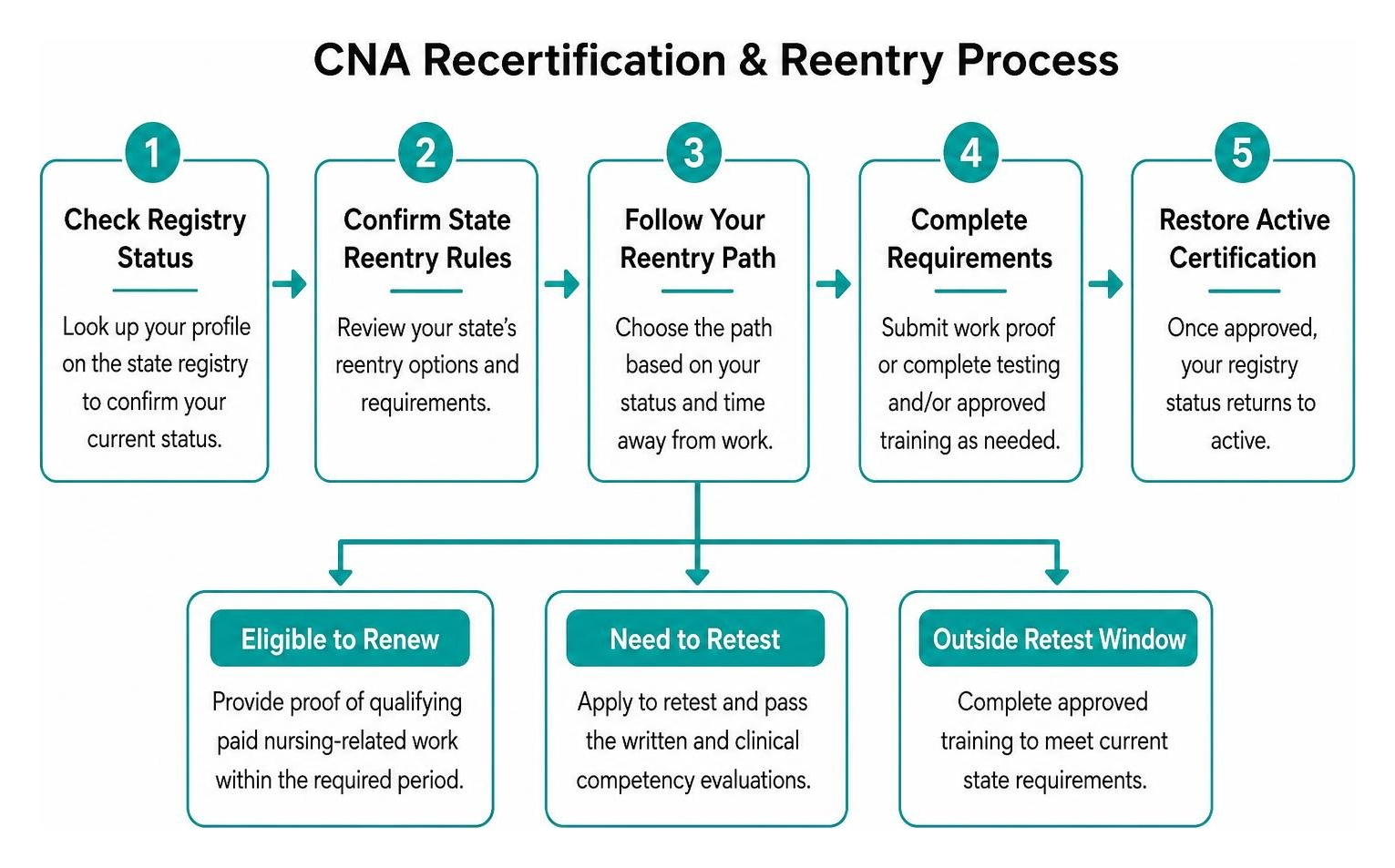
- Verify Your Registry Profile: Search your profile on your state registry portal using your Social Security number, full legal name, and certificate number. Confirm whether you need an administrative renewal, a competency retest, or full retraining.
- Submit the Reentry Application: Download or complete the state-specific reinstatement form. In Maryland, for instance, aides use the digital CHART system, while other states require designated paper packets.
- Complete Criminal Background Clearance: Most states mandate updated 10-point rolled fingerprints submitted via vendors such as Idemia or state police agencies to clear FBI and state background databases.
- Pay Registry and Processing Fees: Depending on your state, fees range from $10 to $50 for administrative processing, while exam scheduling carries separate charges.
- Schedule and Pass Your Competency Evaluations: If your lapse requires testing, secure an Authorization to Test (ATT) letter and schedule your written and clinical sessions.
Following this path allows you to renew your CNA license in simple steps without missing vital state deadlines.
Retesting and Examination Rules for CNA Renewal for Reentry
When your break exceeds the basic employment verification window, state boards require you to prove your clinical knowledge before returning to bedside care. In testing jurisdictions managed by vendors like Prometric, Headmaster, or academic testing centers, retesting involves two core parts:
- Written/Oral Knowledge Exam: Consisting of 60 to 75 multiple-choice questions covering patient rights, infection control, basic nursing skills, safety protocols, and communication techniques.
- Clinical Skills Evaluation: A hands-on test where an evaluator observes you performing 3 to 5 randomly assigned nurse aide skills (such as transferring a resident using a gait belt, measuring blood pressure, or providing catheter care), alongside core checkpoints like hand hygiene and indirect patient care.
In Illinois, an inactive aide must complete the online recertification form with the Nurse Aide Testing office, complete phone verification with their SSN, and coordinate through the SIU INACE program. Candidates receive one year from their eligibility approval date to pass the written competency exam, with up to three testing opportunities allowed.
Testing requirements vary by jurisdiction. Candidates in Arkansas should consult the AR NA Licensing Information Bulletin for local testing rules, while those in New York can review specific clinical skills checkpoints in the New York State Department of Health Certified Nurse Aide Manual.
Mandatory Retraining Programs After Repeat Exam Failures
State regulations establish firm limits on testing attempts to safeguard healthcare quality. If you do not pass both the written and skills portions of your competency exam within the allowed tries (typically three attempts within a one- to two-year eligibility window), you cannot simply test again.
Once you exhaust your testing attempts, you must re-enroll in a state-approved Nurse Aide Training and Competency Evaluation Program (NATCEP). Federal standards require these programs to provide at least 75 hours of total instruction, including a minimum of 16 hours of hands-on, supervised clinical training in an approved facility. After successfully completing the curriculum again, you receive fresh testing eligibility. If you are dealing with a lapsed credential, reviewing options for renewing an expired CNA license can help you select the most efficient route.
State-by-State Variations in Work Hours and Reciprocity

CNA renewal rules are set by individual states within federal guidelines. Because each state licensing board establishes its own work-hour thresholds, fees, and expiration terms, a single standard does not apply nationwide.
Taking time to explore how to renew your CNA license online within your specific jurisdiction will keep your career moving forward.
Out-of-State Transfers and Reciprocity for CNA Renewal for Reentry
If you hold an active certificate in one state and plan to practice in another, you must apply for interstate reciprocity (endorsement). The general requirements include:
- A current, active certificate in good standing with no findings of abuse, neglect, or misappropriation of resident property on your home state’s registry.
- Submission of a formal reciprocity application to the new state registry.
- Verification forms completed by your home state’s licensing department.
- State-specific criminal background checks and fingerprinting.
For example, aides moving to Georgia must verify their active out-of-state status through Alliant Health Solutions before working, because Georgia does not allow aides to practice while an application is pending. Similarly, those relocating to Oklahoma must submit an Affidavit of Lawful Presence alongside out-of-state credentials, as detailed in the CNA License in Oklahoma: Requirements & Renewal guide.
State Lapsed Timelines and Work-Hour Thresholds
Renewal thresholds vary significantly across state lines. The table below outlines work hours, renewal periods, and lapsed retest limits across key states:
| State | Required Paid Work Hours (Per 24 Months) | Grace Period / Late Renewal Policy | Retesting vs. Retraining Cutoff |
|---|---|---|---|
| Utah | 200 paid hours under RN/LPN supervision | Renewal available 90 days prior; 1–6 months late incurs a $40 late fee via TMU portal | Retest required if 6–24 months expired; full retraining required after 24 months |
| Louisiana | 8 paid hours of nursing-related duties | Provider must submit NAT-7 form via LARS portal | Retest allowed within 2 years of expiration; full retraining required after 2 years |
| Oklahoma | 8 paid hours of nursing-related duties | LTC aides renew free online; non-LTC aides submit a $10 fee | Retest permitted if lapsed 2–3 years ($15 fee); full retraining required after 3 years |
| Georgia | Qualifying paid nursing work within 24 months | No formal CE required; facility-level in-service typically 12 hrs/year | Retest (knowledge & skills) mandatory upon lapse; no refresher courses accepted |
| Illinois | Qualifying paid nursing work within 24 months | Shifted to inactive after 24 consecutive months of non-nursing employment | Inactive aides must pass the written test (3 attempts in 1 year); retraining required if failed |
| Iowa | 1 day (8 hours) of paid nursing work within 24 months | Registry status expires for LTC facilities; initial certificate does not expire | Retake written and skills registry exams at a community college to restore active status |
For comprehensive details on Utah’s policies, refer to the Utah Nursing Assistant handbook.
Alternative Reentry Pathways and Registry Verification Methods
If you do not meet standard work-hour thresholds, several alternative options may help you regain your status without completing a full basic training program from scratch:
- State-Approved Refresher Courses: Some states permit previously certified aides to take a targeted refresher course covering updated clinical practices and documentation standards. In Iowa, certified aides who have dropped off the registry can take refresher training to prepare for retesting at local community colleges, as outlined in the Iowa Certified Nursing Assistant/Aide (CNA) FAQs | Community Colleges for Iowa.
- Nursing Student Clinical Equivalency: Active nursing students currently enrolled in accredited LPN or RN programs who have completed their fundamentals of nursing and introductory clinical rotations can often challenge the CNA exam or apply directly for certification without attending a separate CNA course.
- Military Medic & Corpsman Experience: Individuals with documented military medical training (such as Army Medics, Navy Corpsmen, or Air Force Medical Technicians) frequently qualify for testing waivers or direct reciprocity by submitting their DD-214 and joint services transcripts.
- Foreign-Trained Nurses: Registered nurses trained outside the United States can present evaluated educational credentials and language proficiency certifications to gain eligibility for CNA registry testing.
To check your current status, look up your record on your state’s online registry portal (such as the Health Care Worker Registry, TMU, or Prometric Registry). You will generally need your legal name, date of birth, Social Security number, or existing certificate number.
Frequently Asked Questions About CNA Recertification
How long do I have to retest after my CNA certification expires before I must retrain?
In most states, you have a 24-month (two-year) window from your expiration date to challenge and pass the competency examination without repeating a training class. However, state rules vary: in Oklahoma, aides have up to three years to apply for a retest before full retraining is mandatory. In Utah, missing your expiration date by more than 24 months requires completing a new NATCEP program.
Can I work as a CNA while my reentry application is pending?
In nearly all jurisdictions, you cannot work as a Certified Nursing Assistant in a licensed long-term care facility or hospital while your renewal or reciprocity application is pending. Facilities must confirm that you are listed as “Active” on the state registry before allowing you to provide direct patient care.
What documentation is required to verify qualifying work hours?
You must provide written proof of paid nursing or nursing-related services performed during the preceding 24 months. Acceptable proof includes a state-specific employment verification form (such as the NAT-7 form in Louisiana or a signed renewal notice in Utah) completed by a supervising Registered Nurse, Director of Nursing, or Human Resources representative on official facility letterhead. Pay stubs or W-2 forms may be requested to corroborate employment history.
Conclusion
Returning to direct patient care as a Certified Nursing Assistant is a straightforward process once you know your state’s requirements. Whether your path involves submitting a simple work-history verification, challenging the competency exam, or enrolling in an approved refresher course, completing these steps will keep your credentials in full compliance with state and federal standards.
At Scrubs CE, we support healthcare professionals with convenient, high-quality professional education courses designed to help you succeed at every stage of your career. When you are ready to update your credentials and return to patient care, keep your CNA status active with online renewal to continue making a difference at the bedside.