
Renew Your NY Dental License on Time by Tracking Mandatory CE Credits
Meeting Your New York Dental CE Hours Before Renewal

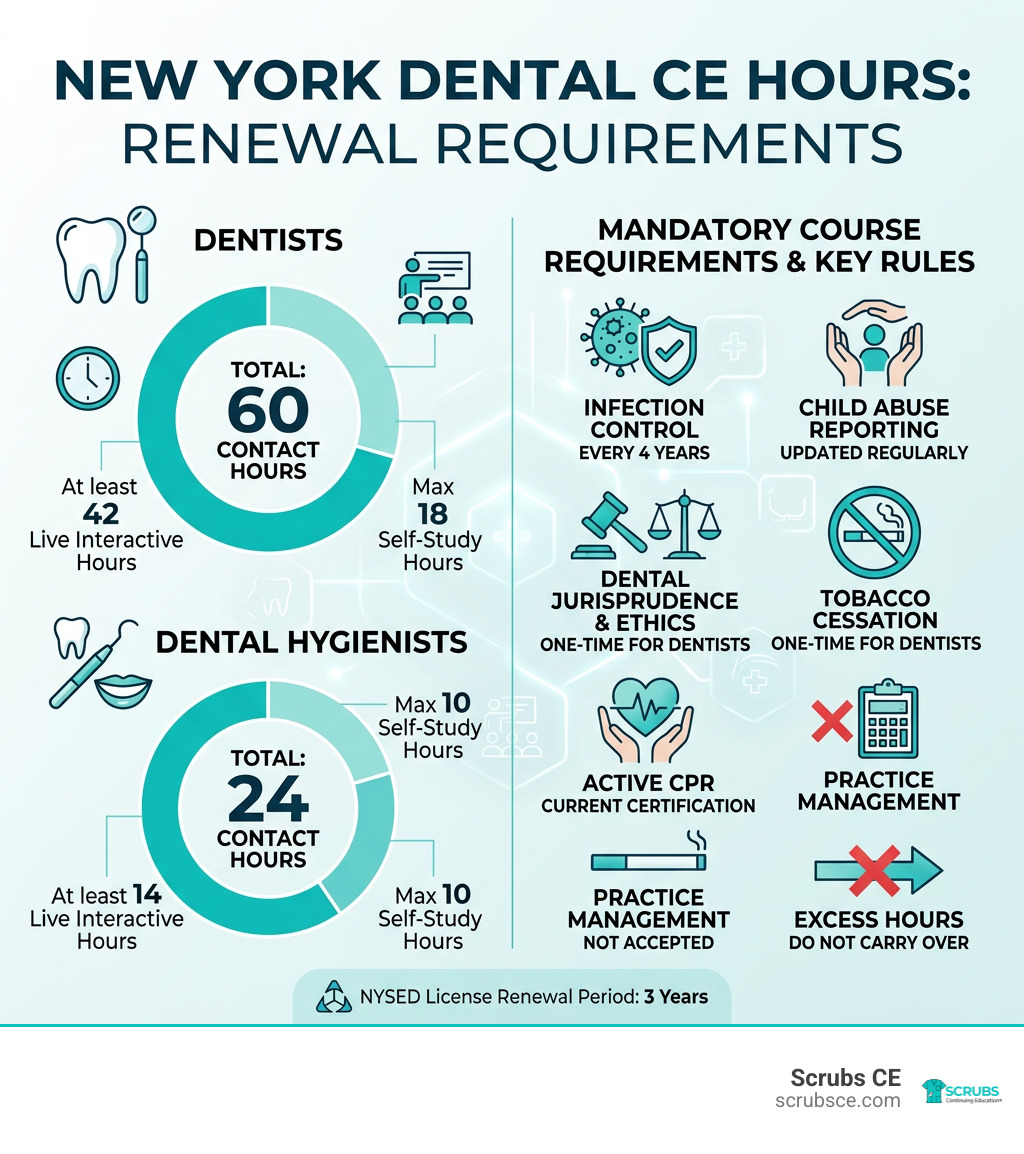
To renew your professional license with the New York State Education Department (NYSED), you must complete a specific number of new york dental ce hours during each three-year registration period:
- Dentists: Complete 60 contact hours total (at least 42 live interactive hours, with a maximum of 18 self-study hours).
- Dental Hygienists: Complete 24 contact hours total (at least 14 live interactive hours, with a maximum of 10 self-study hours).
In addition to meeting these credit totals, you must complete state-mandated courses in infection control (every 4 years), updated child abuse reporting, dental jurisprudence and ethics (one-time for dentists), tobacco cessation (one-time for dentists), and active CPR. Practice management courses are not accepted, and excess hours cannot carry over to the next cycle.
I’m Zita Ewert, founder of SCRUBS Continuing Education®, where I help healthcare professionals navigate complex regulatory rules and stay compliant with their new york dental ce hours. Let’s break down the exact course breakdowns, mandatory subjects, and tracking strategies you need to renew your license without stress.
New york dental ce hours vocabulary:
Understanding New York Dental CE Hours and Triennial Requirements
Navigating state licensing regulations can feel daunting, but maintaining your license in New York comes down to understanding your triennial cycle and completing your contact hours in the proper formats. The New York State Education Department (NYSED) Board for Dentistry oversees these regulations to guarantee patient safety and professional excellence across the state.
Calculating New York Dental CE Hours for Dentists vs Hygienists
The baseline requirements set by NYSED depend directly on your specific license type:
- Licensed Dentists: Must complete 60 contact hours of continuing education during each 3-year registration period.
- Registered Dental Hygienists: Must complete 24 contact hours during each 3-year registration cycle.
If your initial registration period is shorter than the standard 36 months—which often happens when you are first licensed or reactivating an inactive status—your required hours are prorated. You calculate your prorated hours by multiplying the standard monthly rate by the number of months in your abbreviated registration period (1.67 hours per month for dentists, and 0.67 hours per month for hygienists). Understanding these core CE credit requirements prevents surprises when your renewal notice arrives.
| Requirement Metric | Licensed Dentists | Registered Dental Hygienists |
|---|---|---|
| Total Triennial Hours | 60 contact hours | 24 contact hours |
| Minimum Live Course Hours | 42 hours (70%) | 14 hours (~58%) |
| Maximum Home-Study Hours | 18 hours (30%) | 10 hours (~42%) |
| CPR Credit Allowance | Up to 12 hours | Up to 12 hours |
| Registration Cycle | 3 Years | 3 Years |
Approved Formats for Earning New York Dental CE Hours
NYSED enforces strict limits on delivery formats to ensure practitioners engage in collaborative, real-time learning:
- Live Interactive Formats: Dentists must complete at least 42 hours, and hygienists at least 14 hours, through formats that allow immediate two-way communication between the instructor and participants. This includes physical classroom lectures, hands-on workshops, and live interactive webinars.
- Self-Study and Home-Study: Dentists may earn up to 18 hours, and hygienists up to 10 hours, via pre-recorded on-demand courses, journal-based articles with post-tests, and flexible online CEU credits.
It is critical to remember that NYSED strictly regulates course subjects. Clinical sciences, patient care techniques, dental materials, pharmacology, and diagnostic technologies qualify for credit. However, practice management courses are not accepted toward your renewal totals. Topics covering marketing, staff financial incentives, practice promotion, or billing optimization cannot be counted toward your required credits.

Mandatory NYS Dental Continuing Education Courses and Frequencies
Beyond fulfilling broad credit totals, every dental professional in New York must satisfy specific recurring and one-time statutory courses.
Core State-Mandated Subject Requirements
To maintain compliance, ensure you have active documentation for each of the following required subjects:
- Infection Control Certification: Required once every 4 years for all practicing dentists and hygienists. The course must be approved by the NYSED or the New York State Department of Health (NYSDOH) and cover standard precautions, barrier techniques, sterilization protocols, and bloodborne pathogen protection.
- Dental Jurisprudence and Ethics: A one-time requirement for dentists during their first registration period. This coursework covers state law, scope of practice, and professional ethical obligations.
- Oral Health Effects of Tobacco and Tobacco Products: A one-time, 2-hour course required for licensed dentists. It covers tobacco cessation counseling, oral cancer detection, and the systemic impacts of nicotine and smoking products.
- Updated Child Abuse Reporting Curriculum: All licensed dentists and dental hygienists must complete an updated Mandated Reporter Training course. While historically considered a once-in-a-lifetime course, recent state legislative amendments require all professionals to complete the updated curriculum—which includes guidance on implicit bias, adverse childhood experiences (ACEs), and remote/virtual child abuse identification—to remain in full compliance.
Reviewing the official rules on state approved CE course requirements helps ensure your selected provider is recognized by the State Board.

Prescriber Regulations and Emergency Response Training
Practitioners who handle controlled substances and emergency care face additional mandatory requirements:
- Pain Management and Addiction Recognition (NYS Mandate): Dentists registered with the DEA must complete at least 3 hours of coursework every 3 years covering pain management, palliative care, appropriate prescription protocols, and addiction identification.
- Federal MATE Act Requirement: Practitioners renewing their DEA registration must complete a one-time, 8-hour training requirement focusing on the safe treatment of patients with opioid or other substance use disorders.
- Cardiopulmonary Resuscitation (CPR): All dentists and dental hygienists must maintain active, in-person CPR certification (such as Basic Life Support, ACLS, or PALS). Dentists may apply up to 12 hours of approved emergency response and life support training toward their triennial 60-hour total.
For comprehensive details on broader state mandates across disciplines, consult our detailed A to Z guide to CE hours requirements or official Continuing Education) resources from state dental associations.
Strategic Planning and Cost-Effective CE Opportunities
Balancing practice schedules with educational requirements requires a proactive approach. Rather than scrambling in the final months of your triennial registration, you can stagger your live and home-study courses over the full three years.

Interactive Webinars and Live CE Opportunities
Meeting your 42-hour (or 14-hour) live requirement does not necessarily mean taking extensive time away from your practice. Live interactive webinars allow you to fulfill live credits from your home or office while asking real-time questions to clinical specialists.
Additionally, state conventions and regional district meetings offer excellent aggregations of live credits. For example, local societies host regular Events & Continuing Education sessions, and large regional conferences—such as the Greater New York Dental Meeting—routinely offer over 6 hours of free CE daily through scientific workshops and lectures. These venues utilize attendance verification numbers (AVNs) distributed throughout lectures to confirm full attendance for accredited certificates.
Flexible Self-Study and Remote Learning
Self-study coursework provides the perfect solution for satisfying your remaining non-live hours (up to 18 hours for dentists and 10 hours for hygienists). Using self-paced modules allows you to explore specialized clinical topics such as advanced imaging and diagnostic interpretation.
If you are expanding your clinical imaging skills, our guides on unlocking intraoral anatomy top dental Radiology CE programs and strategies on how to earn dental Radiology credits for free provide accessible options. Professionals practicing across multiple states can also review our Say Cheese your step by step Florida dental Radiology license guide to compare cross-jurisdictional rules.
We focus on delivering high-quality, self-paced learning modules that provide instant certificate generation upon completion. Finding accessible options for affordable CE credits through a comprehensive continuing education credits online guide makes it simple to stay compliant without overspending.
Compliance, Recordkeeping, and Submission Protocols
Completing your coursework is only half the battle; maintaining verifiable audit trails ensures your license remains unencumbered.
Record Retention and Audit Documentation
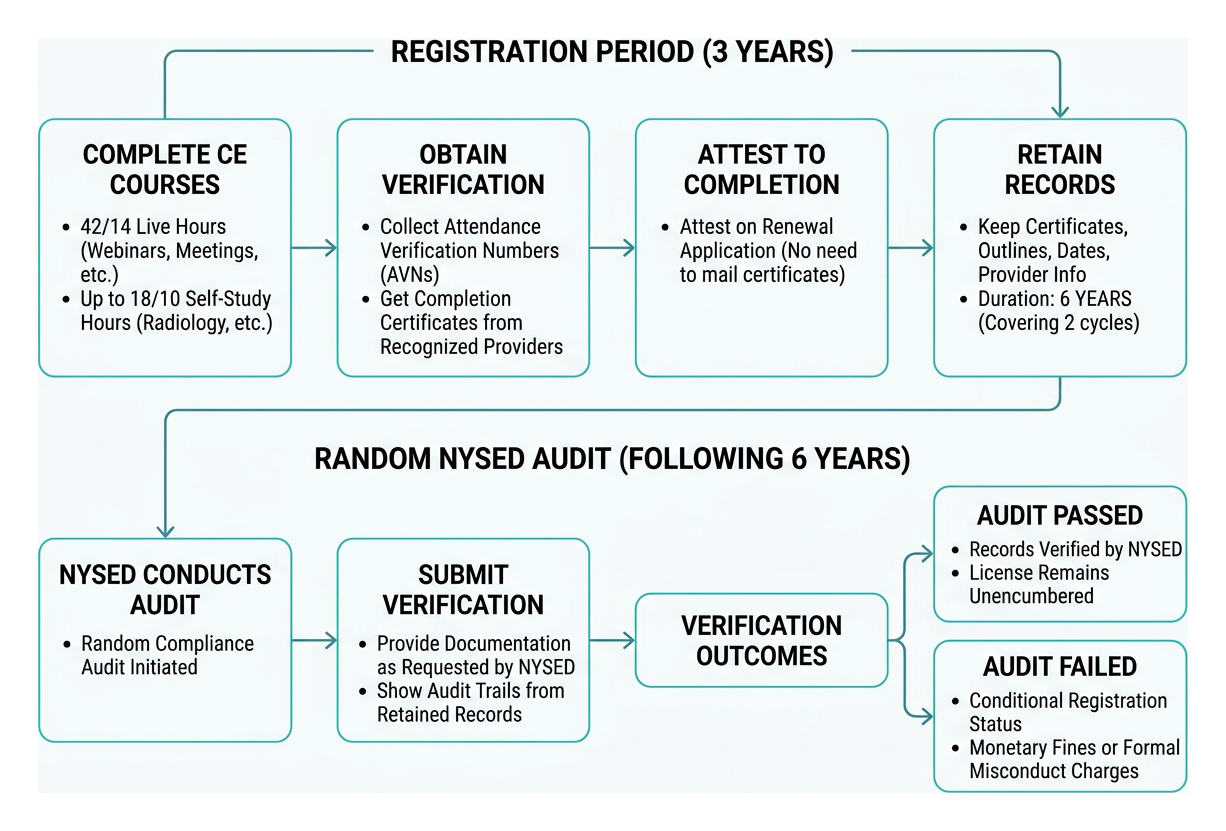
The New York State Education Department does not require you to mail in certificates upon routine renewal. Instead, you attest to completing your required hours on your renewal application. However, NYSED conducts random compliance audits.
To protect your professional standing:
- Retain Records for 6 Years: Keep copies of all completion certificates, course outlines, dates, provider names, and instructor credentials for at least six years (covering two full registration cycles).
- Verify Provider Recognition: Ensure all coursework is taken through recognized sponsors, such as ADA CERP-recognized providers, AGD PACE-approved organizations, NYSED-approved institutions, or accredited dental schools. You can read more about selecting vetted providers in our guide to accredited CE courses the smart way to stay certified.
- Avoid Disciplinary Actions: Failing to verify your credits during an audit can lead to conditional registration status, monetary fines, or formal professional misconduct charges.
Whether you need to review an earn CE credits complete guide or update specific credentials, organized recordkeeping is essential.
Frequently Asked Questions About NY Dental CE
Can excess CE credits carry over into the next New York registration period?
No. NYSED regulations strictly state that continuing education hours completed in excess of the statutory requirement cannot be applied or carried over to any subsequent registration period. Every three-year cycle begins with a zero credit balance.
Do practice management and billing courses count toward NY dental renewal?
No. Practice management, financial planning, marketing, insurance billing, and office administration courses are expressly excluded by NYSED regulations. Only courses related to clinical sciences, patient care, professional ethics, and statutory healthcare mandates qualify toward your required total.
What qualifies as a live interactive course for NY CE credit?
A live course is defined by NYSED as any educational activity where learners and instructors can interact in real time. This includes in-person classroom lectures, hands-on clinical simulations, and live interactive webinars with real-time audio/visual Q&A capabilities. Pre-recorded, on-demand video broadcasts do not qualify as live hours and must be counted under self-study limits.
Conclusion
Renewing your New York dental or dental hygiene license on time is simple when you understand the balance between live interactive learning, approved self-study, and mandatory statutory topics. By planning your educational calendar early, verifying that your course sponsors are approved by NYSED, and maintaining organized digital records for at least six years, you protect your credential and advance your clinical knowledge.
At Scrubs CE, we are dedicated to providing accessible, self-paced continuing education tailored to the needs of busy healthcare professionals. When you are ready to complete your home-study hours, explore our course catalog to maintain licensure and access accredited courses with Scrubs CE today.