
What Every New York LMHC Needs to Know About Counselor CE

New York counselor CE requirements can feel overwhelming — especially when you’re already managing a full caseload. Here’s a quick summary so you can get the essentials at a glance:
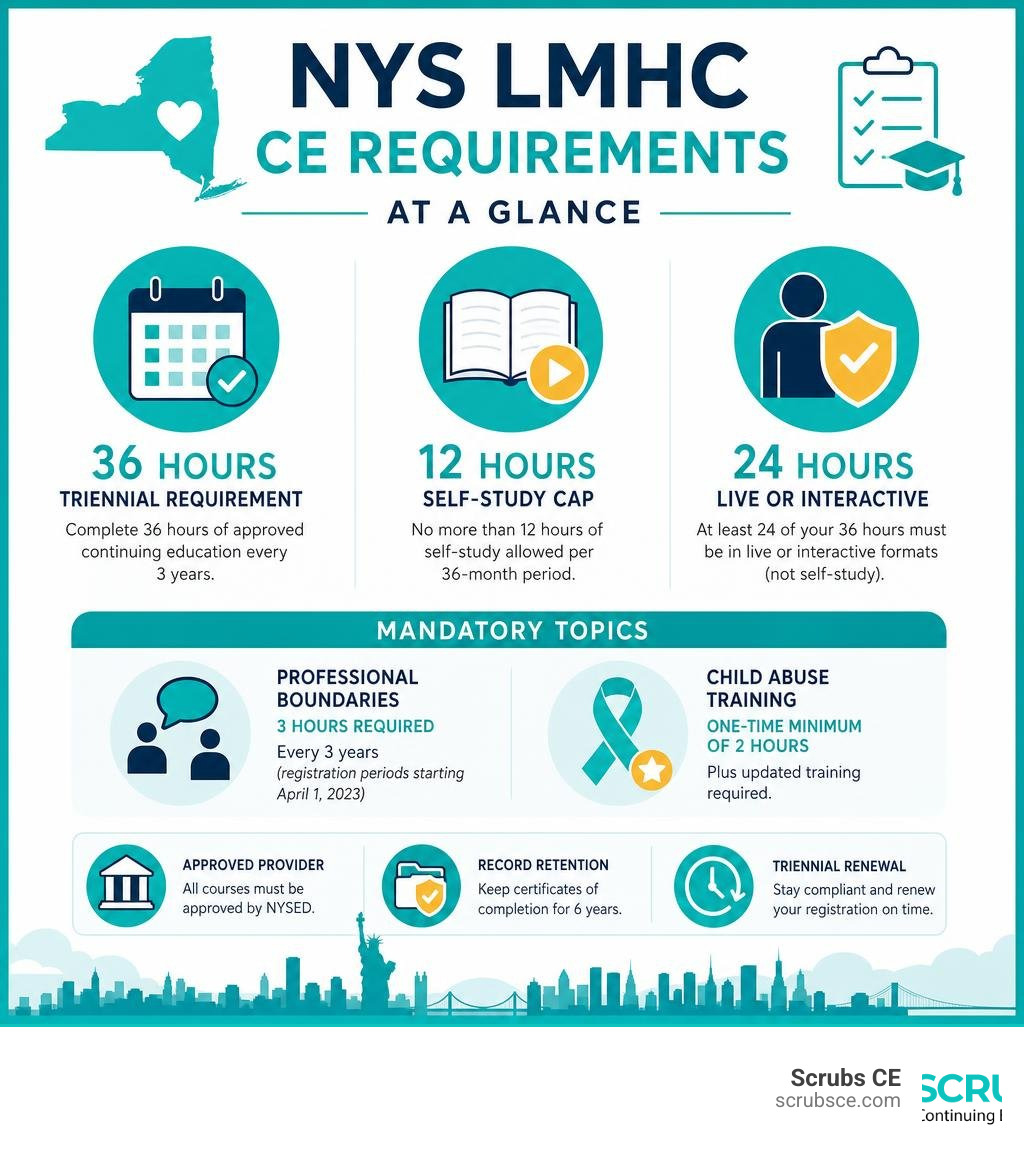
NYS LMHC Continuing Education at a Glance:
| Requirement | Details |
|---|---|
| Total hours per period | 36 hours every 3 years |
| Self-study limit | No more than 12 hours per 36-month period |
| Professional boundaries | 3 hours required every 3 years (registration periods starting April 1, 2023) |
| Child abuse training | One-time minimum of 2 hours (plus updated training required) |
| Approved provider | Must be NYSED-approved |
| Record retention | Keep certificates for 6 years |
At least 24 of your 36 hours must come from live or interactive formats — not self-study. All courses must be approved by the New York State Education Department (NYSED).
If you hold a License as a Mental Health Counselor (LMHC) in New York, staying on top of these requirements isn’t optional. Missing the mark before your triennial registration renewal can put your ability to practice at risk. The rules have also evolved — new mandates around professional boundaries and updated child abuse training have added layers of complexity since 2023.
The good news? Once you understand the structure, compliance is very manageable — especially with the right CE provider.
I’m Zita Ewert, and my work in continuing education has given me a deep understanding of state-specific licensing requirements, including New York counselor CE standards for mental health professionals. I’ll walk you through everything you need to know to stay compliant, confident, and current.
Core Requirements for New York Counselor CE
To maintain your active registration as a Licensed Mental Health Counselor (LMHC) in New York State, you must complete 36 hours of approved continuing education during each three-year (triennial) registration period.
In New York, a “contact hour” is defined as a minimum of 50 minutes of active instruction. This means if you take a course that is advertised as 3 hours, it must represent at least 150 minutes of instructional time.
The “Phase-In” and Pro-Rated Requirements
What happens if your registration period is shorter than the standard 36 months? This sometimes occurs if your registration is adjusted or if you are reactivating a license. In these cases, the State Education Department pro-rates your requirement. You are generally required to complete 1 hour of CE for each month you are registered. For example, if you have a 30-month registration period, you must complete 30 CE hours.
Format Comparison: How Your Hours Must Be Split
NYSED is very specific about how you can earn your 36 hours. You cannot simply complete 36 hours of self-paced reading online. The state divides courses into live formats and self-study formats.
| CE Format | Description | Maximum Hours Allowed |
|---|---|---|
| Live In-Person / Live Online | Real-time, interactive learning where you can communicate with the instructor (e.g., live Zoom webinars, in-person workshops). | No limit (You can complete all 36 hours here). |
| Self-Study | Self-paced, non-interactive learning (e.g., pre-recorded video courses, reading articles, home study). | Maximum 12 hours per 36-month period. |
All continuing education must be taken from NYSED-approved providers. Taking courses from an unapproved provider means those hours will not count toward your renewal, leaving you scrambling at the last minute.
Understanding the 12-Hour Self-Study Limit for New York Counselor CE
The self-study limitation is one of the most common tripwires for New York counselors. NYSED regulations state that no more than 12 hours of continuing education in any 36-month period may consist of self-study activities.
To stay on the right side of this rule, you must understand what qualifies as “live” versus “self-study”:
- Live Webinars and Interactive Online Learning: If you attend an online training that occurs in real-time, where you can ask the presenter questions and interact with other participants, this counts as a live format. There is no cap on these hours.
- Pre-recorded Webinars and Home Study: If you buy a course, read a PDF, or watch a video that was recorded months ago on your own schedule, this is self-study. You can only count up to 12 hours of this format per registration cycle.
When planning your new york counselor ce calendar, we recommend knocking out your live hours first so you don’t accidentally exceed the 12-hour self-study limit.
Mandatory Topics in New York Counselor CE
While you have plenty of freedom to choose clinical topics that interest you, New York mandates specific training areas that every LMHC must complete.
- Appropriate Professional Boundaries (3 Hours): Every three years, you must complete at least 3 hours of coursework dedicated to professional boundaries.
- Child Abuse Identification and Reporting (One-Time / Updated): A one-time minimum of 2 hours is required for initial licensure, but updated training mandates have recently gone into effect for all practicing clinicians.
- Ethics and Clinical Practice: While not a standalone hour-specific mandate like boundaries, your chosen CE courses must contribute to the professional practice of mental health counseling and align with ethical standards.
Mandatory Coursework: Boundaries and Child Abuse Training

Let’s dive deeper into the two most critical mandatory training requirements in New York.
The 3-Hour Professional Boundaries Mandate
Beginning with registration periods that started on or after April 1, 2023, the New York State Board of Regents mandated that all mental health counselors complete a 3-credit continuing education course on maintaining professional boundaries every three years.
This course must cover:
- The legal, ethical, and clinical standards that necessitate strict boundaries.
- The difference between minor “boundary crossings” (which may sometimes be clinically appropriate) and “boundary violations” (which are unethical and harmful).
- High-risk clinical scenarios, including the use of social media, digital communication, and managing multiple relationships.
- The legal and professional consequences of boundary violations under New York State law.
Updated Child Abuse Identification and Reporting Training
Historically, New York required a one-time, 2-hour course in child abuse identification and reporting. However, the state implemented a major update to this curriculum.
The April 1, 2025 Deadline: Every healthcare professional in New York who previously completed mandated reporter training was required to complete an updated curriculum by April 1, 2025. Because we are currently in July 2026, this deadline has already passed.
If you have not yet completed this updated training, you must do so immediately to remain compliant. The updated curriculum is designed to modernize how professionals protect children and includes:
- Adverse Childhood Experiences (ACEs) and Trauma: Understanding the long-term health and psychological impacts of developmental trauma.
- Implicit Bias: Recognizing how racial, economic, and cultural biases affect who gets reported to child protective services.
- Virtual Child Abuse Identification: Learning how to spot signs of abuse, neglect, or maltreatment when conducting telehealth sessions or interacting with children in a virtual environment.
Verifying Approved Providers and Course Formats
To ensure your hard work actually counts toward your license renewal, you must verify that your course provider is officially recognized by the New York State Education Department (NYSED).
How to Check for NYSED Approval
Do not assume that because a provider has national approvals (like NBCC or ASWB) they are automatically accepted in New York. NYSED maintains its own strict approval system. Approved providers are issued a specific MHC provider code (for example, MHC-XXXX).
Before purchasing any course, check the provider’s website for their NYSED approval statement. You can also search the official database directly:
- Use the NYS Mental Health Counseling: Continuing Education – Department Approved Providers directory to verify a provider’s status.
Evaluating Course Formats
If you want to take specialized clinical training, always check how the hours are classified. For example:
- If you are looking to specialize in couples therapy, you might consider an intensive program like the Four Day Externship in Emotionally Focused Couples Therapy – NYCEFT – New York Center For Emotionally Focused Therapy . This program offers 24 CE credits and, because it features live, interactive training, counts fully toward your live hour requirements.
- If you want to refine your individual therapy skills, a targeted workshop like the Deepen Your EFIT Practice: Consultation & Guided Practice Workshop – NYCEFT – New York Center For Emotionally Focused Therapy provides 4 live CE credits.
- For trauma-focused clinicians, comprehensive programs such as the EMDR: Eye Movement Desensitization and Reprocessing live online course provide up to 50 NYSED-approved contact hours. Because it is live and interactive, it easily fulfills your live training needs.
Always ensure the provider explicitly states that the specific course is approved for NYS LMHCs, not just social workers or psychologists.
Compliance, Recordkeeping, and Special Licensing Circumstances

Completing your courses is only half the battle; you must also prove you did them if the state comes calling.
The 6-Year Record Retention Rule
In New York, you do not submit your CE certificates to the state when you renew your registration. Instead, you sign an attestation on your renewal form stating that you have met the requirements.
However, NYSED conducts random audits. If you are audited, you must produce official certificates of completion. New York law requires you to retain all CE certificates for at least 6 years from the date of completion. We recommend keeping digital backups in a secure cloud folder so they are easy to retrieve.
Reactivating an Inactive License
If you let your registration lapse or placed your license on inactive status, you cannot simply jump back into practice. To reactivate your New York registration, you must prove you have kept up with your education:
- You must complete a prorated number of CE hours for the period your license was inactive (up to a maximum requirement) before the state will issue an active registration.
- Once reactivated, your new triennial cycle begins, and you must complete the standard 36 hours during that new period.
Scam Alert: Protecting Yourself from Licensing Fraud
The Office of the Professions has issued warnings regarding sophisticated “vishing” (voice phishing) and email scams targeting licensed healthcare professionals in New York.
- The Scam: Scammers call or email clinicians pretending to be employees of the NYSED Board of Mental Health Counseling. They may claim that your license is under investigation, suspended, or that you owe immediate fees for CE non-compliance.
- What to Do: NYSED will never demand immediate payment over the phone or ask for sensitive personal information via unsecure channels. If you receive a suspicious communication, hang up and contact the Office of the Professions directly to verify. You should also report these fraudulent attempts to the Federal Trade Commission (FTC).
Frequently Asked Questions about NYS LMHC Renewal
Can I carry over excess CE hours to my next registration period?
No. New York regulations are very clear on this: excess CE hours cannot be carried over to a subsequent registration period. If you complete 45 hours of CE during your current three-year cycle, those extra 9 hours cannot be applied to your next renewal. Every three years, your CE clock resets to zero.
Additionally, remember the distinction between licensure and registration. Your LMHC license is granted for life (unless suspended or revoked), but your registration (the permission to actively practice and use the title) must be renewed every three years.
Note on the First Registration Exemption: If you are a newly licensed LMHC in New York, you are exempt from the continuing education requirement during your very first triennial registration period. Your CE obligations begin at the start of your second registration period.
What happens if I cannot complete my CE hours on time?
If you cannot complete your 36 hours before your registration expires, you must not practice. Practicing without an active registration is a class E felony in New York. However, you have options:
- Conditional Registration: If you have met most of your requirements but fell slightly short due to unforeseen circumstances, you can apply for a Conditional Registration. This allows you a limited, non-renewable window (usually not exceeding one year) to make up the missing hours while continuing to practice. You must pay an additional fee and complete the remaining hours within the agreed timeframe.
- Hardship Adjustment: In cases of extreme personal hardship (such as severe illness, active military duty, or caring for a disabled family member), you can apply for a temporary adjustment or waiver of the requirements.
- Contact the Board: For any compliance struggles or to request an adjustment, email the board administration directly at mhpbd@nysed.gov.
How do out-of-state or inactive licensees meet New York continuing education requirements?
If you live out of state but maintain your New York LMHC license, you must still meet the 36-hour NYS requirement if you want to keep your registration active.
If you choose to let your New York registration go inactive because you are practicing in another state:
- You are exempt from NYS CE requirements while your registration is inactive.
- When you decide to return to active practice in New York, you must complete the required prorated reactivation hours (typically 1 hour for each month inactive, capped at 36 hours) before you can legally practice in the state again.
Conclusion
Navigating New York counselor CE requirements doesn’t have to be a source of professional stress. By keeping the 36-hour triennial requirement in mind, limiting your self-study to 12 hours, and completing your mandatory boundaries and child abuse updates, you can easily maintain compliance.
At Scrubs CE, we provide convenient, affordable online continuing education courses designed specifically for busy healthcare professionals. Our e-learning platform offers high-quality, self-paced courses with instant certificates, helping you meet your professional development goals without disrupting your clinical practice.
Ready to simplify your next renewal cycle? Explore our course options at Scrubs CE today!