
The Complete Guide to Accredited RN CEUs
Understanding Mandatory RN CEUs and State Board Requirements

Staying compliant with your State Board of Nursing protects your clinical credentials and ensures patient safety. State regulatory bodies mandate continuing education to verify that licensed nurses maintain current clinical competence, adapt to evolving pharmacotherapy, and understand public health statutes.
When planning your renewal, you must distinguish between general contact hours and mandatory subject-specific credits. Most state boards calculate continuing education units (CEUs) where one contact hour equals 50 to 60 minutes of didactic or clinical instruction. Falling short during an audit puts your credential at risk for administrative fines, license suspension, or mandatory disciplinary remediation.
How State Continuing Education Mandates Differ
Across all 50 states and the District of Columbia, RN continuing education requirements vary dramatically:
- Zero-Hour Jurisdictions: States like Arizona, Colorado, and Oregon do not mandate specific continuing education hours for routine renewals, relying instead on active clinical practice hours or professional portfolio models.
- Moderate-Demand States: States like Texas mandate 20 contact hours every two years, targeting areas such as jurisprudence, ethics, and geriatric care.
- High-Demand States: States like California mandate 30 contact hours every two-year cycle, while Wyoming requires up to 40 hours.
To see how your jurisdiction compares, check this comprehensive directory of State CE Requirements.
Choosing Accredited Providers for Your RN CEUs
State boards require courses from approved, accredited educational providers. Taking non-accredited courses can result in rejected renewal applications.
Look for providers accredited by national nursing bodies or approved directly by state licensing boards. When reviewing legal mandates and administrative standards, you can protect your practice by staying legally compliant with online nursing law courses.
Florida RN License Renewal: Specific Hours and Mandatory Topics
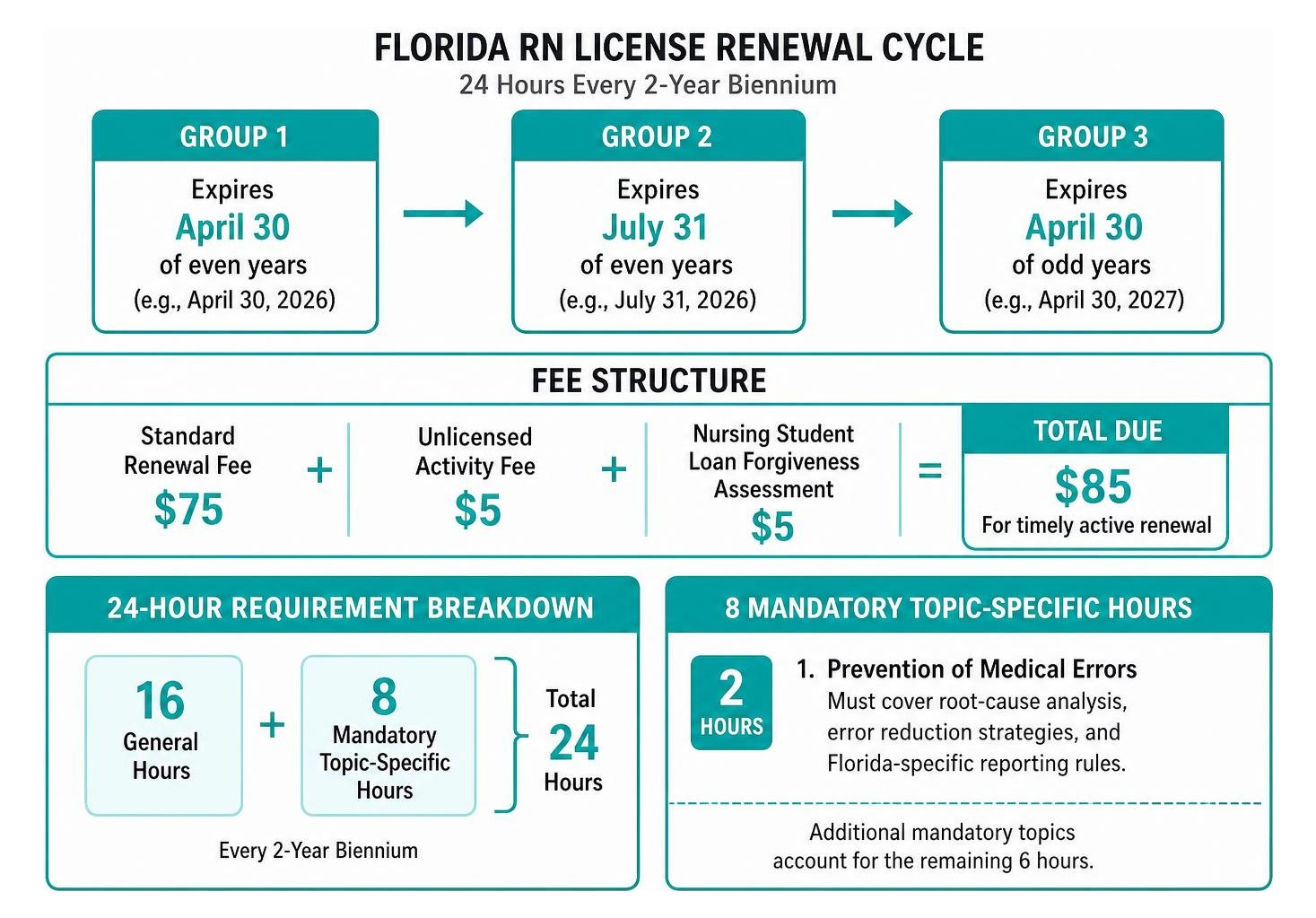
Florida enforces strict compliance tracking through the Department of Health and the Florida Board of Nursing renewal portal. Florida registered nurses must complete 24 hours of continuing education every two-year biennium cycle.
Licenses expire in staggered cohorts:
- Group 1: April 30 of even years (e.g., April 30, 2026)
- Group 2: July 31 of even years (e.g., July 31, 2026)
- Group 3: April 30 of odd years (e.g., April 30, 2027)
The standard renewal fee is $75, accompanied by a $5 unlicensed activity fee and a $5 Nursing Student Loan Forgiveness assessment, totaling $85 for timely active renewal.
Florida Required Topics: Medical Errors, Impairment, and Human Trafficking
Florida’s 24-hour total breaks down into 16 general hours and 8 mandatory topic-specific hours:
- Prevention of Medical Errors (2 hours): Must cover root-cause analysis, error reduction strategies, and Florida-specific reporting rules.
- Florida Laws and Rules (2 hours): Reviews Chapter 464 of the Florida Statutes and Rule Title 64B9 of the Florida Administrative Code.
- Recognizing Impairment in the Workplace (2 hours): Covers substance abuse identification, reporting protocols, and intervention resources.
- Human Trafficking (2 hours): Statutory mandate covering victim identification, assessment factors, and reporting resources. Note: Unlike other Florida mandates, this specific course can be completed through any educational provider that meets the statutory curriculum requirements, even if they lack direct Florida Board approval.
- Domestic Violence (2 hours): Required every third renewal cycle (every 6 years), counting toward general hours.
- HIV/AIDS (1 hour): Mandatory only for your first license renewal cycle.
Board Exemptions and Reporting Hours to CE Broker
Florida uses CE Broker as its official electronic continuing education tracking system. All course completions must be uploaded directly to CE Broker before the Medical Quality Assurance (MQA) portal allows you to finalize your renewal.
Special exemptions exist under Florida administrative rules:
- Specialty Certification Exemption: RNs certified by an accredited health care specialty program (such as those accredited by the National Commission for Certifying Agencies or the Accreditation Board for Specialty Nursing Certification) are exempt from general and state-specific CE requirements, except for the mandatory 2-hour Human Trafficking course.
- Military Exemption: Active-duty military personnel are exempt from renewal requirements during their period of active duty and for up to six months following honorable discharge.
- Volunteer Health Services: RNs providing uncompensated health care to underserved populations or public schools may receive a waiver of up to 25% of their general CE hours and renewal fees.
State-by-State Comparison: Renewal Hours and Costs
Renewal cycles, fees, and hour requirements differ significantly nationwide:
| State | Required CE Hours | Renewal Cycle | Standard Renewal Fee | Key Topic Mandates |
|---|---|---|---|---|
| Florida | 24 hours | 2 Years | $85 | Medical Errors, FL Laws, Impairment, Human Trafficking |
| California | 30 hours | 2 Years | $190 | General nursing practice, pharmacology, patient care |
| Texas | 20 hours | 2 Years | $68 | Jurisprudence, ethics, targeted clinical areas |
| Ohio | 24 hours | 2 Years | $65 | Category A (Ohio nursing law and administrative rules) |
| New York | Specific topics | 3 Years | $73 | Child Abuse (every cycle), Infection Control (every 4 yrs) |
| Oregon | 0 hours | 2 Years | $258 | Pain management (one-time requirement only) |
| Indiana | 0 hours | 2 Years | $50 | No general CE requirement for standard renewals |
| Wyoming | 40 hours | 2 Years | $110 | Direct practice hours combined with CE options |
Meeting California, Ohio, and Texas License Standards
High-population states carry precise instructional requirements:
- California: Requires 30 board-approved contact hours every two years after the first renewal cycle. Review RN CEUs California The Winner Revealed to explore top-rated curriculum options, or explore fast and stress-free California RN CE courses to finish your requirements quickly.
- Ohio: Mandates 24 contact hours per biennium, with at least 1 hour dedicated to Category A (Ohio Nursing Law and Rules). Check out Ohio no-test renewal options for compliant packages.
- Texas: Requires 20 contact hours every two years, with periodic mandates in nursing jurisprudence and ethics.
Streamlining Self-Paced RN CEUs for Busy Nurses

Managing 12-hour shifts alongside clinical education requires flexible, self-directed learning formats. Modern e-learning platforms provide self-paced digital modules with instant certificates of completion, allowing you to fulfill your license requirements without taking time away from patient care.
Nurse Licensure Compact (NLC) Rules and Multistate CE Compliance
The Nurse Licensure Compact (NLC) allows registered nurses to hold one multistate license issued by their primary state of residence (PSOR) and practice in any of the 40 participating compact jurisdictions without purchasing separate individual state licenses.
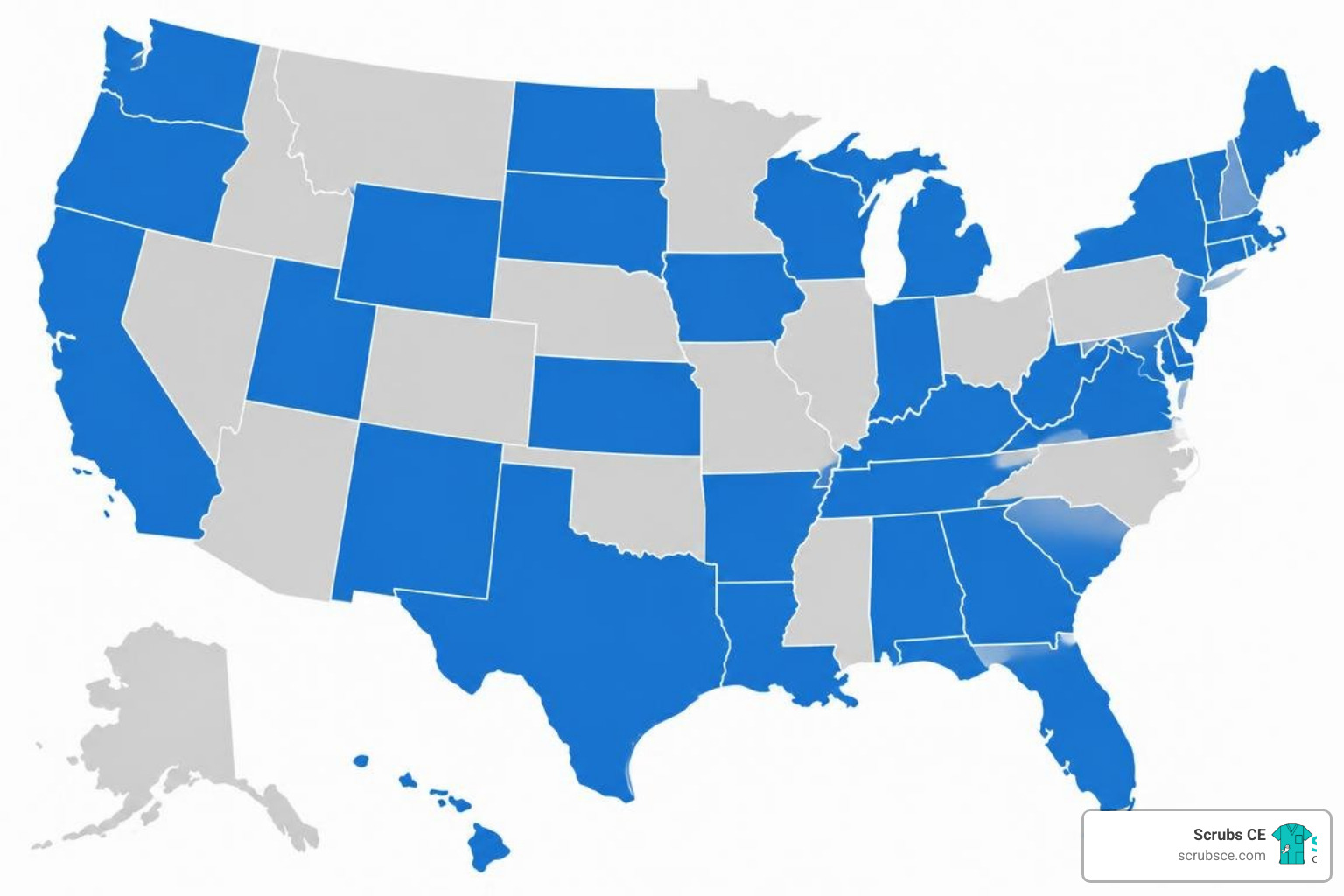
Under the NLC:
- You must comply with the continuing education requirements of your primary state of residence.
- Practicing across state lines via travel nursing or remote telehealth does not require completing additional CEUs for each secondary compact state.
- If you practice in a non-compact state (such as California or Oregon), you must hold an active single-state license for that state and fulfill its specific CE requirements.
Relocating Across Compact States and License Transition
When moving your primary residence to a new compact state:
- Apply for licensure by endorsement in your new home state.
- Complete the new state’s required background checks and CE requirements.
- Upon issuance of your new multistate license, your previous state’s license becomes inactive.
- You cannot maintain a single-state license in Florida while holding an active multistate license in another compact state.
Avoiding Delinquent Status and License Reinstatement
Missing your license expiration date leads to progressive administrative penalties:
- Delinquent Status: Incurred immediately upon passing the renewal deadline without completing CEUs or paying fees. Florida assesses an additional $55 late fee.
- Lapsed Status: Unrenewed licenses remain delinquent for up to two years. Reinstating requires submitting full CE documentation, paying retroactive active fees, and satisfying late penalties.
- Null and Void Status: If a Florida license remains expired past two years (one full renewal cycle), it automatically becomes Null and Void. At that point, you can no longer reactivate the credential—you must reapply for licensure from scratch, submit fresh electronic fingerprints, and petition the Board of Nursing.
Frequently Asked Questions About Continuing Education for Nurses
How many CEU hours do Florida RNs need every renewal cycle?
Florida RNs must complete 24 board-approved contact hours every two-year cycle. This includes 16 general contact hours and 8 hours across mandatory subjects: Prevention of Medical Errors (2 hrs), Florida Laws and Rules (2 hrs), Impairment in the Workplace (2 hrs), and Human Trafficking (2 hrs). Domestic Violence (2 hrs) is required every third cycle.
What happens if an RN license becomes null and void?
Once a license reaches Null and Void status, the previous credential cannot be reactivated through standard continuing education reporting. You must submit a formal petition to the Board of Nursing or reapply for licensure, complete new electronic fingerprint screening, and verify clinical competency.
Do specialty certifications exempt nurses from continuing education?
Yes. Florida RNs holding accredited national certifications from the National Commission for Certifying Agencies (NCCA) or the Accreditation Board for Specialty Nursing Certification (ABSNC) are exempt from all general and mandatory CE requirements, with one exception: they must still complete the mandatory 2-hour Human Trafficking course every renewal cycle.
Conclusion
Maintaining compliance with state board regulations ensures your nursing license remains active, protected, and fully verified for clinical practice. Whether you practice in a state with strict topic-specific mandates or work across borders using a compact license, tracking your renewal cycle prevents costly penalties and administrative delays.
When it is time to renew your credentials, choose an accredited, self-paced learning solution that simplifies compliance. You can complete your full 30-hour nursing CEU package online through Scrubs CE to get fast, verifiable certificates and keep your career moving forward.