
MRI Training 101: Learn MRI Basics
MRI Training: What You Need to Know to Get Started

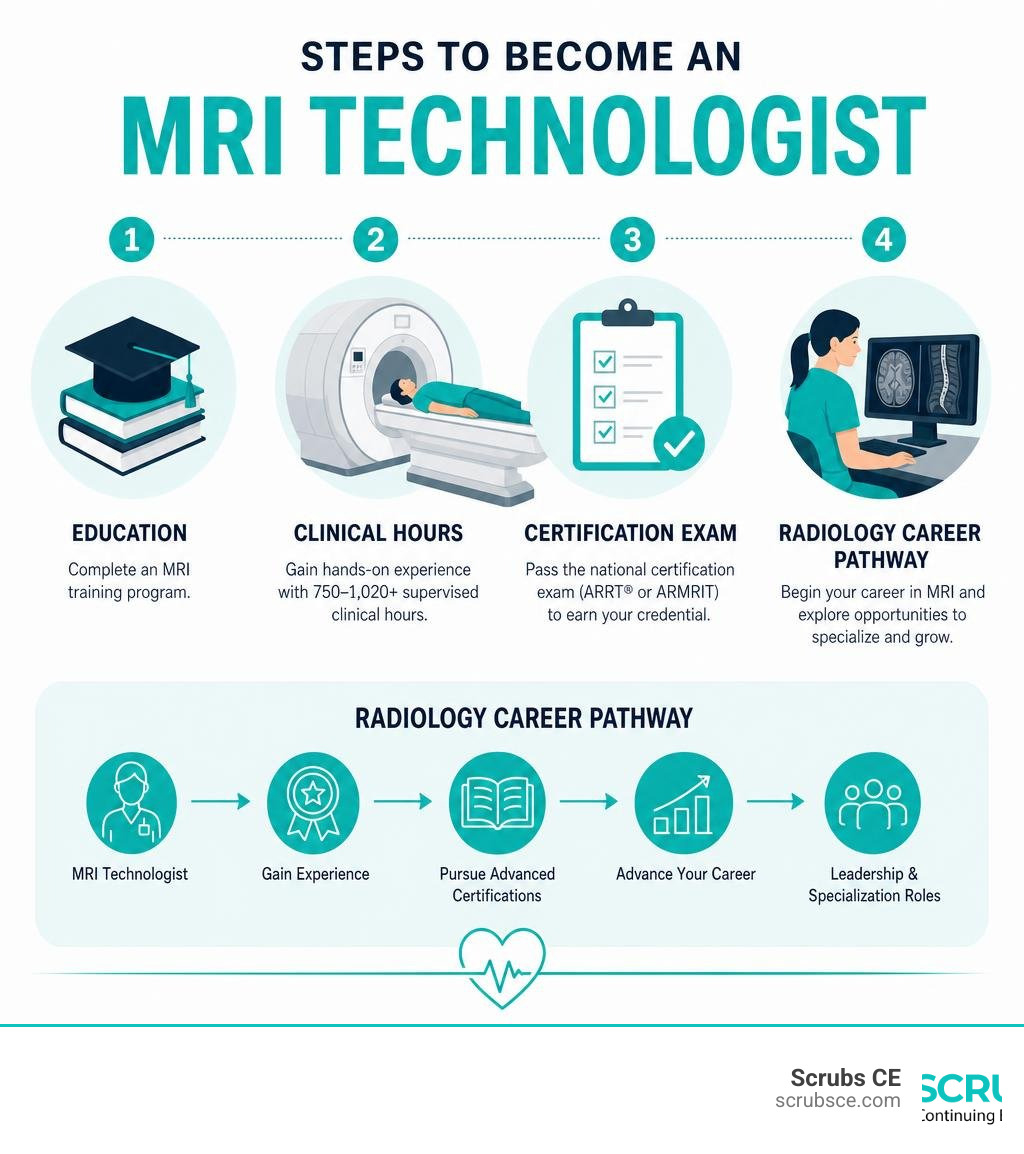
MRI training is the structured education and clinical preparation that qualifies you to operate magnetic resonance imaging equipment, produce diagnostic images, and sit for national certification exams.
Quick answers for common questions:
| Question | Short Answer |
|---|---|
| Who needs MRI training? | Radiologic technologists cross-training into MRI, and career changers entering medical imaging |
| Main certification bodies | AMERICAN REGISTRY OF RADIOLOGIC TECHNOLOGISTS® (ARRT®) and ARMRIT |
| Typical program length | 6 months (post-primary) to 18 months (full associate degree) |
| Clinical hours required | 750–1,020+ supervised hours depending on pathway |
| National median salary | $88,180 per year (BLS, May 2024) |
| Job growth outlook | 6% through 2033, with a 17.4% national vacancy rate |
MRI is one of the fastest-growing and hardest-to-staff imaging modalities in the country. Hospitals and imaging centers are actively competing to hire qualified technologists — and that gap is only widening.
Whether you’re an existing Radiologic technologist looking to add MRI as a specialty, or a career changer considering the field from scratch, understanding your training options is the critical first step.
I’m Zita Ewert, and as the leader behind Scrubs Continuing Education®, I’ve spent years helping imaging professionals navigate the evolving landscape of MRI training — from initial certification to ongoing CE requirements. In the sections ahead, I’ll break down everything you need to make a confident, informed decision about your path forward.
Choosing the Right MRI Training Program
Selecting the right pathway depends on your educational background, budget, and long-term career goals. The two major credentialing bodies in the United States—the AMERICAN REGISTRY OF RADIOLOGIC TECHNOLOGISTS® (ARRT®) and the American Registry of Magnetic Resonance Imaging Technologists (ARMRIT)—offer distinct routes to becoming a certified technologist.
ARRT® vs. ARMRIT Pathway Comparison
| Feature | AMERICAN REGISTRY OF RADIOLOGIC TECHNOLOGISTS® (ARRT®) | ARMRIT |
|---|---|---|
| Primary Target | Existing Radiologic technologists (post-primary) or students completing an accredited associate degree program | Career changers seeking direct entry into MRI without prior X-ray/Radiology credentials |
| Prerequisites | Associate degree + primary certification (e.g., Radiography) OR completion of an ARRT®-approved MRI primary program | High school diploma or GED; completion of an ARMRIT-approved training program |
| Clinical Hours | Variable (must complete all ARRT® clinical competency requirements) | 1,000+ supervised clinical hours |
| Employer Acceptance | Universally accepted by hospitals, academic medical centers, and outpatient clinics | Widely accepted by outpatient imaging centers and specialized clinics; some hospital limitations |
| Program Cost | $2,000–$5,000 (post-primary certificate) to $15,000–$40,000+ (primary associate degree) | $11,000–$25,000 (typical hybrid/private vocational school) |
The AMERICAN REGISTRY OF RADIOLOGIC TECHNOLOGISTS® (ARRT®) Pathway
For those who already hold a credential in Radiography, Radiation Therapy, or Sonography, the ARRT® post-primary pathway is the gold standard. It allows you to build on your existing knowledge of patient care and anatomy while completing the required 16 hours of structured didactic education and clinical competencies. Alternatively, students can enroll directly in an ARRT®-approved primary MRI program, which culminates in an Associate of Science (A.S.) degree.
The ARMRIT Pathway
If you are a career changer with no prior background in medical imaging, the ARMRIT pathway is highly attractive. It does not require you to obtain an X-ray or general Radiology certification first. Instead, you enroll directly in an ARMRIT-approved program focusing exclusively on MRI physics, safety, and clinical scanning.
Program Costs and Prerequisites
Prerequisites vary significantly. Post-primary programs require active registry status with the AMERICAN REGISTRY OF RADIOLOGIC TECHNOLOGISTS® (ARRT®). Primary programs require college-level prerequisites, particularly Anatomy & Physiology with a lab.
For those looking to transition, enrolling in comprehensive Online MRI Courses can help build the required foundational knowledge before stepping into a clinical setting.
Hybrid vs. Traditional MRI Education Models
As of June 2026, the educational landscape has shifted heavily toward flexible learning formats. Students can choose between hybrid programs that blend online didactics with local clinical placements, and traditional, hospital-based or on-campus programs.
Hybrid and Online MRI Training Options
Hybrid models have revolutionized mri training by allowing students to complete their classroom work from the comfort of home. Programs offered by institutions like the Tesla MR Institute or Pulse Radiology provide structured online didactics that fit around a student’s busy schedule.
- Pulse Radiology’s Premium Plan: Fulfills structured education requirements over a 14-week online curriculum, pairing students with local clinical coordinators to complete a 16-week clinical phase.
- Flexible Clinical Placement: These programs utilize vast networks of affiliate imaging centers (Pulse Radiology has over 1,300 clinical sites nationwide) to place students locally, eliminating the need to relocate.
To understand how the technology you will be training on is shifting, check out our insights on MRI Tech in 2025: Bigger Bores and Better Brains?.
Traditional and Hospital-Based Programs
Traditional programs, particularly those run by major academic medical centers, offer unparalleled clinical immersion but require a rigid, full-time commitment.
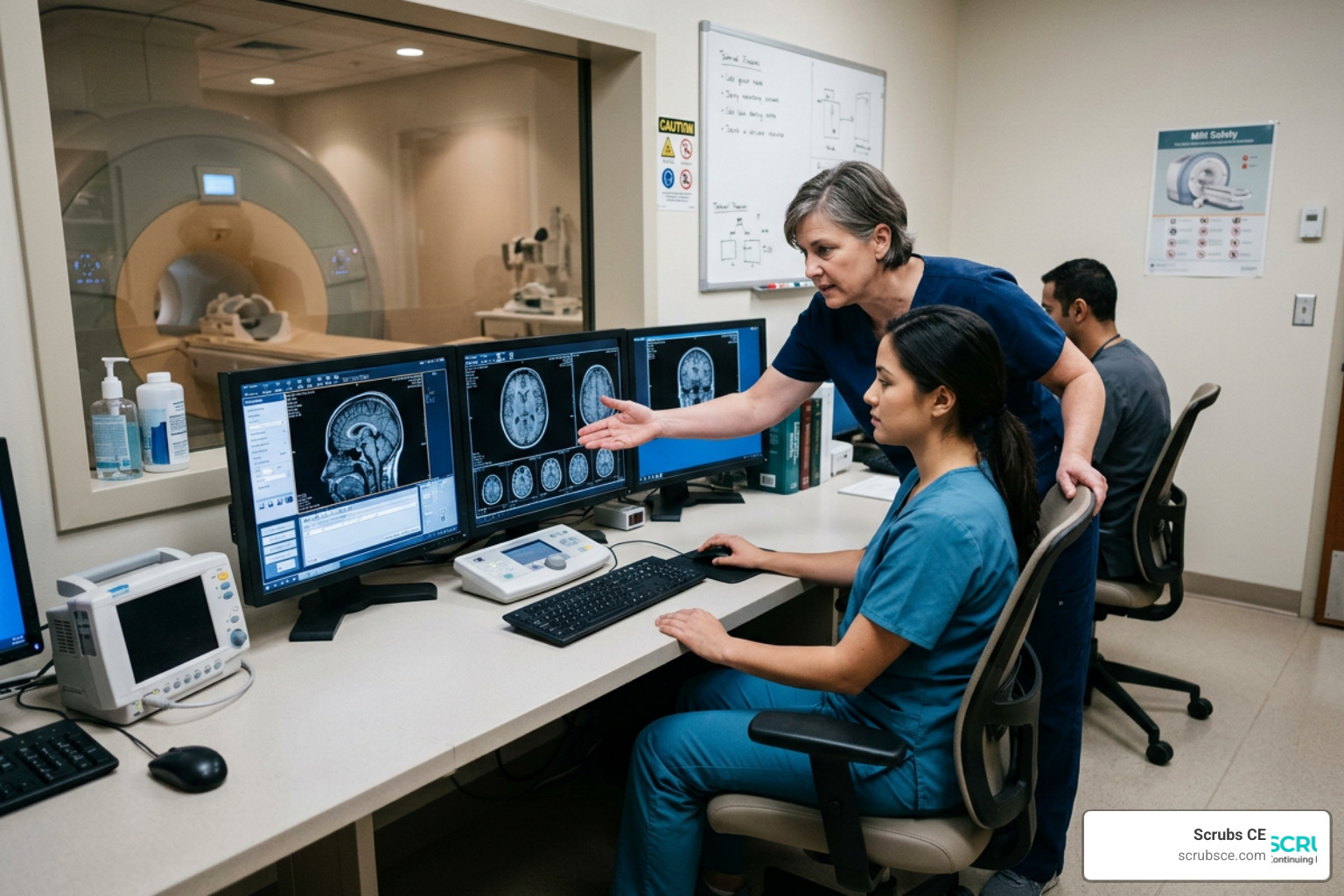
A prime example is the Johns Hopkins Department of Radiology MRI Technologist Training Program. Over the past 15 years, this prestigious program has trained approximately 100 students, boasting an impressive 99% average pass rate on the ARRT® advanced certification in MRI.
- Format: A 6-month, full-time, paid post-primary program.
- The Catch: While you are paid during your training, graduates must commit to a two-year post-graduation work commitment at a Johns Hopkins facility.
- Clinical Exposure: Students rotate through diverse, high-volume environments including pediatric, oncology, trauma, and critical care units.
Other traditional options include community colleges like St. Louis Community College, which offers a 42-credit-hour Certificate of Proficiency. These programs are incredibly cost-effective (averaging $122 per credit hour for in-district students) but often require rigorous prerequisites, including job shadowing and documented patient care experience, before admission.
Clinical Requirements and Simulation Technology
No matter how much theory you study, you cannot become a competent technologist without hands-on scanning experience.
Clinical Requirements for Hands-On MRI Training
To sit for the certification exams, you must prove you can perform scans safely and accurately in a real clinical environment.
- ARRT® Requirements: Rather than mandating a specific number of hours, the AMERICAN REGISTRY OF RADIOLOGIC TECHNOLOGISTS® (ARRT®) requires candidates to document clinical competencies across a wide range of procedures (such as brain, spine, musculoskeletal, and abdominal scans) on a formal case checklist.
- ARMRIT Requirements: ARMRIT mandates a minimum of 1,000 clinical hours.
- Degree Programs: Accredited associate degree programs, such as those at a JRCERT-aligned Accredited MRI School | Magnetic Resonance Imaging Program, require up to 1,020 supervised clinical hours spread over 48 weeks.
Virtual Simulation Tools in MRI Education
Historically, students had to compete with scheduled patients to get precious “knob-turning” time on live MRI scanners. Today, virtual simulation tools have changed the game.

Advanced simulators, such as those developed by Corsmed, teach universal imaging principles in a vendor-neutral environment. Unlike basic programs that use static pre-rendered image libraries, physics-based simulators like Corsmed calculate every pixel in real time using the Bloch equations.
- Realistic Outcomes: If a student inputs a poor parameter, the simulator generates the exact artifact (such as motion ghosting, phase wrap, or chemical shift) that would occur on a real scanner.
- Reduced Training Time: Studies show that utilizing an MRI Simulator for Hospitals & Clinics | Train Technologists 2x Faster | Corsmed can cut onboarding times by 50% and train competent technologists up to two times faster.
- ScanLabMRI Integration: Educational providers like MTMI integrate ScanLabMRI software (including SliceQuant, ContrastLab, and ResolutionLab) directly into their curriculums, giving students unlimited, risk-free scanning practice 24/7.
MRI Physics, Safety, and State Regulations
Operating a multi-ton superconducting magnet requires a deep understanding of physics and strict adherence to safety protocols.
Core Curriculum: Physics, Protocols, and Safety
A comprehensive mri training curriculum covers several core domains:
- MRI Physics and Instrumentation: Understanding nuclear magnetism, RF pulses, gradient systems, spatial localization, and image reconstruction.
- Pulse Sequences: Mastering Spin Echo, Gradient Echo, Inversion Recovery (STIR/FLAIR), and advanced methods like Diffusion-Weighted Imaging (DWI) and ADC mapping.
- Artifact Recognition: Identifying and correcting common imaging errors to prevent diagnostic mistakes.
- MRI Safety: Differentiating between Level 1 MR Personnel (basic safety for general staff) and Level 2 MR Personnel (advanced safety for technologists), as outlined in the ACR Manual on MR Safety and mandated by The Joint Commission.
To master these complex topics, we highly recommend studying authoritative texts. You can access the industry-standard curriculum through our courses on MRI in Practice 5th Ed, dive deep into safety with the Essentials of MRI Safety, or explore comprehensive imaging concepts in Magnetic Resonance Imaging.
State-Specific Licensing and Job Market Outlook
The job market for MRI technologists is exceptionally strong.
- High Demand: The national MRI vacancy rate stands at 17.4% according to the latest ASRT® survey, and the BLS projects a 6% employment growth through 2033.
- Earning Potential: The national median annual wage is $88,180. However, location plays a massive role. For example, technologists working in the Washington-Arlington-Alexandria metro area earn a mean annual wage of $99,910.
- State Regulations: Licensing requirements vary by state. In Virginia, for example, there is no state-specific MRI license because MRI uses non-ionizing radiation. This makes the state highly attractive for career changers pursuing the ARMRIT pathway. Educational providers like the Tesla MR Institute support this local demand with over 65 clinical training sites across Virginia.
Frequently Asked Questions about MRI Training
What is the difference between AMERICAN REGISTRY OF RADIOLOGIC TECHNOLOGISTS® (ARRT®) and ARMRIT certification?
The AMERICAN REGISTRY OF RADIOLOGIC TECHNOLOGISTS® (ARRT®) is the most widely recognized credentialing body, accepted by virtually all hospitals and healthcare networks. It requires either an existing imaging credential or the completion of an associate degree. ARMRIT focuses exclusively on MRI and offers a direct pathway for career changers without prior Radiology experience. While widely accepted in outpatient clinics, some hospital systems exclusively require ARRT® certification.
How long does it take to complete an MRI training program?
If you are already an ARRT®-registered Radiologic technologist, a post-primary certificate program typically takes 6 to 12 months. For career changers entering a primary pathway, a hybrid or traditional Associate of Science program generally takes 12 to 18 months of full-time study, which includes completing the necessary clinical hours.
Do I need a prior Radiology degree to become an MRI technologist?
No. While many MRI technologists start as X-ray techs, you can enter the field directly. The ARMRIT pathway and ARRT® primary pathway programs are designed to take you from a high school diploma or GED straight into MRI-specific didactics and clinical practice.
Conclusion
Embarking on mri training is a rewarding decision that leads to a stable, high-paying, and intellectually stimulating career. Whether you choose a local community college, a prestigious hospital-based residency, or a flexible hybrid program utilizing advanced virtual simulators, the key to success is matching the training model to your lifestyle and career goals.
Once you complete your initial training and earn your credentials, your learning journey doesn’t stop. To maintain your certification, satisfy ARRT® Continuing Qualifications Requirements (CQR), and stay at the forefront of the field, you will need high-quality continuing education.
At Scrubs CE, we offer convenient, affordable, and self-paced CE for MRI Technologists with instant certificates. Whether you need specialized MRI CE for ARMRIT or dual-approved credits like MRI CE for ARMRIT and AMERICAN REGISTRY OF RADIOLOGIC TECHNOLOGISTS® (ARRT®), we have you covered.
Explore our full catalog of courses today and keep your career moving forward: