
Anatomy Radiology Book Essentials: Top Texts for Diagnostic Imaging
Why Choosing the Right Anatomy Radiology Book Matters for Imaging Professionals

The right anatomy Radiology book can be the difference between confident clinical practice and constant second-guessing at the reporting station. Here are the top texts worth knowing about:
Top Anatomy Radiology Books at a Glance:
- Anatomy for Diagnostic Imaging, 4th Ed. – Comprehensive multimodality reference for Radiology trainees and technologists
- Imaging Anatomy: Chest, Abdomen, Pelvis, 3rd Ed. – Nearly 2,800 images; ideal point-of-care reference
- Imaging Anatomy: Text and Atlas Volume 3 – 958 pages, 2,175 images; covers upper and lower extremity anatomy
- Applied Radiology Anatomy for Medical Students – Integrates radiographs, MRI, CT, and ultrasound with line illustrations
- Weir & Abrahams’ Imaging Atlas of Human Anatomy – Widely recommended for first-year Radiology residents
The human body contains 206 bones, 10 major body systems, and roughly 7,620 cm² of skin surface. Understanding all of that through the lens of imaging is no small task. Whether you’re preparing for an AMERICAN REGISTRY OF RADIOLOGIC TECHNOLOGISTS®-aligned exam, fulfilling ARRT® continuing education requirements, or simply sharpening your diagnostic skills, having the right reference on your shelf saves time and builds real-world confidence.
I’m Zita Ewert, and through my work developing accredited continuing education at SCRUBS CE for radiologic technologists and imaging professionals, I’ve seen how the right anatomy Radiology book shapes clinical competence and exam readiness. Let’s break down exactly which texts belong in your library and why.
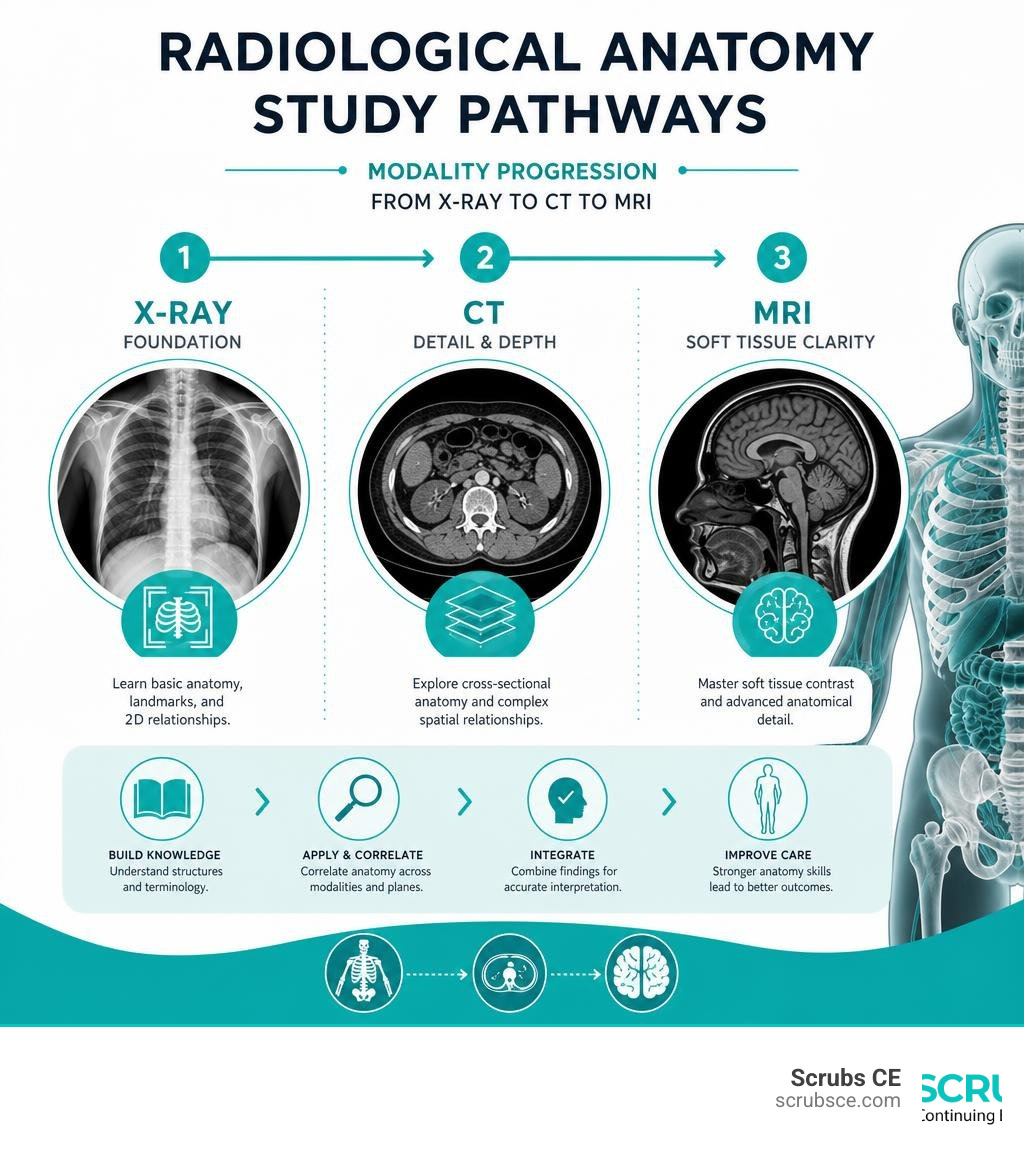
Selecting the Right Anatomy Radiology Book for Clinical Practice
In the world of diagnostic imaging, reference guides are more than just dusty academic requirements. They are essential tools for professional development, providing immediate answers at the workstation when you encounter a rare anatomical variant or a tricky projection.
When searching for the ultimate anatomy Radiology book, you must look beyond traditional medical school textbooks. Standard anatomy texts show beautiful, hand-drawn illustrations of muscles and nerves, but they do not show how those structures look on a high-resolution CT or a 3-Tesla MRI. For practicing technologists and radiographers, we recommend starting with a foundational text like Anatomy for Radiographers, which bridges the gap between pure biological anatomy and daily clinical positioning.
The best books serve dual purposes:
- As a study aid for postgraduate Radiology exams and registry preparation.
- As a point-of-care reference to verify normal anatomy and identify subtle pathologies.
Core Curriculum of a Standard Anatomy Radiology Book
A complete anatomy Radiology book must systematically cover the human organism from cells to complex organ systems. The adult human body is composed of 10 individual body systems, each presenting unique challenges under different imaging modalities.
To master this vast amount of information, standard texts break down the material into systemic anatomy and osteology:
- The Axial Skeleton (80 bones): Including the skull, vertebral column, ribs, and sternum.
- The Appendicular Skeleton (126 bones): Comprising the upper and lower limbs, shoulder girdle, and pelvic girdle.
- Specialized Bone Classifications: Identifying sesamoid bones (like the patella) and their specific radiographic demonstration needs.
- The Muscular System: Knowing that voluntary or striated skeletal muscle accounts for roughly 43% of human body weight helps us understand soft-tissue density and contrast on plain films.
- The Integumentary System: The skin, covering a massive 7,620 cm² surface area and constituting 8% of total body mass in the average adult, serves as our primary external landmark.
For visual learners who want an interactive way to memorize these structures, we highly recommend utilizing the Anatomy Coloring Workbook as an active study companion to your primary Radiology textbooks.
Advanced Modalities in an Anatomy Radiology Book
While plain-film radiography is the bedrock of imaging, a modern anatomy Radiology book must address advanced modalities. Today’s clinical environment relies heavily on computed tomography (CT), magnetic resonance imaging (MRI), and ultrasound.
Cross-sectional anatomy is particularly challenging because structures change appearance completely depending on the slice level and imaging plane. High-yield resources like Imaging Anatomy: Text and Atlas Volume 3: order now in the Thieme Webshop | 9781626239852 focus heavily on these advanced techniques. This text features:
- Over 2,175 high-resolution images across 958 pages.
- In-depth guides to upper and lower extremity anatomy.
- 3-Tesla to 7-Tesla MR views and color-coded volume rendering.
- Advanced 3D reformations and virtual dissection experiences that match the capabilities of modern imaging workstations.
Integrating Radiographic Positioning, Body Planes, and Projections
To capture a diagnostic image, a technologist must translate three-dimensional human anatomy onto a two-dimensional digital detector. This requires a precise command of radiographic positioning, body planes, and projection types.
An excellent reference text clearly differentiates between:
- General Body Positions: Such as supine, prone, erect, recumbent, and Trendelenburg.
- Specific Body Positions: Lateral, oblique, decubitus, and Lordotic.
- Special-Use Projections: Axiolateral, tangential, and transthoracic projections designed to isolate specific structures without anatomical superimposition.
To help visualize how body planes and projection types interact in clinical practice, we have compiled this quick-reference table:
| Body Plane | Description | Common Projection Types | Clinical Focus |
|---|---|---|---|
| Sagittal / Mid-Sagittal | Divides the body into right and left portions. | Lateral, Oblique | Vertebral column, joint spaces, profile views of skull. |
| Coronal / Mid-Coronal | Divides the body into anterior and posterior portions. | AP (Anteroposterior), PA (Posteroanterior) | Chest radiography, abdominal organs, clavicles. |
| Transverse / Axial | Divides the body into superior and inferior portions. | Axial, Tangential | CT slicing, patellar sunrise views, cranial base. |
Image Quality Standards and Technical Principles

A beautiful anatomical image is useless if the technical factors are poor. A comprehensive anatomy Radiology book must emphasize image quality standards and evaluation criteria. Technologists must assess spatial resolution, contrast, distortion, and artifacts on every single digital radiography image.
Furthermore, a great text teaches you how to manipulate physical principles to improve image quality:
- The Anode Heel Effect: Understanding that radiation intensity is greater on the cathode side of the X-ray tube allows us to position thicker body parts (like the femur or thoracic spine) under the cathode side for a more uniform density.
- Compensating Filters: Utilizing wedge or trough filters to even out the exposure of body parts with varying thicknesses, such as the foot or mediastinum.
To master these underlying physiological and physical relationships, we suggest reading Understanding Anatomy & Physiology 3rd Ed, which provides an excellent foundation for understanding how the body’s physical systems respond to and are visualized by diagnostic technologies.
Patient Protection, Radiation Safety, and Ethical Practice
As radiologic professionals, our first duty is to do no harm. Any reputable anatomy Radiology book must integrate patient protection, radiation units (such as Gray and Sievert), and the ethical practice of digital imaging.
With the transition from analog film to digital radiography, “exposure creep” has become a real concern. Because digital systems can process overexposed images to look perfect, it is easy to over-radiate patients without realizing it. Ethical practice dictates that we strictly adhere to the ALARA (As Low As Reasonably Achievable) principle.
The AMERICAN REGISTRY OF RADIOLOGIC TECHNOLOGISTS® (ARRT®) and the American Society of Radiologic Technologists (ASRT®) set high standards for ethical practice and continuing education. Utilizing resources like Essentials of Anatomy and Physiology can help you maintain these vital standards while earning the CE credits required to keep your credentials active in June 2026 and beyond.
Practical Components and Contrast Media Studies

A textbook shouldn’t just be theoretical; it must have practical components that prepare you for the clinical floor. This includes systematic approaches to interpreting anatomical X-rays of the thorax, abdomen, and skull, alongside detailed protocols for contrast media studies.
Contrast media is essential for visualizing structures that have similar tissue densities to their surroundings. For example, the kidneys, ureters, and bladder are virtually invisible on a plain scout film. Introducing iodinated contrast allows us to perform intravenous urograms (IVUs) or retrograde pyelograms, highlighting the delicate renal pelvis and collecting systems.
To expand your clinical library with these practical, real-world protocols, we highly recommend:
- Anatomy for Diagnostic Imaging – 9780443105609 – This text is an exceptional study aid for postgraduate exams and a superb reference for reporting stations, offering over 100 new images and modern color diagrams.
- Applied Radiology Anatomy for Medical Students – A highly accessible atlas that integrates multiple imaging modalities to illustrate normal anatomy and key Radiology findings.
- Imaging Anatomy: Chest, Abdomen, Pelvis, 3rd Edition – The definitive point-of-care reference with nearly 2,800 print and online-only images, detailed 3D reconstructions, and common anatomic variants.
Frequently Asked Questions about Radiology Anatomy
How many bones are in the adult human skeletal system?
The adult human skeletal system consists of 206 bones. This is divided into the axial skeleton (80 bones, including the skull, spine, and ribcage) and the appendicular skeleton (126 bones, including the upper and lower extremities). You may also encounter sesamoid bones, which are small, rounded bones embedded in tendons (like the patella or those in the first metatarsal) that protect tendons from excessive wear.
What is the difference between general and specific body positions?
In radiographic terminology, a general body position refers to the overall posture of the patient during the exam (e.g., supine, prone, erect). A specific body position refers to the precise placement of the body or body part in relation to the image receptor (e.g., Right Anterior Oblique, Left Lateral Decubitus). Special-use projections are highly specific angles of the X-ray beam designed to project certain structures free of superimposition (such as the tangential projection of the patella).
How long does a typical Radiology anatomy course take?
A standard, comprehensive Radiology anatomy course typically requires 36 total hours of study. This is generally structured as 24 hours of interactive lectures focusing on theoretical anatomy and imaging physics, combined with 12 hours of practical field work or laboratory sessions where students identify structures on actual clinical images.
Conclusion
Mastering Radiology anatomy is an ongoing journey. As imaging technology advances, our understanding of normal anatomy, variants, and pathological pathways continues to grow. Investing in a high-quality anatomy Radiology book is one of the most effective steps you can take for your professional development.
At Scrubs CE, we are dedicated to providing convenient, affordable, self-paced online continuing education courses to help you meet your licensure requirements and excel in clinical practice. If you are ready to take the next step in your professional development, check out our highly-rated course Anatomy for Radiographers and earn your CE credits with instant certification today!