
What CE Hours Really Mean for Your License (And Your Career)

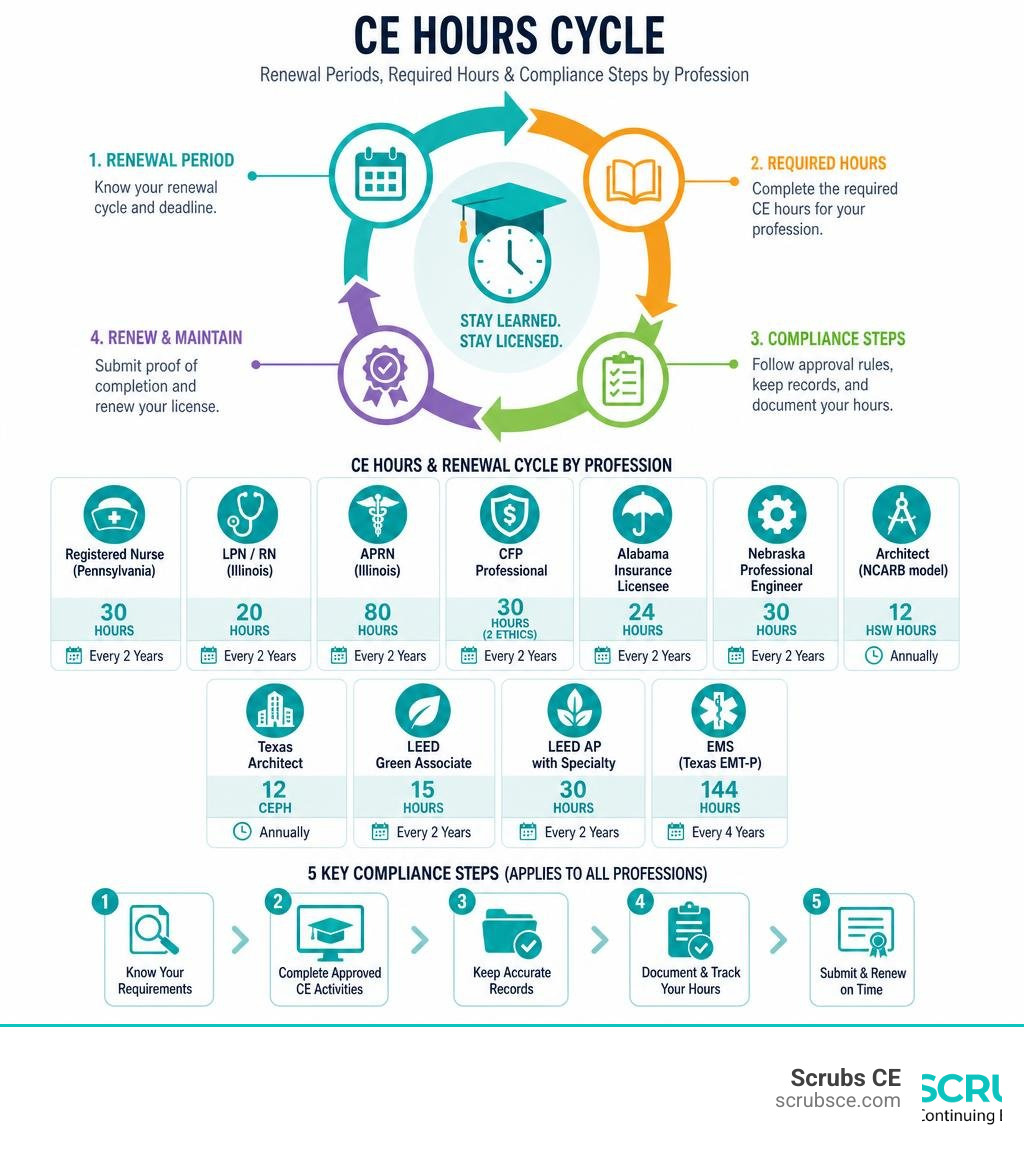
CE hours — or continuing education hours — are the required units of professional learning you must complete to renew your license or certification. Here’s a quick overview of what’s typically required across common professions:
| Profession | CE Hours Required | Renewal Cycle |
|---|---|---|
| Registered Nurse (Pennsylvania) | 30 hours | Every 2 years |
| LPN / RN (Illinois) | 20 hours | Every 2 years |
| APRN (Illinois) | 80 hours | Every 2 years |
| CFP Professional | 30 hours (2 ethics) | Every 2 years |
| Alabama Insurance Licensee | 24 hours | Every 2 years |
| Nebraska Professional Engineer | 30 hours | Every 2 years |
| Architect (NCARB model) | 12 HSW hours | Annually |
| Texas Architect | 12 CEPH | Annually |
| LEED Green Associate | 15 hours | Every 2 years |
| LEED AP with Specialty | 30 hours | Every 2 years |
| EMS (Texas EMT-P) | 144 hours | Every 4 years |
No matter your profession, the core idea is the same: complete a set number of approved learning hours within a specific period, or risk losing your license.
This guide walks you through everything — from how many hours you need, to what counts, to how audits work, and what happens if you fall short.
Whether you’re a nurse juggling 12-hour shifts, an engineer tracking biennial deadlines, or a radiologic technologist managing ARRT® requirements, the rules can feel overwhelming. But once you understand the system, staying compliant is very manageable.
I’m Zita Ewert, and I’ve spent years helping imaging professionals navigate CE hours requirements as the leader behind SCRUBS Continuing Education® — an accredited provider of over 1,500 categories of CE courses approved by major bodies including the AMERICAN REGISTRY OF RADIOLOGIC TECHNOLOGISTS®. In that time, I’ve seen where professionals get stuck, and this guide is built to help you avoid those pitfalls.
What Are CE Hours and Why Do They Matter?
For anyone holding a professional license, ce hours are not just a box to check. They are a fundamental part of maintaining your professional standing. But what exactly are they, and why do regulatory boards care so much about them?
At its core, a continuing education hour represents a measured unit of time spent in structured learning. In most fields, one CE hour is equivalent to 50 to 60 minutes of active instruction. These requirements exist to ensure that as industries evolve, the professionals working within them keep pace.
The Purpose of Professional Continuing Education
The primary purpose of continuing education is to protect public health, safety, and welfare. When you first earn your license, you prove you have the baseline knowledge required to practice safely. However, technology, laws, and best practices change rapidly.
Continuing education serves several critical functions:
- Skill Enhancement: It introduces you to new techniques, tools, and methodologies.
- Industry Standards: It aligns your daily work with current legal, ethical, and professional standards.
- Evidence-Based Practice: In fields like medicine and nursing, it ensures your patient care is guided by the latest scientific research.
To understand how these hours fit into your overall renewal process, it helps to review the core CE Credit Requirements that govern your specific field.
Who Regulates Continuing Education Requirements?
Continuing education is governed by a network of state licensing boards, national certifying agencies, and professional associations.
For example, if you are a nurse, your state Board of Nursing dictates exactly how many hours you need and which topics are mandatory. If you are an architect, state licensing boards often adopt guidelines established by national bodies like the National Council of Architectural Registration Boards (NCARB).
Because regulations vary wildly from state to state, it is vital to obtain your education from approved sources. Understanding how state boards establish these rules will help you avoid taking courses that do not count. For a deep dive into how state-level approvals work, check out our comprehensive guide on State Approved CE Everything You Need to Know for Your License Renewal.
Typical CE Requirements Across Key Professions
Because every industry has its own unique risks and regulatory standards, ce hours requirements are highly diverse. Let’s look closely at how different professions structure their continuing education cycles.
Healthcare and Nursing Standards

In healthcare, keeping your knowledge current is quite literally a matter of life and death. Consequently, healthcare professionals face some of the most rigorous CE mandates.
In Pennsylvania, Registered Nurses (RNs) must complete 30 hours of board-approved continuing education every two years to maintain their licenses. According to the PENNSYLVANIA STATE BOARD OF NURSING P.O. BOX 2649 HARRISBURG, PA 17105-2649 guidelines, these hours must be relevant to patient care or professional nursing, focusing on physical, social, biological, or behavioral sciences.
Meanwhile, under the Illinois Administrative Code Title 68 – PROFESSIONS AND OCCUPATIONS Part 1300 – NURSE PRACTICE ACT Subpart A – GENERAL PROVISIONS Section 1300.130 – Continuing Education , Illinois nurses have distinct tracks:
- Licensed Practical Nurses (LPNs) & Registered Nurses (RNs): Must complete 20 hours of approved CE per two-year renewal cycle.
- Advanced Practice Registered Nurses (APRNs): Must complete 80 hours of CE per two-year cycle. Of these 80 hours, at least 50 must be in specialty topics, including 20 hours of pharmacotherapeutics and 10 hours of opioid prescribing or substance abuse education.
For those working in specialized fields like Radiology, the continuing education pathway is governed by national credentialing organizations. If you hold credentials through the AMERICAN REGISTRY OF RADIOLOGIC TECHNOLOGISTS® (ARRT®), you must meet specific biennial CE requirements to maintain your active status. These courses must align with the professional standards recognized by the ASRT® and other leading imaging organizations. To learn more about how to navigate these technical requirements, read our Earn CE Credits Complete Guide.
Architecture and Engineering Guidelines
Architects and engineers are responsible for the physical safety of our built environment. Their CE requirements reflect this immense responsibility, focusing heavily on Health, Safety, and Welfare (HSW) subjects.
The National Council of Architectural Registration Boards (NCARB) recommends a national model standard of 12 HSW CE hours annually. According to the Continuing Education guidelines published by NCARB, these hours must be earned through structured educational activities that spend at least 75% of their content on HSW topics.
State boards often build upon these model guidelines. For instance, the Texas Board of Architectural Examiners requires 12 Continuing Education Program Hours (CEPH) annually. As detailed in the Continuing Education FAQ – Texas Board of Architectural Examiners , Texas architects must dedicate at least one of those hours to barrier-free design (accessibility) and another to sustainable or energy-efficient design.
For engineers, the requirements are equally structured. In Nebraska, professional engineers must complete 30 actual hours of engineering-related continuing education every two years, as outlined by the Continuing Education (CE) | State of Nebraska Board of Engineers and Architects . These hours must focus on technical or professional body-of-knowledge topics, with at least one hour dedicated to professional ethics.
Financial Planning and Insurance Regulations
If you manage people’s money or protect their assets, you are also bound by strict continuing education rules.
For Certified Financial Planner (CFP) professionals, the CFP Board mandates 30 hours of continuing education every two years. According to the Continuing Education Requirements | CFP Board , this total must include 28 hours of general CE covering the CFP Board’s Principal Knowledge Topics, alongside a mandatory 2-hour, pre-approved CFP Board Ethics course.
In the insurance sector, state departments regulate compliance. In Alabama, non-exempt insurance licensees must complete 24 hours of continuing education per biennial reporting period. These hours can be completed through classroom instruction, seminars, online courses, or self-study, provided they are offered by state-approved providers.
Acceptable Formats and Activities for Earning Credits
Gone are the days when earning ce hours meant spending your entire weekend sitting on a folding chair in a stuffy hotel conference room. Today, licensing boards recognize that learning happens in many different ways.

Online vs. Live Learning Formats
Most professions divide acceptable continuing education into structured study and self-directed learning.
- Structured Study: This includes live webinars, interactive online courses, and traditional classroom seminars. These formats have clear learning objectives, direct instruction, and often a formal assessment (like a quiz or exam) to verify completion.
- Self-Directed Learning: Some boards allow a limited number of hours to be earned through self-guided reading of professional journals, volunteering for industry committees, or publishing research.
Online, self-paced courses have become the gold standard for busy professionals. They offer the flexibility to study whenever your schedule allows. To explore how online learning can simplify your renewal process, take a look at our Continuing Education Credits Online Guide and learn how to maximize your time using Online CEU Credits.
How to Calculate and Track Your CE Hours
Understanding how your time translates into official credits is crucial. In most fields, continuing education is calculated using “contact hours.”
- 1 Contact Hour: Typically equals 50 to 60 minutes of continuous instruction.
- Academic Coursework: If you take a class at an accredited college or university, those credits convert to CE hours at a generous rate. For Pennsylvania nurses, 1 academic semester unit equals 15 CE hours, while 1 quarter unit equals 10 CE hours. For Illinois nurses, 1 academic semester hour also yields 15 contact hours.
To make sure the courses you choose will actually be accepted by your board, consult our guide on Accredited CE Courses The Smart Way to Stay Certified.
Managing Compliance, Carryovers, and Audits
With so many different rules to keep track of, managing your compliance requires a systematic approach.
Across the e-learning industry, modern tracking platforms support over 350 unique professions, reporting more than 90 million course completions from over 6,500 participating education providers. These systems make it much easier to track multiple licenses in one centralized place, but you must still understand your specific state’s rules regarding carryovers and audits.
Can You Carry Over Excess Credits?
If you get ambitious and earn more than your required ce hours during a renewal cycle, can you carry those extra hours over to the next period? The answer is: it depends entirely on your profession and your state.
Here is how different boards handle carryover credits:
- Nebraska Professional Engineers: Allowed to carry over up to 15 excess hours (half of their biennial requirement) into the next renewal period.
- Texas Architects: Allowed to carry over up to 12 excess structured hours for one year only.
- CFP Professionals: Historically, carryovers were not allowed. However, for renewal cycles beginning in or after Q1 2027, CFP professionals will be permitted to roll over up to 10 excess general CE hours to the next two-year cycle.
- Alabama Insurance Licensees: No carryover credits have been permitted since a regulatory change took effect in 2013.
- Nurses (Illinois & Pennsylvania): Generally, nurses cannot carry over excess hours. All required CE must be earned within the active 24-month renewal window.
Preparing for a Continuing Education Audit
Most licensing boards do not require you to submit your physical certificates of completion when you renew your license. Instead, you certify under penalty of perjury that you have completed the required hours, and the board verifies this through random audits.
If you are selected for an audit, you must provide clear, organized proof of your compliance.
Consequences of Failing to Meet Required CE Hours
Failing to complete your required ce hours before your license expiration date can have severe professional consequences. If you submit a renewal application without the necessary credits, your license may be suspended, placed on inactive status, or allowed to expire.
Practicing with an expired or inactive license is illegal and can lead to:
- Stiff financial penalties and late fees.
- Disciplinary action from your state board, which becomes a permanent part of your public professional record.
- Loss of employment, as most employers require active licensure as a condition of work.
If you find yourself short on hours as your deadline approaches, you must act quickly. To find out how to secure valid, accredited credentials rapidly, read our guide on How to Get Instant Certification Online Without Spending a Dime.
Frequently Asked Questions about CE Requirements
Are there CE exemptions for newly licensed professionals?
Yes, many licensing boards offer exemptions or reduced requirements for professionals during their very first renewal cycle.
- Nebraska Professional Engineers: Exempt from continuing education requirements for their first renewal period.
- Illinois Nurses: Exempt from CE requirements for their first license renewal after passing their initial board exams.
- Alabama Insurance Licensees: Exempt from the 24-hour CE requirement if they have been licensed for less than 12 months at the time of their first renewal.
How long should I retain my CE certificates and documentation?
You should always keep your physical or digital certificates of completion on file long after your renewal cycle ends. Audit windows vary by profession:
- Texas Architects: Must retain records for 5 years.
- Pennsylvania Nurses: Must keep certificates for at least 5 years.
- Nebraska Engineers: Must retain records for 4 years.
- CFP Professionals: Must keep documentation for at least 4 years.
- NCARB Guidelines: Recommend that architects maintain their CE records for 6 years.
Do advanced life support courses count toward nursing CE hours?
Yes, in many states, advanced life support certifications can be used to satisfy a portion of your nursing CE requirements. Under Pennsylvania Board of Nursing rules, courses like Advanced Cardiovascular Life Support (ACLS), Pediatric Advanced Life Support (PALS), and Advanced Trauma Life Support (ATLS) are accepted. However, they can only be claimed once per two-year renewal cycle, and basic life support (BLS) courses generally do not qualify.
Conclusion
Continuing education is more than a regulatory hurdle; it is a commitment to lifelong learning and professional excellence. By staying on top of your ce hours, you protect your license, enhance your clinical or technical skills, and ensure that you are providing the highest quality of service to your patients, clients, or the public.
At Scrubs CE, we make staying compliant simple, affordable, and stress-free. We offer convenient, self-paced online courses designed specifically to help healthcare and imaging professionals meet their licensure requirements without disrupting their busy lives. Once you complete your course, you will receive an Instant CE Certificate to keep your records audit-ready.
Ready to complete your continuing education requirements the smart way? Visit the Scrubs CE Homepage today to explore our extensive library of accredited, state-approved courses!