
Why CT and MRI Certificate Programs Are Worth Finding Near You
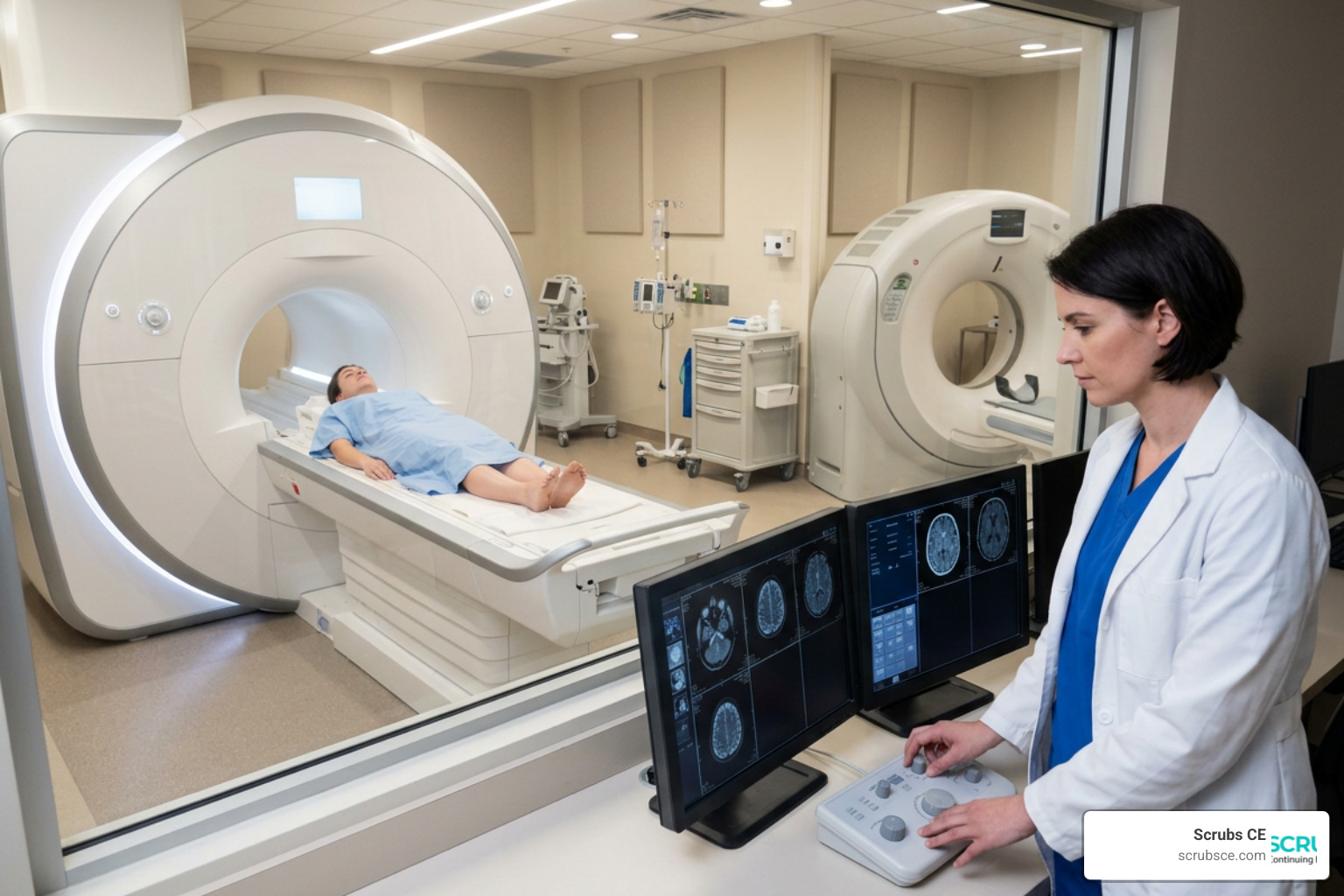
If you’re searching for CT and MRI certificate programs near me, here’s a quick snapshot of what to expect:
| What You Want to Know | Quick Answer |
|---|---|
| Who can apply? | Radiologic technologists, nuclear medicine techs, ultrasound techs, or radiation therapists with ARRT®, ARMRIT, NMTCB, or ARDMS credentials |
| How long do programs take? | 6 months (single modality) to 12–18 months (combined CT/MRI) |
| Online or in-person? | Didactic coursework is usually online; clinical rotations are completed near your location |
| What does it cost? | Roughly $8,000–$17,000 depending on the institution |
| What credential do you earn? | Eligibility to sit for ARRT® advanced-level CT and/or MRI exams |
| Is there job demand? | Yes — the 2025 ASRT® Staffing Survey reports a 17.4% national MRI vacancy rate |
The imaging job market is growing fast, and hospitals can’t fill seats quickly enough. The national median annual wage for MRI technologists hit $88,180 as of May 2024, according to BLS data. Adding CT or MRI credentials to your resume is one of the most direct paths to higher pay and more job options in Radiology.
Whether you’re a working radiographer looking to specialize or an experienced tech ready to add a second modality, a certificate program lets you get there without starting over with a new degree.
I’m Zita Ewert, and as the leader behind SCRUBS Continuing Education®, I’ve spent years helping imaging professionals navigate the credentialing landscape — including the structured education requirements tied to CT and MRI certificate programs near me. I’ll walk you through everything you need to know to choose the right program and move your career forward.
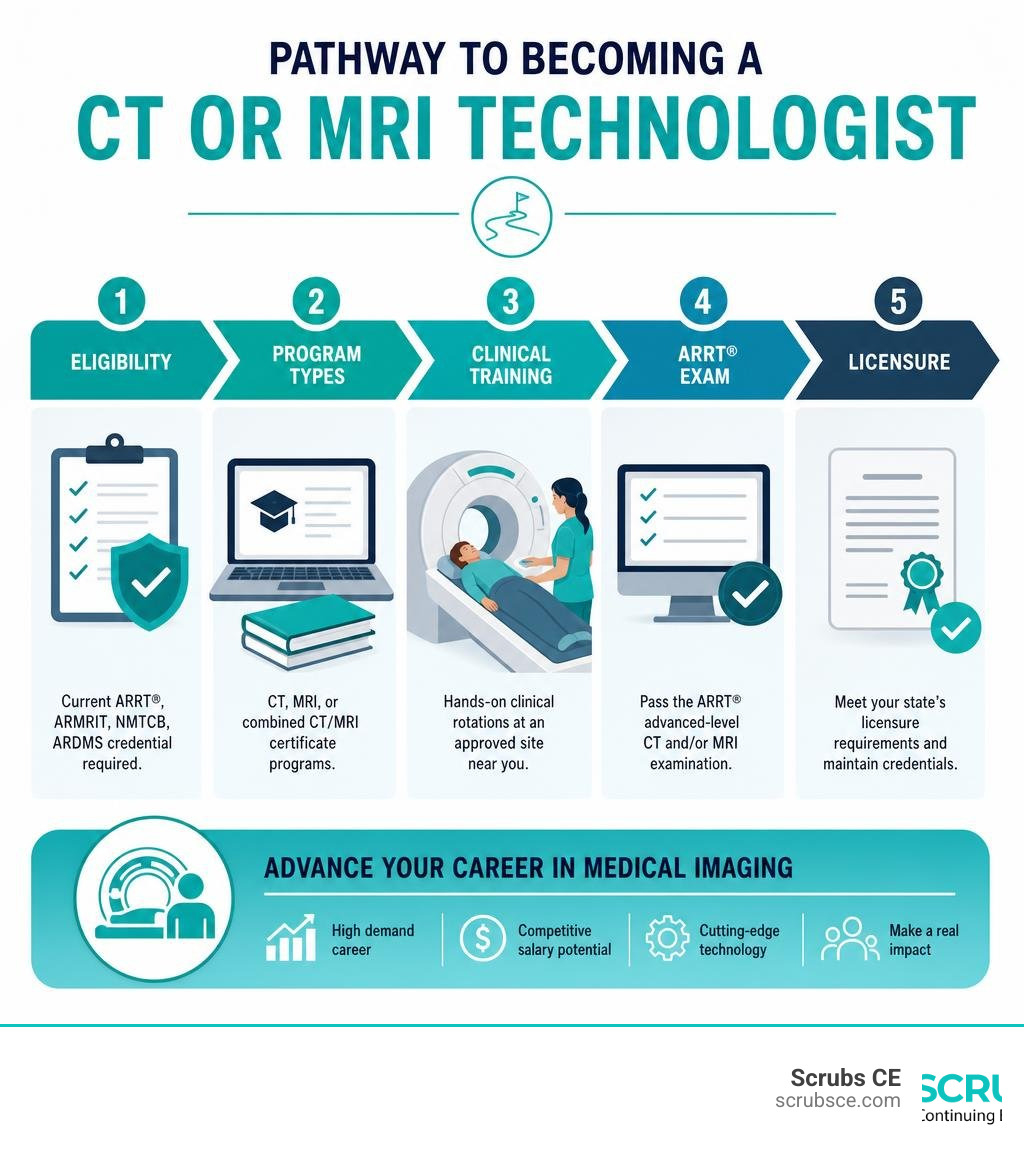
Ct and mri certificate programs near me terms at a glance:
Understanding CT and MRI Certificate Programs Near Me

When you begin searching for ct and mri certificate programs near me, the first thing you’ll notice is that these programs are designed specifically for working professionals. They aren’t entry-level college degrees that teach you how to be a healthcare worker from scratch. Instead, they are targeted, pathways meant to take your existing knowledge of anatomy, patient care, and physics and apply it to advanced cross-sectional imaging.
These certificate programs come in three main flavors:
- CT-Only Certificates: Focus entirely on Computed Tomography physics, instrumentation, radiation safety, dose reduction, and clinical protocols.
- MRI-Only Certificates: Focus on Magnetic Resonance Imaging physics, magnet safety (very different from radiation safety!), pulse sequences, and coil selection.
- Combined CT/MRI Certificates: Dual-modality programs that cover both specialties back-to-back or concurrently.
Choosing the right format depends entirely on your personal career goals and how much time you can commit to clinical training.
Choosing Combined vs. Single-Modality CT and MRI Certificate Programs Near Me
Is it better to study one modality or tackle both at the same time? Let’s break it down.
If you choose a single-modality certificate, you can often finish in as little as 6 months. This is perfect if your current employer has an immediate opening in MRI or CT and you need to get certified quickly to fill that slot.
However, dual-modality programs offer unparalleled career flexibility. Outpatient imaging centers love hiring “hybrid” technologists who can jump from the CT control room to the MRI suite depending on the daily schedule. If you want to maximize your marketability, a combined program is incredibly efficient.
For example, the Concurrent Certificates in Computed Tomography (CT) and Magnetic Resonance Imaging (MRI) program at California State University, Northridge (CSUN) allows students to complete both certificates in just one year. This is a massive time-saver compared to taking them as separate programs over 18 to 24 months.
If you are trying to decide which direction to take, we recommend checking out our guides on MRI Training 101 Learn MRI Basics and Category Computed Tomography Certification to see which technology aligns best with your interests.
Program Formats, Duration, and Cost Expectations
Most modern CT and MRI certificate programs utilize a hybrid format. This means your didactic lectures, physics homework, and anatomy quizzes are delivered 100% online, allowing you to study late at night or during your lunch breaks. However, you cannot learn how to position a patient or run a multi-million dollar scanner from a laptop. The clinical rotation portion of the program must be completed in-person at an approved hospital or imaging clinic.
Here is what you can typically expect in terms of timeline and cost:
- Single-Modality (CT or MRI): Typically lasts 1 to 2 semesters (6 to 9 months). Tuition ranges from $4,000 to $10,000. For example, Nashville – Certificate in Magnetic Resonance Imaging – South College offers an intensive, 6-month full-time hybrid program.
- Combined Dual-Modality: Typically lasts 12 months (4 quarters). Tuition and fees often range from $11,000 to $17,000. The combined certificate at Computed Tomography (CT) & Magnetic Resonance Imaging (MRI), Cert | Loma Linda University is a great example of a structured, 12-month program.
If you don’t want to enroll in a formal, expensive university program just to get your classroom hours, you can also fulfill your ARRT® structured education requirements using self-paced Online MRI Courses or targeted CT MRI CE packages.
Admission Requirements and Clinical Training Compliance
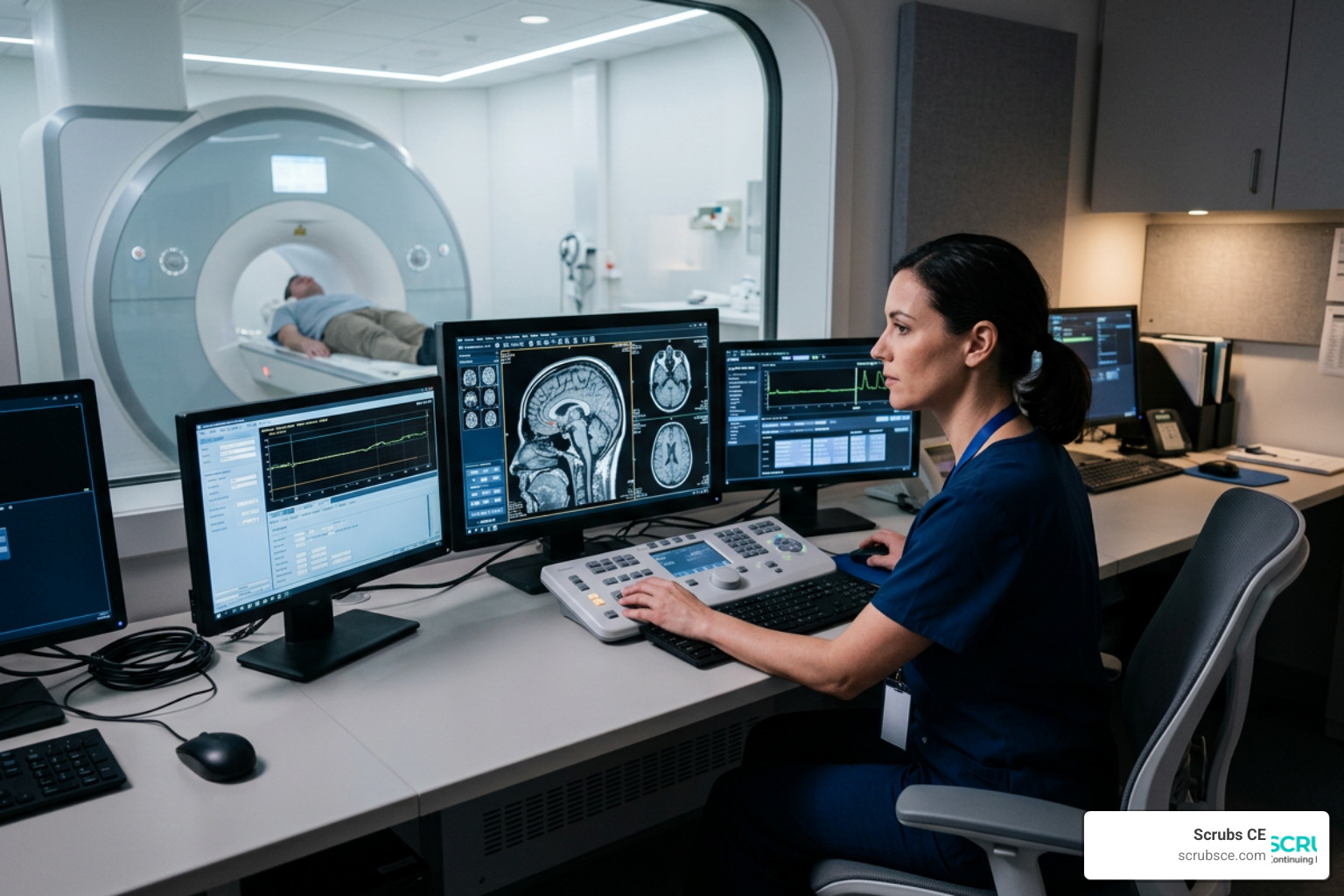
Before you hit “apply” on any of the ct and mri certificate programs near me, you need to make sure you meet the basic gatekeeper requirements. Because these are advanced certificates, schools are highly selective about who they let in.
Prerequisites and Academic Requirements for CT and MRI Certificate Programs Near Me
To get accepted into an advanced imaging certificate program, you must almost always show proof of a primary credential. The AMERICAN REGISTRY OF RADIOLOGIC TECHNOLOGISTS® (ARRT®) requires you to hold a primary-tier certification before you can pursue post-primary certification in CT.
Eligible primary credentials usually include:
- Radiography (R.T.(R))
- Nuclear Medicine Technology (R.T.(N) or NMTCB)
- Radiation Therapy (R.T.(T))
- Diagnostic Medical Sonography (R.T.(S) or ARDMS)
In addition to your primary certification, most programs require:
- An Associate Degree or higher from an accredited institution.
- A minimum cumulative GPA of 2.50 in your prior radiography coursework.
- Prerequisite courses, such as College Algebra, completed within the past 5 years with a grade of “C” or higher.
- A current CPR certification from the American Heart Association (Basic Life Support for Healthcare Providers).
For a deeper dive into these initial steps, check out our Beginners Guide to Computed Tomography Technician Certification and our breakdown of CT Technologist Requirements.
Clinical Training, Placements, and Background Compliance
The academic work is only half the battle. To graduate and earn your eligibility to sit for the national board exams, you must complete a set number of hands-on clinical hours.
The clinical time commitment is significant:
- CT Programs: Usually require around 355 hours of clinical education.
- MRI Programs: Often require between 355 and 495 hours. For instance, the Magnetic Resonance Imaging (MRI) Program | Greenville Technical College requires 495 clinical contact hours, which equates to about 15 to 18 hours per week over two semesters.
One of the biggest hurdles for online students is securing a clinical site. Some colleges have a built-in network of local hospital affiliates and will place you automatically. Other programs require you to find your own clinical site and establish an affiliation agreement before they will officially admit you.
Before you can step foot in a clinical department, you must also pass rigorous compliance checks. Hospitals have strict safety protocols, meaning you will need to submit:
- A criminal background check and a 10-panel drug screening.
- Proof of immunizations (Tetanus, Measles/Mumps/Rubella, Varicella, Hepatitis B, and annual flu shots).
- A negative Tuberculosis (TB) test.
- Some facilities may also require a physical examination form signed by your physician.
Certification Pathways and State Licensing Requirements
Once you complete your certificate program, the ultimate goal is to obtain your national credentials and state license so you can actually practice.
Earning Credentials Through the AMERICAN REGISTRY OF RADIOLOGIC TECHNOLOGISTS® (ARRT®)
To earn your letters as a Registered Technologist in CT or MRI, you must navigate the post-primary pathway established by the AMERICAN REGISTRY OF RADIOLOGIC TECHNOLOGISTS® (ARRT®).
This process requires two main components:
- Structured Education: You must complete at least 16 hours of structured education that covers the specific content outline of the ARRT® exam.
- Clinical Experience: You must perform and document a long list of clinical competencies (scans, safety procedures, and quality control checks) signed off by a certified supervisor.
If you are looking for a highly efficient way to knock out these structured education hours without spending thousands on tuition, we offer a Computed Tomography CE Complete Guide and a curated list of the Best CE for CT Technologists to help you satisfy the requirements.
State Licensing Boards and Regional Recognition
Having your national ARRT® credential is great, but your state’s medical board has the final say on whether you can work.
State laws vary wildly:
- Texas: The Texas Medical Board (TMB) requires all CT and MRI technologists to register. This process requires a formal application, a $135 fee, and a fingerprint-based criminal background check. Texas accepts both ARRT® and ARMRIT (American Registry of Magnetic Resonance Imaging Technologists) certifications.
- Ohio and Other States: Some states do not have separate state licensing for MRI because it does not use ionizing radiation, but they strictly regulate CT. Always check the professional licensure disclosures of your chosen program, such as the Magnetic Resonance Imaging Certificate | Kent State – Online Degrees & Programs | Kent State University disclosure page, to make sure the curriculum aligns with your local state board rules.
Here is a quick comparison of the two main national credentialing bodies for MRI:
| Feature | ARRT® (Post-Primary Pathway) | ARMRIT (Direct Entry) |
|---|---|---|
| Prior Credential Required? | Yes (Radiography, Sonography, etc.) | No (Can enter directly from high school/college) |
| Exam Focus | Comprehensive (Physics, Safety, Anatomy, Procedures) | MRI-Specific Physics and Clinical Practice |
| Clinical Hours Required | Varies by competency completion | Minimum 1,000 hours of clinical training |
| State Recognition | Universally accepted across all states | Accepted in many states (including Texas), but check local rules |
Career Outcomes, Salaries, and Job Market Outlook
If you are wondering if the time, effort, and money required for these programs are worth it, the short answer is a resounding yes. The demand for advanced imaging professionals has never been higher.
Salary Ranges and Regional Demand
According to the May 2024 Bureau of Labor Statistics data, the national median annual wage for MRI technologists is $88,180. If you decide to take travel assignments, that number can climb significantly, with travel MRI positions routinely paying between $2,000 and $3,500 per week.
Regional demand is heavily driven by population shifts. For example, Texas gained over 470,000 residents in 2024 alone. This rapid population growth, combined with an aging Baby Boomer demographic, has created an urgent need for diagnostic imaging.
Here is what average annual salaries look like across major Texas metro areas:
- Dallas-Fort Worth: $75,000 – $90,000
- Houston: $72,000 – $88,000
- Austin: $70,000 – $85,000
- San Antonio: $68,000 – $82,000
Because Texas has no state income tax, your actual take-home pay in these cities is often higher than what you would keep from a slightly larger salary in high-tax states like California or New York. For more tips on maximizing your earning potential, read The Ultimate Guide to Becoming an MRI Tech and Attracting Success and our article on MRI Tech in 2025 Bigger Bores and Better Brains.
Comparing Certificate Programs to Associate Degrees
If you don’t already have an associate degree in radiologic technology, you might wonder if you should go back to school for a full 2-year degree or try to find a direct-entry certificate program.
For those who already hold an ARRT® credential in Radiography, a certificate program is almost always the better choice. It is faster (6 to 12 months vs. 2 years), significantly cheaper, and focuses purely on the clinical skills you need for your new modality.
However, if you are a career changer with no medical background, a direct-entry Associate Degree in Radiologic Technology or an ARMRIT-accredited MRI certificate is your only path forward. To understand what a typical day looks like on the job, check out our What Does an MRI Tech Do Guide and read up on the Category MRI Training Requirements.
Frequently Asked Questions about CT and MRI Certificate Programs
How long does it take to complete a CT or MRI certificate program?
A single-modality certificate (just CT or just MRI) typically takes 6 to 9 months of full-time study. Combined dual-modality programs generally take 12 to 18 months because you have to split your clinical hours between both scanner types.
Can I complete a CT or MRI certificate program entirely online?
You can complete 100% of the classroom lectures, physics modules, and academic exams online. However, you must complete your clinical training hours in-person at a hospital or imaging center. There is no such thing as a fully online clinical rotation!
Do I need prior Radiology experience to enroll in an MRI certificate program?
For ARRT® post-primary programs, yes—you must already hold a primary credential in a supporting discipline like Radiography or Sonography. However, if you attend an ARMRIT-approved program, you can enter directly without prior X-ray or imaging experience, though you will need to complete a much longer clinical rotation (usually 1,000+ hours).
Conclusion
Finding the right ct and mri certificate programs near me is the ultimate launchpad to a high-paying, stable, and intellectually stimulating career in medical imaging. By upgrading your skills, you make yourself an indispensable asset to hospital trauma units, busy outpatient clinics, and rapid-response mobile imaging teams.
Once you are enrolled or working in the field, we are here to support your professional development. At Scrubs CE, we offer convenient, highly affordable, and fully online continuing education courses designed to help you easily meet your biennial ARRT® requirements and state licensing mandates.
Ready to take your career to the next level? Explore our self-paced courses today:
- Explore MRI CE Courses
- CE for MRI Technologists