
From Service to Scanner: What Every Veteran Should Know About the CT Tech Veteran Transition
If you’re exploring a CT tech veteran transition, here’s the short answer on how it works:
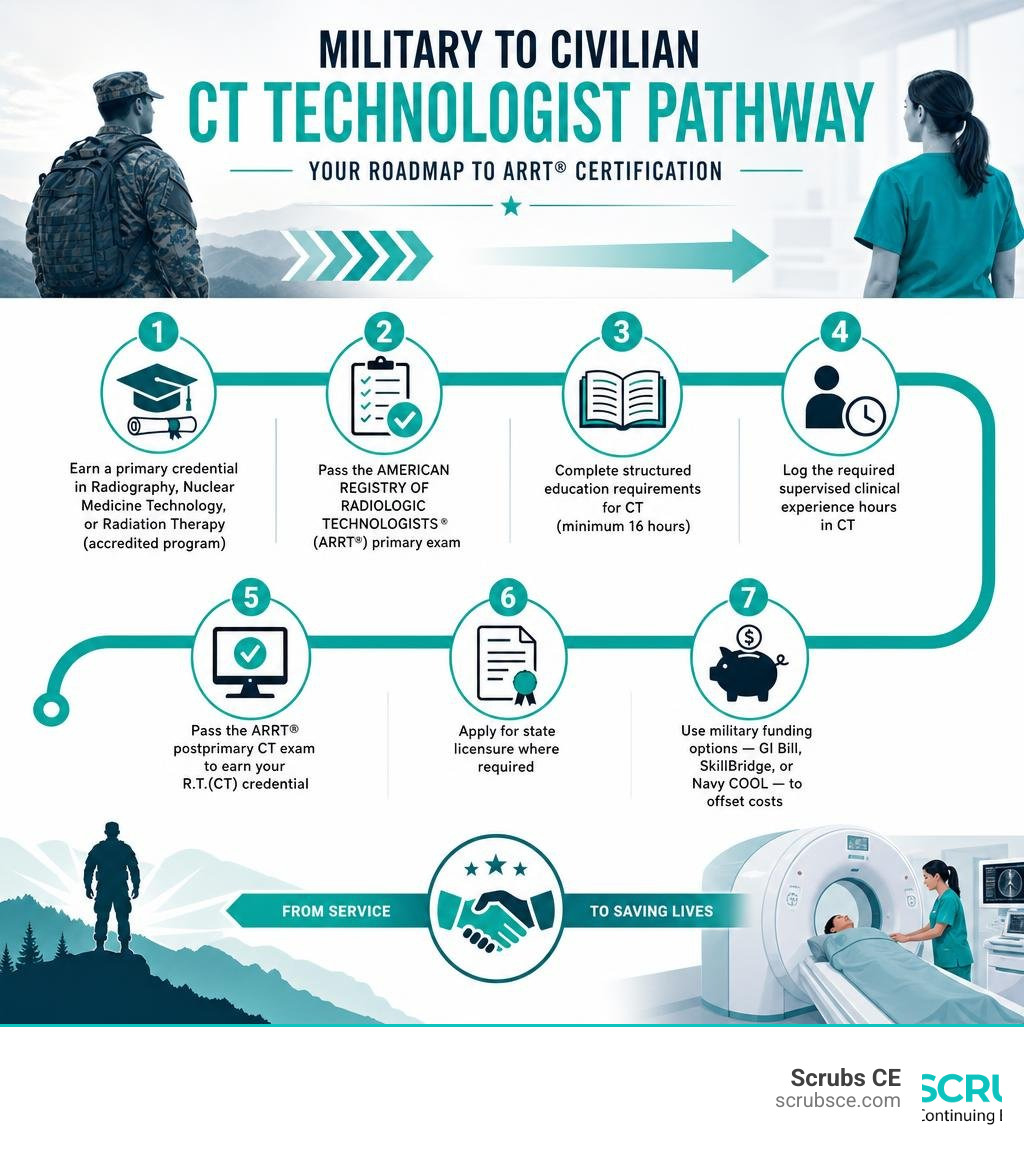
How Veterans Become CT Technologists:
- Earn a primary credential in Radiography, Nuclear Medicine Technology, or Radiation Therapy (via an accredited program)
- Pass the AMERICAN REGISTRY OF RADIOLOGIC TECHNOLOGISTS® (ARRT®) primary exam
- Complete structured education requirements for CT (minimum 16 hours)
- Log the required supervised clinical experience hours in CT
- Pass the ARRT® postprimary CT exam to earn your R.T.(CT) credential
- Apply for state licensure where required
- Use military funding options — GI Bill, SkillBridge, or Navy COOL — to offset costs
Military service builds exactly the kind of person hospitals want running a CT scanner. You already know how to follow strict protocols without cutting corners. You’ve operated complex equipment under pressure. You’ve stayed calm when the stakes were high.
Those aren’t soft skills. In computed tomography, they’re job requirements.
CT volumes sit at the center of emergency, trauma, and oncology workflows. Facilities need technologists who can perform precise, high-stakes imaging day in and day out — and veterans are built for that environment.
The transition does require a structured certification path through the ARRT®. It takes planning. But with the right roadmap, it’s very achievable — often within two to three years of starting your primary credential program.
I’m Zita Ewert, leader of SCRUBS Continuing Education® and a longtime advocate for imaging professionals navigating the CT tech veteran transition through accessible, accredited CE courses. In this guide, I’ll walk you through every step — from military skills that transfer directly, to ARRT® pathways, funding options, salary expectations, and how to land your first CT role.
Ct tech veteran transition terms at a glance:
Why Veterans Excel in Computed Tomography Roles
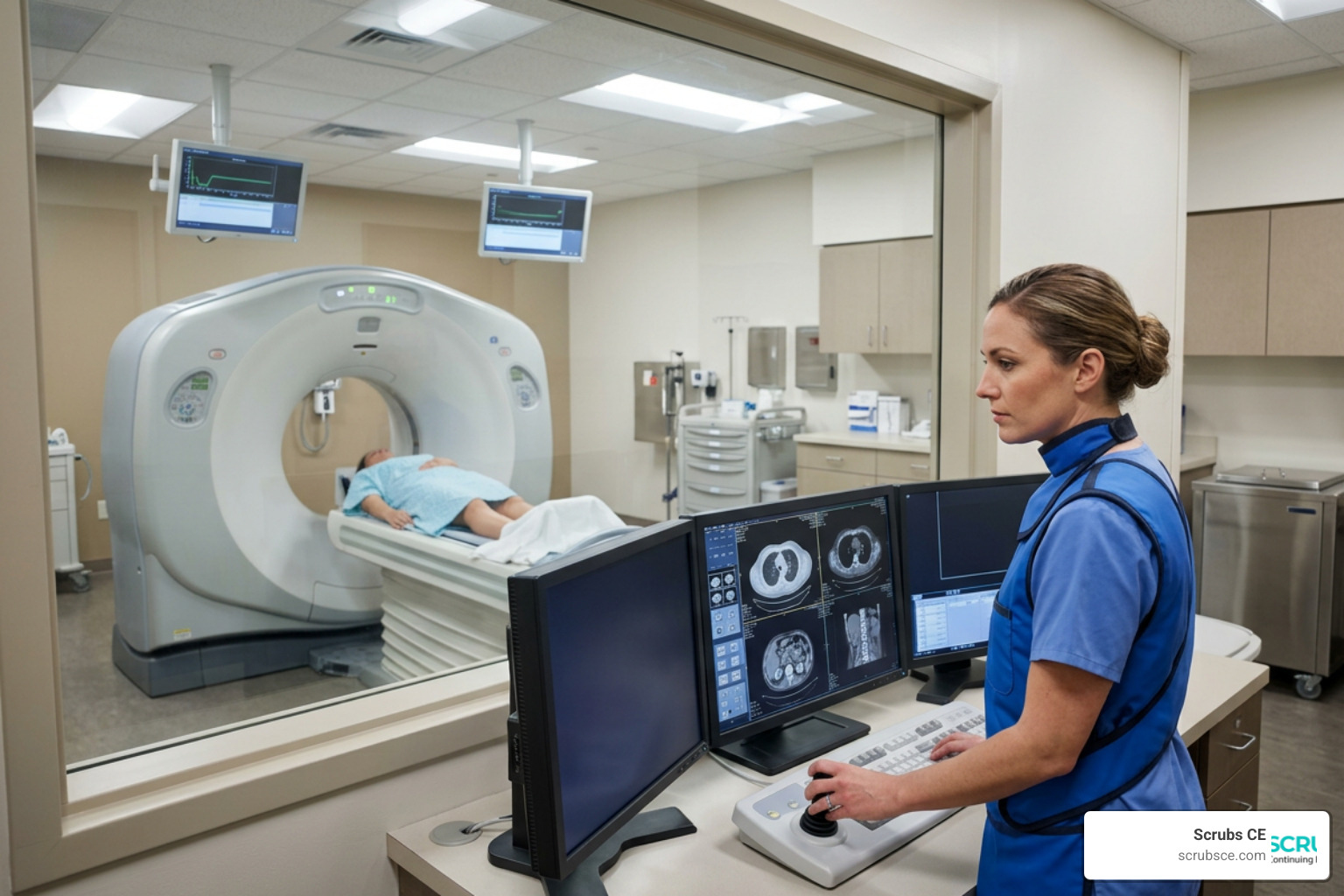
Transitioning from military life to a civilian career can feel like trying to decipher a foreign language. However, the field of diagnostic imaging—specifically Computed Tomography (CT)—shares a striking amount of DNA with military operations. Veterans excel as CT technologists because their military background has already trained them in the core competencies required on the hospital floor: technical expertise, strict protocol adherence, performance under high pressure, and seamless teamwork.
Military Discipline and Protocol Adherence
In the military, standard operating procedures (SOPs) are not friendly suggestions; they are the baseline for safety and mission success. The exact same rule applies in a CT suite.
When you are operating a multi-slice CT scanner, you are managing ionizing radiation and high-pressure intravenous contrast injectors. There is no room for “freestyling.” A successful ct tech veteran transition relies heavily on this ingrained respect for protocols.
Whether it is running daily quality control (QC) calibration checks on the scanner, maintaining High-Level Disinfection (HLD) procedures for sterile imaging environments, or adhering to ALARA (As Low As Reasonably Achievable) radiation safety principles, veterans naturally respect the rules. This discipline ensures patient safety and maintains the high-level diagnostic quality that radiologists depend on.
Technical Aptitude and High-Pressure Performance
Modern CT scanners are highly complex, computerized machines that require a strong technical aptitude to operate. Military veterans—whether they served in aviation electronics, communications, or mechanical roles—are already comfortable troubleshooting sophisticated technical systems.
Furthermore, CT is the diagnostic workhorse of the emergency department. When a trauma patient arrives after a severe accident, the CT technologist must act with speed, precision, and absolute calm.
Veterans are uniquely equipped to handle this level of adrenaline. Having trained to perform under pressure, a veteran technologist can manage a chaotic trauma bay, coordinate with emergency physicians, and execute rapid scan protocols without letting panic compromise image quality. This ability to think critically while the clock is ticking makes veterans incredibly valuable assets in high-volume, 24/7 hospital imaging departments.
Comparing CT to Other Imaging Modalities for Veterans
When planning your post-military career, it helps to see how different imaging specialties stack up. While general radiography (X-ray) is the typical starting point, many veterans quickly look to specialize in advanced modalities like CT, MRI, or mammography.
Here is a comparative look at how these modalities compare as of July 2026:
| Modality | Average Training Length | Job Demand / Outlook | Work-Life Balance | Key Characteristics |
|---|---|---|---|---|
| General Radiography (X-Ray) | 18–24 Months (Primary) | High / Stable | Moderate (Shift work common) | The foundational modality; highly physical with high patient volume. |
| Computed Tomography (CT) | 3–6 Months (Post-Primary) | Exceptionally High | Varied (24/7 ER coverage needed) | Fast-paced, trauma-heavy, highly technical, and critical to hospital workflows. |
| Magnetic Resonance Imaging (MRI) | 12–18 Months (Primary or Post-Primary) | High (5% growth projected) | Great (Many outpatient settings) | Slow-paced, highly analytical, complex physics, strict magnetic safety. |
| Mammography | 1–3 Months (Post-Primary) | High / Specialized | Excellent (Primarily daytime hours) | Highly regulated under MQSA; focused on patient interaction and screening. |
CT vs. MRI and Mammography
For veterans, choosing between CT and MRI often comes down to personal pacing preferences. MRI technologists earn a solid living—with a national median salary of $88,180 per year (BLS, May 2024)—but the training takes longer (often 12–18 months) and the environment is slower, with individual scans taking 30 to 45 minutes.
CT, on the other hand, is fast. Scans are completed in minutes, meaning you will see a much higher volume of patients. This makes CT an exciting environment for veterans who prefer a dynamic, fast-moving shift.
Additionally, CT is often the most accessible post-primary pathway for registered radiographers. Because CT scanners are embedded in almost every hospital emergency department, finding opportunities to cross-train on the job is highly common.
If you are looking to maintain multiple credentials to maximize your marketability, exploring CT MRI CE courses can help you bridge the gap between both modalities, keeping your skills sharp across the board.
The Strategic CT Tech Veteran Transition Roadmap

Successfully navigating a ct tech veteran transition requires a clear, step-by-step strategy. You cannot simply walk into a civilian hospital and start scanning patients based on your military background alone. You need to follow a structured educational and clinical pathway to earn your credentials.
Navigating the CT Tech Veteran Transition via ARRT® Pathways
To work as a civilian CT technologist, you must earn certification and registration through the AMERICAN REGISTRY OF RADIOLOGIC TECHNOLOGISTS® (ARRT®). The most common route is the postprimary eligibility pathway.
Here is how the process works step-by-step:
- Earn a Supporting Primary Credential: You must first be certified and registered with the ARRT® in a primary discipline, such as Radiography, Nuclear Medicine Technology, or Radiation Therapy. (Nuclear Medicine credentials may also be held through the NMTCB).
- Complete Structured Education: The ARRT® requires a minimum of 16 hours of structured education that directly maps to the CT registry exam content specifications. This coursework must cover patient care, safety, image production, and anatomy.
- Document Clinical Experience: You must perform and document a specific list of clinical competencies under the direct supervision of a credentialed technologist. This includes performing a variety of CT scans (head, spine, chest, abdomen, etc.) and quality control procedures.
- Apply and Pass the Exam: Once your education and clinical hours are logged and verified, you will apply to take the ARRT® Computed Tomography registry exam. Passing this exam grants you the R.T.(CT) credential.
For a deeper dive into this certification process, check out our Beginners Guide to Computed Tomography Technician Certification. Additionally, keeping an eye on CT Technologist Requirements will ensure you are meeting all state-specific licensing rules, which can vary across the country.
Utilizing Military Funding and Transition Programs
The civilian transition can be expensive, but as a veteran, you have powerful funding tools at your disposal:
- DoD SkillBridge: This program allows transitioning service members to participate in civilian job training, apprenticeships, or internships during their last 180 days of service. You can use SkillBridge to gain valuable clinical experience in a civilian Radiology department while still receiving your military pay and benefits.
- The GI Bill: You can use your Post-9/11 GI Bill benefits to pay for tuition and fees at accredited radiologic technology schools, as well as licensing exam fees.
- Navy COOL and Army IgnitED: These credentialing programs can fund the cost of classroom training, study materials, and exam vouchers while you are still on active duty.
- State Veteran Resources: Organizations like the Georgia Veterans Education Career Transition Resource (VECTR) Center assist veterans by evaluating prior military transcripts for college credit, helping you fast-track your journey through civilian technical colleges.
Salary, Job Market, and VA Career Opportunities
One of the most reassuring aspects of the ct tech veteran transition is the strength of the job market. Diagnostic imaging departments nationwide are facing persistent staffing shortages, meaning qualified CT technologists are in high demand.
The starting salary for newly certified technologists typically ranges from $55,000 to $70,000, depending on the region. However, experienced technologists—especially those working in high-cost-of-living states like California—can earn upwards of $114,000 annually. For those willing to take on temporary travel assignments, travel CT technologists can command impressive weekly rates ranging from $2,500 to $4,000.
Advancing Within the VA Healthcare System
For many veterans, the transition to civilian life does not mean leaving the military community behind entirely. The Veterans Health Administration (VHA) is the largest integrated healthcare system in the United States, and it actively recruits veteran technologists.
Working within the VA offers excellent federal benefits, competitive salaries, and a profound sense of purpose as you continue to serve your fellow brothers and sisters in arms. Career progression within the VA is highly structured, offering clear pathways to supervisory and leadership roles.
Consider the career of Chris L. , who climbed the ranks to become the Chief Technologist of the Radiology Department at the James A. Haley VA Medical Center. Throughout his career, he leveraged advanced imaging protocols—such as implementing dual-energy CT protocols to eliminate non-diagnostic pulmonary embolism studies and introducing helical brain imaging to reduce patient radiation dose—to dramatically improve care for veterans.
His journey shows that a transition into CT is not just a job; it is a platform where you can lead, innovate, and make a lasting impact on veteran healthcare.
Overcoming Transition Challenges and Translating Military Experience
While the opportunities are vast, transitioning from the military to civilian healthcare does come with hurdles. Understanding these challenges ahead of time allows you to build a strategy to overcome them.
Translating Military Jargon for Civilian Healthcare Employers
One of the biggest obstacles veterans face is explaining their military achievements in a way that civilian hiring managers understand. A civilian hospital recruiter likely does not know what a “68W,” “4N0X1,” or “Navy Hospital Corpsman” actually does on a daily basis.
To write an effective resume, you must translate military jargon into civilian healthcare terms. Focus on quantifying your achievements using the STAR (Situation, Task, Action, Result) method.
For example, instead of writing: “Served as NCOIC of a mobile medical unit,” translate it to: “Managed daily operations and quality control for a mobile diagnostic team, supervising 8 personnel and ensuring 100% compliance with strict safety protocols.”
If you are transitioning from a technical, non-medical military role, highlight your adaptability and systems management. Much like a Navy communications specialist transitions to civilian network engineering—a journey highlighted in the story of Leaving a Navy tech role for a life on the road with Smart CT was a shore thing —your experience operating complex, high-stakes military hardware translates directly to managing a multi-million dollar CT scanner.
Overcoming Cultural and Financial Hurdles in Your CT Tech Veteran Transition
Adapting to civilian healthcare culture can also be a shock. The direct, hierarchical communication style of the military must often be softened in a civilian hospital setting, where collaborative, patient-centered communication is the standard.
Additionally, the cost of continuing education and registry preparation can add up. That is where we can help.
At SCRUBS CE®, we specialize in providing affordable, self-paced continuing education courses that help you meet your professional development requirements without breaking the bank. For example, our Product Computed Tomography for Radiologic Technologists course is an excellent resource for building a rock-solid foundation in CT physics, cross-sectional anatomy, and clinical protocols.
To keep your career moving forward, you can also explore our Computed Tomography CE Complete Guide or browse our list of the Best CE for CT Technologists to find the perfect fit for your schedule and budget.
Frequently Asked Questions about CT Tech Veteran Transitions
Can I use my military medical experience to bypass ARRT® certification?
Generally, no. While some military medical training programs have agreements that allow you to sit for the ARRT® primary radiography exam, you cannot bypass the certification process entirely. Civilian hospitals and state licensing boards almost universally require active ARRT® certification and registration. You must complete the structured education and clinical competency requirements to earn your civilian credentials.
How long does the transition to a CT technologist role take?
If you already hold a primary credential in radiography, completing your CT structured education and logging your clinical competencies can take anywhere from 3 to 6 months. If you are starting from scratch without a prior medical background, you will first need to complete an accredited 2-year associate degree program in radiologic technology before specializing in CT.
Are there CT technologist jobs that require a security clearance?
Yes. While less common than in cybersecurity or defense contracting, there are specialized healthcare roles within military treatment facilities (MTFs), federal intelligence agencies, and mobile defense support units that require an active security clearance. Maintaining your clearance during your transition can give you a major competitive advantage for these high-paying federal positions.
Conclusion
The journey from military service to a civilian healthcare career is a path paved with opportunity. By embarking on a ct tech veteran transition, you are choosing a profession that rewards your discipline, utilizes your technical aptitude, and allows you to continue serving your community in a deeply meaningful way.
As you take these next steps, education is a lifelong journey. Once you earn your credentials, you will need to complete 24 continuing education credits every two years to maintain your ARRT® registration.
At SCRUBS CE®, we are proud to support our nation’s veterans by offering convenient, self-paced online courses with instant certificate delivery. When you are ready to expand your knowledge or fulfill your CE requirements, we invite you to explore our Category Computed Tomography Certification courses.
Thank you for your service, and we look forward to helping you build a thriving civilian career in Computed Tomography!