

Core Requirements and Guidelines on How to Renew CNA License Credentials
To renew your CNA license, start by checking your state nurse aide registry expiration date, then complete your required continuing education or in-service hours, obtain employer verification of paid nursing-related work, and submit your renewal application through your state registry portal.
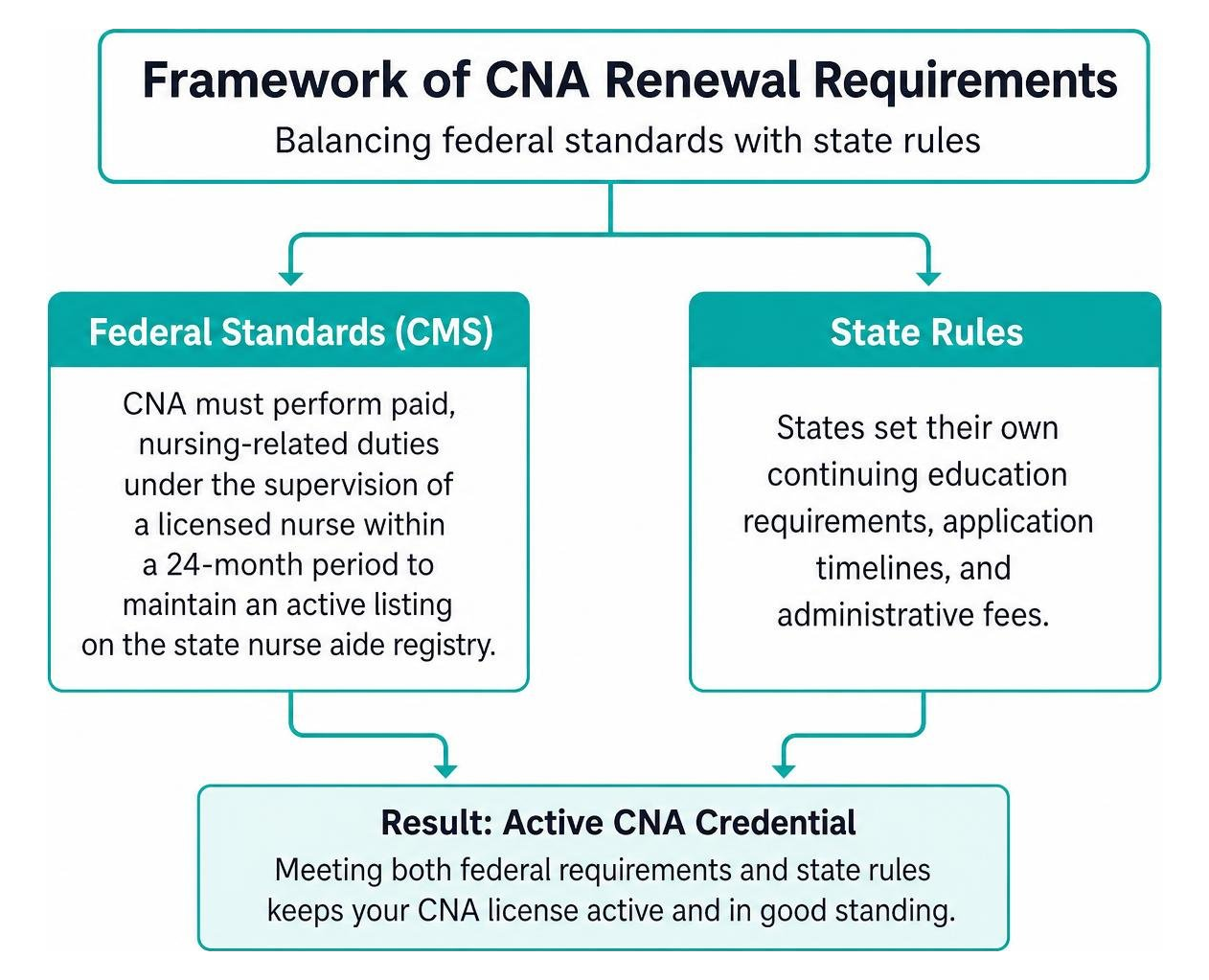
Maintaining your certified nursing assistant credential requires balancing federal baselines with specific state regulations. The Centers for Medicare & Medicaid Services (CMS) establishes the federal foundation: every CNA working in Medicare- or Medicaid-certified facilities must perform paid, nursing-related duties under the supervision of a licensed nurse within a 24-month period to maintain an active listing on the state nurse aide registry.
Beyond this federal floor, individual states establish their own continuing education requirements, application timelines, and administrative fees. While some jurisdictions keep requirements minimal, others mandate comprehensive classroom or online education hours during each renewal cycle. Navigating these rules becomes much easier when you consult our comprehensive CE hour requirements to ensure your educational hours align with state expectations.
Paid Work Hours and CEU Verification
The most critical element of the renewal process is meeting the paid work-hour threshold. Volunteer work, unpaid clinical practice during original training, or personal care provided to family members without formal employment documentation do not satisfy state registry requirements.
In most states, nurse aides must complete between 8 and 16 hours of paid nursing-related tasks every 24 months. Certain states set significantly higher expectations—some requiring 64 hours or even 160 hours within the renewal cycle. To document these hours, you will need:
- Signed employment verification forms from your Director of Nursing (DON) or Human Resources department
- Recent pay stubs showing paid hours worked as a nurse aide
- Official facility letters on corporate letterhead detailing job duties and dates of employment
Alongside employment hours, continuing education units (CEUs) or in-service training must be completed through state-approved providers. Continuing education topics generally focus on infection control, resident rights, medical record documentation, bloodborne pathogens, CPR maintenance, and communication with cognitively impaired patients.
License vs Certification Renewal Distinctions
Healthcare professionals often use the terms “CNA license” and “CNA certification” interchangeably, but there is a distinct administrative difference depending on your state’s regulatory body.
Regardless of whether your state terms your credential a registration, certificate, or license, failing to submit the required documentation results in your status shifting from “Active” to “Expired” or “Delinquent,” which legally prevents you from working as a nurse aide.
Step-by-Step Process for CNA Renewal
Renewing your credential does not have to be stressful if you follow an organized timeline. Starting the process 60 to 90 days before your expiration date ensures sufficient time to obtain employer signatures, finalize your coursework, and resolve any portal issues.
Review our simple nurse aide certificate renewal guide for additional workflow strategies to keep your credential current.
Step-by-Step Instructions on How to Renew CNA License Records
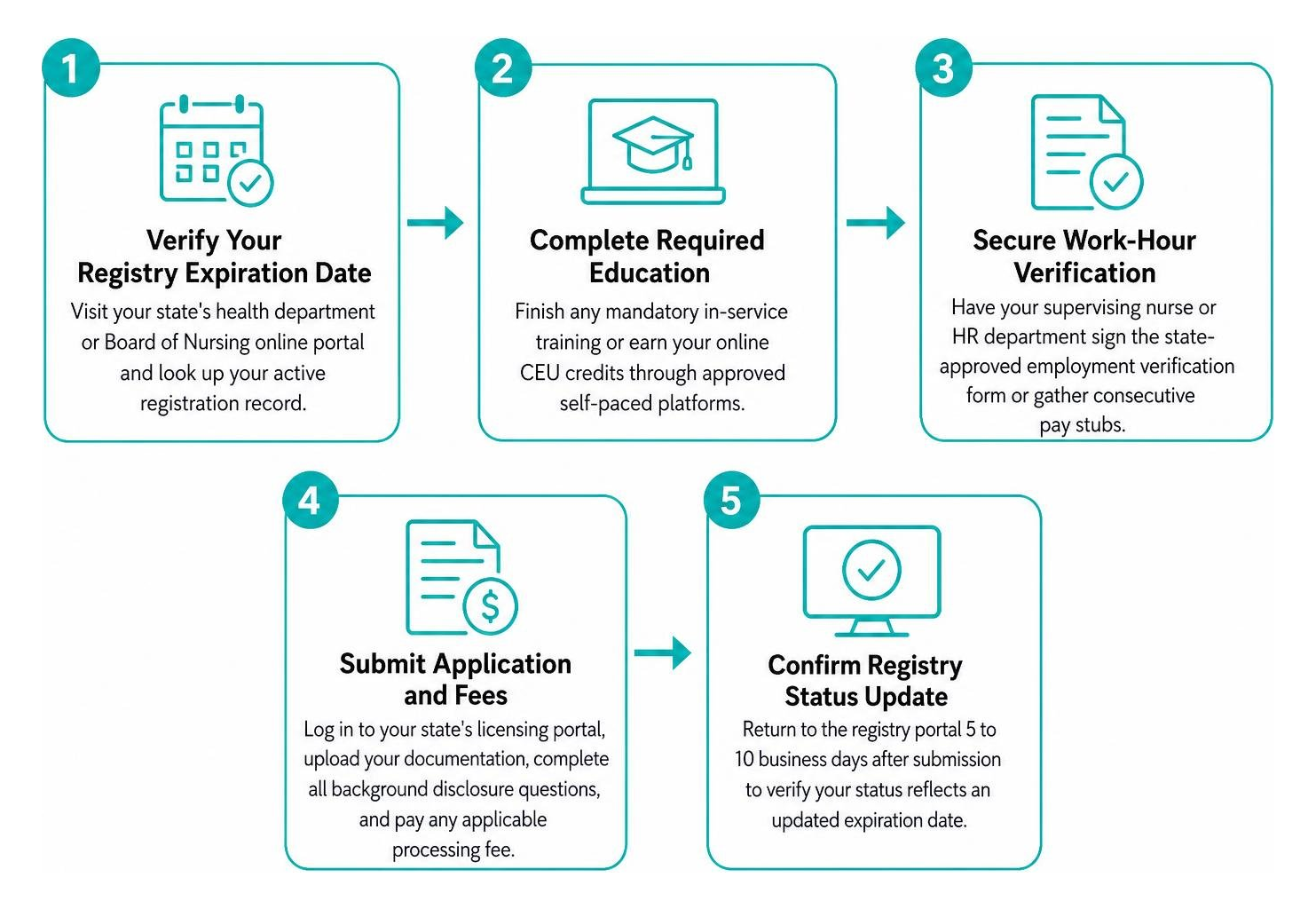
To submit your renewal without delays, follow this structured five-step workflow:
- Verify Your Registry Expiration Date: Visit your state’s health department or Board of Nursing online portal and look up your active registration record.
- Complete Required Education: Finish any mandatory in-service training or earn your online CEU credits through approved self-paced platforms.
- Secure Work-Hour Verification: Have your supervising nurse or HR department sign the state-approved employment verification form or gather consecutive pay stubs.
- Submit Application and Fees: Log in to your state’s licensing portal, upload your documentation, complete all background disclosure questions, and pay any applicable processing fee.
- Confirm Registry Status Update: Return to the registry portal 5 to 10 business days after submission to verify your status reflects an updated expiration date.
Updating Name, Address, and Contact Details
One of the primary reasons healthcare workers miss renewal deadlines is an outdated mailing or email address in the state database. State licensing boards send courtesy renewal notices 60 to 90 days before expiration, but they will only reach you if your record is accurate.
If you have moved or changed your legal name due to marriage or court order:
- Submit an official registry amendment form through the online licensing portal.
- Upload certified supporting documentation, such as a marriage certificate, divorce decree, or updated government-issued photo ID.
- Notify the registry within 30 days of any change in residence to avoid missing crucial statutory notifications.
State-Specific Requirements and Renewal Fees
State boards establish their own renewal fee structures, training hour thresholds, and work requirements. While some registries charge nothing for on-time renewals, others assess administrative fees that increase if you file late.
| State / Jurisdiction | Renewal Cycle | Required Paid Work Hours | Continuing Education (CEUs) | Standard Renewal Fee |
|---|---|---|---|---|
| Florida | 2 Years (Biennial) | Must provide nursing-related services for pay | 24 hours in-service training | $55.00 |
| Massachusetts | 2 Years | Minimum 8 hours of paid nursing duties | Determined by facility in-service | $0.00 (No state fee) |
| Delaware | 2 Years | 64 hours of nursing care | 24 hours approved CE | $25.00 |
| Alaska | 2 Years (Even years) | 160 hours paid nurse aide work | 24 hours approved CE | Varies by cycle |
| Texas | 2 Years | Minimum 8 hours under licensed nurse | 24–48 hours depending on setting | $0.00 |
State Guidelines: How to Renew CNA License in Florida and Massachusetts
Florida CNA Renewal Protocol
Florida CNAs renew their licenses through the Florida Board of Nursing on a biennial cycle divided into two groups: Group 1 licenses expire midnight EST on May 31, 2027, and Group 2 licenses expire May 31, 2028.
Florida requires 24 hours of approved in-service training covering specific topics, including Medical Error Prevention, Domestic Violence, CPR Skills, and Infection Control. Additionally, under Florida statutes, CNAs must complete mandatory electronic fingerprinting via an FDLE-approved Livescan service provider using the correct Originating Agency Identification (ORI) number.
Renewals are processed online via the MQA Services portal. Renewal fees are tiered based on timing:
- On-time renewal: $55.00 (plus statutory unlicensed activity fee)
- Post-expiration renewal: $105.00
- Delinquent renewal (120-day notice period): $160.00
Employers can also cover these costs through the state’s “Other Payer Code” system. Complete details can be reviewed via the Certified Nursing Assistant (CNA) Renewal – Florida Board of Nursing portal.
Massachusetts CNA Renewal Protocol
In Massachusetts, certified nurse aides maintain their credentials through the Nurse Aide Registry. To be eligible for renewal, you must have worked for pay performing nursing-related duties for at least 8 hours within the previous 24 months.
Massachusetts CNAs must use the modern online portal to submit their paperwork. The transition to the new system is outlined directly in the Renewal information for Massachusetts certified nurse aides | Mass.gov documentation. Massachusetts does not assess a state renewal fee for standard biennial updates, provided employment continuity is documented prior to expiration.
Managing Lapsed Credentials, Grace Periods, and Special Accommodations
When life gets busy, deadlines can slip. The National Council of State Boards of Nursing notes that approximately 15% of nurse aides experience a certification lapse at some point in their careers. Understanding how your state handles expired credentials can save you significant time and retraining expenses.
Always verify state-approved CE requirements to make sure any catch-up coursework satisfies registry standards.
Renewal Lapses: Under 12 Months vs Over 24 Months
The pathway to restoring an expired credential depends entirely on the duration of the lapse:
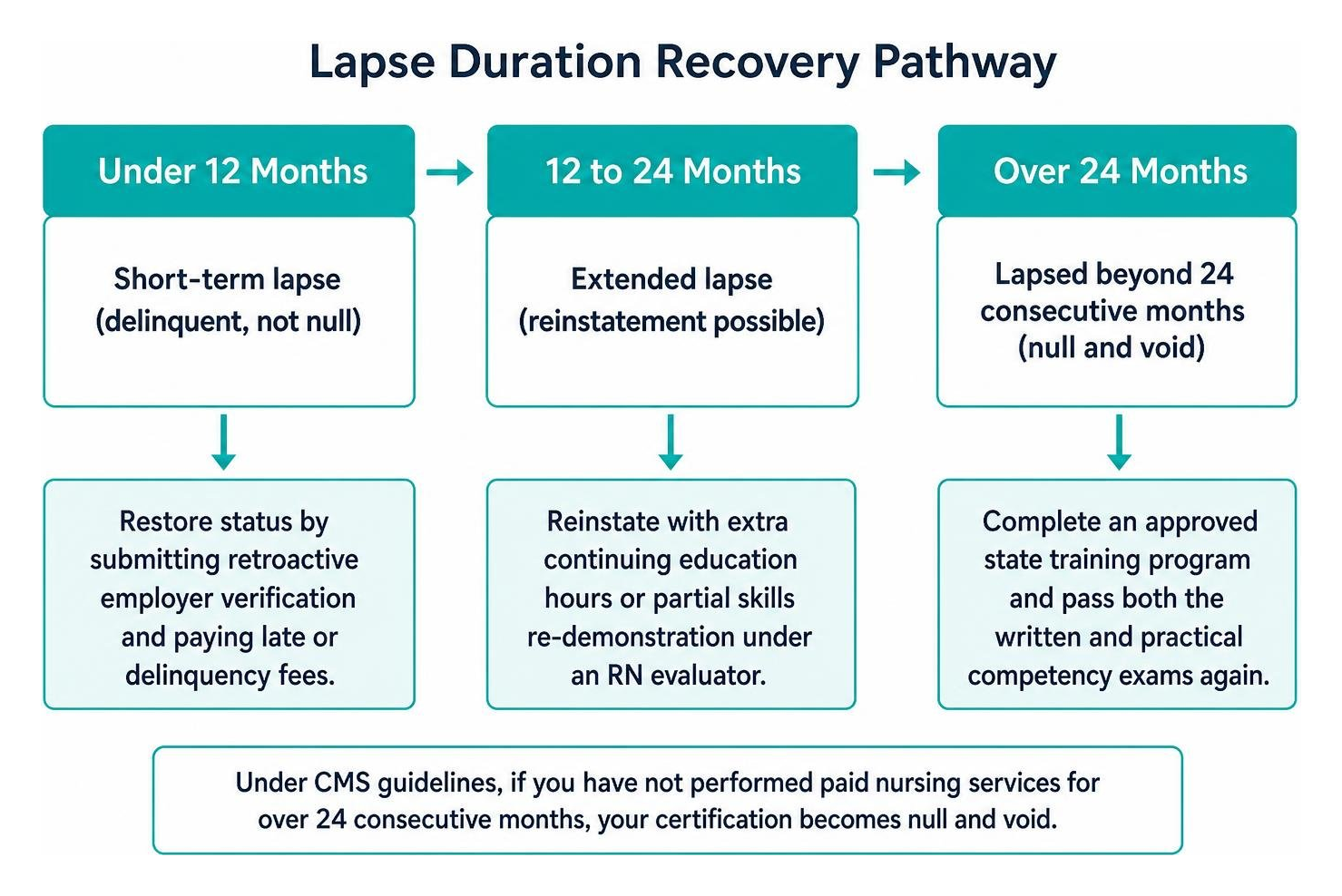
- Lapse Under 12 Months: In most states, a short-term lapse is considered delinquent rather than null. If you worked the required paid hours before your expiration date, you can generally restore your status by submitting retroactive employer verification forms and paying a late or delinquency fee.
- Lapse Between 12 and 24 Months: Some states allow reinstatement with extra continuing education hours or a partial skills re-demonstration under an RN evaluator, avoiding the need to retake the full course.
- Lapse Over 24 Months: Under CMS guidelines, if you have not performed paid nursing services for over 24 consecutive months, your certification becomes null and void. In nearly all jurisdictions, you must complete an approved state training program and pass both the written and practical competency examinations again.
Accommodations for Military Deployment and Medical Leave
Special provisions exist to protect certified nursing assistants facing unforeseen interruptions:
- Military Deployment: Active-duty service members and their spouses deployed outside their licensing jurisdiction can pause their renewal timelines by submitting official military orders. Most states grant an automatic extension of 60 to 180 days following return from active duty.
- Medical and Parental Leave: Extended leaves under the Family and Medical Leave Act (FMLA) or temporary medical disability can qualify for renewal waivers or timeline adjustments. Contact your state registry directly with medical documentation before your credential expires to request a formal practice clock extension.
Frequently Asked Questions About CNA Renewal
How do I check my CNA certification status online?
You can verify your current certification status at any time by visiting your state’s Department of Health or Board of Nursing online registry. Select “License Verification” or “Registry Search,” enter your full legal name, certification number, or Social Security number, and confirm that your status reads “Active” alongside the correct expiration year.
How early can I submit my CNA renewal application?
Most state nurse aide registries open their renewal submission windows 60 to 90 days before your official expiration date. Submitting early gives your employer ample time to complete work verifications and ensures your renewal is processed before any system deadlines.
Can my employer pay my CNA renewal fees directly?
Yes. Many healthcare organizations, particularly long-term care facilities and hospital networks, provide renewal payment assistance. States like Florida offer an “Other Payer Code” option in their online portal, allowing employers to directly receive invoices and pay state licensing fees on your behalf.
Conclusion
Keeping your CNA credential active protects your career, maintains your earning potential, and prevents the hassle of mandatory retraining programs. By tracking your work hours continuously, completing quality in-service education, and submitting your registry forms well before deadlines, you ensure seamless compliance year after year.
Ready to finish your educational requirements without stress? Visit Scrubs CE to keep your CNA status active with online renewal through self-paced, fully approved courses designed for working healthcare professionals.