
Top CT Registry Flashcards Put to the Test
CT Tech Flashcards Review: What Makes a Set Worth Using?
The best CT tech flashcards for registry prep cover all four ARRT® exam areas, give accurate answers with clear explanations, and make it easy to revisit missed cards. Digital cards are handy for short study breaks; printed cards offer a screen-free option. Neither replaces practice tests, which help you apply what you know under a time limit.
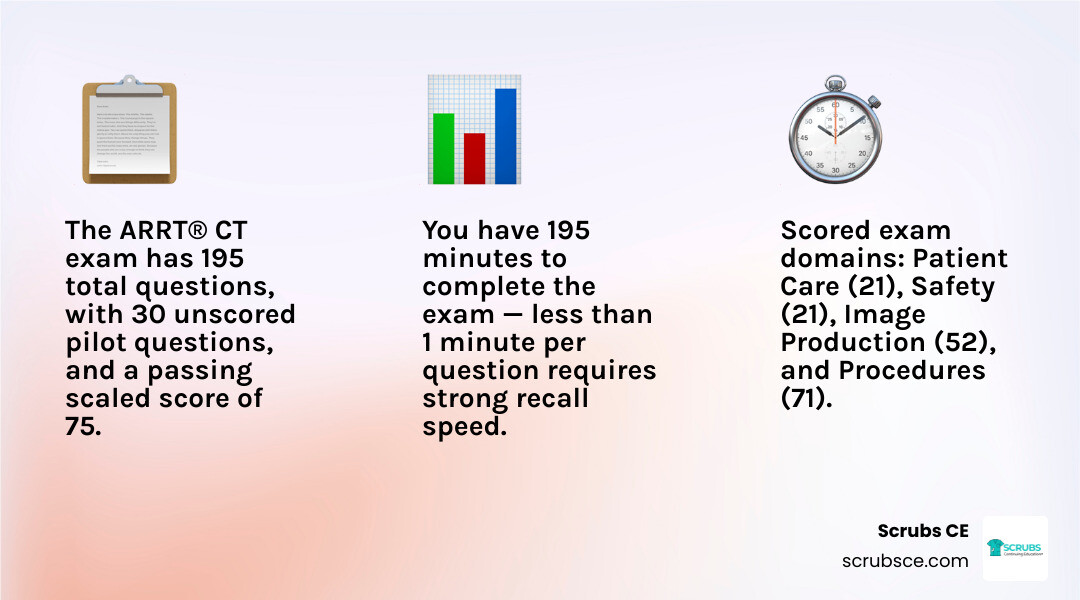
The AMERICAN REGISTRY OF RADIOLOGIC TECHNOLOGISTS® CT exam has 195 questions, including 30 unscored questions. You need a scaled score of 75 to pass. That makes flashcards useful for steady recall, but a full study plan should also include practice questions and review of weak topics.
Preparing for advanced registry certification in computed tomography requires mastering an enormous volume of precise technical parameters, cross-sectional anatomy relationships, radiation dose metrics, and patient safety algorithms. Flashcards serve as a targeted memorization engine, allowing candidates to test their knowledge on demand and reinforce challenging facts through repeated exposure.
I’m Zita Ewert, and I lead continuing education at Scrubs CE for imaging professionals. My experience with CT registry preparation and course design shapes this ct tech flashcards review: a practical look at which features are worth your study time. This article offers a review of CT tech flashcards that focuses on how well they support active recall, align with the exam blueprint, and fit into a realistic study routine.
Quick ct tech flashcards review definitions and resources:
- CT Registry Review Online
- How to Become a Computed Tomography Technician
- Military to Medical: Your Roadmap to Becoming a CT Technologist
Comprehensive CT Tech Flashcards Review: Evaluating the Top Formats
Preparing for post-primary certification requires shifting away from passive rereading toward active recall. When we simply highlight textbooks or re-watch video modules, our brains fall into an illusion of competence. We recognize the material, so we assume we have mastered it. Testing ourselves with flashcards breaks that illusion by forcing our brains to retrieve technical data from memory.
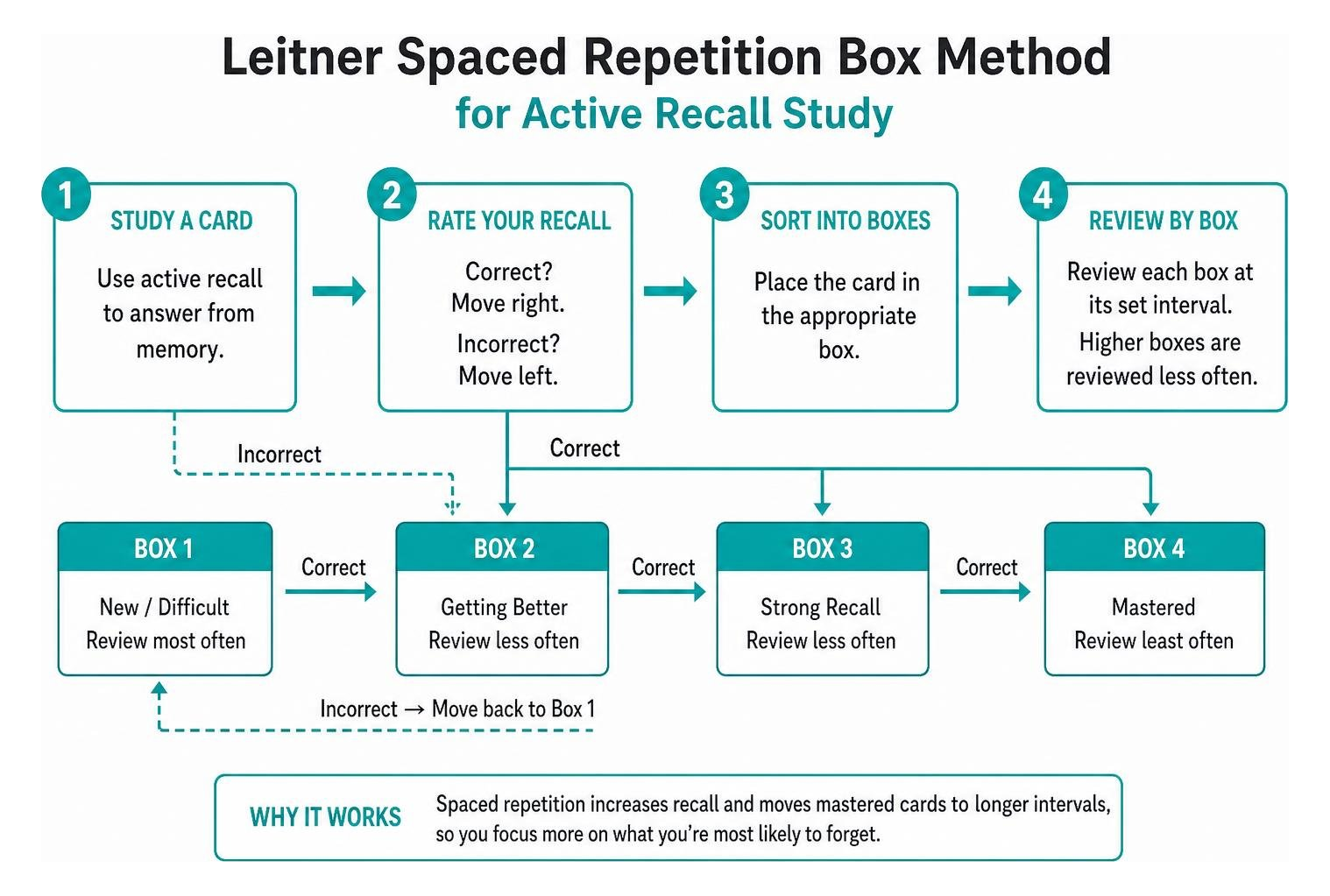
Flashcard formats generally fall into two main categories: digital applications and physical boxed decks. To get the highest return on your study hours, it helps to understand how these formats leverage spaced repetition—such as the classic Leitner system—to lock high-yield imaging concepts into your long-term memory. When you actively pull a definition, delay time, or reconstruction formula out of memory, neural pathways strengthen far more than during passive review.
| Format | Ideal Study Environment | Key Advantages | Potential Drawbacks |
|---|---|---|---|
| Digital Flashcard Apps | Commutes, clinical downtime, on-the-go review | Built-in spaced repetition algorithms, searchable decks, zero physical bulk | Screen fatigue, potential digital distractions |
| Printable / DIY Decks | Custom note conversion, highly personalized review | Deep initial encoding during card creation, low financial cost | Time-intensive manual creation, lacks automatic scheduling |
| Traditional Boxed Cards | Dedicated desk sessions, screen-free evening study | Tactile sorting, color-coded exam domains, detailed printed rationales | Bulky to carry, manual card sorting required |
Digital Apps and Spaced Repetition Tools: A CT Tech Flashcards Review
Digital flashcard apps have transformed certification preparation by automating study intervals. Rather than manually tracking which terms you missed yesterday, modern tools use algorithms to surface difficult concepts right as you are about to forget them. This algorithmic timing optimizes cognitive load by showing well-mastered cards less frequently and prioritizing volatile facts.
These apps excel in clinical environments where you might have five minutes between patient scans. Being able to pull up your phone and drill ten questions on contrast media reactions, extravasation procedures, or pitch calculations keeps information fresh without requiring a heavy study binder. For tech professionals and candidates balancing heavy workloads, reviewing AI study tools for technical certifications and spaced repetition highlights how smart software can streamline active recall and remove the manual friction of flashcard organization.
Traditional Boxed Study Sets: A Physical CT Tech Flashcards Review
Physical study sets remain a reliable staple for candidates who experience digital eye strain after long shifts at scanner consoles. Boxed decks typically feature color-coded margins corresponding to each primary exam section, allowing you to isolate weak areas immediately.
The physical act of sorting cards into separate piles based on mastery provides clear visual reinforcement of your progress. While you sacrifice the pocket-sized convenience of an app, physical cards eliminate notification pop-ups and let you focus entirely on high-yield exam content. Many technologists report that writing personal annotations on physical cards creates an additional layer of tactile memory that aids recall during high-pressure testing sessions.
Core Exam Domains Covered in CT Registry Flashcard Sets
The AMERICAN REGISTRY OF RADIOLOGIC TECHNOLOGISTS® CT exam measures your clinical competency across four specific domains. A quality flashcard set must align with this blueprint to ensure you do not spend time memorizing outdated or irrelevant parameters.
Patient Care and Safety Protocols
Patient Care accounts for 21 scored questions, while Safety accounts for another 21 scored questions. Flashcards targeting these sections must reinforce critical safety procedures, including:
- Informed Consent Types: Distinguishing between simple, written, implied, and parental consent protocols in urgent and routine settings.
- Infection Control: Adhering to standard precautions, aseptic technique, and using essential PPE requirements in CT to protect patients and staff.
- Radiation Protection: Applying ALARA principles, optimizing pitch and mAs, employing automatic exposure control (AEC), and managing pediatric radiation risks (where lifetime cancer mortality risk is estimated around 1 in 1,000).
- Dose Metrics: Memorizing Volume CT Dose Index (CTDIvol), Weighted CTDI (CTDIw), and Dose-Length Product (DLP) formulas, units, and conversion factors.
Image Production and Technical Physics
Image Production represents 52 scored questions on the examination. Flashcard decks should drill technical relationships until they become second nature:
- Artifact Identification: Recognizing beam hardening, metal streak artifacts, ring artifacts, and partial volume averaging (PVA).
- Parameter Adjustments: Knowing how changing slice thickness, display field of view (DFOV), reconstruction algorithms, and matrix size affects spatial resolution, contrast resolution, and image noise.
- Window Settings: Calculating window width (WW) and window level (WL) settings for soft tissue, lung parenchyma, mediastinum, posterior fossa, and bone differentiation.
- Detector Technology: Understanding detector efficiency, dynamic range, slip-ring mechanical design, and iterative reconstruction methods.
Clinical Procedures and Cross-Sectional Anatomy
With 71 scored questions, Procedures is the largest single category on the exam. Flashcards in this section must cover cross-sectional anatomy across axial, coronal, and sagittal planes, standard scan delays, and imaging protocols, including specialized bariatric CT imaging protocols where technical parameter adjustments are essential for adequate image quality.
Cards should reinforce key anatomical bifurcations (such as the abdominal aorta at L4 and common carotids at C3-C4), arterial versus portal venous contrast phases, parenchymal enhancement curves, and cranial landmark identification.
How to Build an Effective CT Exam Study Stack
Flashcards provide maximum value when integrated into a structured, multi-tier study stack. Relying solely on one tool leaves knowledge gaps that can compromise your performance during the 195-minute testing window.

Candidates preparing for their registry exam benefit from pairing daily flashcard drills with structured course materials and extensive question banks. If you want to refine your overall strategy, review our blueprint on passing the ARRT® CT exam on the first try.
Combining Flashcards with Practice Tests and Clinical Experience
To build lasting test readiness, combine your active recall habits with full-length simulations and clinical reinforcement:
- Daily Spaced Repetition (20–30 Minutes): Review 30 to 50 flashcards daily, focusing on terms and physics formulas flagged as difficult during previous sessions.
- Weekly Timed Practice Exams: Complete full-length practice tests to build your pacing and endurance for the 195-question format.
- Clinical Application: Connect the parameters you memorize on cards (like power injector flow rates, contrast viscosities, and scan acquisition delays) directly to the protocols you run on scanner consoles during clinical shifts.
- Structured Education Requirements: Complete your mandatory 16 hours of structured education across all four core domains to establish a strong theoretical base before sitting for the exam.
Frequently Asked Questions About CT Registry Flashcards
Are flashcards alone enough to pass the ARRT® CT exam?
No. Flashcards excel at terminology memorization and rapid recall, but the exam contains complex scenario questions and 30 unscored pilot questions designed to test clinical reasoning. Flashcards should always be combined with full-length timed practice tests, clinical procedure repetitions, and comprehensive review courses.
How many flashcards do I need to master all CT exam topics?
An effective CT exam flashcard set generally contains between 450 and 600 cards. This volume thoroughly covers cross-sectional anatomy, physics calculations, contrast timing protocols, pathology recognition, and safety standards without becoming unmanageable.
How do flashcards help with complex contrast media protocols and radiation doses?
Flashcards break down multi-variable concepts into digestible prompts. They are particularly effective for drilling renal function cutoffs (such as eGFR thresholds and serum creatinine limits), pediatric contrast injection dosing formulas (like 2 mL per kilogram), extravasation emergency interventions, and specific organ delay windows (such as 30 to 45 seconds for hepatic arterial phases and 65 to 75 seconds for portal venous phases).
Conclusion
Mastering the technical, safety, and procedural intricacies of Computed Tomography requires consistent, active study habits. A high-quality flashcard set serves as the engine of your daily prep, ensuring that vital facts and parameters remain sharp for exam day and clinical practice in modern Radiology departments.
At Scrubs CE, we are dedicated to supporting radiologic technologists at every phase of their professional journey. Explore our comprehensive ARRT® computed tomography certification preparation resources to access the structured courses, registry prep guides, and continuing education credits you need to advance your career in Radiology.