
Beginner’s Guide to Computed Tomography Technician Certification
Your First Step Toward Becoming a Computed Tomography Technician
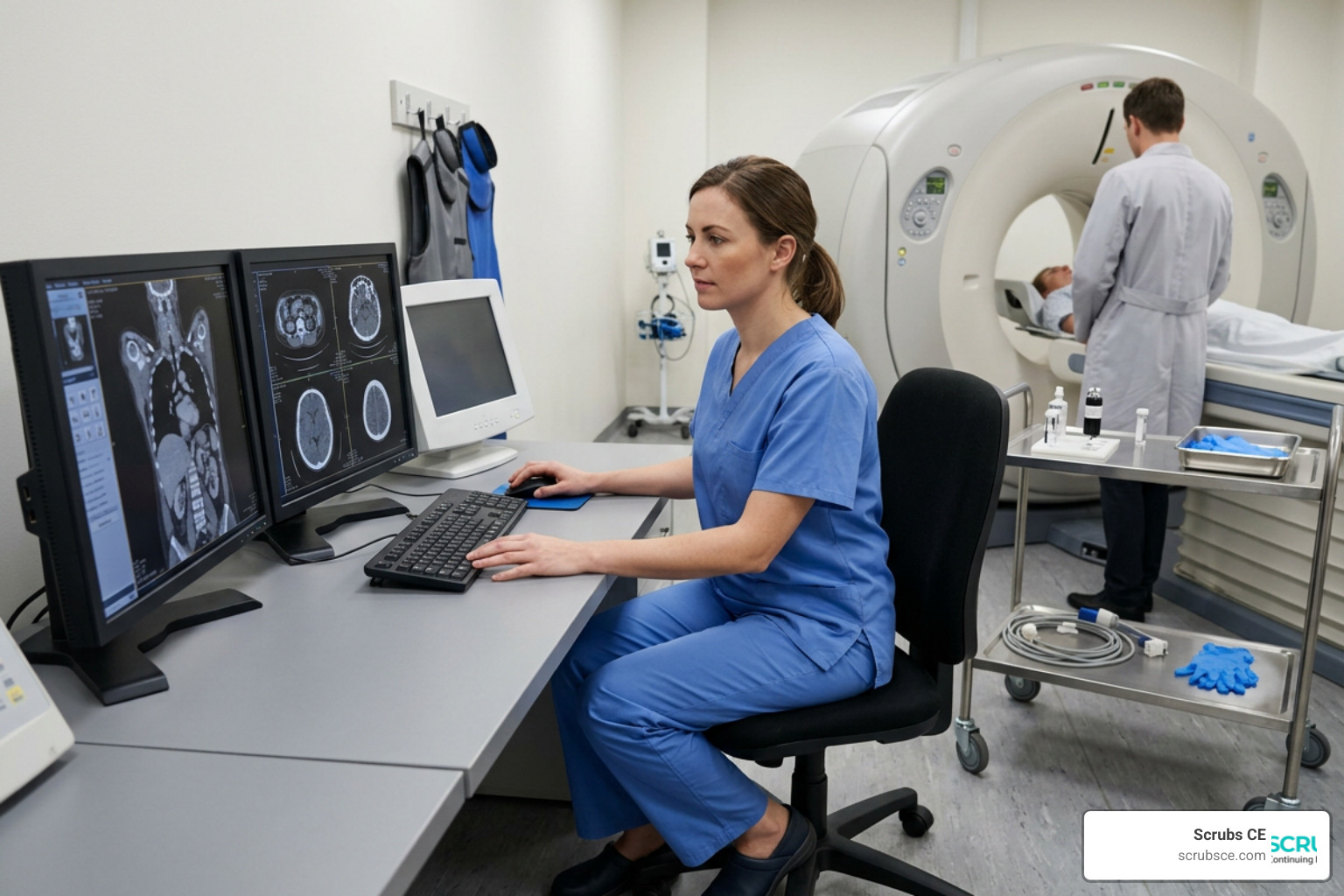
Learning how to become a computed tomography technician is more straightforward than most people expect — but it does take a clear plan and the right sequence of steps.
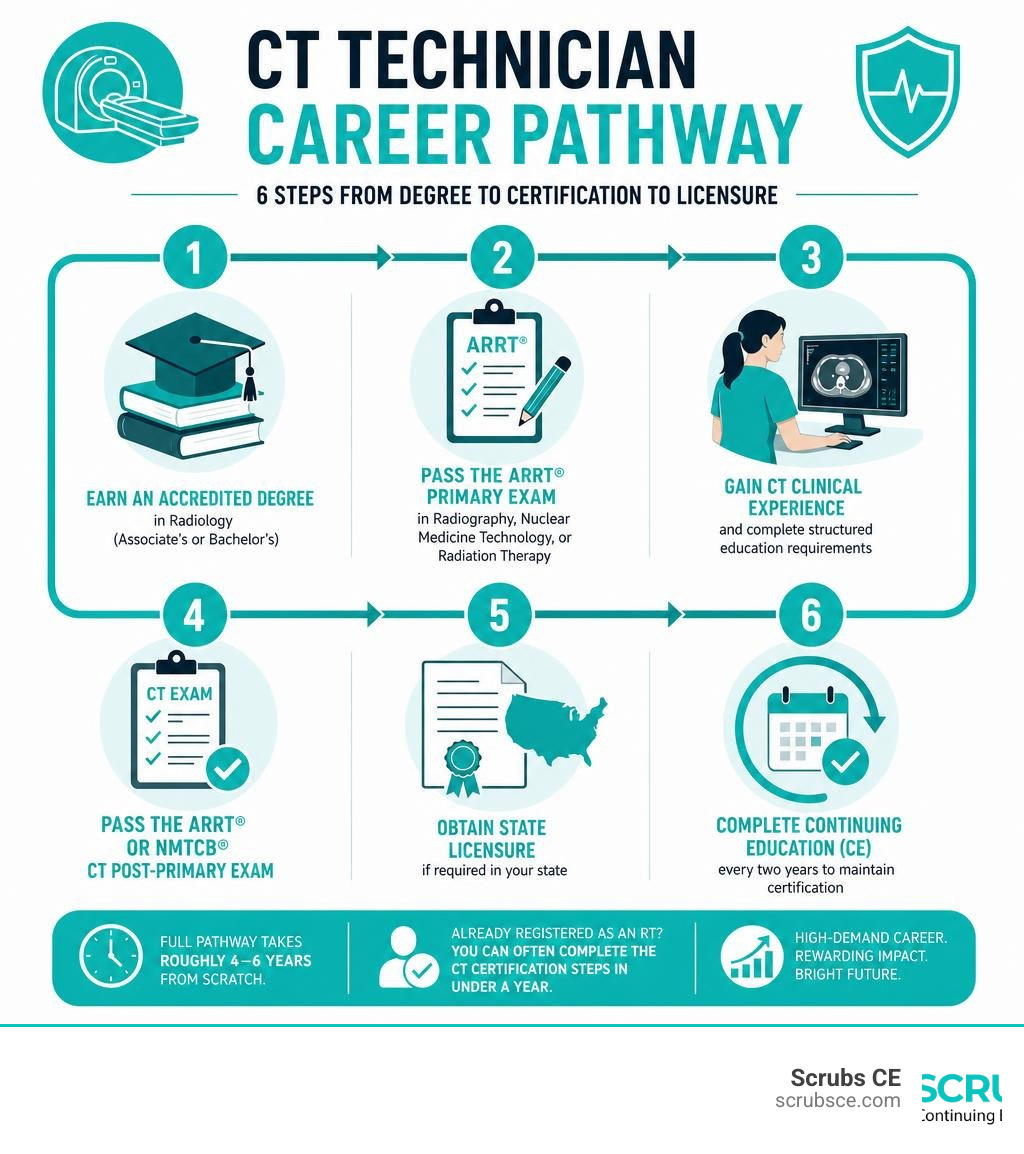
Here is the quick answer:
- Earn an accredited degree in Radiology (associate’s or bachelor’s)
- Pass the ARRT® primary exam in Radiography, Nuclear Medicine Technology, or Radiation Therapy
- Gain CT clinical experience and complete structured education requirements
- Pass the ARRT® or NMTCB® CT post-primary exam
- Obtain state licensure if required in your state
- Complete continuing education (CE) every two years to maintain certification
The full process takes roughly four to six years from scratch. Already registered as an RT? You can often complete the CT certification steps in under a year.
CT is one of the most in-demand specialties in medical imaging. The Bureau of Labor Statistics projects 6% job growth for radiologic technologists through 2032 — faster than average — with about 15,700 openings expected each year. Median annual pay sits at $61,370, with the top 10% earning over $94,880.
Whether you are just starting out or looking to specialize, this guide walks you through every requirement.
I’m Zita Ewert, and as the leader behind SCRUBS Continuing Education®, I’ve spent years helping imaging professionals navigate certification requirements — including the CT post-primary pathway — so you can stay current without the confusion. My work directly supports technologists at every stage of learning how to become a computed tomography technician and beyond, and I’ll make sure this guide gives you everything you need to move forward with confidence.
What is a Computed Tomography (CT) Technologist?
A Computed Tomography (CT) technologist is a highly skilled healthcare professional who operates specialized, high-tech CT scanners to produce detailed, cross-sectional images of a patient’s internal anatomy. Unlike traditional 2D X-rays, which project a flat image of the body, a CT scanner rotates around the patient to capture a sequence of slices. These slices are then compiled by advanced computer software to create 3D views of bones, blood vessels, organs, and soft tissues.
Because CT scans expose patients to ionizing radiation, safety is a paramount concern. CT technologists are trained to adhere strictly to the ALARA (As Low As Reasonably Achievable) principle. This means we must carefully balance image quality with radiation dose, selecting optimal scan parameters (such as kVp, mA, pitch, and slice thickness) to minimize patient exposure while still capturing the crisp, diagnostic images that radiologists need.
Beyond technical execution, satisfying the core CT Technologist Requirements involves a deep commitment to patient care. In hospitals, emergency departments, and outpatient imaging centers, CT technologists are often the calm in the middle of a patient’s storm. Many patients arriving for a scan are anxious, in pain, or claustrophobic. A great technologist takes the time to explain the procedure, answer questions, and reassure patients to keep them calm and still during the scan.
Roles and Responsibilities of a CT Tech
The day-to-day workflow of a CT technologist is and highly varied. Some of the typical responsibilities include:
- Patient Preparation and Positioning: We review medical histories, verify physician orders, screen for potential contraindications (such as pregnancy or renal impairment), and position patients precisely on the scanner table to capture the exact anatomical region requested.
- Contrast Media Administration: Many CT procedures require the use of contrast agents to highlight blood vessels or digestive pathways. Technologists must use sterile and aseptic techniques to perform venipuncture, insert IV lines, and operate automated power injectors safely.
- Advanced Imaging and 3D Reconstruction: Today’s high-speed scanners produce hundreds, sometimes thousands, of images per scan. We are responsible for post-processing these datasets, which includes creating multiplanar reformats (sagittal and coronal views) and detailed 3D reconstructions to help radiologists diagnose complex acute conditions.
- Equipment Calibration and Quality Control: To ensure patient safety and diagnostic accuracy, we perform daily quality control tests, such as air calibrations and Hounsfield unit verifications. We also document and report any equipment issues or mechanical discrepancies promptly.
- Emergency and Interventional Assistance: In trauma centers, CT techs must work rapidly to help diagnose life-threatening conditions like internal bleeding, stroke, or pulmonary embolisms. We also assist radiologists during interventional procedures, including CT-guided needle biopsies and abscess drainages.
How to Become a Computed Tomography Technician: A Step-by-Step Guide
Navigating the career roadmap to become a certified CT technologist requires a structured approach. If you are starting from scratch, the journey is built on a series of educational, clinical, and examination milestones. If you want a comprehensive deep dive into the overall timeline and professional expectations of this career, we recommend exploring this detailed How to Become a CT Tech Guide.
Below, we outline the essential steps to guide you from an aspiring student to a fully certified professional.
Step 1: Earn an Accredited Degree in Radiology
Your journey begins in the classroom. To be eligible for professional certification, you must graduate from an academic program accredited by the Joint Review Committee on Education in Radiologic Technology (JRCERT) or another recognized accrediting body. Enrolling in a non-accredited program is a major bottleneck because it will make you entirely ineligible to sit for the national registry exams.
Most aspiring technologists choose between an Associate of Applied Science (A.A.S.) in Radiologic Technology or a Bachelor of Science (B.S.) in Medical Imaging. Both degrees provide the foundational knowledge of anatomy, physiology, physics, and patient care required to work in a clinical setting.
| Feature | Associate Degree (A.A.S.) | Bachelor’s Degree (B.S.) |
|---|---|---|
| Average Duration | 2 years | 4 years |
| Tuition Cost | Generally lower, highly affordable | Higher, university-level tuition |
| Focus Area | Clinical skills and entry-level practice | Advanced clinical skills, leadership, and research |
| Career Outlook | Excellent for clinical, imaging-only roles | Opens doors to management, administration, and teaching |
Step 2: Obtain Primary ARRT® Certification
Before you can specialize in computed tomography, you must first establish a foundation in a primary discipline. The AMERICAN REGISTRY OF RADIOLOGIC TECHNOLOGISTS® (ARRT®) requires candidates to hold a primary credential before pursuing CT as a post-primary specialty.
To earn your primary credential, you must pass the corresponding ARRT® national registry exam. The most common primary pathways include:
- Radiography (R.T.(R)): The traditional and most popular route, focusing on diagnostic X-rays.
- Nuclear Medicine Technology (R.T.(N)): Focusing on radiopharmaceuticals and physiological imaging.
- Radiation Therapy (R.T.(T)): Focusing on the delivery of therapeutic radiation to treat diseases like cancer.
Passing this exam proves you have mastered the basics of radiation physics, patient care, equipment operation, and image evaluation.
Step 3: Complete CT Clinical Experience and Structured Education
Once you hold your primary credential, you can enter the post-primary pathway to specialize in CT. This pathway has two main components: structured education and hands-on clinical experience.
First, you must complete at least 16 hours of structured education. This coursework must cover the core topics established in the ASRT® Computed Tomography Curriculum, which includes CT physics, instrumentation, safety, cross-sectional anatomy, and clinical procedures.
Second, you must log supervised clinical procedures. The ARRT® requires candidates to document the successful performance of specific clinical competencies. This involves completing a minimum number of repetitions across a variety of procedures (such as head, spine, chest, abdomen, and musculoskeletal scans), ensuring you can operate the equipment safely and effectively in real-world clinical situations.
Step 4: Pass the ARRT® or NMTCB® CT Exam
The final hurdle in your certification journey is passing a dedicated post-primary credentialing exam. Depending on your primary background and professional goals, you will choose between two major credentialing bodies:
- The ARRT® CT Exam: This is the most common national standard. The exam tests your knowledge of patient care, safety, image production, and specific CT procedures. A minimum scaled score of 75 is required to pass and earn the right to use the credential R.T.(R)(CT).
- The NMTCB® CT Exam: Offered by the Nuclear Medicine Technology Certification Board, this exam is specifically designed for nuclear medicine technologists who operate hybrid systems like PET/CT or SPECT/CT. For more information on eligibility, fees, and scheduling, review the NMTCB® CT Exam Information. The exam consists of 200 multiple-choice questions with a 3.5-hour time limit.
Educational Pathways: Associate vs. Bachelor’s Degree
When planning how to become a computed tomography technician, deciding which degree to pursue is a critical choice.
An Associate Degree is the fastest and most cost-effective route to the clinic. These two-year programs focus heavily on hands-on clinical training, preparing you to pass your primary registry exam and enter the workforce quickly. Because hospitals are facing a steady demand for imaging staff, an associate degree is highly respected and more than sufficient to secure an entry-level position as a radiologic technologist or CT specialist.

A Bachelor’s Degree, while requiring a four-year commitment and higher tuition costs, is an excellent investment if you have long-term career goals beyond clinical scanning. In addition to advanced imaging techniques, bachelor’s programs incorporate coursework in healthcare management, research methodologies, and instructional design. This makes B.S. graduates highly competitive for leadership roles, such as lead technologist, department supervisor, clinical educator, or Radiology administrator.
For professionals who are already registered technologists, many institutions offer accelerated, online “bridge” programs. These allow you to earn your bachelor’s degree or advanced CT certificate while continuing to work full-time. For instance, the Computed Tomography Program | Cleveland Clinic offers a comprehensive 9-month certificate program with flexible online and evening options, making it easier for working professionals to specialize.
Certification and State Licensure Requirements
Earning your ARRT® or NMTCB® certification is a massive achievement, but your legal right to practice depends on your state’s regulations.
State licensure rules vary significantly across the country:
- ARRT®-Only States: Some states accept national ARRT® certification as sufficient proof of competence and do not require a separate state license.
- Dual-Licensure States: Many states, such as New York and California, require you to hold both your national ARRT® credential and a specific state-issued license.
- Special Permits: In California, for example, CT technologists who operate certain equipment or perform specific fluoroscopic procedures may also need to secure a California Fluoroscopy Permit, which involves passing an additional state-administered safety exam.
To make sure you are fully compliant with local laws, always check with your state’s radiologic health branch before applying for jobs. Additionally, staying certified requires a commitment to lifelong learning. The ARRT® requires technologists to complete 24 Continuing Education (CE) credits every two years. To learn more about how to track, earn, and report these credits, check out our comprehensive Computed Tomography CE Complete Guide.
Understanding the ARRT® Postprimary Pathway for a Computed Tomography Technician
The ARRT® post-primary pathway is meticulously structured to ensure that only highly qualified professionals earn the CT credential. To successfully navigate this pathway, you must fulfill three core requirements:
- Prerequisite Supporting Discipline: You must hold active ARRT® registration in Radiography, Nuclear Medicine Technology, or Radiation Therapy.
- Ethics Requirements: You must maintain compliance with the ARRT® Standards of Ethics. Any past misdemeanor or felony convictions must be cleared through an ethics review before you can sit for the exam.
- Clinical Experience Log: You must document your clinical competencies using the ARRT® online tool. This digital log tracks your performance of specific procedures under the direct supervision of a certified technologist or radiologist.
To browse accepted courses and find structured educational materials designed to help you meet these rigorous standards, visit our Category Computed Tomography Certification page.
Salary Expectations and Job Outlook in 2026
Entering the CT field in 2026 is one of the smartest and most stable career moves in healthcare. As our population ages, the demand for non-invasive diagnostic imaging continues to skyrocket. CT scans are vital for diagnosing chronic illnesses, evaluating cardiac health, and guiding emergency trauma treatments.
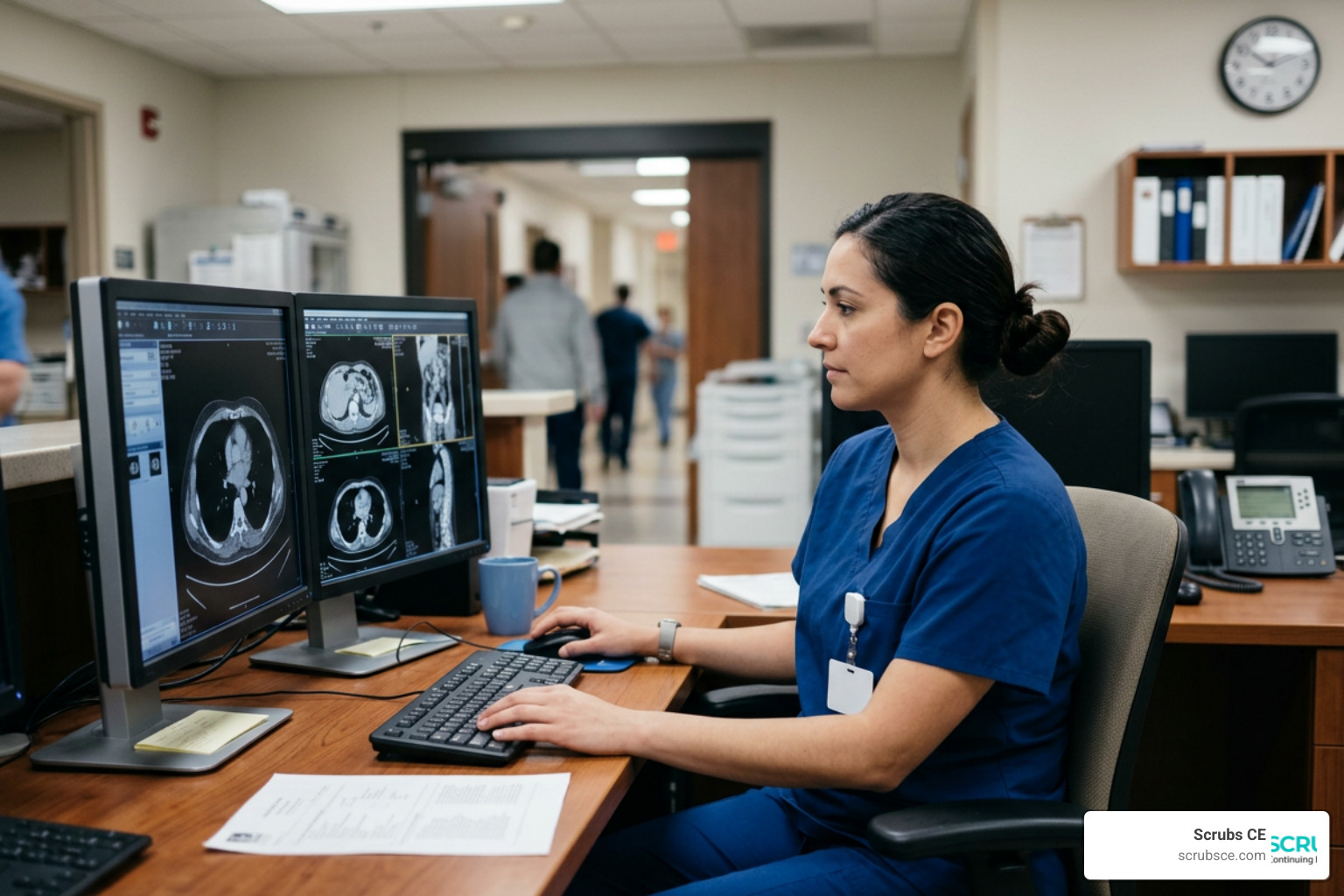
According to the Bureau of Labor Statistics (BLS), employment for radiologic and MRI technologists is projected to grow 6% through 2032, adding roughly 15,700 new jobs to the field every year.
Financially, the career is highly rewarding. While the median annual wage for general radiologic technologists was $61,370, specializing in CT typically brings a substantial pay bump. Technologists who hold a post-primary ARRT® credential in CT often earn 10% to 20% more than non-certified general radiographers. In high-demand metropolitan areas, senior CT technologists and travel techs can easily earn salaries that exceed the top 10% threshold of $94,880 annually.
Career Progression and Salary Factors for a Computed Tomography Technician
Several factors influence your earning potential as a CT technologist:
- Geographic Location: High-cost-of-living states like California, New York, and Massachusetts offer some of the highest salaries in the country, with average earnings ranging from $80,000 to over $110,000.
- Work Setting: Technologists working in rapid-response trauma hospitals or specialized outpatient imaging centers often earn higher hourly wages than those in small, private medical clinics.
- Shift Differentials: Working nights, weekends, or taking on-call emergency shifts can significantly boost your take-home pay.
- Professional Experience: As you gain experience, you can transition into lucrative leadership roles, such as Lead CT Technologist, Clinical Coordinator, or Imaging Director.
To maintain your edge and qualify for these top-tier positions, keeping your credentials active is essential. We offer a wide range of convenient, self-paced continuing education courses to help you earn your required CT CEU Credits quickly and affordably.
If you are preparing for your exams or looking to expand your technical knowledge, we recommend exploring our highly rated educational resources:
- For a comprehensive textbook and exam prep experience, check out Computed Tomography for Technologists 2.
- If you already have the textbook and simply need to complete your CE testing, we offer several convenient testing options:
Frequently Asked Questions about CT Technicians
How long does it take to become a CT tech?
If you are starting from scratch, the entire process typically takes four to six years. This includes earning a two-year associate degree, obtaining your primary ARRT® credential, gaining clinical experience, and passing the post-primary CT exam. However, if you are already a registered Radiologic Technologist (R.T.), you can complete your structured education and clinical hours to earn your CT credential in under 12 months.
Can you become a CT tech without being an RT?
In almost all cases, no. The ARRT® requires candidates to hold a primary credential in an approved supporting discipline (such as Radiography, Nuclear Medicine Technology, or Radiation Therapy) before they are eligible to pursue post-primary CT certification. This ensures all CT technologists have a strong foundation in radiation safety, patient care, and basic imaging physics.
What are the physical demands of a CT technologist role?
A career as a CT technologist is physically active and demanding. We spend most of our shifts on our feet, moving between the control console and the scanner room. You must have the physical stamina to assist, lift, and transfer patients—many of whom are immobile, injured, or elderly—onto the scanner table safely. You will also need to wear protective lead aprons and assist with heavy equipment accessories during specialized procedures.
Conclusion
Learning how to become a computed tomography technician is a journey that requires focus, dedication, and clinical precision. By earning an accredited degree, securing your primary ARRT® registration, and completing the structured education and clinical hours of the post-primary pathway, you can unlock a highly rewarding, stable, and lucrative healthcare career.
At SCRUBS Continuing Education®, we are dedicated to supporting you at every stage of your professional journey. Our convenient, self-paced online courses make it easy to satisfy your structured education requirements and maintain your continuing education credits without disrupting your busy clinical schedule.
Ready to take the next step in your medical imaging career? Explore our affordable and high-quality Computed Tomography Certification Courses today, and let us help you achieve your career goals with confidence!
For more information on certification pathways and to browse our course catalog, visit the SCRUBS CE Computed Tomography Certification portal.