
Texas nursing CE requirements at a glance

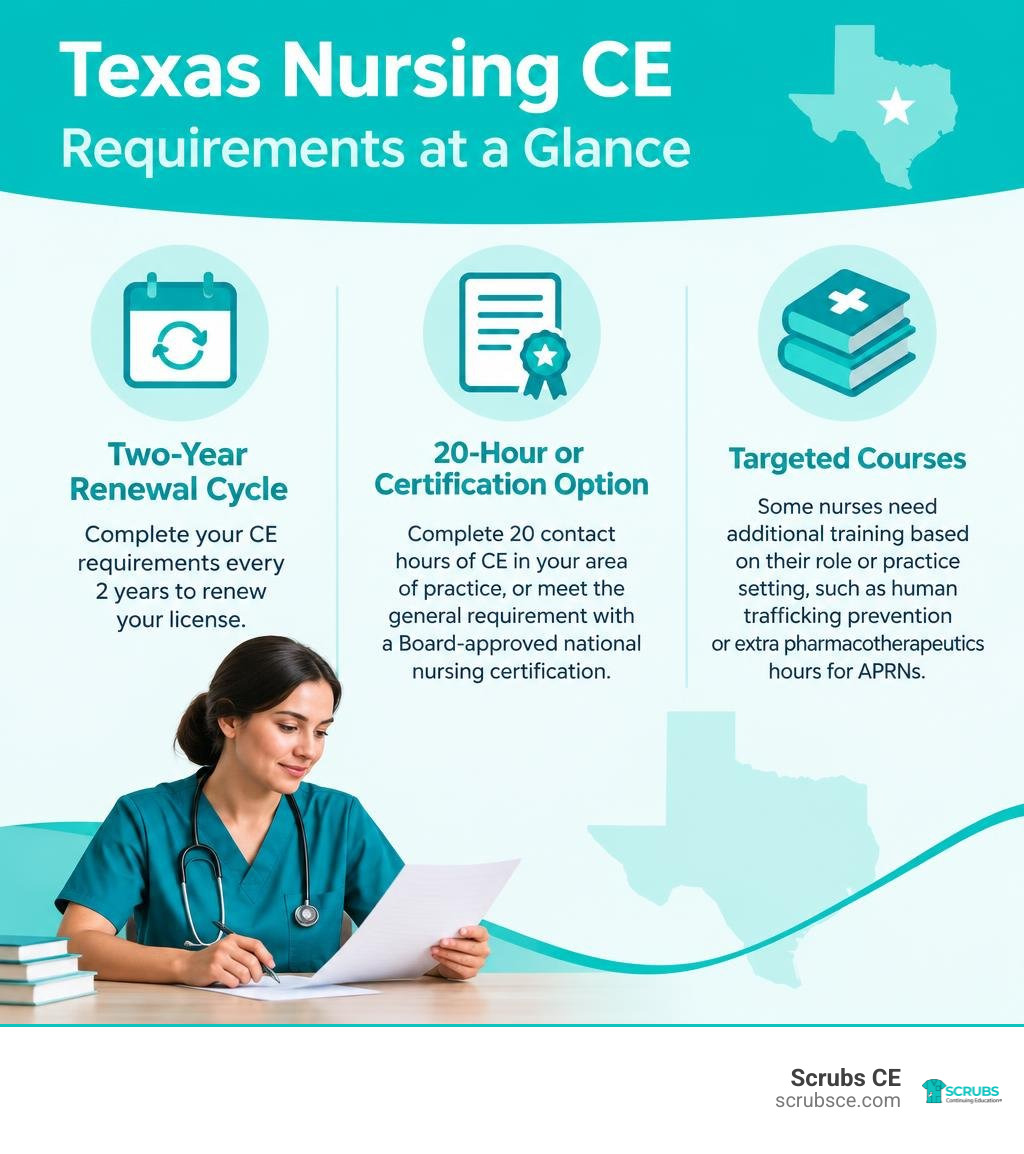
Texas nursing CE requirements call for LVNs, RNs, and APRNs to complete 20 contact hours of continuing nursing education in their area of practice during each two-year licensing period, or meet the general requirement through a Board-approved national nursing certification. Some nurses also need training tied to their role or practice setting, such as human trafficking prevention for direct patient care nurses or additional pharmacotherapeutics hours for APRNs with prescriptive authority.
Start by checking your license expiration date and the dates of your completed education. Then identify any targeted courses you need before you renew. Keep your certificates, even after you enter your activities in the Texas Nurse Portal.
I’m Zita Ewert, and I lead continuing education for imaging professionals at Scrubs CE. I bring that experience making licensure rules easier to understand to this guide on Texas nursing CE requirements.
Terms related to Texas nursing CE requirements:
Overview of Texas Nursing CE Requirements for LVNs, RNs, and APRNs
Navigating professional licensure can feel daunting, but Texas makes its primary benchmark straightforward: licensed vocational nurses (LVNs), registered nurses (RNs), and advanced practice registered nurses (APRNs) must earn 20 contact hours of continuing nursing education (CNE) every two years. Governed by the Texas Board of Nursing (BON) under Texas Administrative Code Rule 216, these hours cannot be random clinical refreshers. Every contact hour must directly relate to your specific area of practice.
Whether you practice in intensive care, pediatrics, ambulatory surgery, or clinical informatics, the Board expects your education to enhance the specific clinical judgments you make every day. If you need a comprehensive overview of how continuing education units work nationwide, check out our guide to accredited RN CEUs.
Meeting Texas Nursing CE Requirements via CNE vs. National Certification
Texas nurses have two primary pathways to satisfy their general continuing competency mandate:
- Earning 20 Contact Hours of CNE: Complete courses accredited through credentialing bodies recognized by the Board.
- Maintaining a Board-Approved National Nursing Certification: Hold an active, recognized specialty credential in your area of practice.
Holding an approved national certification completely replaces the standard 20 contact hour requirement for that renewal cycle. However, it does not exempt you from specific legislative mandates (like human trafficking prevention or jurisprudence).
| Requirement Category | 20 Contact Hours CNE Pathway | National Nursing Certification Pathway |
|---|---|---|
| Primary Mechanism | Complete accredited CNE courses | Maintain active specialty certification |
| Hours Required | 20 contact hours per 2-year cycle | 0 general contact hours needed |
| Practice Area Match | Mandatory clinical relevance | Certification must match practice setting |
| Board-Mandated Topics | Must complete all applicable targeted CE | Must still complete all applicable targeted CE |
| Audit Verification | Transcripts and course certificates | Copy of current national certificate |
Calculating Licensing Periods and Contact Hour Timelines
Your renewal cycle is tied directly to your birth month and birth year. Texas uses a biennial system:
- If you were born in an even-numbered year, your license expires in your birth month during even-numbered years.
- If you were born in an odd-numbered year, your license expires in your birth month during odd-numbered years.
Your two-year licensing period officially begins on the first day of the month immediately following your birth month and ends on the last day of your birth month two years later. For example, if you were born in November 1992, your reporting window runs from December 1, 2024, through November 30, 2026.
Crucially, you cannot roll over extra hours into future cycles. If you complete 35 contact hours in a single period, those excess 15 hours cannot be applied to your next renewal. Furthermore, newly licensed nurses renewing their Texas license for the very first time are exempt from the standard 20-hour requirement for that initial renewal.
Targeted and Mandatory Continuing Education Topics in Texas

In addition to baseline contact hours, Texas enacts statutory educational mandates under Rule 216 that apply to nurses based on their practice environments and credentials.
Targeted Texas Nursing CE Requirements by Practice Setting and Role
Depending on where you work and who you treat, specific targeted topics are required:
- Nursing Jurisprudence and Ethics: Mandated by Tex. Occ. Code Section 301.305, all nurses must complete at least 2 contact hours covering Texas nursing jurisprudence and ethics before the end of every third two-year licensing period (every six years). The statute establishes that the Board may not require more than 4 hours on this topic.
- Human Trafficking Prevention: Any nurse who provides direct patient care must complete an approved human trafficking prevention course through the Texas Health and Human Services Commission (HHSC) during every renewal cycle.
- Older Adult and Geriatric Care: Nurses whose practice includes older adults or geriatric populations must complete at least 2 contact hours related to elder care every renewal cycle.
- Forensic Evidence Collection: Any nurse employed in an emergency room (ER) setting must complete at least 2 contact hours in forensic evidence collection. This is a one-time requirement, and documentation must be retained indefinitely.
- Tick-Borne Diseases: Nurses who treat patients presenting with symptoms of tick-borne illnesses are encouraged to complete targeted instruction regarding clinical assessment and treatment protocols.
Prescriptive Authority and Advanced Practice CE Mandates
Advanced Practice Registered Nurses have heightened educational duties to support safe clinical practice:
- Pharmacotherapeutics: APRNs holding prescriptive authority must complete at least 5 additional contact hours in pharmacotherapeutics every renewal cycle.
- Safe and Effective Pain Management: APRNs who have entered into a prescriptive authority agreement authorizing the prescribing of opioids must complete at least 2 contact hours annually (4 hours per renewal cycle) regarding safe pain management, opioid alternatives, and monitoring protocols.
- Prescription Monitoring Program (PMP): Integrating state-mandated controlled substance database checks into clinical workflow.
Staying current with these targeted expectations ensures you protect your prescriptive privileges. To learn more about selecting the right courses for your clinical focus, explore how to stay compliant and advance your career with the right CEU credits for nurses.
Acceptable CNE Activities, Providers, and Credit Conversions
The Board accepts contact hours issued by credentialing organizations that adhere to national continuing education standards, such as the American Nurses Credentialing Center (ANCC), state nurses associations, and accredited colleges. For healthcare professionals who hold dual credentials or work across disciplines, our guides on Texas Medical Board Radiology CE requirements and the Texas Radiology CE complete guide outline parallel rules under state law.
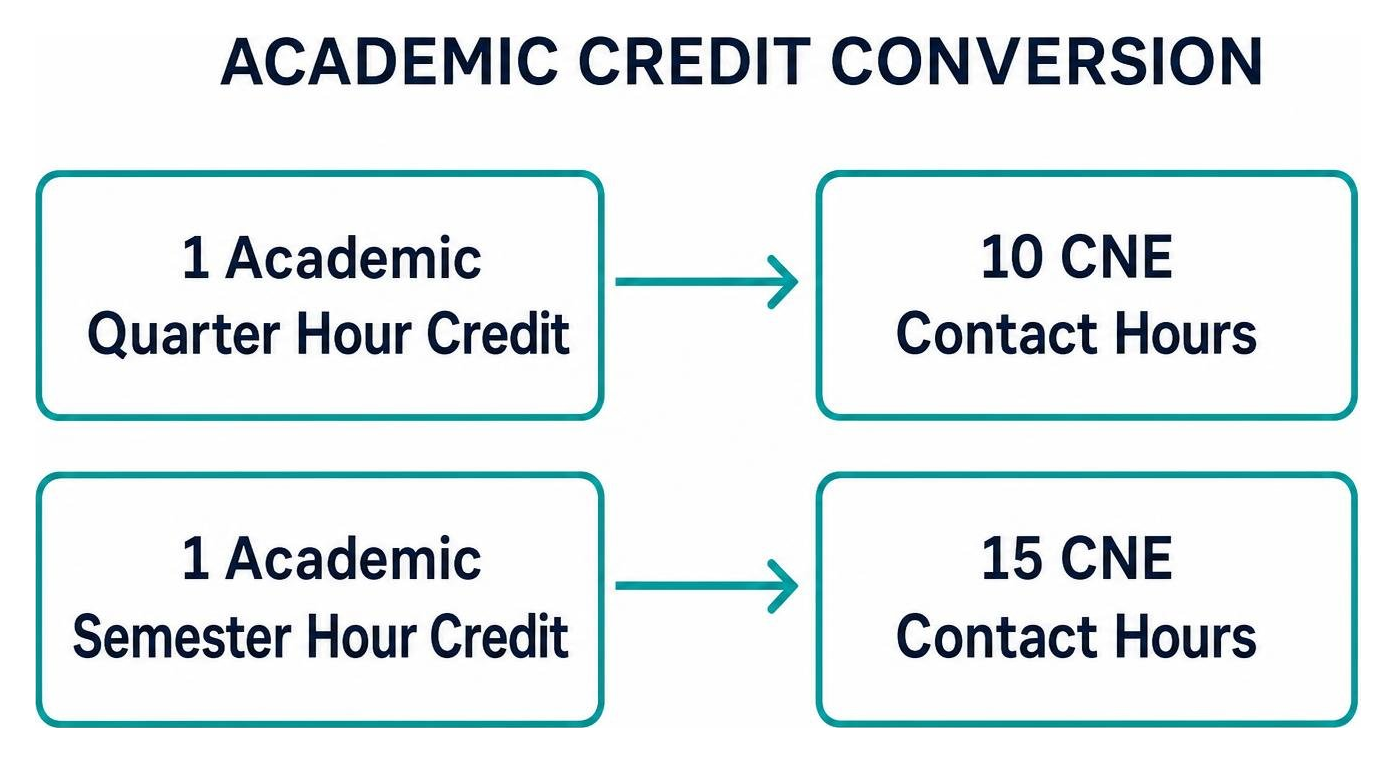
If you participate in academic coursework, you can convert college credits into contact hours:
- 1 academic quarter hour = 10 contact hours
- 1 academic semester hour = 15 contact hours
You can also earn credit through professional program development, presenting educational offerings, or authoring clinical papers published in peer-reviewed journals. For an exhaustive walkthrough of state-level standards, read our guide on state approved CE for your license renewal.
Unacceptable Activities for Texas Nursing Continuing Education
Not every clinical training session qualifies for Board credit. Under Board Rule 216, the following activities are explicitly unacceptable:
- Basic Life Support (BLS) and CPR certification or recertification courses
- Institution-specific employee orientation programs
- Standard hospital in-service training on internal policies or specific vendor equipment
- Courses designed strictly for self-improvement, personal financial planning, or career marketing
- Liberal arts courses that do not directly improve nursing practice
Texas Nurse Portal CE Module and Audit Compliance
Historical records show that compliance requires diligent tracking. As highlighted in a July 2006 Board of Nursing Bulletin, formal audits revealed that nursing CE compliance rates dropped from 87.2% in FY 2004 to 80.6% for RNs, and from 81.3% to 61.7% for LVNs during the first six months of FY 2006.

To make reporting more efficient, the Board implemented the Texas Nurse Portal CE Module. Effective September 1, 2026, nurses enter their completed continuing education details directly into the portal prior to renewal or reactivation. The Board no longer requires mandatory certificate uploads for routine submissions, significantly cutting down administrative hurdles.
However, eliminating upfront certificate uploads does not eliminate your duty to store records. Under Board Rule 216.7(b), you must retain certificates and documentation for a minimum of three consecutive licensing periods (six years). The only exception is your forensic evidence collection documentation, which must be stored indefinitely.
Avoiding Common Renewal Pitfalls and License Delinquency
A simple administrative misstep can disrupt your ability to practice. In an analysis of 4 common Texas nursing license renewal issues, legal experts point out that the most frequent complications include CNE deficiencies, missing practice-specific mandatory topics, audit delays, and online payment errors.
If your renewal is selected for a random audit, your application pauses until the Board verifies your submitted education. Practicing with an expired or delinquent license carries severe disciplinary penalties. If a renewal denial occurs, nurses have the right to request an administrative appeal through the State Office of Administrative Hearings (SOAH). You can review standard requirements and avoid these common pitfalls through our breakdown of general CE credit requirements.
Frequently Asked Questions About Texas Nursing Continuing Education
How many CE hours are required for Texas RN and LVN license renewal?
LVNs and RNs must complete 20 contact hours of continuing nursing education in their clinical area of practice during every two-year licensing cycle. Alternatively, maintaining an active, Board-approved national specialty certification satisfies the general 20-hour requirement.
What happens if I am selected for a Texas BON continuing education audit?
If selected for a random audit, you must provide formal documentation (certificates of completion, provider accreditation details, course dates, and hours earned) for all reported activities. You must maintain these records for six years (three consecutive renewal periods).
Can Basic Life Support (BLS) or ACLS count toward Texas nursing CE?
Basic Life Support (BLS) and CPR training courses are explicitly excluded and cannot be counted toward your 20 required contact hours. While standard BLS is not accepted, advanced clinical resuscitation courses (such as ACLS or PALS) that award accredited CNE contact hours through a Board-recognized provider may be applied toward your total if they are directly relevant to your practice setting.
Conclusion
At Scrubs CE, we believe professional education should be transparent, stress-free, and clinically valuable. If you are completing your biennial hours, you can explore self-paced modules, flexible learning options, and clear state-by-state guidance. For nurses managing broader professional development goals, our comprehensive guide covers everything you need to know about completing your nursing CEU requirements.
Review your birth month, verify your targeted topics, and complete your courses early to keep your Texas license fully active.