
Stay Compliant and Advance Your Career with the Right CEU Credits for Nurses
CEU Credits for Nurses: Start With Your State’s Rules

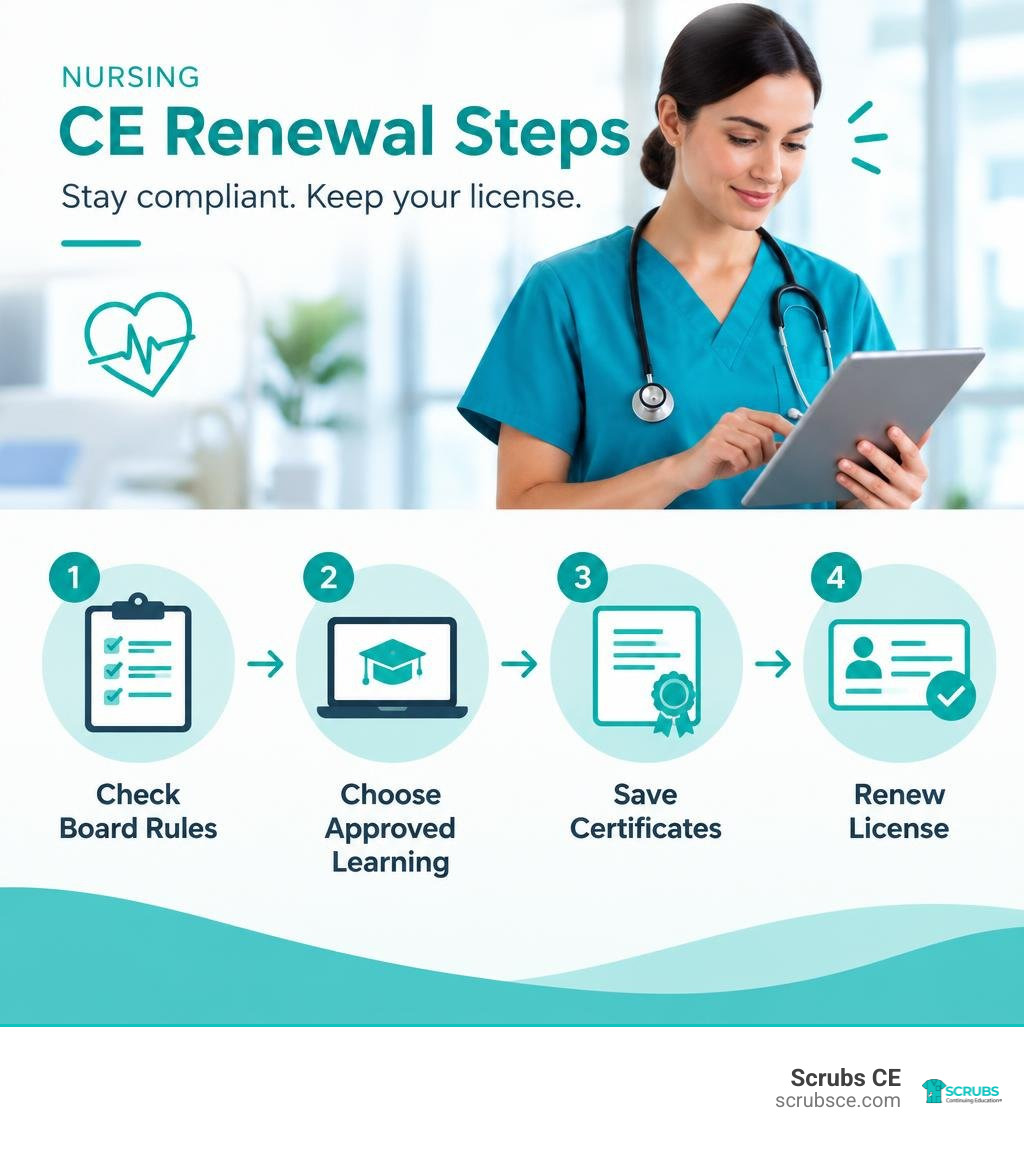
To renew your nursing license, check your state board’s continuing education rules first. Confirm how many contact hours you need, which topics are required, what activities count, and when your renewal is due. Choose a provider your board accepts, then save each completion certificate in case you need to report your hours or respond to an audit.
The terms CEU and contact hour are often used loosely, but they are not the same: one CEU equals 10 contact hours. Nursing boards commonly state requirements in contact hours, and the rules vary by state and license type. Knowing the difference can help you avoid a shortfall at renewal time.
I’m Zita Ewert, and I lead continuing education for imaging professionals at Scrubs CE. My experience making CE requirements easier to understand informs this guide to ceu credits for nurses, while your state nursing board remains the source for your license requirements. The American Nurses Association notes that continuing education supports safe, current clinical practice, and the American Nurses Credentialing Center provides widely accepted accreditation standards for nursing education.
Ceu credits for nurses word roundup:
Understanding CEU Credits for Nurses: Definitions, Value, and Contact Hours
Navigating continuing education can sometimes feel like deciphering a completely different language. Between balancing twelve-hour shifts, patient charting, and family life, figuring out continuing education units should not add unnecessary friction to your week.
At its core, continuing education exists to safeguard patient care by ensuring healthcare professionals stay up to date with modern clinical protocols, pharmacology breakthroughs, and technological advancements. As healthcare standards evolve in 2026, evidence-based nursing care demands ongoing learning that bridges didactic theory with bedside reality.
What Are Continuing Education Units and Contact Hours?
The most common point of confusion among healthcare workers is the difference between a continuing education unit (CEU) and a contact hour. Under standard educational benchmarks established by the International Association for Continuing Education and Training (IACET):
- 1 Contact Hour represents 50 to 60 minutes of organized, didactic learning or clinical instruction.
- 1 CEU represents exactly 10 contact hours of formal participation in an accredited program.
When state licensing boards mandate continuing education, they almost always measure requirements in contact hours. However, everyday hospital terminology often uses the term “CEU” interchangeably with individual hours. If your state board requires 20 hours of education, you need 20 contact hours (which technically equals 2.0 CEUs), not 20 full CEUs (which would equal an overwhelming 200 contact hours). Understanding this distinction ensures you choose the right accredited RN CEUs without miscalculating your educational portfolio.
Why CEU Credits for Nurses Improve Patient Outcomes and Career Growth
Continuing education is much more than a routine regulatory hurdle—it directly enhances clinical outcomes and accelerates professional trajectory.
According to research from the American Nurses Association, 85% of nurses report that continuing education directly improved their bedside patient care skills. Refreshing your knowledge on critical topics such as sepsis recognition, complex pharmacology, wound staging, and line management translates directly into safer care environments.
Furthermore, investing in high-quality educational modules significantly boosts your certification readiness. Data from the American Nurses Credentialing Center (ANCC) reveals that nurses who actively engage in targeted continuing education credits are 30% more likely to pass specialty certification exams, such as CCRN, CEN, or Med-Surg-BC. Prioritizing structured professional development healthcare programs equips you with the confidence and clinical acumen needed for clinical ladder promotions, leadership roles, and advanced practice programs.
State Licensing Requirements and Mandatory Renewal Guidelines
Every state’s Board of Nursing operates independently, establishing distinct timelines, required hours, and mandatory subjects for license maintenance. Most states operate on a biennial (two-year) renewal cycle, although some mandate annual or triennial filings.
To remain compliant, you must align your coursework with your specific state board’s published CE credit requirements.
Common State-by-State CE Hour Variations
Across the country, typical renewal benchmarks range from 20 to 30 contact hours per renewal period. While some states allow general nursing electives, many specify mandatory subjects that must be refreshed every single cycle.
Common state-mandated courses include:
- Implicit Bias & Health Equity Training (e.g., California, Michigan)
- Infection Control & Barrier Precautions (e.g., New York)
- Substance Abuse & Opioid Prescribing (frequently required for APRNs across multiple states)
- Domestic Violence & Child Abuse Reporting (e.g., Florida, Pennsylvania)
- Nursing Jurisprudence and Ethics (e.g., Texas, Ohio)
Below is an overview of how state requirements vary across common renewal cycles:
| State | License Type | Contact Hours Required | Cycle Length | Mandatory Topics Included |
|---|---|---|---|---|
| California | RN / LVN | 30 Hours | 2 Years | Implicit Bias (direct initial requirement), relevant clinical practice |
| Florida | RN / LPN | 24 Hours | 2 Years | Prevention of Medical Errors (2h), Florida Laws (2h), Human Trafficking (2h), Domestic Violence (2h every 3rd cycle) |
| Texas | RN / LVN | 20 Hours | 2 Years | Nursing Jurisprudence & Ethics (2h every 3rd cycle), Geriatrics/Stroke (if applicable) |
| Ohio | RN / LPN | 24 Hours | 2 Years | Category A: Ohio Nursing Law & Rules (at least 1h) |
| New York | RN / LPN | Topic Specific | 4 Years | Infection Control (every 4 years), Child Abuse Identification (one-time) |
| Colorado | RN / LPN | 0 Hours | 2 Years | Practice-based state (CE not mandatory for standard RN renewal) |
If you practice in the Golden State, you can explore our detailed guide to California CE requirements to verify subject compliance.
What Happens If You Fail to Meet Licensure Deadlines?
Allowing your license renewal deadline to pass without completing your mandatory education leads to administrative and professional consequences:
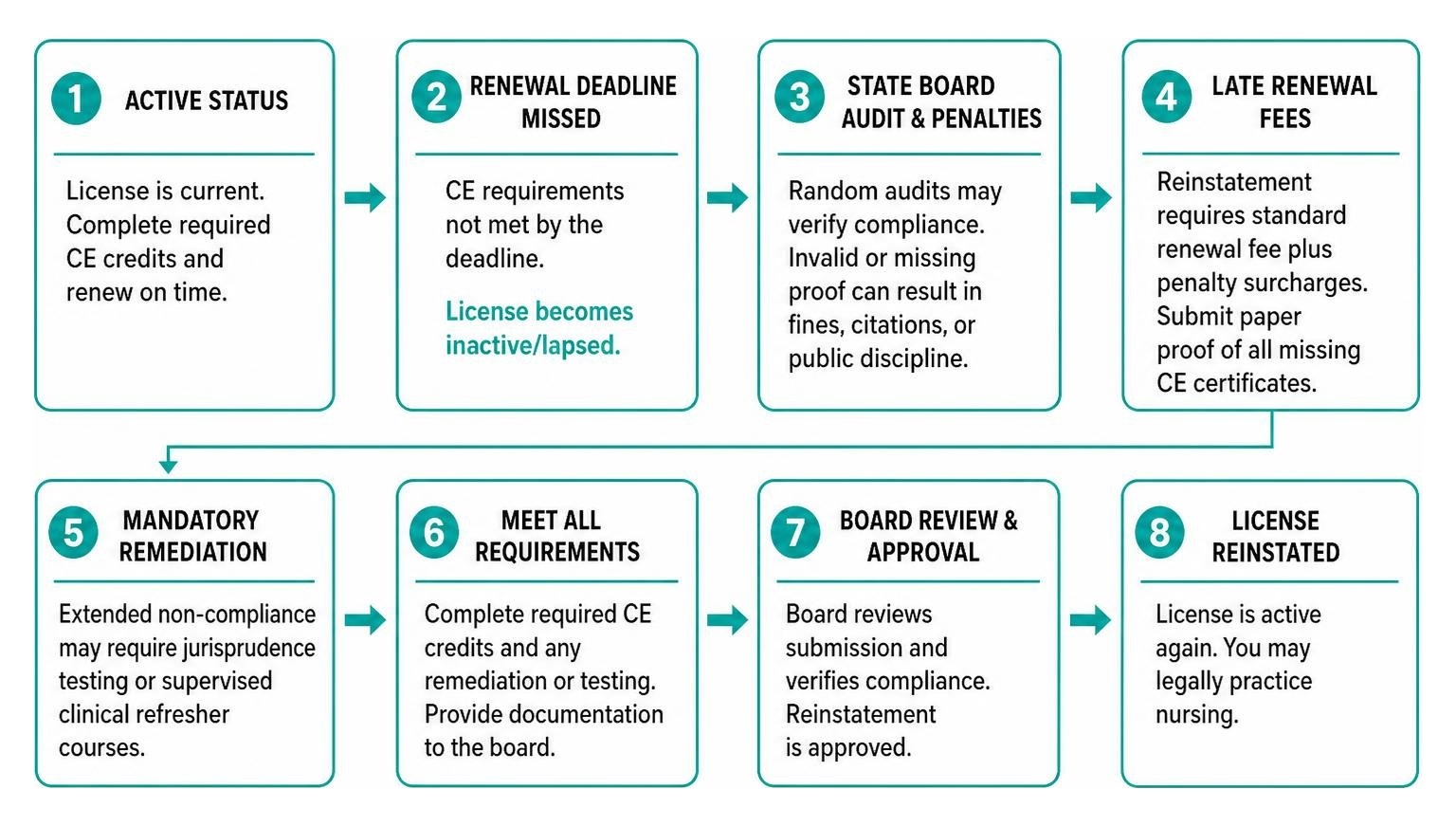
- Immediate Inactive/Lapsed Status: You cannot legally practice nursing with an expired or non-compliant license. Working on a lapsed credential constitutes unauthorized practice under state law.
- State Board Audits and Penalties: State nursing boards routinely conduct random compliance audits. Submitting a renewal form claiming compliance without valid completion certificates can trigger financial fines, administrative citations, or public disciplinary reprimands.
- Late Renewal & Reinstatement Fees: Reinstating a lapsed credential requires paying standard renewal fees plus substantial penalty surcharges, alongside submitting paper verification of all missing course certificates.
- Mandatory Remediation: In severe cases of extended non-compliance, boards may require formal jurisprudence testing or supervised clinical refresher courses prior to license restoration.
Qualifying Activities and Finding Accredited Providers
Not all educational activities automatically satisfy state board mandates. State licensing bodies require that courses come from recognized, accredited organizations to ensure content accuracy and rigorous clinical standards.
How to Choose Accredited CEU Credits for Nurses Online
When selecting an online learning platform, always look for programs accredited by established governing bodies, such as the American Nurses Credentialing Center (ANCC), state boards of nursing, or joint accreditation councils.

Over 70% of nurses prefer online CEU courses due to their flexibility and 24/7 self-paced accessibility. Rather than spending weekends in crowded seminar halls, you can complete modules on your tablet or laptop between shifts. High-quality platforms deliver online CEU credits backed by an instant CE certificate upon course completion, giving you immediate proof of compliance for board records.
Eligible Course Formats, Specialty Certifications, and Free Options
Nursing boards generally accept a wide variety of structured educational formats:
- Self-Paced Online Courses: The most popular and budget-friendly format for full-time clinicians.
- No-Exam Learning Modules: Options like nursing CEUs with no test required allow you to satisfy requirements by completing reading materials and reflective evaluations.
- National Specialty Certifications: Initial attainment or renewal of advanced credentials (such as CCRN, PCCN, or OCN) often covers full or partial state CE hour quotas.
- Academic Coursework: Taking upper-division college healthcare courses (BSN, MSN, DNP) generally converts directly to contact hours (1 academic semester credit typically equals 15 contact hours).
- Employer In-Services: Hospital-led trainings and life support certifications (BLS, ACLS, PALS) may count toward general hours if formally accredited.
- Cost-Effective Bundles: The average cost of a single credit ranges from $10 to $50, making affordable CE courses and subscription bundles an economical alternative to individual course purchases.
Best Practices for Tracking, Documenting, and Auditing CE Records
Completing your modules is only half the battle; maintaining clear, accessible documentation is essential should your state board request verification.

Maintaining Compliance and Digital Recordkeeping
Most state boards do not require you to mail in certificates upon renewal; instead, you attest under penalty of perjury that you have met the requirements. However, boards mandate that you retain physical or digital certificates for a minimum of 4 years (or two complete renewal cycles) in case of a random audit.
Follow these best practices to keep your portfolio organized:
- Create a Dedicated Digital Folder: Save downloadable PDF completion certificates immediately upon finishing each module, labeled clearly with the course title, date, and contact hours.
- Leverage State Electronic Portals: In states that utilize central verification portals like CE Broker (e.g., Florida, Georgia, Ohio), ensure your provider reports hours automatically or upload your certificates directly.
- Review Requirements Early: Consult an A-Z guide to CE hours requirements at the start of your renewal cycle to avoid last-minute cramming days before your license expires.
Frequently Asked Questions About Nursing Continuing Education
How many contact hours equal one CEU?
One official Continuing Education Unit (CEU) equals ten contact hours of structured learning (where one contact hour represents 50 to 60 minutes of instruction). When reviewing state requirements, check whether your board asks for contact hours or CEUs to ensure accurate calculations.
Can I use the same CE credits for multiple state nursing licenses?
Yes. If you hold active licenses in multiple states or utilize a compact multi-state license, accredited courses can generally be applied toward both licenses, provided the content meets both boards’ specific topic requirements and falls within both active renewal periods.
Do all states require continuing education for RN license renewal?
Not all states require continuing education. A small number of states (such as Colorado, Maine, and Wisconsin) do not mandate formal CE hours for standard RN renewals, instead relying on active practice hours or alternate competency pathways. Always verify with your specific state board.
Conclusion
Maintaining clinical competence and protecting your hard-earned nursing license does not have to be an overwhelming ordeal. By understanding the distinction between contact hours and CEUs, selecting accredited providers, and completing courses through a flexible self-paced schedule, you can turn mandatory compliance into meaningful career growth.
Whether you need to fulfill state-mandated ethics topics or simply need to complete your standard biennial hours, we make licensure maintenance seamless and affordable. Check out our complete guide to completing your 30-hour nursing CEU requirement to finish your hours quickly, download instant certificates, and return your focus to delivering exceptional patient care.