

CT Radiographer Daily Duties and Responsibilities at a Glance
A CT radiographer’s daily duties and responsibilities include checking the scanner, reviewing orders and patient history, positioning patients, selecting scan settings, managing radiation exposure, and checking image quality. When the exam calls for contrast, they prepare and administer it within their scope of practice, monitor the patient, and document the procedure.
A busy shift may move from scheduled scans to urgent trauma imaging with little warning. The work changes, but the goal stays the same: safe care and clear images for the radiologist to review.
I’m Zita Ewert, and I lead continuing education for imaging professionals at Scrubs CE. My work supporting CT learning gives me a practical view of ct radiographer daily duties and responsibilities, from patient safety to keeping skills current.
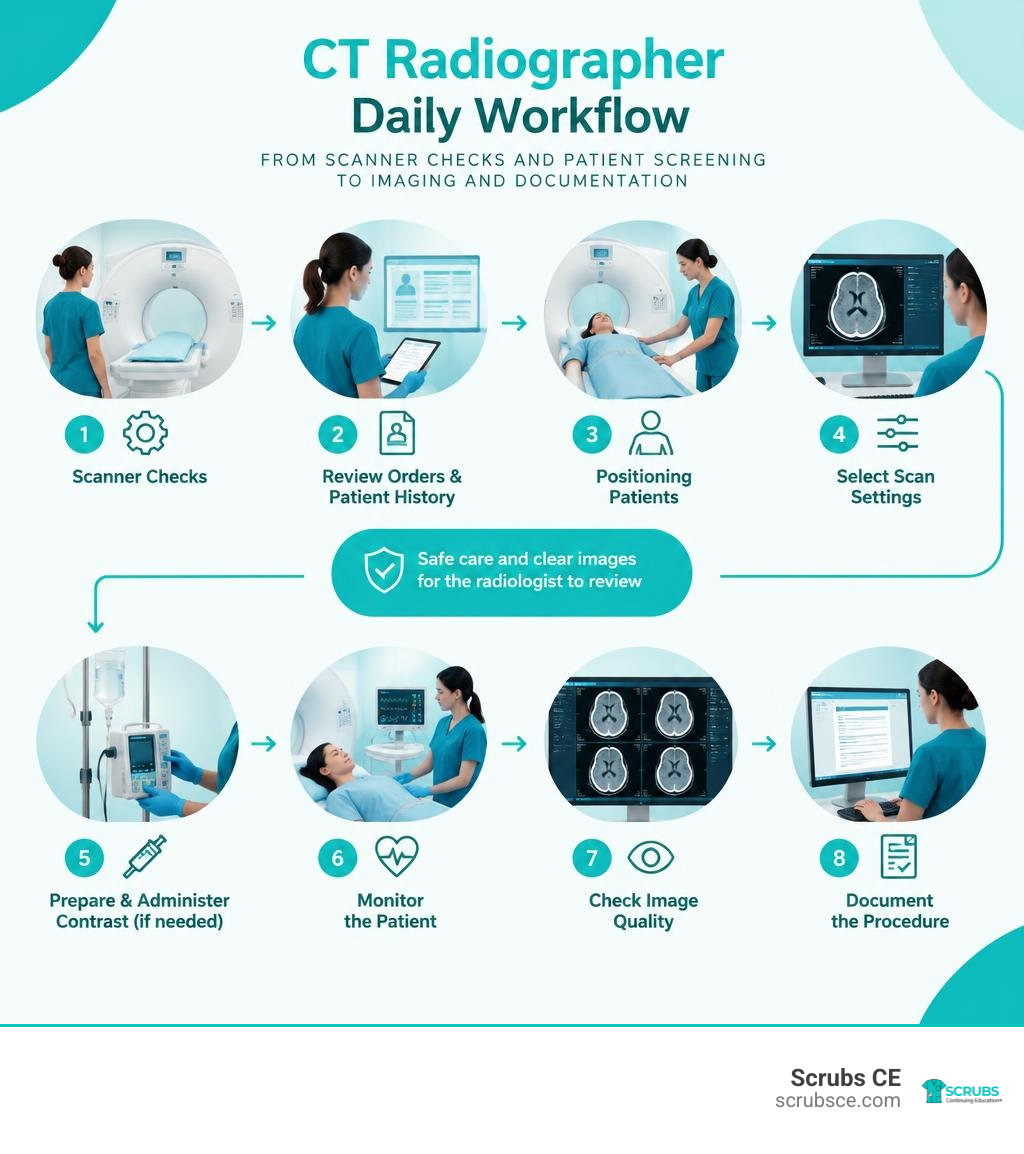
Essential ct radiographer daily duties and responsibilities terms:
1. Morning Shift Handover and Scanner Quality Assurance
Every shift in a busy Radiology department begins before the first patient ever rolls through the door. Handover communication sets the tone for the day. Technologists on incoming shifts receive updates on pending emergency department cases, critically ill inpatients requiring scan monitoring, scanner performance anomalies, and inventory levels for contrast agents and intravenous tubing.
Following handover, the immediate priority is scanner quality assurance (QA). Modern computed tomography units feature high-speed rotating gantries and sensitive multidetector arrays that require strict thermal and electronic stability. Technologists execute automated tube warm-up protocols to gently heat the X-ray tube anode, preventing thermal shock and extending component lifespan.
Next, we run air calibrations to balance detector sensitivity across the entire arc. We also position specialized tissue-equivalent phantoms in the gantry center to measure CT numbers (Hounsfield units) of known substances like water and air. These tests verify water reads zero Hounsfield units within standard tolerances, ensuring image noise and low-contrast resolution meet clinical requirements. Imaging suites regularly look ahead to equipment longevity through proactive maintenance and future-proofing CT hardware to minimize unplanned downtime.
Equipment Calibration and Daily Troubleshooting
Daily quality control is both an operational necessity and a regulatory obligation. In accordance with guidelines like The Practice Standards for Medical Imaging and Radiation Therapy, CT radiographers inspect the scanning suite for mechanical integrity. We test emergency stop buttons, verify table movement accuracy, inspect the integrity of lead shielding, and clean injector pistons.
When artifacts appear on calibration images—such as ring artifacts caused by miscalibrated detector elements or streak artifacts from detector drift—the technologist troubleshoots immediately. Simple recalibrations often resolve minor shifts. When hardware faults persist, the technologist documents error codes, takes the system offline to protect patient safety, and escalates the issue to biomedical service engineers.
2. Core CT Radiographer Daily Duties and Responsibilities in Patient Care
While CT technology is intricate, compassionate patient care remains our central duty. Patients arrive in imaging suites under stressful circumstances, ranging from acute trauma and stroke alerts to oncology staging. Technologists bridge the gap between complex machinery and human comfort, explaining procedures clearly to alleviate anxiety.

Safety begins before positioning. Technologists practice standard infection control, donning essential PPE requirements based on clinical presentation. We establish reliable peripheral intravenous access, typically placing an 18- or 20-gauge catheter into an antecubital vein capable of handling flow rates between 3 and 6 mL/second for rapid contrast delivery. We monitor patient vitals continuously during dynamic acquisitions, watching closely for signs of vagal responses or contrast reactions.
A CT Radiographer’s Daily Duties and Responsibilities During Patient Intake and Safety Screening
Intake screening requires disciplined attention to detail. Technologists verify the physician order against the patient’s clinical presentation to ensure exam appropriateness. We confirm two unique patient identifiers and review relevant laboratory values, particularly estimated glomerular filtration rate (eGFR) and serum creatinine, to assess renal clearance prior to administering iodinated contrast agents.
Federal occupational data on 29-2034.00 – Radiologic Technologists and Technicians highlights that reviewing health histories and screening for contraindications are fundamental daily tasks. Technologists confirm the absence of prior severe contrast reactions, assess diabetic medication regimens (such as metformin use), and screen all individuals of childbearing capacity for potential pregnancy. In non-emergency scenarios, informed consent is secured after outlining the benefits and potential risks of both ionizing radiation and contrast administration.
Patient Positioning and Radiation Dose Optimization
Proper patient positioning is essential for diagnostic quality and radiation dose management. Using internal sagittal and coronal laser alignment lights, technologists center the anatomical region of interest precisely at the scanner isocenter. Off-centering can degrade spatial resolution and cause automatic tube current modulation algorithms to deliver unnecessarily high radiation doses.
Technologists employ positioning sponges and immobilization straps to maintain stability and avoid motion artifacts, which prevents repeat scans. We apply ALARA (As Low As Reasonably Achievable) principles on every examination by utilizing:
- Anatomically specific tube voltage (kVp) and current (mA) modulation
- Bismuth or lead shielding where clinically appropriate
- Iterative reconstruction algorithms that preserve high image quality at lower radiation doses
- Specialized weight-adjusted parameter tables when performing bariatric CT imaging to optimize tissue penetration without excessive patient exposure
3. Routine and Specialized CT Examinations Across the Shift
A standard shift brings an evolving mix of diagnostic imaging studies. Technologists perform routine unenhanced head scans to evaluate falls, altered mental status, or suspected intracranial hemorrhages. We conduct high-resolution chest CTs for interstitial lung disease and contrast-enhanced abdominal/pelvic examinations for acute conditions such as appendicitis, bowel obstruction, or diverticulitis.
Trauma cases require immediate prioritization and rapid execution. Technologists run rapid whole-body polytrauma series, capturing the head, cervical spine, chest, abdomen, and pelvis in minutes. Stroke alerts also trigger immediate action: technologists execute non-contrast head CTs followed by multiphase CT angiograms and CT perfusion studies, calculating cerebral blood volume and transit times to guide emergency thrombolytic intervention.
Executing Specialized Scans and Angiographic Studies
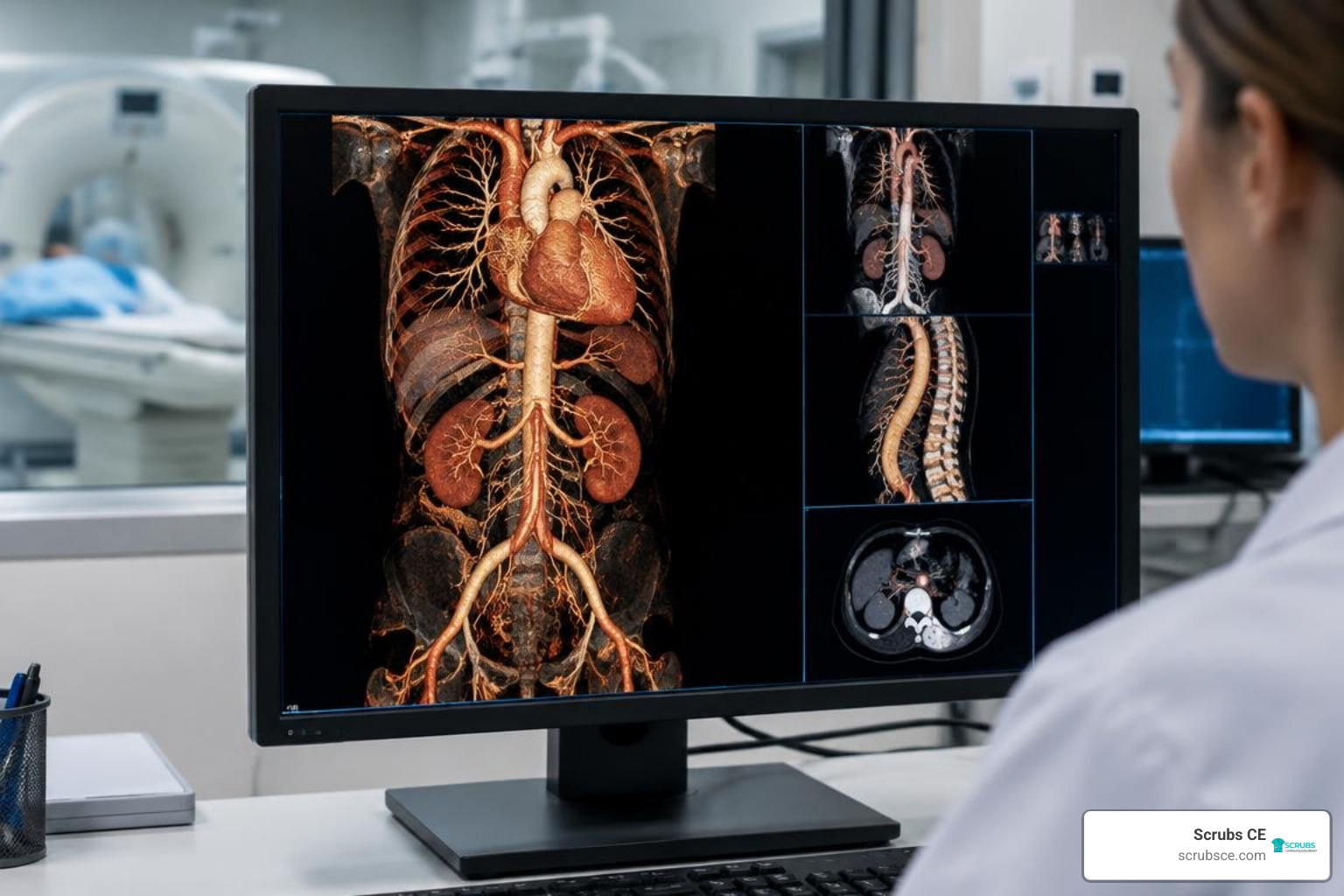
Advanced imaging requires precise timing and execution. For CT Angiography (CTA), technologists use automated bolus tracking software (such as SmartPrep or Care Bolus), placing a region-of-interest monitor over target vessels like the ascending aorta or pulmonary artery. When iodinated contrast concentration reaches a predefined Hounsfield threshold, the scanner automatically triggers data acquisition to catch peak arterial enhancement.
Technologists also perform specialized protocols, including dual-energy CT to characterize renal calculi composition or detect myocardial perfusion deficits. For complex cardiovascular diagnostics, we apply electrocardiogram (ECG) gating during cardiac CT angiography protocols to eliminate cardiac motion artifacts. Following data acquisition, technologists generate multiplanar reformations (MPR), maximum intensity projections (MIP), and 3D volume-rendered reconstructions to display vascular and skeletal anatomy for surgical teams.
4. Documentation, Interdisciplinary Collaboration, and Emergency Response
Once raw data is captured and reconstructed, the technologist’s administrative and communication responsibilities begin. We send complete image series to the Picture Archiving and Communication System (PACS) and verify that all reconstruction kernels, thin slices, and reformats transmit successfully. In the electronic medical record (EMR), we record procedural notes, IV catheter site and gauge, total volume and flow rate of contrast media, lot numbers, expiration dates, and total radiation dose metrics (Dose Length Product and Volume CT Dose Index).
Clear interdisciplinary collaboration is central to diagnostic Radiology. Technologists consult regularly with reading radiologists to discuss protocol adjustments for complex presentations or atypical anatomy. When urgent abnormalities appear—such as acute aortic dissections, tension pneumothoraces, active arterial extravasation, or intracranial herniation—the technologist immediately contacts the radiologist and the primary clinical team to communicate critical findings.
Technologists must also be prepared to manage clinical emergencies directly in the scanner suite. If a contrast reaction occurs, we assess the symptoms promptly:
- Mild reactions (urticaria, localized pruritus): Monitor vital signs, provide patient reassurance, and notify the supervising physician.
- Moderate to severe reactions (bronchospasm, laryngeal edema, anaphylaxis): Halt contrast injection, call the rapid response or code team, maintain airway patency, administer oxygen, and assist physicians with emergency medications like epinephrine.
- Contrast extravasation: Immediately terminate the injection, aspirate residual agent when possible, elevate the affected extremity, apply warm or cold compresses according to facility protocol, assess neurovascular integrity, and complete detailed incident documentation.
The comprehensive scope of these tasks is codified nationally in the Computed Tomography Task Inventory published by credentialing authorities.
5. Career Pathways, Education, and Clinical Practice Variations
Entering the profession requires structured education and formal credentials. Candidates complete an accredited associate or bachelor’s degree program in radiologic technology, followed by primary certification. Technologists then pursue post-primary certification through the AMERICAN REGISTRY OF RADIOLOGIC TECHNOLOGISTS® by documenting clinical competencies and passing the ARRT® credentialing examination. Professional organizations like the ASRT® establish ongoing clinical practice and ethics standards across the field.
Aspiring imaging specialists often use targeted ARRT® CT exam online prep to master physics, radiation safety, and cross-sectional anatomy.
| Dimension | General Radiologic Technologist (R.T.(R)) | Computed Tomography Technologist (R.T.(R)(CT)) |
|---|---|---|
| Primary Imaging Modality | Projectional 2D Radiography (X-ray), Fluoroscopy | Cross-Sectional 3D Volumetric CT Imaging |
| Contrast Media Administration | Oral contrast, assist fluoroscopy injections | High-pressure power injections of IV iodinated contrast |
| Radiation Dose Management | Manual technique selection (kVp/mAs), collimation | Iterative reconstruction, organ-specific mA modulation, DLP monitoring |
| Advanced Post-Processing | Basic digital adjustments, cropping, windowing | 3D volume rendering, MIP, MPR, perfusion analysis |
| Credentialing Pathway | Primary ARRT® examination in Radiography | Post-primary ARRT® examination in Computed Tomography |
| Emergency Case Involvement | Skeletal injury, standard portable chest imaging | Acute stroke perfusion, polytrauma series, aortic dissection triage |
How CT Radiographer Daily Duties and Responsibilities Differ by Work Environment
A CT technologist’s daily schedule and primary tasks vary depending on their work setting:
- Level 1 Trauma and Emergency Centers: High volume of urgent scans, unpredictable patient intake, extensive polytrauma protocols, and rapid stroke triage. Work schedules often feature rotating shifts, overnights, weekends, and on-call rotations.
- Outpatient Imaging Facilities: Scheduled diagnostic appointments, consistent throughput, contrast-enhanced oncology follow-ups, arthrograms, and musculoskeletal assessments. Shifts are typically predictable daytime hours with minimal on-call demands.
- Ambulatory Surgical Centers: Focused on interventional CT guidance for biopsies, drainages, pain management injections, and preoperative planning.
- Mobile CT Units: Travel between regional community health centers or rural facilities, requiring technologists to handle equipment transport setup, independent patient registration, and system calibration alongside standard imaging tasks.
Meeting the baseline CT technologist requirements helps ensure clinicians adapt across any of these environments.
Frequently Asked Questions About CT Radiographer Roles
What are the primary daily duties of a CT radiographer?
A CT radiographer checks and calibrates the scanner, evaluates physician orders, reviews patient labs, screens for contraindications, establishes IV access, administers contrast agents, positions patients accurately, selects optimized radiation protocols, executes scans, generates 3D multiplanar reconstructions, and archives images to PACS with complete EMR documentation.
How much does a CT radiographer earn in 2026?
According to national occupational wage metrics, the median annual wage for radiologic and CT technologists is approximately $80,110 to $80,984, with overall earnings typically spanning from $64,910 for entry-level positions to over $121,420 for experienced specialists. Weekly contract and travel rates average around $2,443, with compensation influenced by geographical region, shift differentials, and clinical setting.
What qualifications are required to practice as a CT technologist?
Technologists must complete an accredited radiography program, obtain primary radiography certification, secure state licensure where mandated (over 75% of states require dedicated licensing), earn Basic Life Support (BLS/CPR) certification, and obtain post-primary CT certification through the AMERICAN REGISTRY OF RADIOLOGIC TECHNOLOGISTS® (ARRT®). Maintaining active credentials requires completing mandatory continuing education credits on an ongoing basis.
Conclusion
The daily responsibilities of a CT radiographer blend technical expertise with attentive, compassionate patient care. From morning system calibrations and contrast screening to urgent trauma evaluations and advanced 3D multiplanar reconstructions, CT technologists play an indispensable role in accurate diagnostic Radiology. As imaging technologies advance with faster scan speeds and artificial intelligence reconstruction tools, keeping your clinical knowledge current is essential for safe practice and career growth.
Whether you are preparing for registry examinations or fulfilling mandatory renewal requirements, explore our comprehensive catalog of accredited computed tomography certification continuing education at Scrubs CE. Our self-paced, convenient online courses deliver instant certificates to help you meet ARRT® and state licensing requirements seamlessly.