
Everything You Need to Know About Virtual Support for CT Technologists
What Is CT Tech Remote Support and How Does It Work?
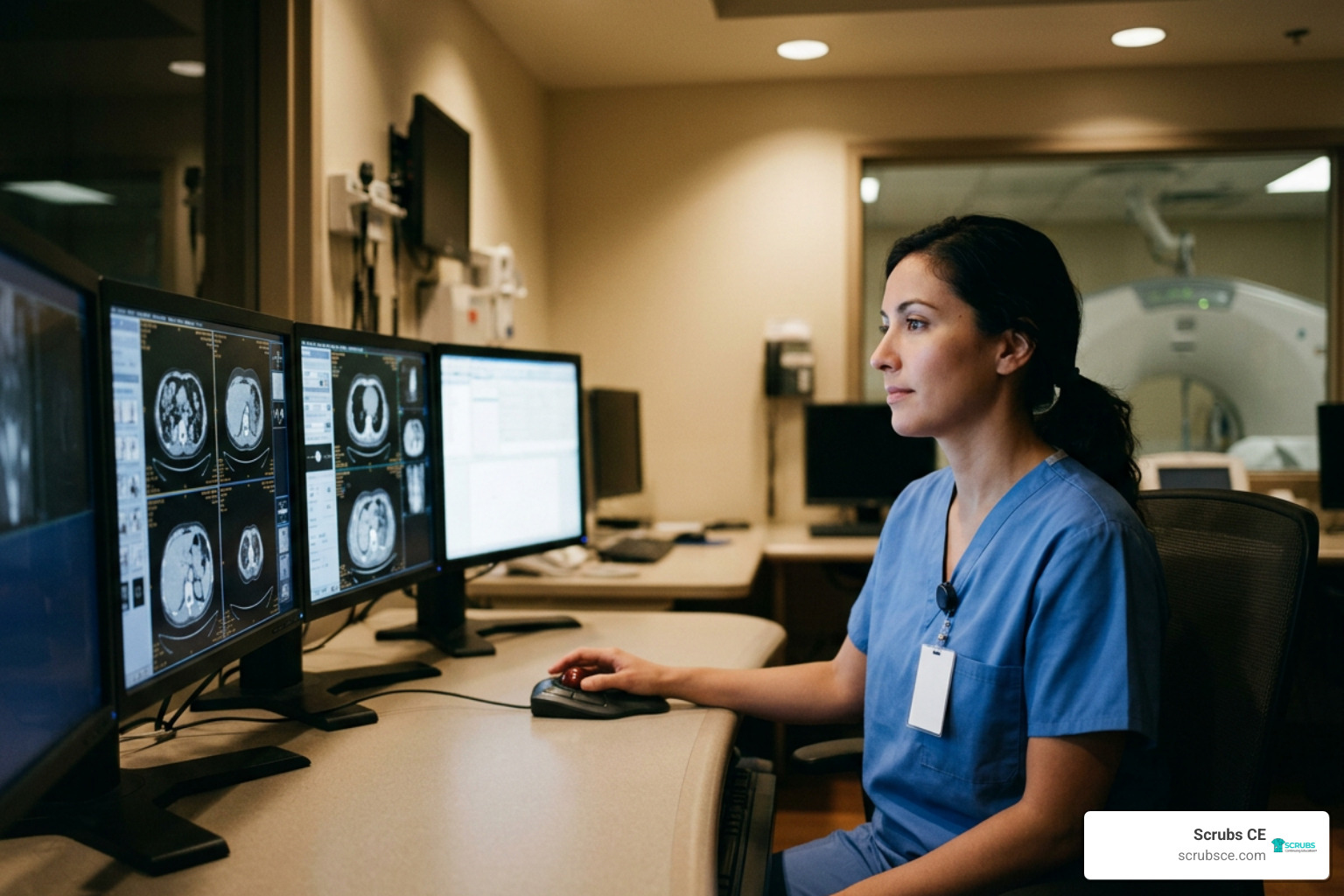
Virtual support bridges the gap between specialized clinical expertise and on-site patient care. In traditional healthcare environments, an advanced imaging department relies on having every tier of clinical and technical expertise physically present at the scanner console. When a complex protocol arises or staffing runs thin, facilities face delayed patient throughput or diverted emergency scans.
Virtual operations change this dynamic by separating physical patient handling from digital protocol configuration and system monitoring. A remote specialist connects directly to the imaging environment over high-bandwidth, encrypted networks. While the local team positions the patient and establishes intravenous access, the virtual specialist reviews order requisitions, checks previous imaging series, verifies scan boundaries, and adjusts radiation dose modulation parameters in real time.
Facilities modernizing their hardware fleets increasingly configure new scanners with teleassistance capabilities right out of the box. Investing in modern systems often ties directly into future proofing your imaging department a guide to ct hardware upgrades, ensuring that consoles can integrate with secure digital networks without degrading scan speed or image reconstruction fidelity.
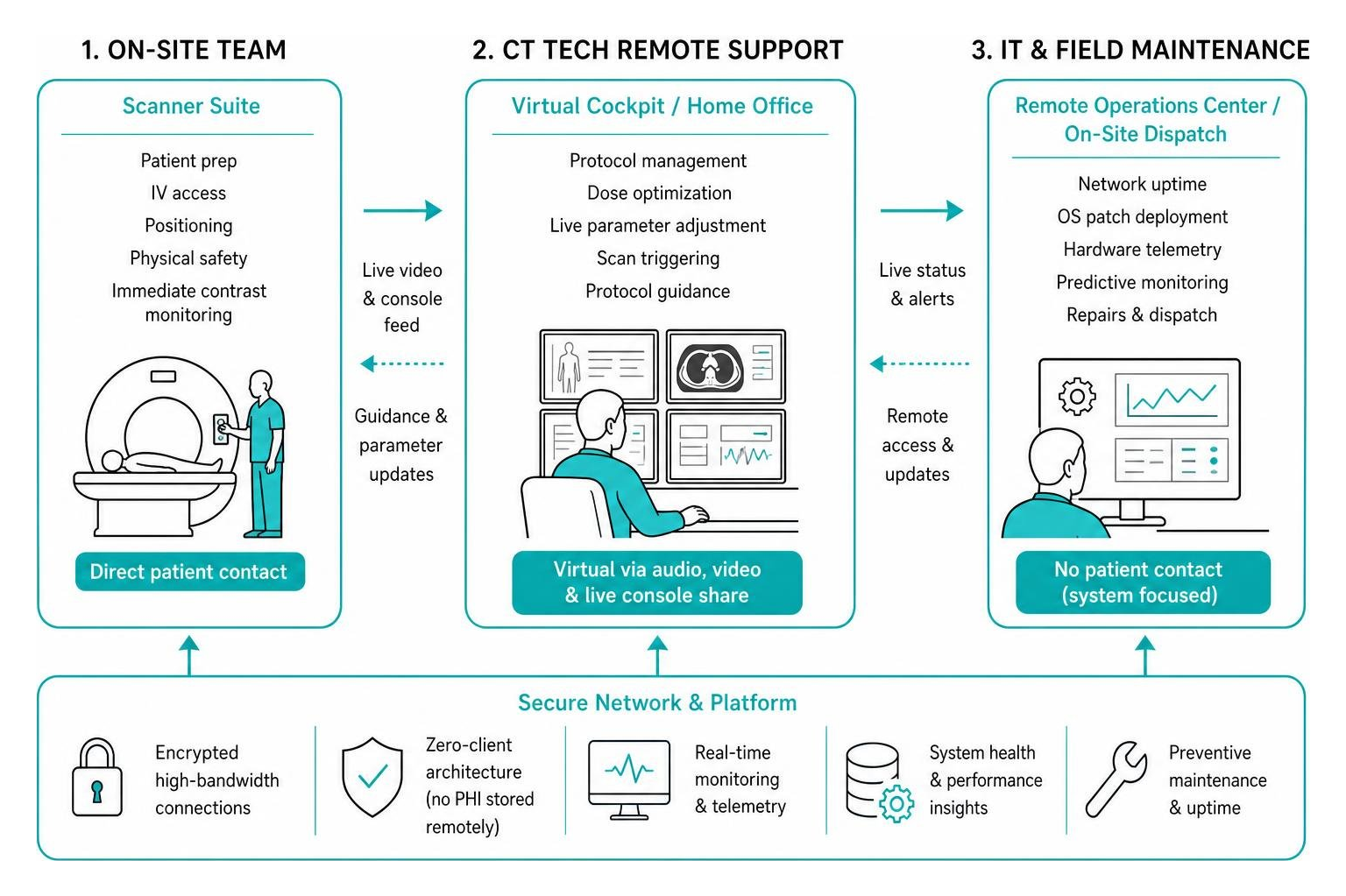
| Model | Primary Location | Key Responsibilities | Patient Contact |
|---|---|---|---|
| On-Site Staffing | Scanner suite | Patient prep, IV access, positioning, physical safety, immediate contrast monitoring | Direct, continuous physical contact |
| CT Tech Remote Support | Centralized virtual cockpit / home office | Protocol management, dose optimization, live parameter adjustment, scan triggering | Virtual via high-definition audio, video, and live console share |
| IT & Field Maintenance | Remote operations center / on-site dispatch | Network uptime, OS patch deployment, hardware sensor telemetry, predictive repairs | None (system and infrastructure focused) |
Remote Scanning vs Teleassistance vs IT Maintenance
It is helpful to distinguish between the three primary tiers of off-site assistance operating across modern Radiology networks:
- Remote Scanning (Virtual Control): A qualified technologist takes direct control of the acquisition workstation from a remote console. They review the scout, set up anatomical range boxes, trigger the scan sequence, and supervise reconstruction parameters.
- Teleassistance (Real-Time Guidance): The local technologist maintains primary console control, while a remote senior specialist provides over-the-shoulder guidance via interactive screen sharing, chat, and voice feeds. This model proves invaluable for coaching junior techs through specialized pediatric, bariatric, or vascular protocols.
- IT and Hardware Monitoring: This tier focuses purely on technical uptime. Platforms such as CT Tech Support – On-Site & Remote IT Support or specialized vendor monitoring centers evaluate scanner telemetry. For instance, a Technical Service Specialist – CT Systems tracks tube temperature, gantry rotation balance, chiller loop pressures, and high-voltage electronics to catch mechanical faults before they cause equipment downtime. General support services like CTNY Tech Remote Services or CTNY Tech Computer Services: On-Site Throughout Fairfield & New Haven Counties + Global Remote Support handle supplementary IT and connectivity layers.
Core Technologies Powering Virtual Radiology Consoles
Modern virtual cockpits rely on software solutions that provide low-latency screen replication, bidirectional audio-video feeds, and console control without introducing perceptible lag. Platforms like Canon Remote Assist and Siemens Healthineers syngo Virtual Cockpit allow centralized technologists to oversee multiple systems concurrently.
These systems utilize zero-client architectures. In a zero-client environment, image data, patient identifiers, and diagnostic series are rendered on the host console in the hospital and transmitted as encrypted pixel streams to the remote user. No protected health information (PHI) is cached or stored on the remote computer, maintaining strict data boundaries while allowing complete operational fluidity.
Clinical and Operational Benefits for Healthcare Facilities
Distributing clinical expertise virtually helps healthcare networks solve persistent operational bottlenecks. When senior technologists can project their expertise across multiple sites, facilities experience shorter scan turnaround times, fewer protocol errors, and lower overall operational stress. Technologists interested in honing their advanced protocol skills can explore the best ce for ct technologists to stay ahead of these digital workflow shifts.
Improving Patient Care and Staffing in Rural Hospitals
Rural critical access hospitals often struggle to maintain round-the-clock specialized CT coverage. When an emergency trauma or stroke patient arrives during the night shift, a solo local technologist might have general radiography experience but feel less confident executing high-speed, dual-phase neurovascular protocols.
Virtual CT operations allow rural facilities to connect instantly with a remote specialist. The remote technologist loads the exact protocol, verifies gating parameters, and assists in scanning, ensuring that patients in remote communities receive the exact same imaging quality as patients at tertiary academic medical centers.
Real-Time Protocol Optimization for Complex Scans
Subsecond timing and precise anatomy tracking are critical for advanced applications. In emergency cardiac evaluations, combining correct ECG pulsing windows with contrast bolus tracking determines whether a study is diagnostic. Technologists managing these workflows benefit from foundational knowledge found in beyond the x ray understanding cardiac ct angiography.
Similarly, adjusting kilovolt peak (kVp) settings, mA modulation, and pitch for patients with high body mass indexes requires careful balancing of tube current and image noise. Reviewing techniques outlined in bariatric ct imaging empowers both on-site and remote teams to minimize beam hardening artifacts while keeping radiation dose ALARA (As Low As Reasonably Achievable).
The Technologist Experience: Benefits, Workflows, and Daily Operations
Working in a remote operations center or dedicated home workspace offers a distinct change of pace from traditional scanner suites:
- Elimination of Daily Commuting: Remote technologists save hours each week by working from centralized regional hubs or compliant home setups.
- Ergonomic, Low-Noise Environments: Technologists spend their shifts in quiet, ergonomically optimized workspaces away from scanner acoustic noise, gantry heat, and chaotic emergency corridors.
- Reduced Physical Strain: Virtual positions eliminate the continuous physical lifting, patient transferring, and heavy equipment maneuvering that often contribute to career-ending musculoskeletal injuries.
- Enhanced Focus on Technical Parameters: Without the physical distractions of room turnover and linen management, specialists can devote 100% of their cognitive bandwidth to protocol perfection, image reconstruction, and radiation safety.
Specialists interested in field engineering and hybrid operational structures can evaluate roles such as a Remote Field Services Engineer at CTS • $60k – $80k | Hiring.Camp to see how remote diagnostic tools integrate with hands-on service careers.
Daily Workflow in a CT Tech Remote Support Center
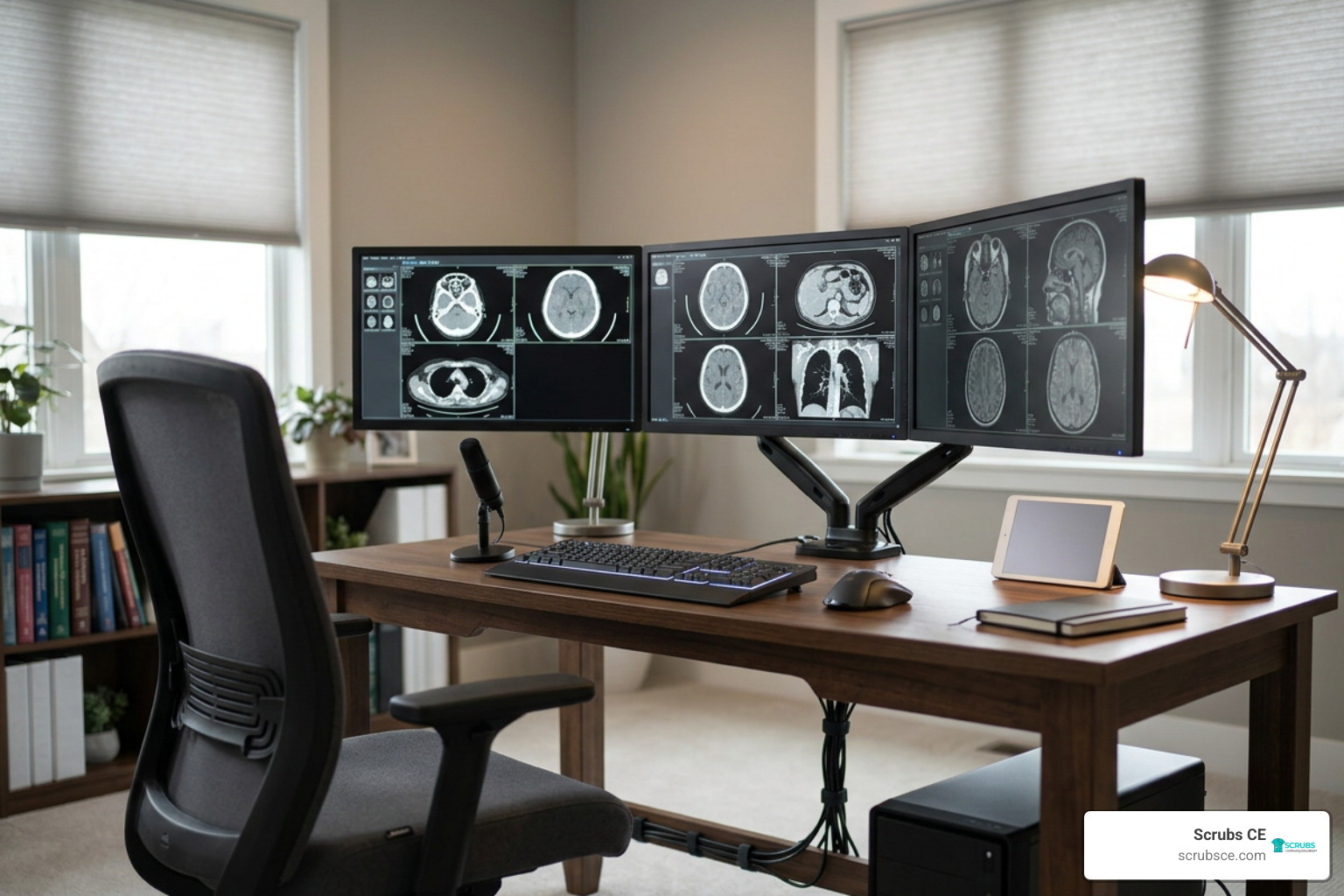
A typical shift begins in a multi-monitor cockpit equipped with dedicated communication panels, an enterprise RIS/PACS interface, and real-time scanner console links.
- Shift Handover and Lineup Review: The remote technologist logs into active sessions—frequently using platforms like C_Tech Remote Sessions to establish secure handshakes—and reviews scheduled contrast studies across designated partner sites.
- Pre-Scan Protocol Audit: As the local patient manager brings a patient into the scanning room, the remote specialist reviews the requisition, checks renal function labs, and verifies contrast volume requirements.
- Live Communication and Console Setup: Using dedicated voice headsets and integrated chat windows, the remote specialist confirms with the on-site tech that the IV line is patent and the patient is positioned at the laser landmark.
- Acquisition and Quality Assurance: The remote technologist triggers the scout, adjusts scan coverage margins, verifies bolus tracking triggers, and monitors the acquisition. Once reconstructed, they inspect the series for motion or contrast artifacts before releasing the patient.
Balancing Remote Flexibility with Patient Safety Considerations
While virtual assistance improves technical execution, it introduces unique responsibilities for patient safety that require tight on-site coordination.
A remote technologist cannot physically palpate an IV site during a high-pressure contrast injection. If an extravasation occurs, the on-site team must be fully trained to stop the injection immediately and assess tissue integrity. Facilities mitigate this risk by utilizing contrast injectors equipped with extravasation detection accessories (EDA) and programmable pressure limiters (typically capped between 300 and 325 psi). The remote technologist monitors injection pressure curves on their telemetry display while the on-site patient manager stays directly beside the patient during the initial contrast delivery phase.
Qualifications, Credentialing, and Training Requirements
Operating as a virtual CT specialist requires advanced clinical acumen and proven technical versatility across diverse hardware platforms.
Technologists must first meet core clinical competencies before transitioning to virtual cockpits. A solid understanding of baseline education and credential paths is outlined in our beginners guide to computed tomography technician certification, while specific state and institutional prerequisites are detailed in our breakdown of ct technologist requirements.
Meeting Professional Standards for CT Tech Remote Support
To command consoles across multiple hospitals, technologists must maintain their primary certification through the AMERICAN REGISTRY OF RADIOLOGIC TECHNOLOGISTS® (ARRT®), hold a post-primary credential in Computed Tomography (R.T.(R)(CT)(ARRT®)), and abide by the ARRT® Standards of Ethics and ASRT® Practice Standards.
Technologists must also log structured continuing education credits to keep their knowledge aligned with modern dose reduction algorithms, photon-counting detectors, and advanced cross-sectional anatomy. Technologists can maintain their credentials through convenient courses designed for ct ceu credits and broader ct mri ce requirements. Those reviewing their biennial milestones can consult our computed tomography ce complete guide or explore fast, flexible options in shockingly easy ways to earn your pediatric and ct imaging ce credits.
Military veterans transitioning into civilian diagnostic imaging can chart their trajectory using military to medical your roadmap to becoming a ct technologist, while students mapping out initial academic routes can research local options via ct and mri certificate programs near me your ticket to a high tech career.
Ensuring Strict HIPAA Compliance and Data Security
Operating across decentralized networks requires rigorous data protection protocols:
- Encrypted VPN Tunnels: All telemetry and control data stream across AES-256 encrypted virtual private networks.
- Role-Based Access Controls (RBAC): Technologists authenticate using multi-factor credentials, gaining access only to the specific scanner sessions assigned to their shift.
- Zero Local Data Caching: Host platforms prohibit local screen capturing, file exporting, or local caching of patient images, ensuring that no electronic protected health information (ePHI) ever resides on off-site hard drives.
- Audit Trails: Every mouse click, parameter change, and communication log is stamped with technologist identification for comprehensive quality assurance reviews.
Future Outlook for Virtual Imaging and Nationwide Teleassistance
The integration of artificial intelligence and high-speed fiber connectivity is transforming virtual Radiology networks into agile, multi-facility operations.

As AI algorithms automate baseline segmentation and noise filtering, remote technologists will increasingly operate as supervisory clinical conductors. Beyond standalone CT operations, hybrid imaging modalities are also embracing remote consultation models; technologists managing hybrid SPECT/CT platforms can explore foundational concepts in the spect ct scan explained how this advanced imaging works.
Cross-State Licensing and Global Remote Radiology Trends
The long-term expansion of virtual imaging operations depends on state licensing reform. As multi-state licensing compacts gain traction, specialized technologists will be able to support hospital networks across state lines during regional emergencies, off-hours spikes, or local staffing shortages. Centralized operation centers will provide round-the-clock specialized coverage, leveling the standard of imaging care across urban centers and rural community clinics alike.
Frequently Asked Questions About Virtual CT Assistance
Can a remote technologist administer contrast media or position patients?
No. Physical tasks—including patient verification, positioning at the laser landmark, IV placement, and contrast injector loading—must always be performed by a qualified on-site healthcare professional. The remote technologist focuses on protocol selection, dose parameters, timing coordination, and image acquisition.
How does remote CT scanning maintain patient safety during emergencies?
Remote systems feature instant protocol abort switches and immediate voice-link overrides. If a patient displays distress, movement, or signs of an adverse reaction, the remote technologist or the on-site staff can abort the scan immediately. The on-site team provides hands-on emergency response while the remote tech documents scan parameters and notifies the radiologist.
What certifications are required to work in virtual CT operations?
Employers generally require a current ARRT® post-primary certification in Computed Tomography, valid state licenses for the facility locations being supported, and extensive on-site clinical experience (typically 3 to 5 years) across multiple scanner platforms.
Conclusion
Virtual operations represent a major step forward in how healthcare systems deploy clinical expertise and maintain high standards of patient care. By pairing on-site patient care teams with remote specialists, hospitals can eliminate coverage gaps, optimize complex imaging protocols, and ensure rapid diagnostic services for every patient regardless of geographic location.
For imaging professionals, virtual support offers new career paths that reward deep clinical expertise, protocol mastery, and clear communication. Staying current with evolving modality standards is the key to thriving in these modern imaging workflows. We invite you to explore our course catalog and earn your computed tomography certification CE credits with SCRUBS Continuing Education® to expand your skills and lead the future of diagnostic imaging.