
How to Start Nursing Assistant Renewal

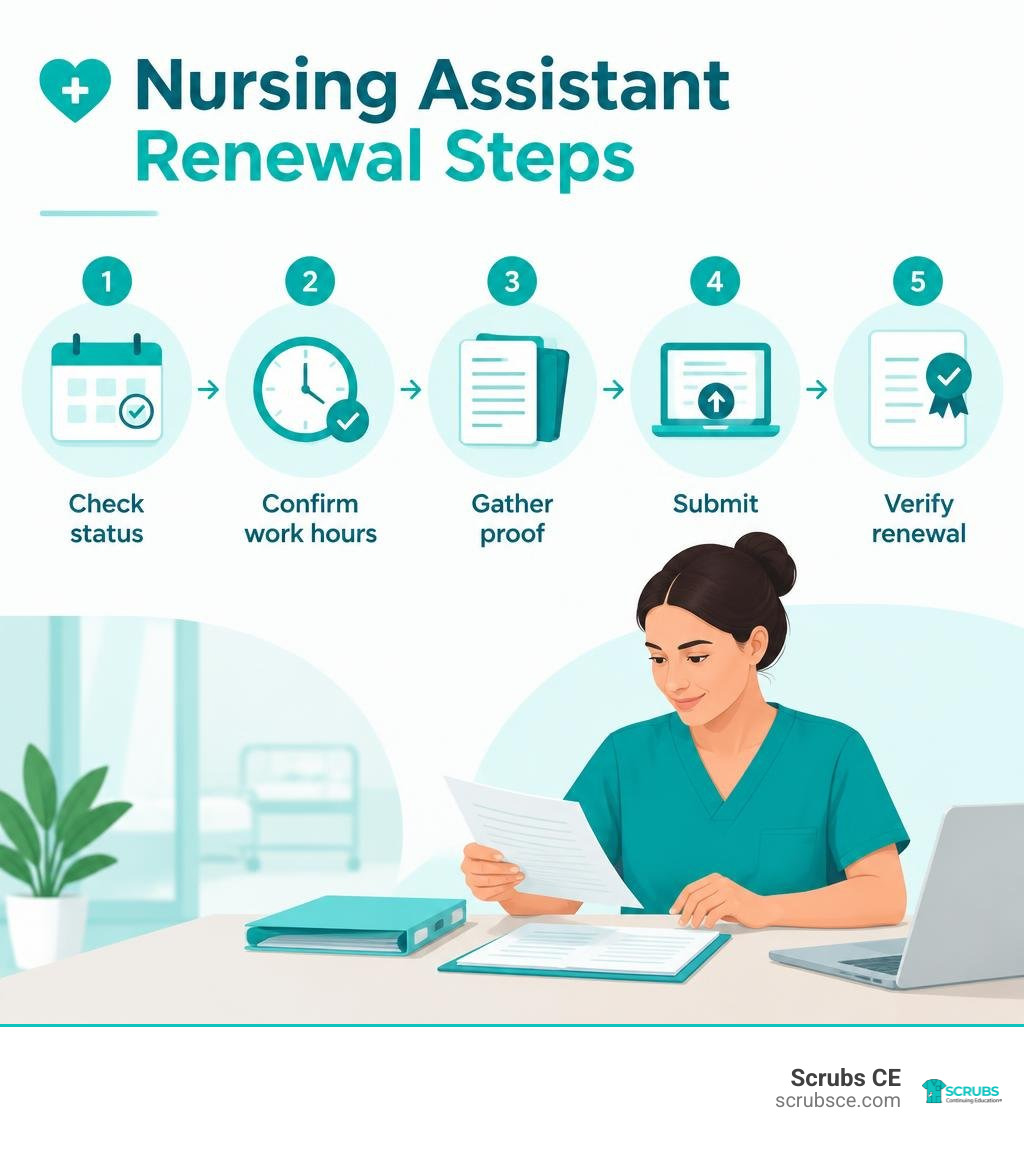
To start nursing assistant renewal, check your expiration date on your state nurse aide registry. Then confirm that your paid work meets your state’s rules, gather proof of employment, and submit the renewal form before the deadline. Requirements vary: New York calls for 7 hours of qualifying work in the past 24 months, while Arizona requires 160 hours over two years. Check your state’s rules before you apply.
If your certification has expired, contact the registry before working as a certified aide. You may need to provide more work records or pass a competency exam.
I’m Zita Ewert, and I lead continuing education programs that help healthcare professionals understand licensure requirements. I’ll use that experience to make nursing assistant renewal easier to navigate, while keeping state-specific rules front and center.
Explore more about nursing assistant renewal:
Core Work and Practice Requirements for Nursing Assistant Renewal
Maintaining an active listing on your state’s nurse aide registry protects your ability to provide bedside care without interruption. Across the United States, federal baseline rules require nurse aides to perform paid nursing or nursing-related duties within a standard 24-month validity cycle. However, state regulatory boards interpret and expand upon these baseline rules in unique ways. Following practical steps to renew your CNA license ensures you do not inadvertently let your certification lapse.

To qualify for renewal, your work must involve actual nursing tasks—such as assisting with activities of daily living (ADLs), vital sign monitoring, and mobility support—performed under the direct supervision of a licensed healthcare professional, usually a Registered Nurse (RN). Unpaid volunteering, informal family caregiving, and companion sitting do not satisfy state registry requirements.
Employment settings also dictate eligibility:
- Approved Facilities: Certified nursing facilities, licensed skilled nursing homes, hospitals, and assisted living centers almost universally satisfy renewal mandates.
- Home Health Agencies: Working for a licensed home health agency under RN supervision meets state requirements across the country.
- Private Duty Care: Direct-hire, private-duty employment paid out-of-pocket by a client often faces strict scrutiny. In states like North Carolina, standard private duty work is excluded unless the aide provides care through specific Home and Community-Based Services (HCBS) programs like CAP/DA or CAP/C with verifiable RN oversight.
Under statutory rules such as Section R4-19-809. Nursing Assistant and Medication Assistant Certificate Renewal, state nursing boards require verification of continuous practice. The RN supervisor or authorized human resources representative must sign an employment verification document confirming your dates of employment, job title, and total hours worked before your state registry processes your application.
Comparing State-by-State Work Hour Standards for Nursing Assistant Renewal
State requirements for nursing assistant renewal vary significantly in the minimum hours required and associated administrative costs. While some states only require a single documented shift, others demand substantial clinical hours over the two-year cycle.
| State | Minimum Work Requirement | Continuing Education (CEU) | State Renewal Fee | Verification Method |
|---|---|---|---|---|
| New York | 7 hours within past 24 months in an Article 28 facility | Not mandated for standard renewal | $40 | Prometric renewal form / Employer sign-off |
| Pennsylvania | 1 documented day (8 consecutive hours) in past 24 months | Not mandated for standard renewal | $0 (Funded by state/employer) | Credentia platform online employer verification |
| Massachusetts | 8 hours of paid nursing-related duty in past 2 years | Not mandated for standard renewal | $0 | Health Profession Licensing System portal |
| Arkansas | 1 documented day (8 hours) in past 2 years | Not mandated for standard renewal | $0 | AR DHS Registry portal / Pay stub & notarized letter |
| Florida | Paid nursing duties within past 24 months (no 24-month gap) | 24 hours per biennium | $20 – $50 | FL Board of Nursing online portal |
| Arizona | 160 hours within past 2 years | Not mandated if work hours met | Board fee applies if late | AZBN Nurse Portal / Employer verification |
Under Arkansas administrative rules outlined in 20 CAR § 403-603. Certification renewal – Code of Arkansas Rules, an aide who works for a private-pay client must submit both a pay stub and a notarized employer letter detailing their clinical duties over the 24-month period to maintain an active registry status.
Continuing Education and In-Service Training Rules Across States
While clinical work hours form the backbone of recertification in most jurisdictions, several states require formal continuing education units (CEUs) or structured in-service education hours during each biennial cycle.
For instance, statutory law under SECTION 464.203. Certified nursing assistants; certification requirement. mandates that Florida certified nursing assistants complete 24 hours of in-service training during each biennium. Topics mandated by regulatory bodies typically include:
- Infection control and prevention protocols
- Resident rights and medical ethics
- Patient safety, fall prevention, and emergency procedures
- Dementia care and communication strategies
- Documentation practices and medical error prevention
Keeping your educational records organized is vital. Understanding nurse aide certificate renewal helps you navigate the intersection between clinical practice hours and CE contact hours. When you complete courses through our platform at Scrubs CE, we provide convenient, affordable online continuing education designed for healthcare professionals. Our self-paced courses issue instant certificates upon completion, making it simple to document compliance and maintain audit-ready records for state boards.
Step-by-Step Guide: How to Complete Your Renewal Application Online
Most states have phased out paper applications in favor of centralized digital portals managed by state health agencies or testing vendors such as Credentia and Prometric. For example, New York has eliminated paper certificates, handling registry updates digitally.

Follow these steps to submit your application cleanly and avoid processing bottlenecks:
- Check Your Eligibility Window: Most states open their digital renewal windows approximately 60 days before your certification expires. In Rhode Island and Arkansas, state departments generate renewal notices within this 60-day timeframe.
- Access Your State Portal: Log into your state’s designated management portal (e.g., Credentia Platform account in Pennsylvania, the Health Profession Licensing System in Massachusetts, or the Prometric portal in New York).
- Input Work Verification: Enter your facility license number, dates of employment, and RN supervisor details. If your state uses electronic verification, the system will route an automated notification to your employer.
- Attach Supporting Documents: Upload required pay stubs, continuing education completion certificates, or notarized verification letters if you work in home care.
- Submit Payment: While many states (such as Massachusetts, Pennsylvania, and Arkansas) offer free renewals for aides working in certified facilities, others charge a renewal fee. New York requires a $40 fee (payable via certified check or money order through Prometric), while Florida’s biennial fee ranges from $20 to $50.
Learning the process for renewing your CNA license online in under an hour saves you administrative frustration and ensures uninterrupted employment.
Managing Name and Address Updates During Nursing Assistant Renewal
Failing to report a legal name change or a new home address can lead to missed expiration notices and delays in registry verification. Registry records must match your legal identification documents exactly.
When submitting changes through your state licensing board or portals like the Nursing Assistant | Department of Health system in Rhode Island:
- Name Amendments: You must upload certified legal documentation proving the change, such as a marriage certificate, divorce decree, naturalization document, or court-ordered name change form. Ensure hyphens and suffixes match your legal photo ID exactly.
- Address Updates: Update your physical and mailing address directly inside your online profile. Most registries update contact information within 3 to 5 business days, ensuring official correspondence reaches you on time.
Handling Expired Credentials, Retesting, and Registry Disqualifications
Allowing your certification to lapse past the expiration date changes the recertification pathway considerably. Once your status becomes inactive, you cannot legally work as a certified nursing assistant until the registry reinstates your credential.
Lapsed Certifications and Retesting Thresholds
If your certification has expired, your options depend on how long the credential has been inactive:
- Continuous Employment Exceptions: In Massachusetts, an aide whose certification lapsed but who maintained continuous, uninterrupted employment performing nursing duties can often renew via employer documentation without taking a new exam.
- The 24-Month Rule: In Arkansas, if your certification has been expired for longer than 24 consecutive months, it cannot be renewed through standard paperwork. The individual must complete 16 hours of clinical training and pass the competency evaluation exam again.
- Statutory Lapses Under Five Years: Under 26 V.S.A. § 1645. Renewal, Vermont requires nursing assistants who have experienced an absence from practice of fewer than five years to retake and pass the approved competency examination. If an applicant fails the exam, they must repeat an approved training program before retesting.
Reviewing our guidance on renewing an expired CNA license and our practical recertification guide for CNA reentry will help you determine whether you qualify for administrative reinstatement or must schedule a written and skills re-examination.
Registry Disqualifications and Disciplinary Findings
Under federal regulation 42 CFR 483.12, state registries must permanently record substantiated findings of resident abuse, neglect, or misappropriation of resident property. An active finding of abuse or property misappropriation will disqualify an individual from working in certified healthcare facilities and permanently block registry renewal.
In cases involving a single finding of neglect, states such as Massachusetts provide a formal petition process. An aide can petition the Department of Public Health in writing to request the removal of the neglect finding after establishing at least one continuous year of unblemished, incident-free employment.
Frequently Asked Questions About Nurse Aide Recertification
What is the minimum number of hours required to renew a CNA certification?
Under federal guidelines, nurse aides must perform at least 8 hours of paid nursing or nursing-related services within a 24-month period under the supervision of a licensed nurse. Individual states can establish higher thresholds. For example, New York requires a minimum of 7 paid hours in an Article 28 facility, while Arizona mandates at least 160 hours of nursing assistant work over the two-year cycle.
Can private duty or home caregiving work count toward renewal?
Direct-hire private duty work without RN supervision generally does not count toward renewal in most states. However, if you are employed by a licensed home health agency where care is directed and documented by a Registered Nurse, those hours qualify. In addition, state-administered Medicaid waiver programs (such as North Carolina’s CAP/DA program) allow private duty hours if proper state verification paperwork is submitted.
How long can a CNA certification be expired before full retesting is mandatory?
In most states, a certification that has lapsed for more than 24 months requires full competency re-examination (both written and clinical skills). In Arkansas, aides lapsed beyond 24 months must also complete 16 hours of clinical training before retesting. In Vermont, licensees absent from practice for up to five years must pass competency examinations to regain active status.
Conclusion
Keeping your nurse aide credential in good standing protects your career and ensures uninterrupted patient care. By tracking your expiration dates, verifying your clinical hours under RN supervision, and fulfilling state-mandated continuing education requirements early, you can navigate recertification smoothly.
When you need flexible continuing education to maintain your professional qualifications, explore our course library to keep your CNA status active with online renewal. At Scrubs CE, we are dedicated to providing accessible, self-paced learning resources with instant certification so you can focus on delivering exceptional patient care.