
Radiologic Technologist Salary: What to Expect in 2026

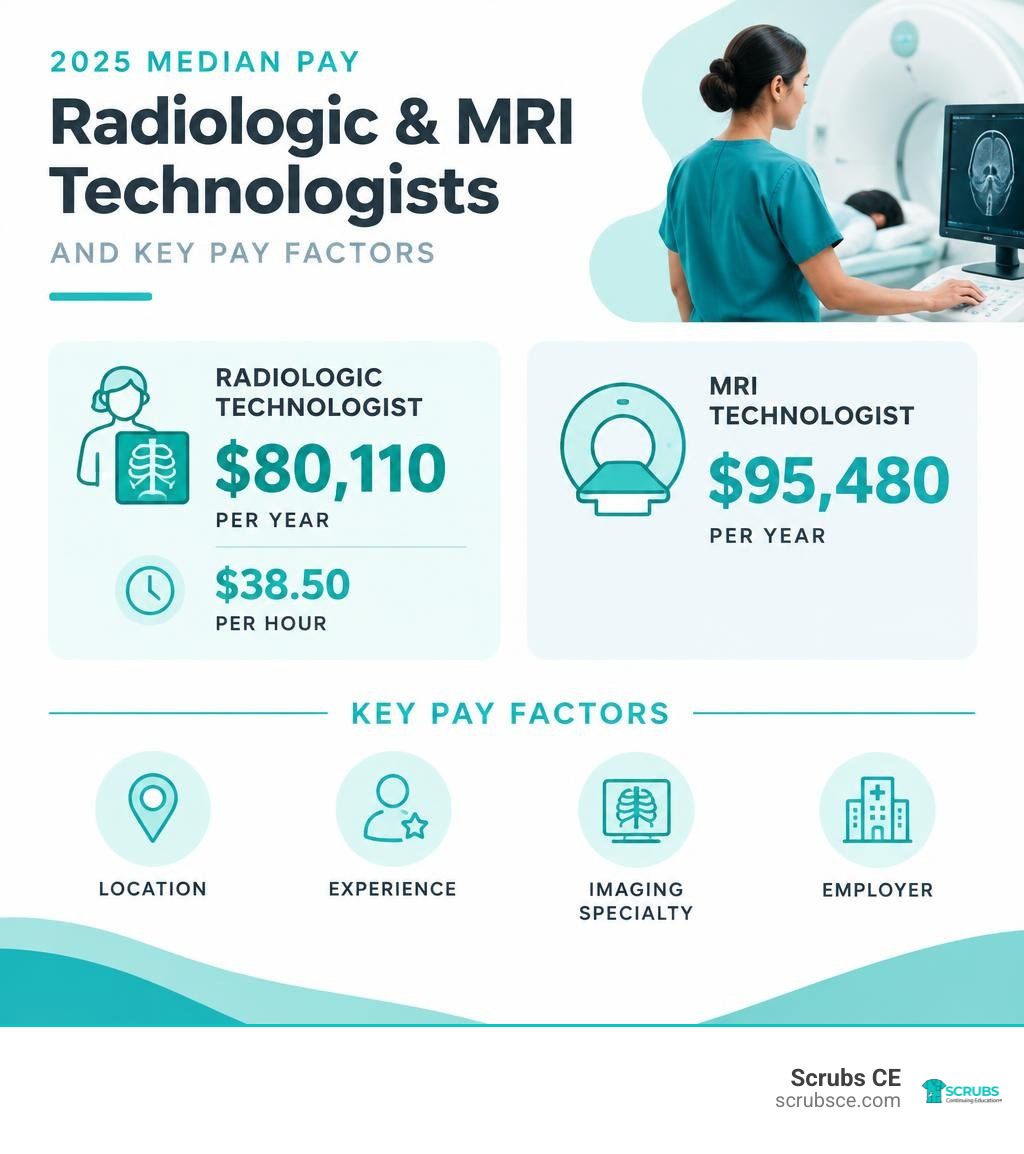
The radiologic technologist salary benchmark is $80,110 a year: the U.S. median wage reported for May 2025. That is about $38.50 an hour for a 40-hour workweek. Pay can change substantially with location, experience, imaging specialty, and employer. For comparison, MRI technologists earned a median of $95,480 in May 2025.
Those figures are a starting point, not a promise about any one job offer. This guide compares the numbers and explains what can move your pay up or down.
I’m Zita Ewert, and I lead continuing education for imaging professionals at Scrubs CE. My work helping technologists maintain credentials and develop skills informs how I explain radiologic technologist salary and career growth.
Radiologic technologist salary word list:
- requirements to be a radiologic technologist
- radiologic technologist requirements
- how to become radiologist technician
Radiologic Technologist Salary: National Benchmarks and Percentiles
When we examine the broader diagnostic imaging landscape in 2026, compensation for medical imaging professionals shows steady upward momentum. According to federal occupational employment and wage data, the national mean annual wage across all general diagnostic imaging roles sits above $75,000, while the overall median has crossed $80,110.
To understand where your potential earnings fall, it helps to examine the entire earnings curve:
| Earnings Percentile | Hourly Wage | Annual Equivalent (2,080 Hours) | Typical Profile |
|---|---|---|---|
| 10th Percentile | $26.91 | Under $55,980 | Entry-level staff in lower-cost markets or outpatient clinics |
| 25th Percentile | $30.24 | $62,910 | Early-career diagnostic radiographers in general medical facilities |
| 50th Percentile (Median) | $38.51 | $80,110 | Mid-career technologists with solid experience |
| 75th Percentile | $45.00 | $93,610 | Multi-modality technologists and high-demand acute hospital staff |
| 90th Percentile | $57.05+ | $118,660+ | Advanced specialists (IR, Dosimetry), lead techs, and travel professionals |
Compensation has expanded significantly over the past several years. Findings from the triennial ASRT® wage and salary survey data highlight that full-time mean compensation across all imaging disciplines grew by over 12% between survey cycles, reaching an average of $86,484. Over 68% of technologists report receiving regular annual pay raises averaging around 2.9%, reflecting sustained institutional investment in retention.
How Modality Specialization Dictates Radiologic Technologist Salary
The single biggest driver of compensation within the imaging sciences is your choice of imaging modality. In diagnostic Radiology, general radiography (plain film X-ray) functions as the foundational entry point, with median earnings clustering between $65,000 and $75,000.
Once you qualify to perform specialized diagnostic imaging, your earning potential steps up rapidly. Cross-sectional imaging modalities such as computed tomography (CT) and magnetic resonance imaging (MRI) require deeper knowledge of cross-sectional anatomy, physics, and contrast administration, commanding higher pay rates.
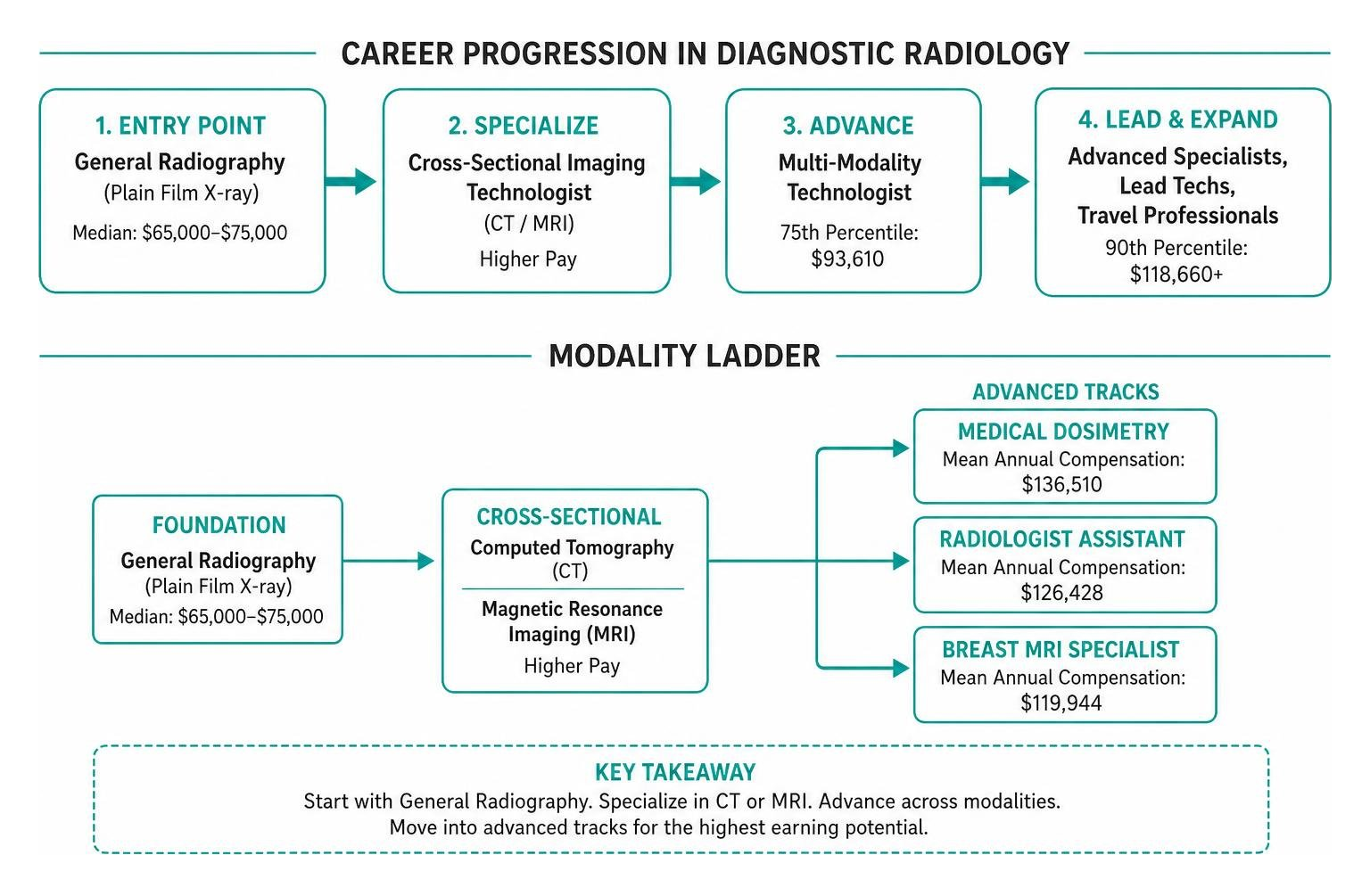
According to discipline-specific surveys published by the ASRT®, mean annual compensation across primary and post-primary imaging tracks ranks as follows:
- Medical Dosimetry: $136,510
- Radiologist Assistant: $126,428
- Breast MRI Specialist: $119,944
- Radiation Therapy: $106,475
- Nuclear Medicine: $103,619
- Cardiac Interventional (CI): $97,647
- Vascular Interventional (VI): $95,317
- Magnetic Resonance Imaging (MRI): $92,729 to $95,480 median
- Computed Tomography (CT): $87,785
- Mammography: $88,468
- Bone Densitometry (DEXA): $74,527
- Diagnostic Radiography (X-Ray): $73,274
Work Environment and Employer Impact on Earnings
Where you practice within the healthcare system shapes your base wage just as much as your modality credential.
- Outpatient Care Centers: Independent diagnostic testing facilities and surgical imaging suites frequently offer the highest median base salaries for general imaging staff ($84,720), leveraging high volume and predictable daytime scheduling.
- General Medical & Surgical Hospitals: Non-profit and municipal health systems employ roughly 60% of imaging staff with median base salaries around $80,650. Non-profit healthcare systems often provide comprehensive retirement and shift differential packages.
- Physician Offices & Outpatient Clinics: Private orthopedic and family practices average between $71,593 and $74,540 annually. These roles often trade top-bracket pay for predictable weekday schedules without night shifts or on-call duties.
- Staffing Agencies and Travel Contracts: Travel technologists stepping into acute hospital shortages can earn weekly gross compensation packages between $1,800 and $3,200 for CT/MRI, and up to $4,500+ weekly in specialized interventional Radiology and cath labs.
Key Factors That Drive Higher Compensation
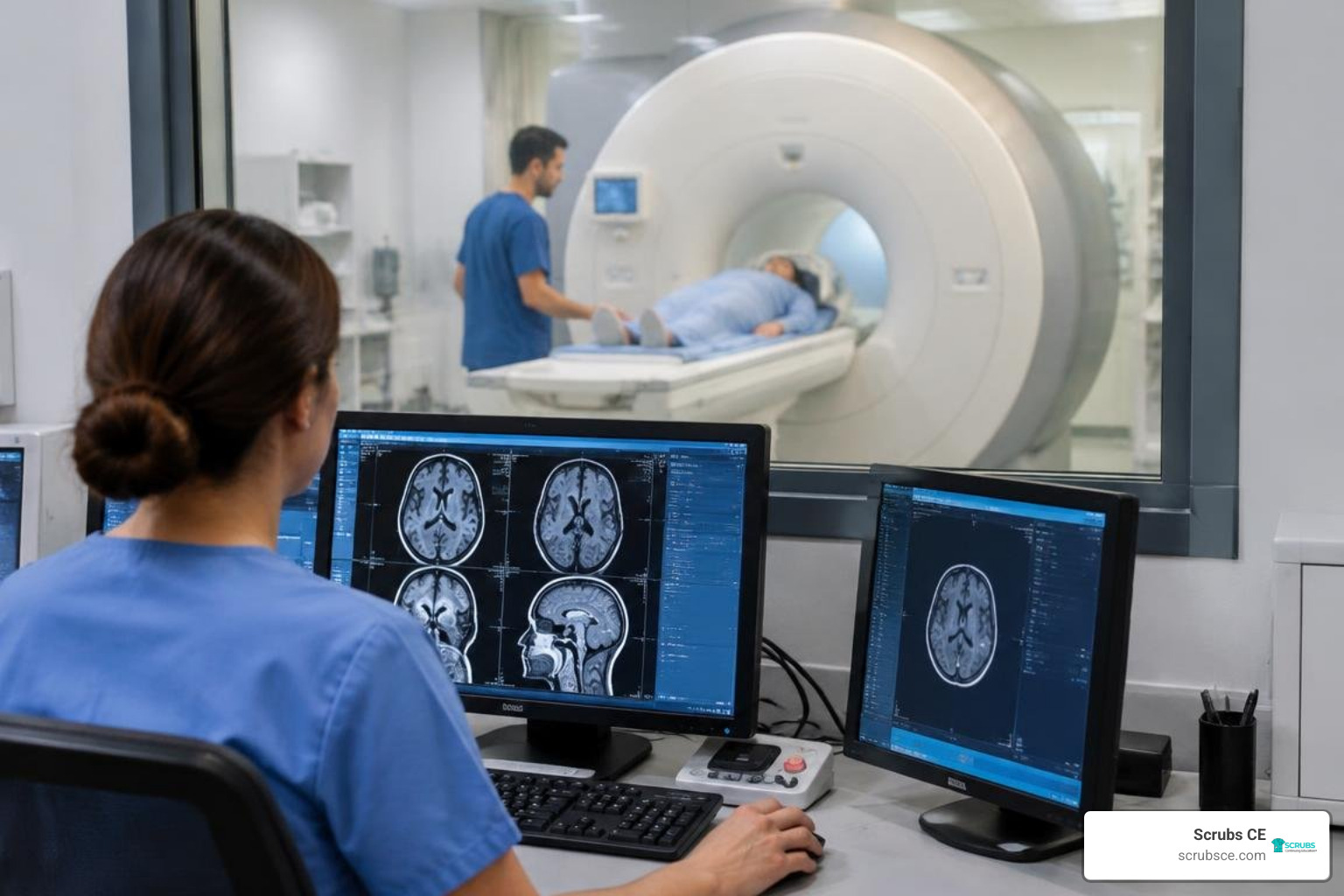
Reaching the upper percentiles of diagnostic Radiology compensation involves more than simply clocking in. Technologists build competitive compensation by combining experience, strategic shift choices, and multi-credentialing.
- Shift Differentials: Working evenings, nights, or weekend shifts in acute care hospitals typically adds $2.00 to $5.50 per hour over standard day rates.
- On-Call and Call-Back Pay: In emergency-heavy disciplines like CT, MRI, and Interventional Radiology, on-call standby pay paired with time-and-a-half guarantees for emergency call-backs substantially increases annual gross income.
- Sign-On Bonuses: Persistent staffing demand has prompted medical centers to offer flash sign-on incentives ranging between $5,000 and $20,000 for multi-modality or night-shift commitments.
How Experience and Degree Level Shape Radiologic Technologist Salary
Tenure directly impacts earning power as technologists gain diagnostic speed, clinical independence, and emergency workflow familiarity.
- Entry-Level (<1 to 2 Years): A technologist starting their career after earning an associate degree in radiologic technology averages between $62,877 and $67,437 annually.
- Mid-Career (3 to 10 Years): Mid-level professionals average $81,462 as they master multiple modalities and take on charge-tech duties.
- Experienced (11 to 20 Years): Seasoned technologists command a mean compensation of $91,204.
- Senior Professionals (21+ Years): Highly experienced staff and supervisors exceed $97,900 to $100,988 annually.
While roughly half of all practicing radiographers enter the workforce through a two-year associate program, higher academic degrees unlock distinct supervisory and administrative pay brackets. Technologists holding an associate degree average $81,546, while those with a bachelor’s degree earn $89,899, master’s degree holders average $104,024, and department administrators reach $137,075.
Certification and Continuing Education Value
To practice safely and command top-tier compensation, technologists must hold credentials from the AMERICAN REGISTRY OF RADIOLOGIC TECHNOLOGISTS® (ARRT®). Reviewing comprehensive certification requirements clarifies how earning advanced credentials establishes professional qualification.
Multi-modality certified technologists—such as an R.T.(R)(CT) or R.T.(R)(MR)—earn roughly 20% more on average than peers maintaining only a single primary certification. Furthermore, meeting your mandatory continuing education requirements every two-year biennium ensures that your license remains active, opening doors to leadership positions and advanced modality cross-training.
Geographic Salary Variations Across the United States

Geographic location heavily dictates nominal wages across the United States, driven by local healthcare competition, union density, and regional living expenses.
Top-Paying States and Metropolitan Areas
States on the Pacific coast and in the Northeast consistently lead the country in nominal earnings:
- California: $114,123 to $125,843 mean full-time compensation across all disciplines. Metros like Vallejo ($148,290), San Jose ($146,530), and San Francisco ($134,790) rank as the highest-paying urban markets in the nation.
- Massachusetts: $92,285 to $104,831 mean annual pay.
- District of Columbia: $96,954 mean annual earnings.
- New York State: Averages $88,237 statewide, with specialized hospital and upstate metropolitan compensation in Rochester ($144,338) and Albany ($134,328) significantly exceeding national averages.
Lowest-Paying Regions and Cost of Living Considerations
Conversely, states in the Southeast and parts of the rural Midwest report lower nominal averages:
- Nebraska: $54,894 to $61,924
- Alabama: $60,891 to $68,822
- Arkansas: $63,233
- Mississippi: $53,320 to $58,000
When evaluating regional pay, local purchasing power matters. A radiologic technologist earning $72,000 in the Midwest may enjoy comparable disposable income and housing affordability to an urban technologist earning $110,000 in a high-cost metropolitan center.
Long-Term Job Outlook and Career Growth
The long-term career outlook for diagnostic imaging professionals remains robust. Federal projections indicate a 5% employment growth rate from 2025 to 2035, outpacing the average for all U.S. occupations.
This sustained expansion will generate approximately 15,300 open positions annually, driven primarily by:
- An aging demographic requiring non-invasive diagnostic scans for chronic conditions, degenerative joint diseases, and oncology management.
- Technological shifts moving complex diagnostic procedures from invasive surgical suites to outpatient imaging centers.
- Retirements creating leadership opportunities across acute care Radiology departments.
Career Ladder: Moving Beyond General Radiography
General diagnostic radiography provides the essential clinical foundation. From there, technologists can progress into higher-paying avenues by preparing for registry review exams to earn post-primary credentials.
Key advancement pathways include:
- Lead / Charge Technologist: Managing shift workflows, quality control, and clinical schedules.
- PACS Administrator: Bridging clinical imaging with healthcare information technology and digital network infrastructure.
- Radiology Department Manager / Director: Overseeing multi-facility imaging operations, capital equipment procurement, and department budgets.
- Applications Specialist: Transitioning into commercial medical equipment training and corporate clinical demonstrations.
Frequently Asked Questions About Radiologic Technologist Salary
What is the starting salary for a new graduate radiologic technologist?
Nationally, a new graduate radiographer with zero to two years of clinical experience earns between $58,977 and $67,437 annually, depending on shift placement and location. Entry-level staff who secure night shifts or hospital roles in coastal states often start above $75,000 to $85,000.
How much more do MRI and CT technologists earn compared to general X-ray?
Cross-training into CT or MRI typically yields an immediate wage increase of $15,000 to $25,000 per year. While general staff radiographers earn an average of $73,274, CT technologists average $87,785 and MRI technologists report a median wage of $95,480. Technologists holding dual ARRT® credentials in both modalities command premium hiring rates.
Do healthcare employers pay for continuing education and credential renewal?
Survey data reveals that 70.6% to 79.8% of employers fully fund health and retirement benefits, while 43.9% provide tuition reimbursement programs. However, only 24.1% to 25.5% of healthcare employers fully fund mandatory continuing education (CE) credits. As a result, most imaging professionals utilize cost-effective, self-paced online CE platforms to maintain their certifications affordably.
Conclusion
A career in medical imaging offers a rare combination of accessible educational timelines, vital patient impact, and clear upward earning trajectories. Whether you are stepping into your first role in general diagnostic radiography or adding advanced credentials in CT, MRI, or Interventional Radiology, your earning potential grows alongside your clinical expertise.
At Scrubs CE, we support your professional growth at every career stage. You can explore accredited Radiology courses and CE credits to fulfill your mandatory ARRT® requirements, expand your diagnostic skill set, and unlock top-tier compensation in the imaging field.