
What It Really Takes to Become a Radiologic Technologist in 2026

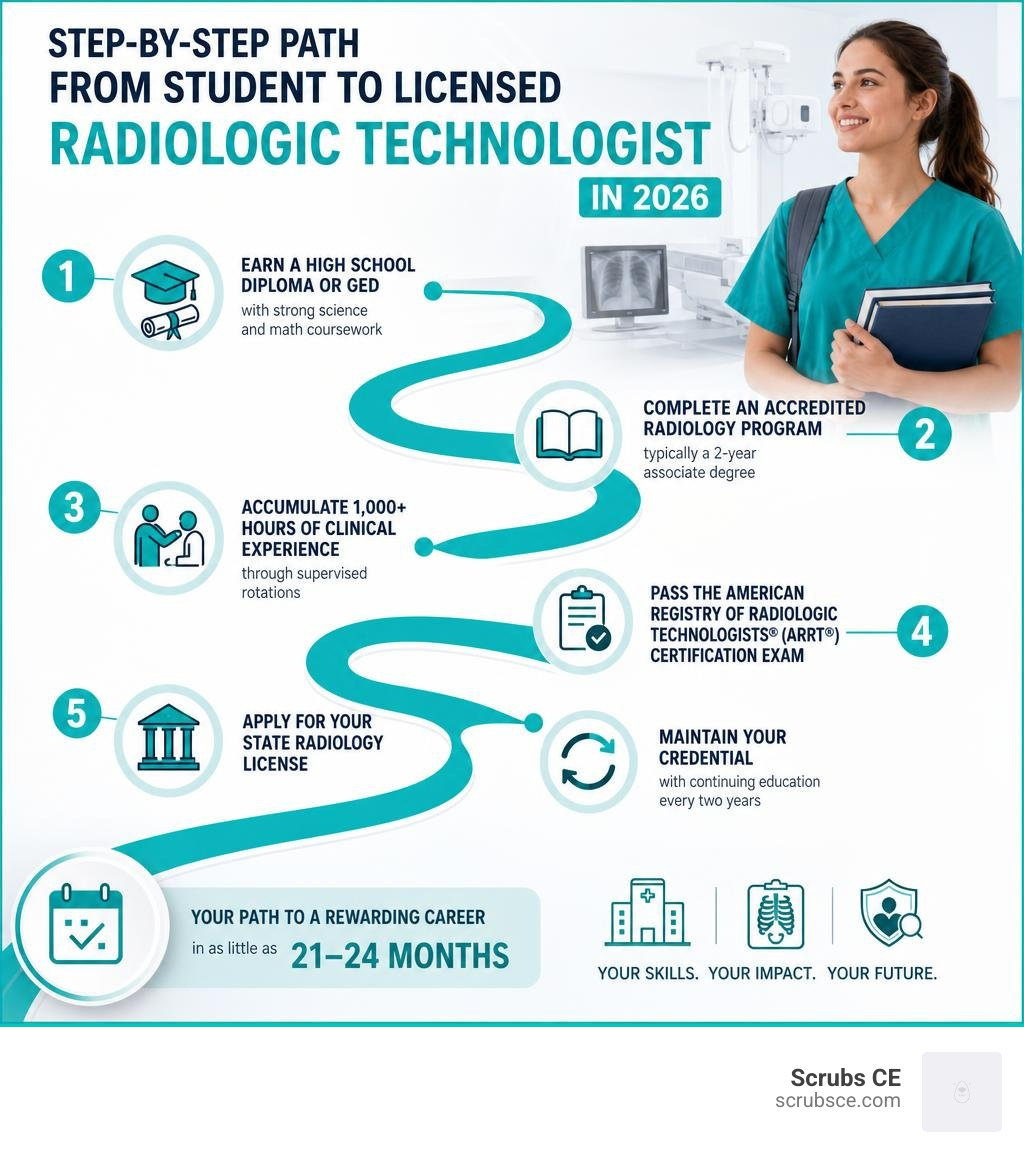
If you want to know how to become a radiologic technician, here is the short answer:
- Earn a high school diploma or GED (with strong science and math coursework)
- Complete an accredited Radiology program — typically a 2-year associate degree
- Accumulate 1,000+ hours of clinical experience through supervised rotations
- Pass the AMERICAN REGISTRY OF RADIOLOGIC TECHNOLOGISTS® (ARRT®) certification exam
- Apply for your state Radiology license
- Maintain your credential with continuing education every two years
That is the full path — from student to licensed Radiologic Technologist — in as little as 21 to 24 months.
Medical imaging is at the center of modern healthcare. Every broken bone assessed in an emergency room, every tumor spotted on a scan, every chest X-ray reviewed by a physician — a Radiologic Technologist made that image possible. These professionals are sometimes called the “eyes of the doctor,” and the demand for them is only growing. The U.S. Bureau of Labor Statistics projects about 15,400 job openings per year through 2034, with a national median wage of $77,660 — and significantly higher in major metro areas.
It is also a career that is genuinely accessible. You do not need a four-year degree to get started. Most people enter through an associate degree program and are working in hospitals or imaging centers within two years.
This guide walks you through every step — education, ARRT® certification, state licensing, salary expectations, specialization options, and how to keep your credentials current throughout your career.
I’m Zita Ewert, and as the leader of SCRUBS Continuing Education®, I’ve spent years helping Radiologic Technologists understand how to become a radiologist technician and navigate the credentialing and CE requirements that keep them licensed and career-ready. Whether you’re just starting out or looking to specialize, this guide covers everything you need to move forward with confidence.
How to Become Radiologic Technologist: Step-by-Step Roadmap
First, a quick terminology note: many people search for “radiologist technician,” but the more accurate professional title is Radiologic Technologist, Radiographer, or sometimes Radiology Tech. A radiologist is a physician. A Radiologic Technologist is the trained imaging professional who positions patients, operates imaging equipment, and produces images for physicians to interpret.
Your roadmap usually looks like this:
- Finish high school or earn a GED.
- Take science, math, and communication courses.
- Apply to an accredited Radiologic Technology program.
- Complete classroom, lab, and clinical training.
- Graduate from an approved program.
- Apply for and pass the ARRT® Radiography exam.
- Apply for state licensure, if required.
- Start working in X-ray, hospital imaging, outpatient imaging, urgent care, or a related setting.
- Maintain your license and certification with continuing education.
Simple? Yes. Easy? Not always. But if you can follow directions, care about patients, and keep calm when someone says, “I definitely heard something crack,” you are already thinking like a Radiologic Technologist.
How to Become Radiologic Technologist After High School
If you are still in high school, you can start preparing now. Strong courses include:
- Anatomy and physiology
- Biology
- Chemistry
- Physics
- Algebra
- Computer science
- English and communication
- Psychology or health science
Radiologic Technologists need to understand the body, radiation, imaging equipment, and patient behavior. That means science matters, but communication matters just as much.
Helpful extras include:
- CPR or Basic Life Support certification
- Volunteering in a hospital or clinic
- Shadowing healthcare workers, if allowed
- Taking dual-enrollment anatomy or medical terminology
- Building strong study habits
Most programs require a high school diploma or GED, transcripts, prerequisite coursework, and sometimes a minimum GPA.
How to Become Radiologic Technologist as a Career Changer
Many excellent Radiologic Technologists start later in life. Career changers often bring skills that healthcare needs badly: maturity, reliability, customer service, teamwork, and the ability to stay calm when things get weird. And in healthcare, things do occasionally get weird.
Good backgrounds for this field include:
- Military service
- Medical assisting
- Nursing assistant work
- Dental assisting
- EMT or paramedic work
- Fitness or rehab support
- Customer service
- Technical or mechanical fields
If you are changing careers, look for programs with flexible prerequisite options, clear clinical schedules, and strong student support. Be realistic about time: clinical rotations are usually in-person and may happen during daytime hours. Financial planning is also important because full-time clinical training can reduce your ability to work.
Step 1: Choose the Right Radiologic Technology program
Your program choice matters because it affects your eligibility for certification, state licensure, clinical experience, and job readiness.
Most entry-level Radiologic Technologists complete an Associate of Applied Science or similar associate degree. Some students choose bachelor’s degrees, and some certificate options exist for people who already have healthcare education or meet specific state rules.
Look for:
- Accreditation by a recognized agency, such as JRCERT
- ARRT®-recognized educational status
- Strong clinical placement sites
- ARRT® exam pass rates
- Graduation rates
- Job placement support
- Transparent tuition and fees
- Experienced faculty
- Modern imaging labs
- Clear state licensure preparation
- Support for CPR/BLS, immunizations, and background checks
Also ask whether clinical rotations include hospitals, outpatient imaging centers, surgery, emergency departments, and portable imaging. The broader your exposure, the less terrifying your first job will feel.
Step 2: Apply, Get Accepted, and Complete Clinical Training
Radiologic Technology programs can be competitive. Typical application requirements include:
- Application form
- Official transcripts
- Prerequisite courses
- Minimum GPA
- Entrance exam, in some programs
- Interview
- Immunization records
- TB screening
- CPR/BLS certification
- Background check
- Drug screening
- Health insurance documentation
- Technical standards form
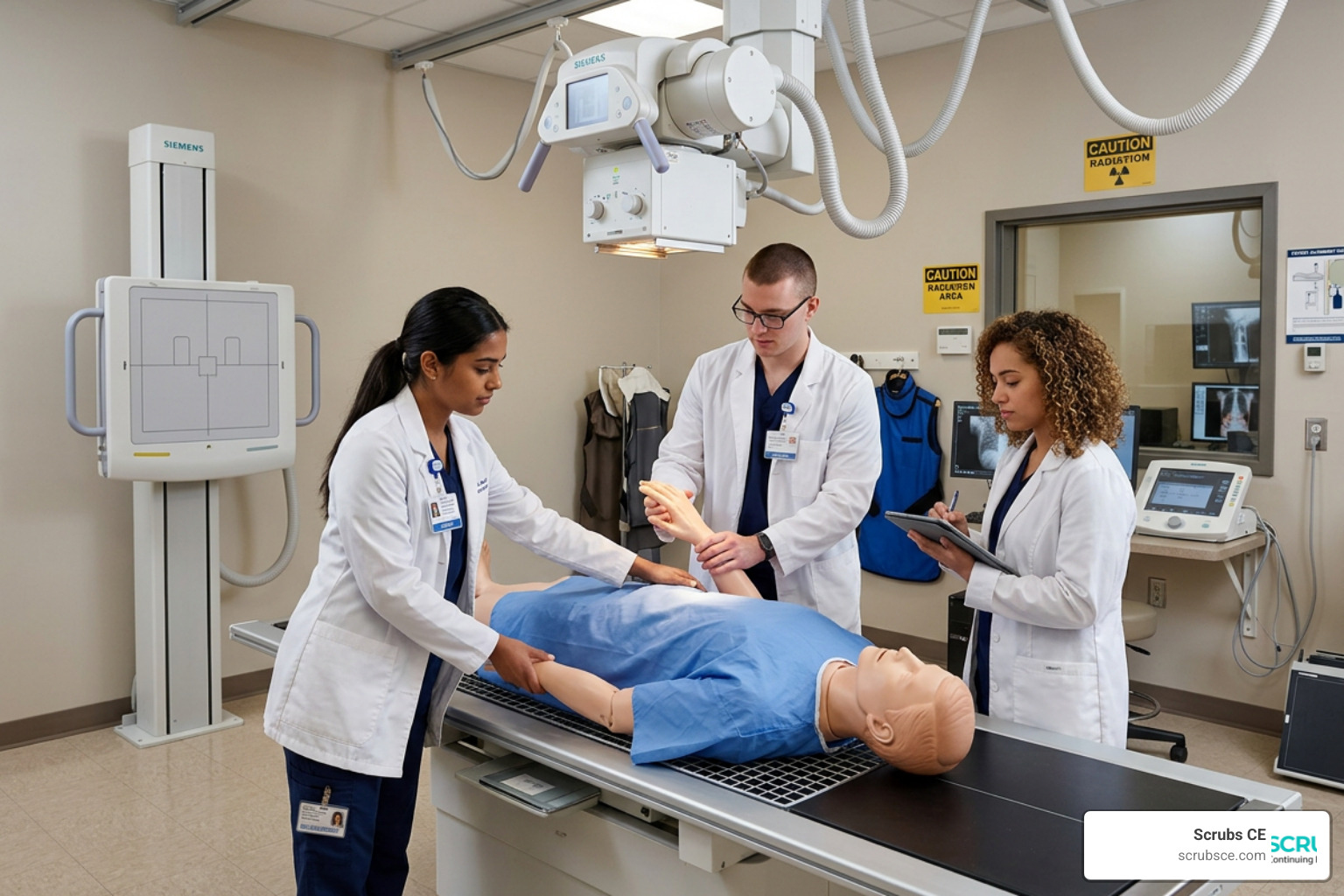
Once accepted, you will complete classroom courses, lab practice, and supervised clinical rotations. Many programs include 1,000 or more clinical hours, where students practice patient positioning, image acquisition, radiation safety, and workflow under supervision.
Clinical training may include:
- Chest X-rays
- Abdomen studies
- Spine imaging
- Extremity imaging
- Portable bedside imaging
- Operating room imaging
- Fluoroscopy support
- Trauma imaging
- Quality control
- Patient documentation
This is where students become professionals. You learn how to position a patient with a painful hip, explain an exam to a scared child, and produce diagnostic images while keeping radiation exposure as low as reasonably achievable.
Education, ARRT® Certification, and State Licensure Requirements
To become a Radiologic Technologist, you need three big pieces: education, certification, and licensure. Think of them as the three legs of the imaging stool. If one is missing, the stool gets wobbly.
Degree and Training Options for Radiologic Technologists
Most people enter the field through an associate degree program. Common options include:
| Pathway | Typical Length | Best For |
|---|---|---|
| Associate degree | 18 to 24 months after prerequisites | Most entry-level students |
| Bachelor’s degree | About 4 years | Students interested in leadership, education, or advanced study |
| Certificate pathway | Varies | Some students with prior healthcare education or specific state eligibility |
| Limited license pathway | Varies by state | Restricted-scope imaging roles |
Coursework commonly includes:
- Anatomy and physiology
- Medical terminology
- Patient care
- Radiation physics
- Radiation protection
- Image production
- Radiographic positioning
- Pathology
- Image evaluation
- Medical ethics
- Clinical procedures
Associate degree programs are the standard entry point because the AMERICAN REGISTRY OF RADIOLOGIC TECHNOLOGISTS® generally requires an associate degree or higher for primary pathway eligibility.
ARRT® Exam and AMERICAN REGISTRY OF RADIOLOGIC TECHNOLOGISTS® Requirements
ARRT® certification is one of the most important milestones in this career. For Radiography, most candidates use the primary eligibility pathway, which includes three major requirements:
- Education: Complete an ARRT®-recognized educational program and earn an associate degree or higher.
- Ethics: Meet ARRT® Standards of Ethics.
- Examination: Pass the ARRT® Radiography certification exam.
The ARRT® primary pathway also includes deadlines and attempt limits. Candidates generally must apply within the required timeframe after completing their program, and ARRT® allows three exam attempts within a three-year window. Always confirm your exact requirements with the official ARRT® primary eligibility handbook.
To prepare for the exam:
- Review the ARRT® content specifications.
- Take practice exams.
- Study image production and radiation protection carefully.
- Review anatomy and positioning daily.
- Practice clinical decision-making questions.
- Do not ignore ethics and patient care topics.
The exam is not just about memorizing bones. It tests whether you can think like a safe, entry-level Radiologic Technologist.
State Licensing and Continuing Education
Certification and state licensure are related, but they are not the same thing.
ARRT® certification shows that you met national credentialing standards. A state license gives you legal permission to practice in that state. Most states require Radiologic Technologists to be licensed or certified, but rules vary.
Depending on your state, you may need to submit:
- Proof of education
- ARRT® exam results
- Application fee
- Background information
- Identification
- Continuing education documentation for renewal
If you plan to work in Florida, we recommend reviewing our state-specific guides:
- Florida Radiology License Complete Guide
- Florida Radiologic Technologist License Application: Your Path to Practice
- How to Get a Radiology License in Florida Without the Headache
- Radiologic Technologist License Florida
- ARRT Certification Florida
For renewal, many professionals must complete continuing education on a regular cycle. ARRT® Registered Technologists typically complete 24 approved continuing education credits every two years to maintain registration. For help with renewal planning, see our Rad Tech License Renewal Complete Guide.
Limited License and Entry-Level Radiology Pathways
Some states offer limited Radiology licenses. These are restricted-scope roles, often used in physician offices, urgent care, orthopedic clinics, or chiropractic settings. A limited license may allow a person to perform certain X-ray exams, but not the full scope of a registered Radiologic Technologist.
Limited license rules vary widely by state and may include:
- Specific body areas allowed
- Required supervision
- State-approved training
- State exam requirements
- Continuing education
- Renewal requirements
A limited license can be a starting point, but it is not the same as full Radiologic Technologist certification. If this pathway interests you, read our guides on becoming a Limited License Radiologic Tech and completing Limited License Radiology CE.
Daily Work, Skills, Patient Care, and Radiation Safety
Radiologic Technology is both technical and personal. You are working with sophisticated imaging equipment, but your patient may be scared, in pain, confused, or having the worst day of their life. The job requires precision with people skills.
What Radiologic Technologists Do Each Day
A typical day may include:
- Reviewing imaging orders
- Verifying patient identity
- Explaining the procedure
- Positioning the patient
- Selecting exposure settings
- Using shielding and collimation
- Taking images
- Checking image quality
- Repeating images only when necessary
- Documenting the exam
- Communicating with radiologists and physicians
- Cleaning equipment
- Following infection control procedures

Radiologic Technologists may perform routine X-rays, assist with fluoroscopy, take portable images in intensive care units, support operating room procedures, or respond to trauma cases. In some settings, they also help with contrast studies and quality control.
Work Environments and Schedules
Radiologic Technologists work in many settings:
- Hospitals
- Emergency departments
- Outpatient imaging centers
- Physician offices
- Orthopedic clinics
- Urgent care centers
- Surgery suites
- Diagnostic laboratories
- Mobile imaging services
According to federal labor data, about 60% of Radiologic Technologists work in hospitals. Hospital jobs often include evenings, weekends, holidays, and on-call shifts. Outpatient centers may offer more predictable daytime schedules, although busy clinics can move fast too.
Patient Care and Communication Skills
Good imaging depends on cooperation. Cooperation depends on communication.
Radiologic Technologists must be able to:
- Explain exams clearly
- Give simple breathing and movement instructions
- Protect patient privacy
- Help patients transfer safely
- Adapt for pediatric and older adult patients
- Work with trauma patients
- Reduce anxiety
- Communicate with patients who have limited mobility, pain, or confusion
Empathy is not optional. A patient may only be with you for ten minutes, but those ten minutes can shape how safe and respected they feel.
Radiation Safety Protocols Every Technologist Must Follow
Radiation safety is central to the profession. The guiding principle is ALARA, which means keeping exposure “as low as reasonably achievable.”
Key safety practices include:
- Collimating the X-ray beam to the area of interest
- Using appropriate exposure settings
- Avoiding unnecessary repeat images
- Wearing dosimeter badges
- Tracking occupational exposure
- Using lead aprons, gloves, and shields when appropriate
- Maintaining distance from the radiation source
- Reducing time near exposure
- Screening for pregnancy when required by policy
- Following physician orders precisely
- Performing equipment quality checks
- Using infection control procedures
Radiologic Technologists protect patients, coworkers, and themselves. Safety is not just a checklist; it is a habit.
Personal Qualities and Physical Demands
This career is active. You may stand for long periods, help transfer patients, move equipment, and work in tight spaces around beds, stretchers, and surgical tables.
Important qualities include:
- Attention to detail
- Physical stamina
- Compassion
- Technical confidence
- Problem-solving ability
- Teamwork
- Ethical judgment
- Calm under pressure
- Manual dexterity
- Comfort with technology
You do not need to be a superhero. But you do need to be dependable, careful, and willing to keep learning.
Timeline, Costs, Salary, Job Outlook, and Career Growth
Radiologic Technology is attractive because the timeline is relatively short, the work is meaningful, and the job outlook is stable.
How Long It Takes to Become a Radiologic Technologist
Most students can become Radiologic Technologists in about 18 to 24 months once they begin the professional phase of training. Some programs run around 21 months. A traditional associate degree usually takes about two years, though prerequisites can add time.
A realistic timeline:
| Stage | Estimated Time |
|---|---|
| Prerequisites | 1 semester to 1 year |
| Radiologic Technology program | 18 to 24 months |
| ARRT® exam preparation and testing | Several weeks to a few months |
| State license processing | Varies by state |
| Total pathway | About 2 to 3 years for many students |
Bachelor’s degree pathways take longer but may support leadership, education, management, or advanced clinical roles later.
Typical Costs and Financial Aid Options
Costs vary widely by school and state. Community colleges are often less expensive than private colleges or universities. When comparing programs, include the full cost, not just tuition.
Common expenses include:
- Tuition
- Lab fees
- Books
- Scrubs
- Shoes
- Radiation monitoring badge fees
- Immunizations
- Physical exam
- Background check
- Drug screen
- CPR/BLS certification
- ARRT® exam fee
- State license fee
- Transportation to clinical sites
Financial aid options may include:
- FAFSA-based federal aid
- State grants
- School scholarships
- Workforce development funding
- Veterans benefits
- Employer tuition support
- Payment plans
- Scholarships through professional organizations, including ASRT® Foundation opportunities
Before enrolling, ask the program for total estimated costs, clinical travel expectations, and whether students can work while enrolled.
Salary Expectations and Job Demand in 2026
The career outlook is strong. The BLS Radiologic and MRI Technologists outlook reports:
- 272,000 Radiologic and MRI Technologists employed in 2024
- 5% projected employment growth from 2024 to 2034
- About 15,400 openings per year
- $77,660 median annual wage for Radiologic Technologists and technicians in May 2024
- $88,180 median annual wage for MRI Technologists in May 2024
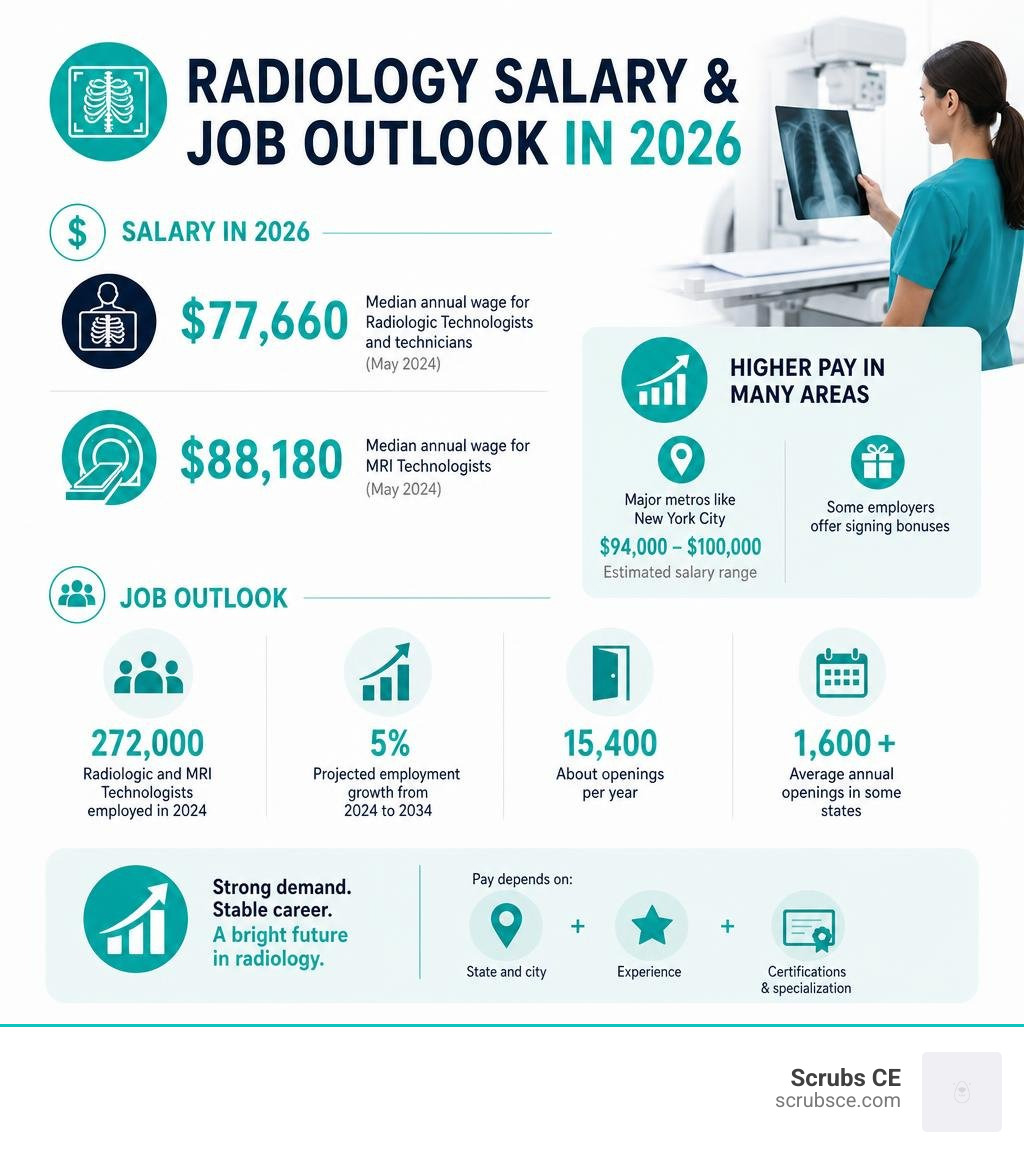
Regional pay can be much higher. Some statewide data shows a median salary of $85,767 and an entry-level salary of $64,351, with projected growth of 27% from 2022 to 2032 and more than 1,600 average annual openings. In major metro areas such as New York City, Radiologic Technologists may earn around $94,000 to $100,000, and some employers offer signing bonuses.
Pay depends on:
- State and city
- Hospital vs outpatient setting
- Shift differentials
- Experience
- Specialty credentials
- Union contracts
- Travel assignments
- Leadership responsibilities
Radiography vs. Sonography, CT, MRI, Nuclear Medicine, and Radiation Therapy
Radiography is the most common entry point, but it is not the only imaging career.
| Field | Main Technology | Uses Ionizing Radiation? | Common Role |
|---|---|---|---|
| Radiography | X-ray | Yes | Bones, chest, abdomen, trauma imaging |
| CT | Computed tomography | Yes | Cross-sectional imaging for trauma, cancer, stroke, and more |
| MRI | Magnetic fields and radio waves | No | Brain, spine, joints, soft tissue imaging |
| Sonography | Ultrasound | No | Obstetric, abdominal, vascular, and cardiac imaging |
| Mammography | Low-dose X-ray | Yes | Breast imaging |
| Nuclear Medicine | Radiopharmaceuticals | Yes | Functional imaging of organs and disease processes |
| Radiation Therapy | Therapeutic radiation | Yes | Cancer treatment delivery |
Radiography focuses on producing diagnostic X-ray images. CT is often a postprimary specialty for Radiologic Technologists. MRI may be entered through primary or postprimary pathways depending on education and credentials. Sonography uses sound waves and has its own educational and credentialing paths. Radiation therapy is treatment-focused rather than diagnostic imaging.
Advancement and Specialization After Certification
After earning your initial Radiography credential, you can grow into advanced roles.
Common specializations include:
- CT
- MRI
- Mammography
- Bone densitometry
- Cardiac interventional Radiography
- Vascular interventional Radiography
- Vascular sonography
- Breast sonography
ARRT® postprimary credentials generally require a supporting credential, structured education, clinical documentation, ethics compliance, and an exam. The postprimary pathway includes at least 16 structured education credits, with credits completed within the required timeframe and clinical procedures verified by approved professionals. Review the official ARRT® postprimary eligibility handbook before planning a specialty.
Career advancement may also include:
- Lead technologist
- Imaging supervisor
- Department manager
- Clinical instructor
- Radiology educator
- PACS or imaging informatics roles
- Travel technologist
- Registered Radiologist Assistant
To keep advancing, stay organized with continuing education. Our guides on Radiology CE made easy and accredited CE courses can help you plan ahead instead of panic-clicking for credits the week before renewal. We have all been there. We just prefer not to live there.
Conclusion: Launch Your Radiology Career and Stay Credential-Ready
If you are serious about how to become a radiologist technician, focus on the right sequence:
- Build a strong science and math foundation.
- Choose an accredited Radiologic Technology program.
- Complete your classroom, lab, and clinical training.
- Pass the AMERICAN REGISTRY OF RADIOLOGIC TECHNOLOGISTS® exam.
- Apply for your state Radiology license.
- Maintain your credentials with continuing education.
- Consider specialty credentials as your career grows.
Radiologic Technology is a practical, respected healthcare career with strong demand, meaningful patient contact, and room to specialize. You can start with an associate degree, enter the workforce in about two years, and continue building your career through CT, MRI, mammography, interventional imaging, education, management, or advanced practice.
At Scrubs CE, we help Radiology professionals stay credential-ready with convenient, affordable, self-paced online continuing education and instant certificates. When you are ready to maintain your license or plan your next renewal cycle, explore online Radiology CE courses.