
Cracking the Code: MQSA Requirements for Mammographers Explained
What Are the MQSA Mammography Technologist Requirements?

mqsa mammography technologist requirements set the federal standards every mammographer must meet to legally perform mammograms in the United States. Here’s a quick summary:
| Requirement | Details |
|---|---|
| Initial Training | 40 hours didactic + 25 supervised exams |
| State License | General radiography license required |
| Continuing Education | 15 Category 1 CEUs every 36 months |
| Continuing Experience | 200 mammography exams every 24 months |
| Digital/3D Modality Training | 8 additional hours per new modality |
| Annual Inspections | Documentation must be ready at all times |
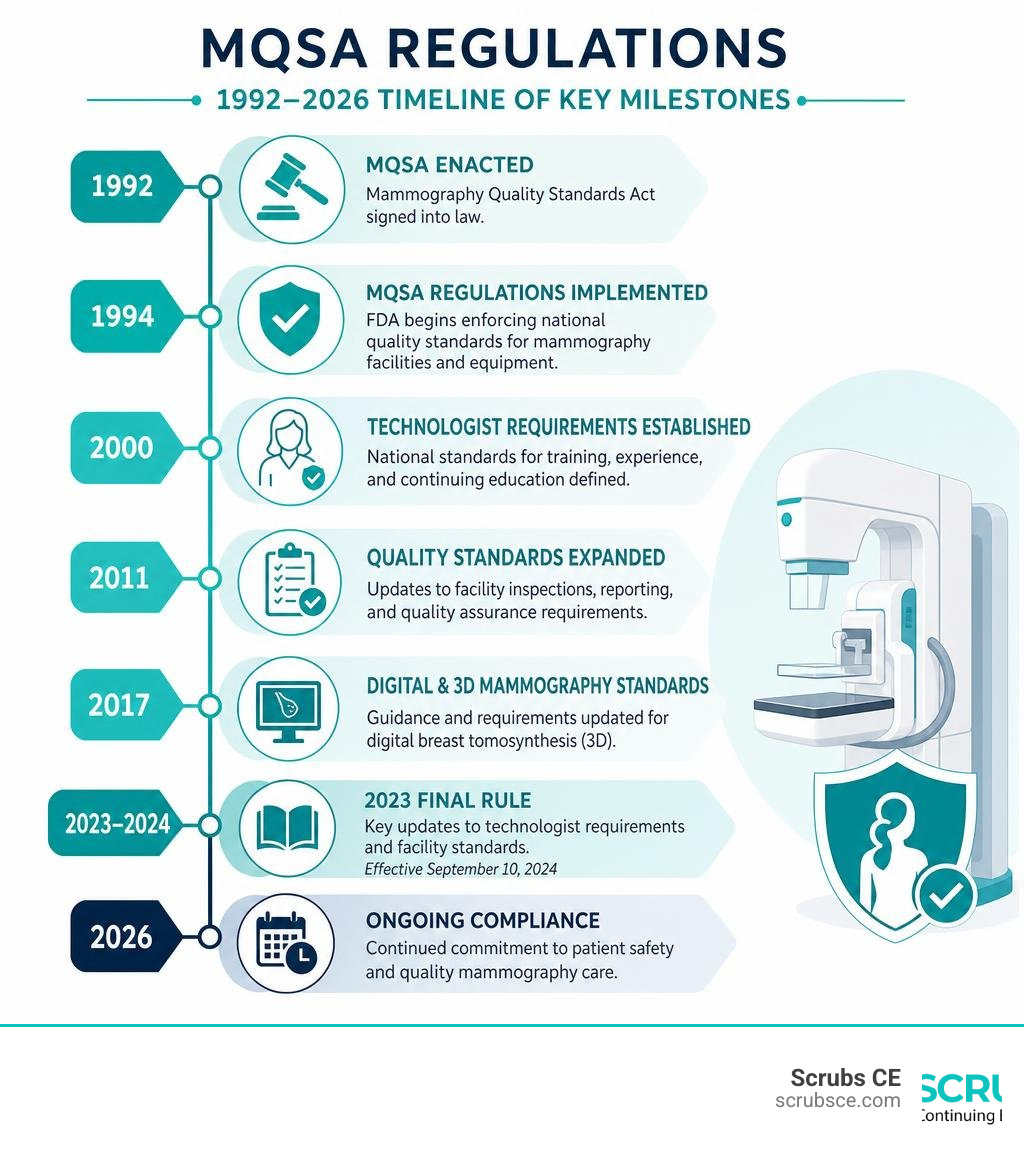
These rules come from the Mammography Quality Standards Act (MQSA), signed into law in 1992 and enforced by the FDA. The law was created to protect patients by ensuring every mammography facility — and every technologist working in one — meets consistent, measurable quality standards.
Before MQSA, training and quality varied widely from facility to facility. Today, any technologist who doesn’t meet these requirements is prohibited from independently performing mammograms, regardless of their general radiography experience.
The 2023 Final Rule (effective September 10, 2024) updated several key requirements — making it more important than ever to stay current.
I’m Zita Ewert, and as the leader of SCRUBS Continuing Education®, I’ve spent years helping radiologic technologists navigate mqsa mammography technologist requirements through accredited, accessible continuing education. In this guide, I’ll break down exactly what you need to know to stay compliant — without the regulatory jargon.
Key mqsa mammography technologist requirements vocabulary:
- how to become radiologist technician
- how to get a arrt certification
- radiologic technologist requirements
Initial MQSA Mammography Technologist Requirements for Independent Practice
To legally step up to a mammography machine and perform an exam without someone hovering over your shoulder, you must fulfill specific initial criteria. These federal regulations ensure that every technologist has a rock-solid foundation in both the science and the art of breast imaging.
First and foremost, you must hold a valid state license to perform general radiography, or be certified by an approved national body. The most common pathway is certification through the AMERICAN REGISTRY OF RADIOLOGIC TECHNOLOGISTS® (ARRT®). This ensures you already understand the fundamentals of radiation safety, patient care, and basic imaging physics before you specialize.
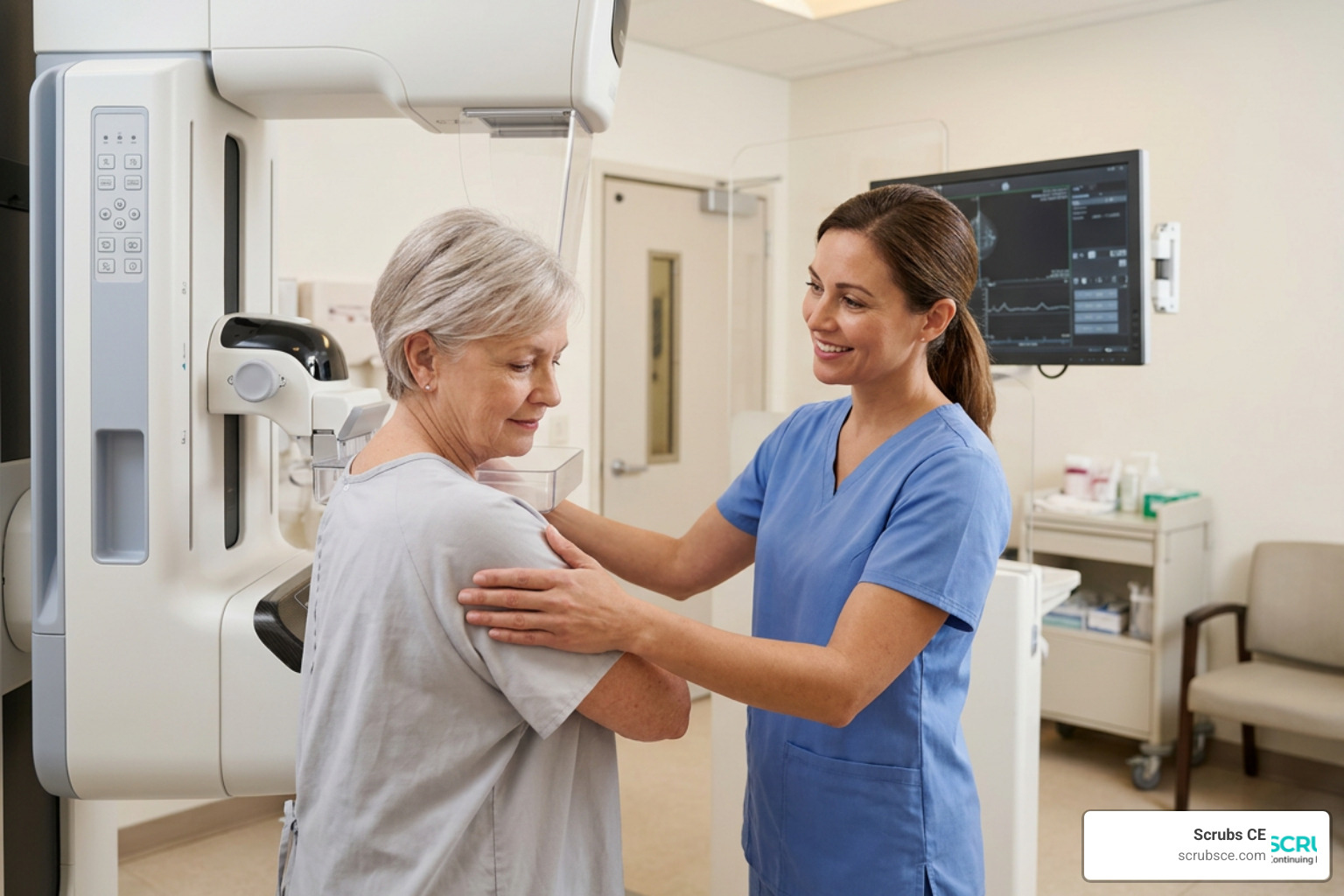
But general radiography is just the entry ticket. To transition into mammography, you must complete specialized clinical supervision. During this phase, you are not permitted to work independently. A qualified mammography technologist must guide your hands, observe your patient interactions, and sign off on your technique.
Core Didactic and Clinical Training Requirements
The heart of your initial qualification lies in a mandatory 40-hour didactic training program. This isn’t just 40 hours of watching videos; it must cover highly specific topics mandated by the FDA:
- Breast Anatomy and Physiology: Understanding the complex tissue structures you will be imaging.
- Positioning and Compression: Learning how to properly position the breast to maximize tissue visualization while managing patient comfort.
- Quality Assurance and Quality Control (QA/QC): Mastering the daily, weekly, and monthly tests required to keep the equipment running safely.
- Imaging Patients with Breast Implants: Special techniques, such as Eklund views, to ensure implant integrity while capturing necessary breast tissue.
In addition to this classroom or online study, you must complete at least 25 supervised mammography examinations. These clinical exams must be performed under the direct supervision of an MQSA-qualified technologist. They are your opportunity to put theory into practice, mastering the physical adjustments needed for different body types and physical limitations.
Modality-Specific Training for Digital and 3D Mammography
As technology has evolved, so have the training requirements. If you plan to work with digital mammography or digital breast tomosynthesis (commonly known as 3D mammography), you must complete an additional 8 hours of modality-specific training for each technology.
For example, if you transition from traditional 2D digital mammography to a 3D tomosynthesis system, you cannot operate that 3D machine independently until you have logged those 8 hours. This training covers the unique physics of tomosynthesis, reconstruction algorithms, and specific positioning adjustments. Utilizing online education is an incredibly efficient way to knock out these 8-hour blocks on your own schedule without taking time away from your clinical shifts.
Maintaining Compliance: Continuing Education and Experience
Obtaining your initial qualification is a major milestone, but MQSA compliance is not a “one-and-done” achievement. The FDA requires active technologists to maintain their skills and knowledge through ongoing practice and education. This is tracked using rolling cycles, meaning your compliance is constantly evaluated based on what you have done over the preceding 24 to 36 months.
Failing to keep up with these rolling requirements can instantly halt your ability to practice. That is why quality assurance and proactive tracking are essential habits for every professional mammographer.
Meeting the Triennial MQSA Mammography Technologist Requirements for CE
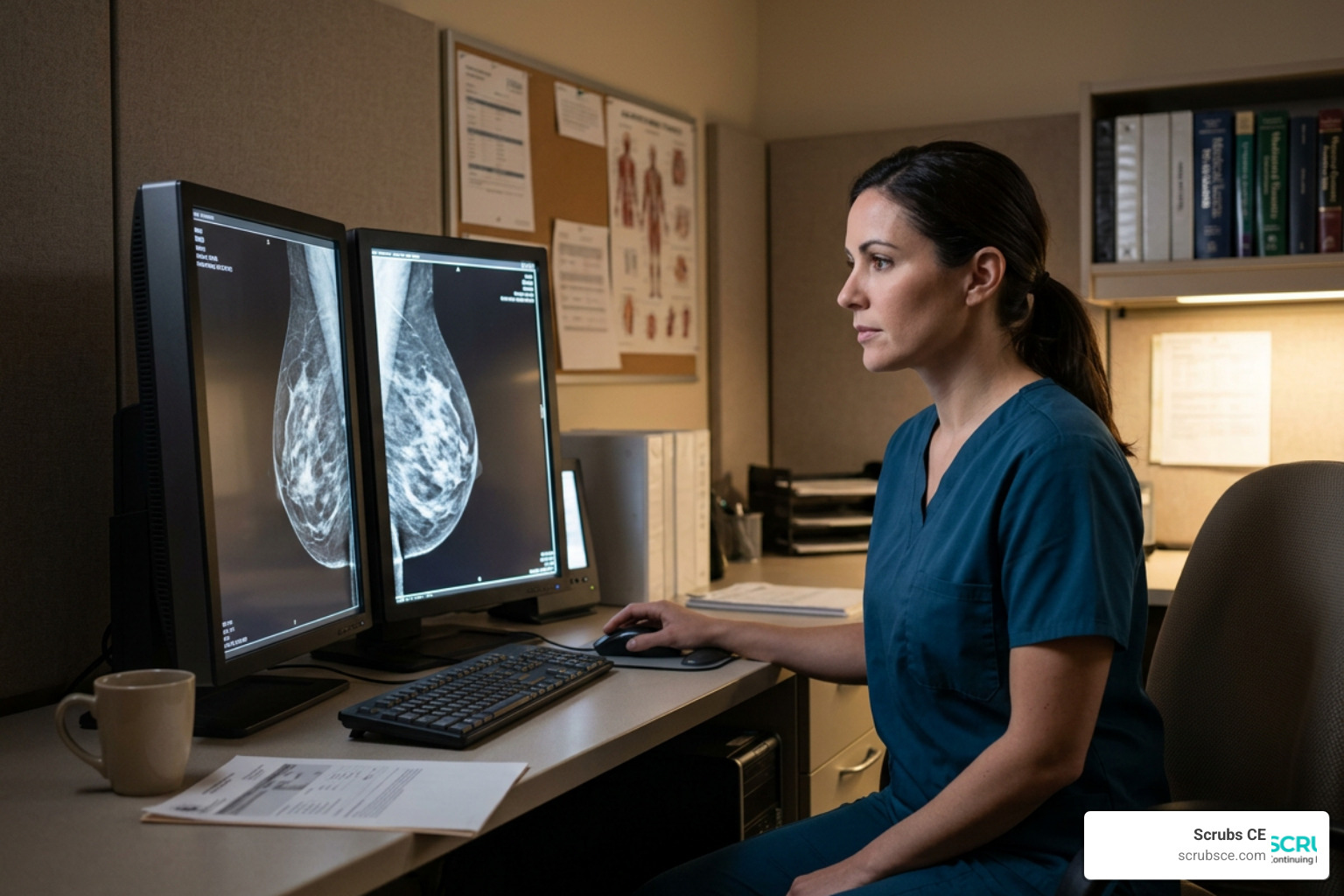
To satisfy the mqsa mammography technologist requirements for continuing education, you must earn at least 15 Category 1 CEUs (Continuing Education Units) every 36 months. This 36-month period is a rolling window, not a fixed calendar block.
These credits must be directly related to mammography. If you are certified by the AMERICAN REGISTRY OF RADIOLOGIC TECHNOLOGISTS®, you should also ensure that these credits align with your ARRT® biennial requirements to avoid double the work.
Furthermore, if you operate multiple modalities (such as both 2D digital and 3D tomosynthesis), you must ensure your CE portfolio includes at least 6 credits directly related to each modality you use. Managing these overlapping timelines can feel like a juggling act, but choosing the right CE provider makes it simple to stay organized.
Biennial Continuing Experience and Exam Quotas
Education is only half the battle; you also have to keep your clinical skills sharp. The FDA enforces a continuing experience requirement of at least 200 mammography examinations within a rolling 24-month period.
This clinical volume ensures that you maintain your eye for detail and your physical dexterity in positioning. Most facilities track these numbers automatically through their Radiology Information Systems (RIS). However, if you work PRN or split your time between multiple facilities, it is your responsibility to collect signed logs from each site to prove you have hit the 200-exam threshold. For strategies on aligning your credits with these clinical demands, check out More info about making credits work for MQSA.
Requalification Pathways and Inspection Readiness
What happens if life gets in the way and you fall out of compliance? Whether due to an extended medical leave, a career break, or simply an oversight in tracking your rolling dates, falling out of active status means you can no longer legally perform mammograms independently.
Operating without active MQSA status puts both you and your facility in a state of non-compliance, which can lead to severe penalties during annual inspections. Fortunately, the FDA provides a clear roadmap to help you safely reenter the field.
Reestablishing Compliance After Falling Out of Active Status
If you fail to meet the 200-exam requirement in a 24-month period, you must bring your clinical numbers back up under direct supervision. The requalification pathway requires you to perform 25 supervised exams. Once those 25 supervised exams are completed and documented, you enter a 6-month window during which you must complete the remaining balance of your 200 exams (175 unsupervised exams) to fully restore your active status.
If your non-compliance is due to a CE deficiency, you must make up the missing credits to meet the 15-credit requirement before you can resume independent imaging. Understanding how to efficiently earn these credits is key to minimizing your downtime.
Documentation Checklist for Annual MQSA Inspections
Every mammography facility undergoes an annual FDA inspection to verify that all equipment, procedures, and personnel meet federal standards. During these inspections, the inspector will audit the files of every practicing technologist.
To ensure you are inspection-ready, your facility must have immediate access to a comprehensive paper or digital trail.
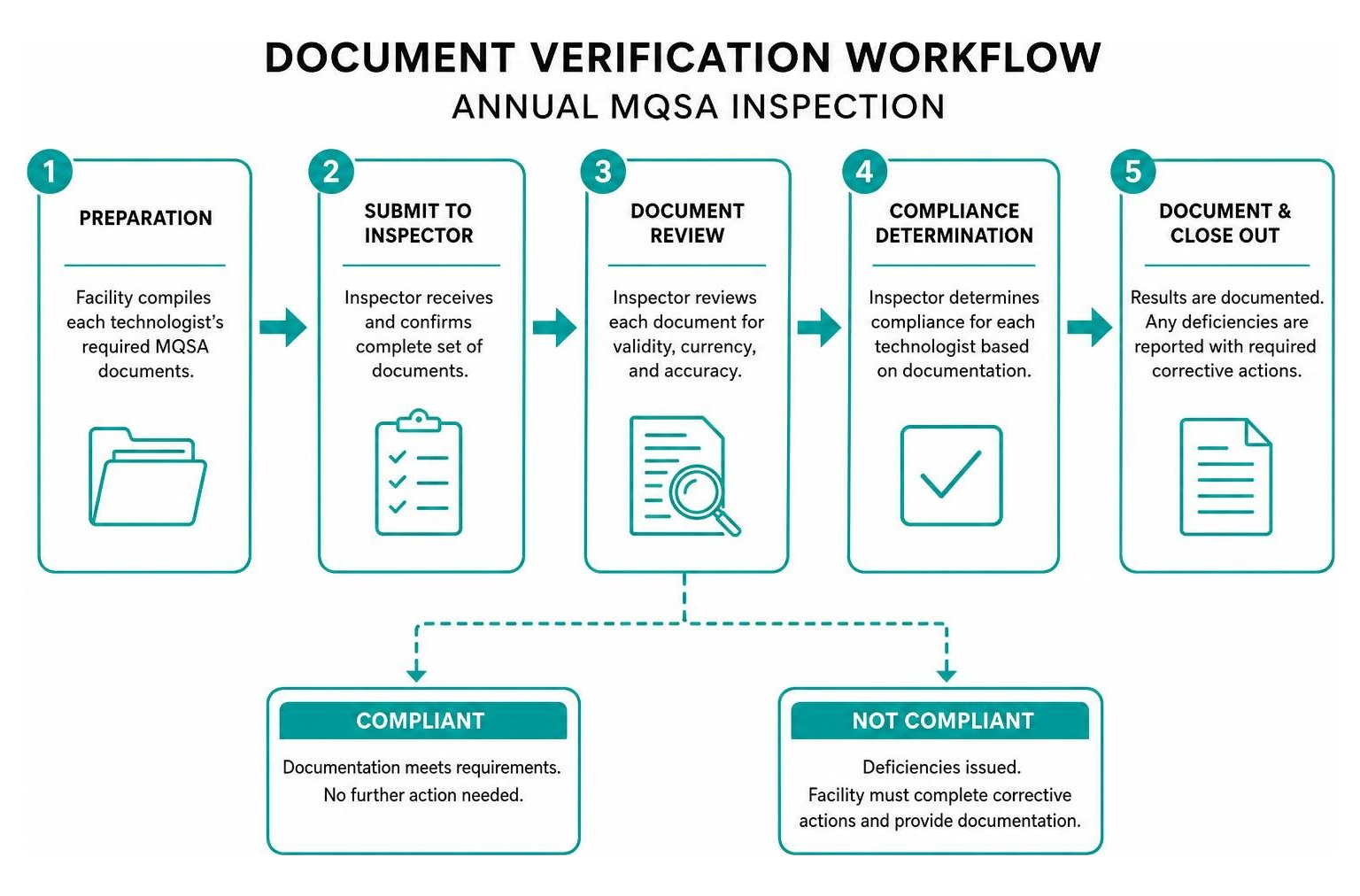
Use this checklist to ensure your records are complete:
- Current State Licensure: Active general radiography license or state-specific mammography permit.
- Board Certification: Active registration with the AMERICAN REGISTRY OF RADIOLOGIC TECHNOLOGISTS® or other approved national body.
- Initial Training Records: Proof of your 40-hour didactic training and certificate of your first 25 supervised exams.
- Modality Certificates: Documentation of your 8 hours of training for digital, 3D, or other specialized modalities.
- CE Certificates: Certificates of completion for your 15 Category 1 CEUs covering the active 36-month rolling window.
- 200-Exam Log: A signed, verified report showing you have completed at least 200 clinical exams in the past 24 months.
Navigating State Regulations, ARRT® Certification, and the 2023 Final Rule
While MQSA sets the baseline federal standards, it is important to remember that federal law is the floor, not the ceiling. Many states and accrediting bodies enforce stricter requirements than the FDA. Navigating this web of federal, state, and institutional rules can be confusing, but keeping a few key distinctions in mind will help you stay compliant wherever you practice.
Do You Need the ARRT® (M) Credential to Practice?
Technically, the FDA’s federal MQSA guidelines do not explicitly require you to hold the advanced ARRT® (M) post-primary credential to perform mammograms; they only require general radiography certification and the completion of the 40-hour/25-exam training. However, in the real world, the answer is almost always yes.
Most state licensing boards, facility accreditation bodies (like the American College of Radiology), and employers require you to obtain your ARRT® (M) credential within a certain timeframe of hire (often 12 to 24 months). To achieve this, you must complete the post-primary pathway, which includes logging 75 clinical exams across various categories and passing the rigorous AMERICAN REGISTRY OF RADIOLOGIC TECHNOLOGISTS® registry exam.
How the 2023 Final Rule Impacts MQSA Mammography Technologist Requirements
The FDA issued a major update to the MQSA regulations with the 2023 Final Rule, which officially took effect on September 10, 2024. Among various clinical changes, this rule introduced strict guidelines regarding record retention for personnel.
Under the updated rules, facilities are now federally required to retain employee qualification and training records for at least 24 months after the employee leaves the facility. This ensures that if an audit occurs after you change jobs, your historic compliance can still be verified. It also mandates that facilities provide former employees with copies of these records upon request, making it easier for you to transfer your credentials to a new employer. For the complete legal text, you can read the Scientific research on the 2023 MQSA Final Rule.
State-Specific Variations and Facility Compliance Roles
States often implement their own regulatory bodies that layer additional rules on top of federal ones. For instance, the California Department of Public Health, Radiologic Health Branch (CDPH-RHB) requires California technologists to hold a specific California Certified Radiologic Technologist (CRT) certificate in mammography.
Additionally, the 2023 Final Rule standardized breast density reporting across the nation. All patient lay summaries must now include specific, easy-to-understand explanations of whether their tissue is “dense” or “not dense” and how that impacts cancer detection. Technologists play a critical role in educating patients about these dense breast notifications during their exams. To learn more about how federal oversight works, see the Scientific research on the FDA MQSA Program.
| Requirement | Federal MQSA Standard | California State Standard (CDPH-RHB) |
|---|---|---|
| Licensure | General Radiography + MQSA training | CRT License + Mammography Permit (CRT(M)) |
| Continuing Education | 15 credits per 36 months | 10 mammography-specific credits per 24-month renewal |
| Breast Density | Standardized national reporting language | Standardized national reporting language |
Frequently Asked Questions about MQSA Compliance
FAQ 1: Can I count my MQSA CE credits toward my ARRT® biennium requirements?
Yes! Because the ARRT® requires 24 Category A or A+ CEUs every two years, you can absolutely use your 15 MQSA-compliant mammography credits to satisfy part of your ARRT® biennium. Just ensure that the courses you take are approved for Category A credit by a Recognized Continuing Education Evaluation Mechanism (RCEEM) like the ASRT®. This double-dipping is a smart, time-saving way to maintain both credentials simultaneously.
FAQ 2: How long must a facility retain my qualification records after I leave?
As established by the 2023 Final Rule, facilities must retain your qualification and training records for a minimum of 24 months after your employment ends. This rule was designed to protect both the facility during retrospective audits and you, the technologist, by ensuring your professional records aren’t lost when you transition to a new role.
FAQ 3: Does routine processor maintenance require a Mammography Equipment Evaluation (MEE)?
No. Routine, minor maintenance—such as changing filters or cleaning rollers—does not require a full Mammography Equipment Evaluation (MEE) by a medical physicist. However, major component replacements (like changing the X-ray tube, detector, or software upgrades) are considered “MEE triggers” and require a physicist to test the system before patients can be imaged on it.
Conclusion
Staying compliant with mqsa mammography technologist requirements is essential to protecting your career and providing high-quality care to your patients. While managing rolling cycles, clinical exam counts, and CE certificates can feel overwhelming, we are here to make the educational piece as smooth as possible.
At Scrubs CE, we offer convenient, affordable online continuing education courses designed specifically for busy medical imaging professionals. Our high-quality, self-paced courses come with instant certificates, helping you meet your licensure and MQSA requirements without the stress. Ready to complete your mammography credits? Explore our catalog and find More info about Radiology CE courses to keep your career moving forward.