

Understanding ASRT Category A CE Credit: Your Essential Guide
ASRT Category A CE credit is the type of continuing education credit approved by the American Society of Radiologic Technologists (ASRT) that meets the requirements of the American Registry of Radiologic Technologists (ARRT) for maintaining your certification and registration.
Quick Answer: What You Need to Know
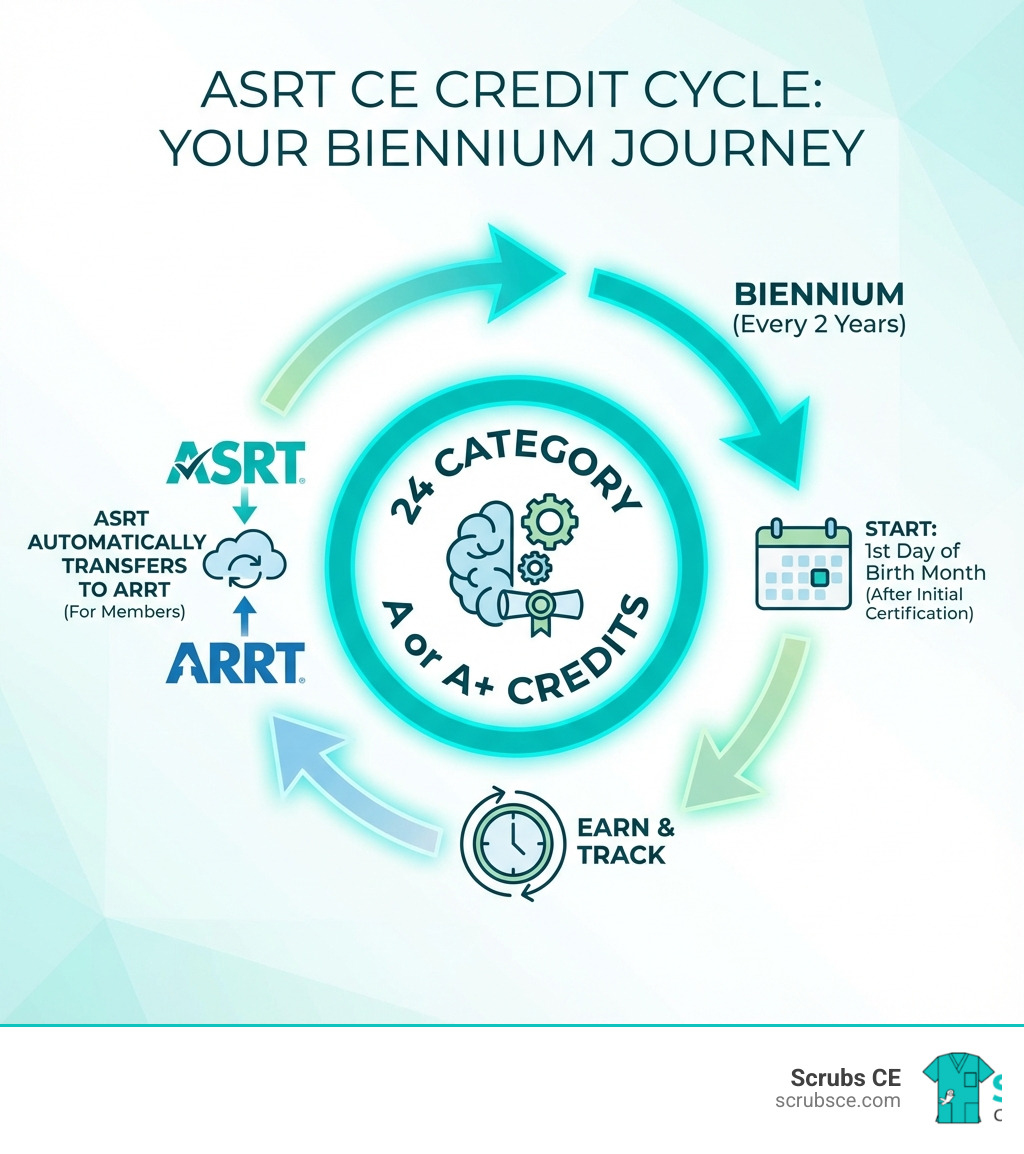
- Requirement: All radiologic technologists must earn 24 Category A or A+ CE credits every two years (called a biennium)
- Approval: Category A activities are evaluated and approved by a Recognized Continuing Education Evaluation Mechanism (RCEEM) like ASRT
- What Qualifies: ASRT-approved courses, academic courses in approved subjects, advanced CPR certification (ACLS/PALS), and passing new ARRT exams
- Tracking: ASRT members can automatically track and transfer credits to ARRT
- Special Limits: Advanced CPR is capped at 6 credits per biennium; onsite equipment training is capped at 8 credits
As an R.T., you’ll have to complete and report a certain number of CE activities every two years to maintain your professional credentials. Your biennium is assigned by the ARRT and is linked to your birth month and the year of your initial certification exam.
Why This Matters
Continuing education isn’t just a checkbox requirement. It’s how you stay current with technological advances, maintain competency, and prevent professional obsolescence. The radiology field evolves rapidly, and your CE credits ensure you’re providing safe, high-quality patient care using the latest knowledge and techniques.
I’m Zita Ewert, and I’ve spent years helping imaging professionals steer the complexities of ASRT Category A CE credit requirements through SCRUBS Continuing Education. We’ve helped thousands of technologists earn their required credits with clear, accessible courses that meet ARRT standards.
Decoding ASRT Category A CE Credit: The Gold Standard
When we talk about ASRT Category A CE credit, we’re referring to the gold standard in continuing education for radiologic technologists. This isn’t just any credit; it signifies that the educational activity has been rigorously evaluated and approved by a Recognized Continuing Education Evaluation Mechanism (RCEEM). The ASRT itself is a prominent RCEEM, which means any activity bearing ASRT approval automatically qualifies for Category A or A+ credit.
These credits are crucial for maintaining your professional competency and ensuring you have the foundational knowledge necessary to excel in your role. They are designed to improve your professional knowledge and skills, directly impacting the quality of care you provide to patients. Think of it as your professional seal of approval, ensuring the education you pursue is relevant, robust, and recognized by the leading bodies in radiologic technology.

The Difference Between Category A and Category A+ Credit
While both Category A and Category A+ credits are essential for your continuing education, there’s a subtle but important distinction, especially if you’re looking to advance into more specialized roles.
Category A credit is the general requirement for most radiologic technologists. These activities cover a broad range of topics relevant to the application of radiologic sciences and patient care. They are designed to keep you updated on general practices, new technologies, and essential skills across various modalities.
Category A+ credit, on the other hand, is specifically custom for registered radiologist assistants (R.R.A.s). These CE activities meet content criteria that are directly related to the role delineation and advanced clinical activities of an R.R.A. They dig deeper into complex topics and skills required for this advanced practice role. However, even if you’re not an R.R.A., you can still benefit: R.T.s are welcome to complete A+ activities to satisfy part or all of their required CE credits each biennium. It’s a great way to challenge yourself and expand your knowledge base!
Here’s a quick comparison:
| Feature | Category A Credit | Category A+ Credit |
|---|---|---|
| Target Audience | Most radiologic technologists (R.T.s) | Primarily Registered Radiologist Assistants (R.R.A.s) |
| Content Focus | General radiologic sciences, patient care, broad topics | Advanced clinical activities, R.R.A. role delineation |
| Eligibility for R.T.s | Primary requirement for biennial CE | Can be used by R.T.s to fulfill part or all CE requirements |
| Approval Mechanism | RCEEM-approved (e.g., ASRT) | A+ CE evaluation mechanism recognized by ARRT (e.g., ASRT) |
For further details, you can always refer to the official ASRT guidelines, which provide comprehensive information on these credit types.
How to Earn Your Category A Credits
So, you know you need ASRT Category A CE credit. But how do you actually get them? The good news is there are many pathways to fulfill your biennium requirement of 24 credits every two years. We understand that every technologist has a unique schedule and learning style, which is why the options are so diverse.
For most R.T.s, the core requirement is to earn 24 approved CE credits during their bienniums. This is a consistent number, regardless of how many ARRT credentials you hold. So, whether you’re certified in radiography, CT, or have multiple credentials, the 24-credit benchmark remains.
At Scrubs CE, we offer a wide array of online courses designed to be convenient and self-paced, allowing you to earn your credits on your own terms. But that’s just one way! You can also pursue credits through:
- Online Courses: These are incredibly flexible, allowing you to learn from anywhere, anytime.
- Seminars and Conferences: Attending professional events often provides valuable CE credits and networking opportunities.
- Directed Readings: Many organizations, including ASRT, offer articles with accompanying quizzes that count for credit.
- Academic Courses: Taking relevant college-level courses can also contribute significantly.

What Qualifies as an ASRT Category A CE Credit Activity?
To ensure your efforts count towards your required 24 credits, choose activities that are explicitly approved for ASRT Category A CE credit. As we’ve mentioned, ASRT is a RCEEM, so anything approved by them is good to go. Here’s a list of activities that typically qualify:
- ASRT-Approved Courses: This includes online modules, directed readings, webcasts, and in-person seminars offered by ASRT or other providers (like Scrubs CE) that have ASRT approval.
- Academic Courses: If you’re taking college-level courses, they can count! To qualify, they must be from an accredited post-secondary institution, you must earn a grade of “C” or better, and the credit must be transferable to a degree program. Acceptable subjects include:
- Biologic sciences
- Physical sciences
- Radiologic sciences
- Health and medical sciences
- Communication
- Mathematics
- Computers
- Education methodology
- Psychology
- Sociology One semester credit hour earns 16 Category A CE credits, and a quarter credit earns 12 Category A CE credits.
- Scholarly Writing: If you’ve published a scholarly article in a peer-reviewed journal, you can earn CE credits (e.g., 10 for a first author). Writing an original textbook related to radiologic sciences can earn you 24 Category A CE credits, and a chapter earns 4 credits.
- Presenting Lectures: Developing and presenting a preapproved lecture can also earn you credits (2 credits for each contact hour of development for an RCEEM or RCEEM+ approved lecture).
- Advanced CPR Certification: Official certification in Advanced Cardiac Life Support (ACLS) or Pediatric Advanced Life Support (PALS) can earn you up to 6 CE credits per biennium, provided it’s approved by a RCEEM or you have a valid card from the American Heart Association or American Health and Safety Institute.
- Passing New ARRT Exams: Successfully passing a new primary certification examination in a discipline you haven’t previously passed, or earning a postprimary certificate, will earn you a full 24 Category A CE credits. This is a fantastic way to both advance your career and meet your CE requirements!
Exceptions and Special Conditions to Know
While many activities qualify, there are a few important exceptions and conditions to keep in mind when planning your CE:
- ACLS/PALS Credit Limits: Although valuable, advanced CPR certifications like ACLS and PALS are limited to a maximum of 6 credits per biennium. So, while they contribute, they won’t cover your entire 24-credit requirement.
- Basic CPR Ineligibility: Unfortunately, basic CPR (BLS) is generally considered a job responsibility and does not count for ASRT Category A CE credit (if completed after January 1, 2007). Similarly, CPR Instructor/Trainer courses completed after January 1, 2015, are also not accepted.
- Onsite Equipment Training Cap: If you receive onsite (facility) applications training, this type of credit is capped at 8 CE credits per biennium by the ARRT. It’s great for hands-on learning, but just be mindful of this limit.
- Specific Academic Course Subjects: Not all academic courses are accepted. While subjects like psychology and sociology are okay, courses in astronomy, geology, geography, history, literature, political science, fine arts, music, philosophy, and religion are generally not accepted for Category A CE credit. Focus on courses directly relevant to health, science, or education methodology.
- Hands-on Lab/Clinical Practice: For academic courses, hands-on lab or clinical practice time is calculated at half-credit and cannot exceed the didactic/lecture credit. Hands-on components of applications training are also not eligible for CE credit.
Understanding these nuances will help you plan your continuing education effectively and avoid any surprises when it comes time to report your credits.
Verifying, Tracking, and Submitting Your Credits
One of the most common questions we hear is, “How do I make sure my credits are actually tracked?” This is where the right processes and resources come into play. Maintaining proof of your CE participation is paramount, whether you’re tracking them yourself or relying on a service.
For ASRT members, there’s a significant advantage: you’re automatically enrolled in their CE tracking system. This means ASRT acts as a full-service record keeper, tracking all your ASRT Category A CE credit and A+ credits once you submit the proper documentation. This service is designed to be fast, easy, and secure, taking a huge administrative burden off your shoulders.
Ensuring an Activity is Approved for ASRT Category A CE Credit
Before you invest your time and effort, how can you be certain an activity counts as ASRT Category A CE credit? It’s simpler than you might think:
- Check for RCEEM Approval: Look for a statement from a Recognized Continuing Education Evaluation Mechanism (RCEEM) like ASRT, JRCERT, or other approved bodies. If it says “approved for Category A credit by the ASRT,” you’re good to go!
- Examine the Certificate Information: Your CE certificate is your golden ticket. It must contain specific information to be valid:
- Sponsor’s name
- Your name and ID
- Activity title
- Credit amount earned
- A reference number
- Date of activity completion
- Signature of an authorized representative
- The approval designation (e.g., ASRT) and credit category (A or A+)
- The course expiration date (effective September 1, 2015)
- Preprinted completion dates (effective September 1, 2013) Each individual lecture title, reference number, and credit amount must be clearly listed. If any of this information is missing or unclear, contact the activity sponsor.
- Verify with the Sponsor: If you’re ever in doubt, reach out directly to the activity sponsor. They should be able to confirm their approval status.
At Scrubs CE, we pride ourselves on offering courses that are carefully approved for ASRT Category A CE credit. We clearly state our approval status, ensuring you can confidently earn your credits with us.
The Process for Submitting and Tracking Credits with ASRT
Once you’ve completed your ASRT Category A CE credit activities, submitting them to ASRT for tracking is straightforward:
- Choose Your Submission Method: ASRT offers several convenient ways to send in your documentation:
- Website Upload: You can directly upload your certificates through the ASRT website. This is a popular and efficient method.
- Email Submission: Send your documentation to memberservices@asrt.org.
- ASRT App Upload: Download the ASRT app (available on Apple App Store or Google Play). This allows you to snap a picture of your certificate with your device and upload it instantly.
- Mail: You can still mail physical copies to 15000 Central Ave., Albuquerque, NM 87123-3909.
- Fax: Send to 505-816-1951. Remember to include your full name and ASRT member number with all submissions to ensure your credits are correctly attributed.
- Processing Time: After submission, it typically takes up to 10 business days for your eligible credits to be entered into your CE record. We know waiting can be tough, but rest assured, they’re working diligently!
- View Your Current CE Record Online: ASRT allows you to view your current CE record online. We recommend checking this regularly, especially as your biennium deadline approaches, to ensure all your credits are accurately tracked.
- Automatic Transfer to ARRT: This is one of the biggest perks of being an ASRT member! When you begin the online renewal of your ARRT certification, the credits ASRT has tracked for your current biennium will be automatically sent to the ARRT. This seamless transfer requires that your identifying information (name, date of birth, ARRT ID) matches between the ASRT and ARRT systems. So, double-check your profile to make sure everything aligns!
What if the ARRT says they didn’t receive your transfer? This can happen if your ARRT registration has lapsed for more than three months, or if your identifying information doesn’t match. If you encounter issues, don’t panic! Contact ASRT Member Services for assistance.
Category A Credits and Other Professional Requirements
Your ASRT Category A CE credit isn’t just about meeting ARRT requirements; it’s also crucial for other professional obligations, including state licensure and specialty certifications. We know navigating these can sometimes feel like a maze, so let’s shed some light on how these credits relate.
Many states align their continuing education requirements with ARRT standards. For instance, the Florida Department of Health automatically receives CE credit transfers from ASRT for members with a Florida license or address. These transfers occur monthly, typically reflected on the FLDOH website by the 15th of the month. However, please allow up to 60 days for ASRT-sponsored courses to appear in your FLDOH record.
California has specific regulations: while they accept ASRT-approved activities, the CE credits must be earned in “subjects related to the application of x-ray to the human body.” This means subjects like MRI and ultrasound may not be accepted for your California state license, even if they are ASRT-approved. Always check your state’s specific guidelines!
Beyond state licensure, your ASRT Category A CE credit can also count towards other specialty certifications:
- American Registry for Diagnostic Medical Sonography (ARDMS): Good news for sonographers! The ARDMS accepts credits for CE activities approved by the ASRT. While there are no restrictions on CE content, ARDMS reserves the right to reject credits. For ASRT members with their ARDMS number in their profile, credits are automatically transferred daily. You can visit the ARDMS website for more information.
- Medical Dosimetrist Certification Board (MDCB): ASRT members who have provided the MDCB with a valid ASRT ID number will also have their ASRT-sponsored CE credits automatically transferred to MDCB.
- Nuclear Medicine Technology Certification Board (NMTCB): Similarly, ASRT members with their NMTCB number and biennium dates in their member profile will have their CE credits automatically transferred to NMTCB.
Our courses at Scrubs CE are carefully designed to meet ASRT Category A CE credit standards, making them widely applicable for various licensure and certification needs. We aim to simplify your CE journey, allowing you to focus on what you do best: providing excellent patient care.
Frequently Asked Questions about ASRT CE Credits
We get a lot of questions about ASRT Category A CE credit, and we’re here to clear up the most common ones.
How many ASRT Category A CE credits do I need?
This is a big one! All radiologic technologists (except those registered as “retired”) must earn 24 continuing education credits every two years. This two-year period is called a biennium. Your biennium is assigned by the ARRT and is linked to your birth month and the year you passed your initial certification exam. So, if you passed your exam in May and your birth month is July, your biennium would start July 1st of that year and end two years later on June 30th.
A common misconception is that you need more credits if you hold multiple ARRT credentials. Not true! Most R.T.s need 24 approved CE credits, regardless of how many ARRT credentials they hold. For Registered Radiologist Assistants (R.R.A.s), however, the requirement is higher: 50 CE credits per biennium, with some specific limitations on Category 1 credits.
Can I earn all 24 credits from one type of activity?
Generally, yes! All 24 of your required CE credits must be Category A or A+ credit, but there isn’t a strict rule limiting how many credits you can earn from a single type of activity. For example, you could theoretically earn all 24 credits through online courses, or by passing a new primary certification exam, which automatically grants 24 Category A credits.
The main exceptions to this flexibility are:
- Advanced CPR (ACLS/PALS): These are capped at a maximum of 6 credits per biennium.
- Onsite Equipment Applications Training: This is capped at 8 CE credits per biennium by the ARRT.
So, while you can stack up on a particular method for most of your credits, it’s always good to diversify your learning and ensure you’re meeting any specific caps.
What happens if I don’t complete my credits on time?
Missing your CE deadline is a serious matter and can have significant consequences for your certification and ability to practice. If you fail to complete your required ASRT Category A CE credit by the end of your biennium, you could face ARRT non-compliance.
The ARRT conducts CE audits, either randomly or if there’s incomplete documentation. If you’re audited and cannot provide sufficient documentation for your reported CE activities within the 30-day response window, or if your activities aren’t accepted, you will be placed on CE probation for six months. During this time, you’ll need to make up any missing credits and demonstrate compliance.
The most severe consequence is the potential loss of certification and registration. If you fail to respond to an audit request or do not fulfill the requirements during probation, your ARRT certification can be revoked. Reinstatement is a much more arduous process than simply completing your credits on time. We strongly recommend staying on top of your CE throughout your biennium and submitting your documentation well in advance!
Conclusion
Navigating continuing education can seem daunting, but understanding ASRT Category A CE credit is your key to maintaining your professional credentials and advancing your career in radiologic technology. These credits aren’t just about meeting requirements; they’re about embracing lifelong learning, staying current with the latest advancements, and ensuring you continue to provide the best possible care to your patients.
From understanding the difference between Category A and A+ credits, to knowing which activities qualify and how to submit them, we’ve covered the essentials. Remember to prioritize activities approved by a RCEEM like ASRT, keep meticulous records, and leverage the tracking services available to you.
At Scrubs CE, we’re dedicated to making your continuing education journey as smooth and enriching as possible. We offer high-quality, self-paced courses designed to meet your needs and help you confidently fulfill your requirements.
Don’t let your CE credits become a last-minute scramble. Be proactive, stay informed, and invest in your professional growth.