
Level Up Your SLP Practice With the Best Speech Therapy CE Programs
Find Speech Therapy CE That Fits Your License and Caseload

The best speech therapy CE programs are ones that do three things: count toward your ASHA or state requirements, match the clients you treat, and fit your schedule and budget. Start by confirming your renewal deadline, choosing courses from recognized providers, and saving each completion certificate as soon as you earn it.
For CCC-SLP maintenance, ASHA requires 30 professional development hours (PDHs) every three years. Your state license may require a different number of hours, renewal period, or required subjects such as ethics. For example, Arizona requires 20 CE hours every two years, Alabama requires 12 hours each year, and Wisconsin requires 20 hours per biennium, including two ethics hours.
This guide will help you find practical online, live, free, and low-cost courses, then build a CE plan that supports better care in areas such as AAC, dysphagia, pediatric speech, and culturally responsive practice.
I am Zita Ewert, a continuing education leader focused on making accredited learning clear, accessible, and affordable for busy healthcare professionals. My work in online CE and licensure guidance helps inform this practical approach to planning speech therapy CE alongside a demanding clinical schedule.
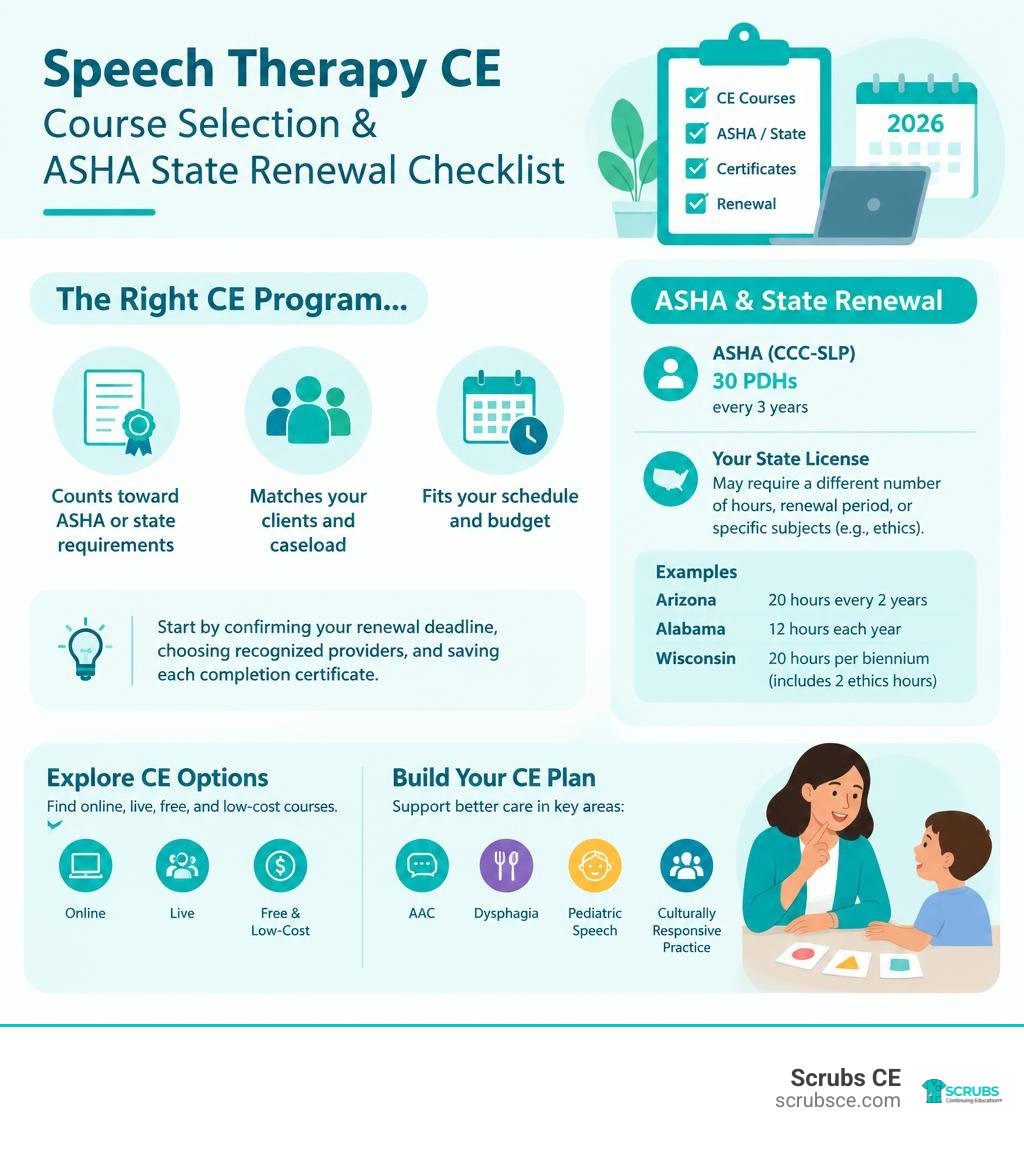
Speech therapy CE word guide:
Understanding ASHA and State Speech Therapy CE Requirements
Managing professional development requires balancing national certification requirements with individual state licensing laws. The American Speech-Language-Hearing Association (ASHA) establishes baseline standards for maintaining the Certificate of Clinical Competence (CCC-SLP), requiring clinicians to accumulate at least 30 Professional Development Hours (PDHs) over a 3-year certification interval. However, state licensing boards set their own statutory frameworks, resulting in distinct timelines, approved provider criteria, and topic mandates.
Understanding these state-specific variations ensures uninterrupted legal authority to practice. While some states mirror ASHA timelines, others operate on annual or biennial cycles that demand careful tracking of online CEU credits.
| Regulatory Body / State Board | Required CE Hours | Renewal Interval | Mandatory Course Topics |
|---|---|---|---|
| ASHA (CCC-SLP) | 30 PDHs (3.0 CEUs) | 3 Years | 1 hour Ethics; 2 hours Cultural Competency |
| Arizona | 20 Hours | Biennial (2 Years) | Relevant clinical practice |
| Alabama | 12 Hours | Annual (1 Year) | Board-approved speech pathology topics |
| Wisconsin | 20 Hours | Biennial (2 Years) | Minimum 2 hours Ethics |
Failing to complete required hours within the mandated window exposes clinicians to audit failures, late fines, temporary license suspension, or forfeiture of ASHA certification.
Mandatory Topics for Speech Therapy CE Compliance
Continuing education mandates ensure that clinicians uphold ethical integrity and deliver culturally aware care. Current ASHA standards require CCC-SLP holders to dedicate specific portions of their 30 PDHs to essential focus areas:
- Ethics Training: At least 1 hour must focus on professional ethics, covering conflicts of interest, client advocacy, and ethical decision-making frameworks. In states like Wisconsin, state boards enforce an independent 2-hour ethics requirement during each renewal biennium.
- Culturally Responsive Practice: Clinicians must complete a minimum of 2 PDHs in cultural competency, diversity, equity, and inclusion (DEI), or culturally responsive assessment methodologies.
- Supervision Requirements: SLPs who supervise clinical fellows or graduate students must complete dedicated professional development in clinical supervision prior to serving as mentors.
Clinicians can complete these mandatory topics through self-paced modules, live webinars, or formal university-level coursework.
Finding Low-Cost and Free Speech Therapy CE Opportunities
Maintaining compliance does not require spending thousands of dollars out of pocket. Many clinical organizations and assistive technology developers provide open-access or complimentary professional education modules.
Augmentative and Alternative Communication (AAC) manufacturers frequently provide complimentary, high-caliber training covering eye-gaze calibration, switch access, and dynamic display software. These technical modules often carry formal ASHA CEU credits.
Similarly, state speech-language-hearing associations and clinical education platforms frequently host sponsored webinars on dysphagia protocols, pediatric motor speech, and telepractice. By combining open-access institutional offerings with comprehensive home study courses, speech-language pathologists can meet their renewal requirements on a manageable budget.

High-Impact Clinical Specialty Courses for SLPs
Selecting continuing education that directly reflects your daily caseload improves clinical outcomes and job satisfaction. Rather than accumulating random hours to meet a deadline, targeted coursework helps clinicians master complex diagnostic and therapeutic interventions.

For pediatric specialists working with structural speech disorders, the Speech Evaluation and Intervention for Cleft Palate and Velopharyngeal Dysfunction (On Demand Webinar) provides 0.2 ASHA CEUs (2.0 PDHs) on differentiating active, passive, and compensatory articulation errors. Clinicians learn when surgical intervention is required versus when motor-learning drills and phonological approaches can resolve velopharyngeal speech distortions.
Other key specialty areas to prioritize in your professional development plan include:
- Tracheostomy and Ventilator Management: Medical SLPs benefit from hands-on training regarding speaking valve placement, cuff deflation protocols, and modified dysphagia assessments.
- Pediatric Feeding and Dysphagia: Evidence-based protocols focusing on sensory-motor feeding challenges, videofluoroscopic swallow study (VFSS) interpretation, and infant feeding development.
- Adult Neurogenic Communication: Advanced coursework addressing cognitive-communication interventions for traumatic brain injury (TBI), primary progressive aphasia, and functional maintenance programming in dementia care.
Interdisciplinary collaboration is also central to modern clinical work. Speech pathologists managing complex head, neck, and chest anatomy routinely collaborate with imaging teams. Broadening your clinical foundation by learning how allied colleagues maintain their credentials—such as how imaging specialists complete Radiologic Technologist Continuing Education Credits—fosters seamless interprofessional communication during complex diagnostic evaluations.
Strategies for Efficient Course Selection and Verification
Verifying the accreditation of a continuing education course before enrolling prevents unapproved hours from causing license renewal issues.
Follow these operational steps when evaluating potential educational programs:
- Check Approved Provider Status: Verify whether the provider is an approved ASHA CE Provider or recognized by organizations like the American Academy of Audiology (AAA) or state departments of public instruction.
- Review the State Pre-Approval Rules: If a course is hosted by an unlisted entity, determine whether your state board requires pre-approval. For instance, some state licensing boards mandate submitting detailed syllabi at least 30 calendar days before the course begins.
- Balance Live and On-Demand Learning: Integrate live interactive seminars for real-time clinical discussions with self-paced accredited CE courses to accommodate shifts in your caseload schedule.
- Confirm the CE Registry Reporting Process: When using the ASHA CE Registry, verify whether the provider submits attendance rosters directly or requires you to self-report through your certification maintenance portal.
Streamlining Clinical Practice and CE Management
Clinicians often juggle heavy treatment caseloads alongside administrative duties and continuing education requirements. Establishing efficient digital documentation systems frees up valuable time for meaningful professional development.

Modern Electronic Health Record (EHR) systems with structured templates and AI-assisted clinical documentation can significantly cut down daily administrative hours. Clinicians utilizing automated transcription and structured SOAP note generators can reduce documentation time, freeing up hours to focus on advanced coursework.
For CE management:
- Maintain a dedicated cloud folder labeled with your current renewal interval to store completion certificates immediately.
- Use automated tracking registries, such as CE Broker, where mandated by your state licensing board.
- Set scheduled quarterly milestones to complete 5 to 10 hours of a CE course online rather than rushing to fulfill requirements at the end of your cycle.
Investing in structured online education healthcare systems keeps your clinical credentials secure and your daily workflow organized.
Frequently Asked Questions About Speech Therapy CE
How many continuing education hours does ASHA require for CCC-SLP maintenance?
ASHA requires certificate holders to complete a minimum of 30 Professional Development Hours (PDHs), equivalent to 3.0 ASHA CEUs, across a rolling 3-year certification maintenance interval. This total must include at least 1 hour of ethics and 2 hours of culturally responsive practice.
Do free CE courses automatically satisfy state licensing requirements?
Not automatically. State licensing boards maintain independent criteria for course acceptance. Even if a free course awards a certificate of completion, it must come from a board-approved provider or fit the specific clinical scope defined by your state board. Always review your state licensing rules before applying unaccredited hours toward renewal.
What happens if an SLP fails to complete required CE hours on time?
Failing to meet CE requirements before your renewal deadline can result in late penalty fees, formal audit notices, license suspension, or the expiration of your CCC-SLP credential. Reinstating lapsed credentials often requires completing backlogged educational hours, paying reinstatement fees, and undergoing mandatory audits.
Conclusion
Building a successful continuing education plan requires balancing regulatory compliance, budget awareness, and clinical relevance. By tracking your state and national deadlines, selecting accredited coursework, and utilizing free and low-cost learning opportunities, you can maintain your credentials with confidence.
At Scrubs CE, we are dedicated to helping healthcare providers stay compliant, expand their clinical expertise, and balance professional growth with everyday clinical demands. Whether you are exploring interdisciplinary subjects or managing your general healthcare credentials, explore our comprehensive Radiology CE course library and healthcare continuing education resources to support your ongoing professional development.