
LGBTQ Healthcare CE Options for Modern Providers
Why LGBTQ Healthcare CE Matters for Today’s Clinicians

LGBTQ healthcare CE is continuing education designed to help clinicians deliver respectful, evidence-based care to lesbian, gay, bisexual, transgender, and queer patients.
Quick answer — top LGBTQ healthcare CE options available right now:
| Course / Program | Credits | Cost |
|---|---|---|
| National LGBTQIA+ Health Education Center (80+ webinars) | AAFP / CME / CEU | Free |
| Pri-Med LGBTQIA+ CME/CE courses | CME / CEU | Free |
| The National LGBTQ+ Curriculum Part II | 6.0 AMA PRA Category 1 Credits | Paid |
| HEAL (Health Education About LGBTQ+ Elders) | CNE / CEU | Varies |
| GLMA continuing education webinars | CNE / CME | Varies |
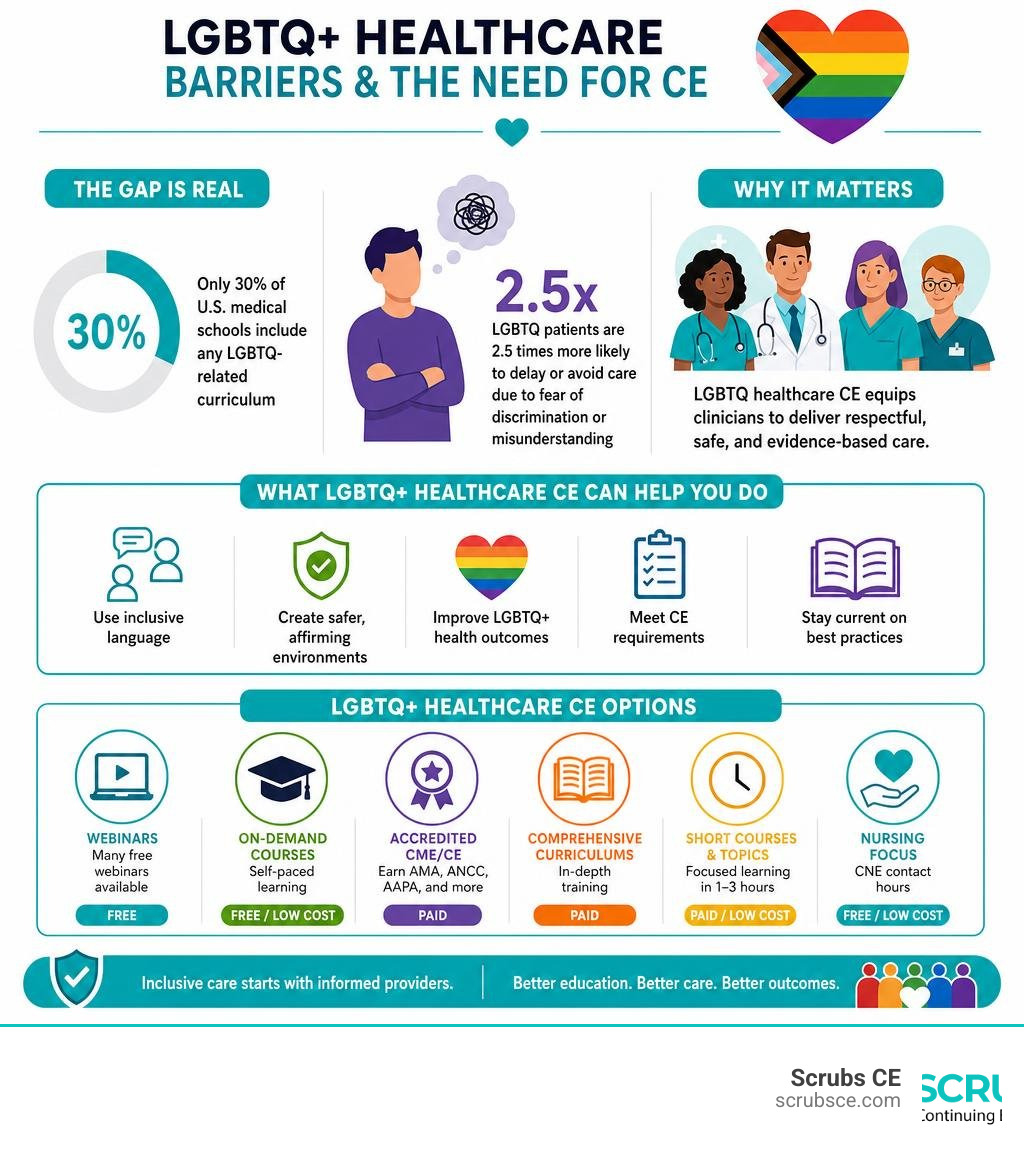
The numbers tell a difficult story. Only 30% of U.S. medical schools include any LGBTQ-related curriculum — and most cover it in a single lecture or less. Meanwhile, LGBTQ patients are 2.5 times more likely to delay or avoid care because they expect discrimination or assume their provider simply won’t understand their needs.
That gap between patient need and provider preparation is exactly what LGBTQ healthcare CE is built to close.
I’m Zita Ewert, and my work leading Scrubs CE has given me a front-row seat to how accreditation requirements and continuing education intersect across healthcare disciplines — including the growing demand for LGBTQ healthcare CE among nurses, allied health professionals, and imaging practitioners. Read on for a practical breakdown of your best training options, what they cover, and how to earn credit.
Understanding Health Disparities and Barriers to LGBTQ+ Care

To understand why LGBTQ healthcare CE is so vital, we have to look closely at the unique structural barriers and health disparities that sexual and gender minority (SGM) populations navigate daily.
The Framework of Minority Stress
At the heart of LGBTQ+ health disparities is minority stress theory. This psychological framework explains that sexual and gender minorities experience chronic, high levels of stress resulting from societal prejudice, discrimination, and stigma. This stress is not an internal pathology; it is an external, hostile burden. Over time, this chronic stress leads to poor physical health outcomes, higher rates of cardiovascular disease, and elevated rates of mental health challenges, such as anxiety and depression.
For transgender and non-binary individuals, this stress is compounded by severe systemic barriers. Transgender individuals experience a staggering 41% lifetime suicide attempt rate, a statistic directly linked to barriers in accessing affirming, respectful healthcare.
Conversely, when patients receive supportive care, the impact is lifesaving. Research shows that LGBTQ youth who have access to gender-affirming care experience a 60% reduction in moderate to severe depression and a 73% reduction in suicidality.
The Cost of Avoidance and Policy Gaps
Because many patients anticipate discrimination, they often choose to avoid the clinic altogether. LGBTQ patients are 2.5 times more likely to delay or avoid medical care due to anticipated discrimination or a historical lack of provider knowledge. When patients only seek care during an emergency, their health outcomes suffer, and the overall cost of care skyrockets.
Unfortunately, institutional policies have been slow to catch up to clinical realities. Only 8% of U.S. hospitals have policies that explicitly protect LGBTQ patients from discrimination in both visitation and care. This lack of clear, top-down protection makes continuing education for individual clinicians even more critical.
Essential Terminology and Best Practices for Affirming Environments
Providing high-quality care starts with using the right language. When a provider uses incorrect or outdated terminology, it signals a lack of competence and can instantly damage the therapeutic alliance.
Separating the Concepts
A common clinical mistake is conflating different aspects of a patient’s identity. When completing LGBTQ healthcare CE courses, you will learn to clearly differentiate between these three core concepts:
- Gender Identity: A person’s deeply felt, internal sense of being male, female, a blend of both, or neither. This may or may not align with the sex they were assigned at birth.
- Sexual Orientation: Who a person is physically, romantically, and emotionally attracted to (e.g., lesbian, gay, bisexual, asexual, pansexual).
- Anatomical Sex (or Assigned Sex): The biological characteristics (chromosomes, hormones, and internal/external anatomy) present at birth.
Understanding that gender identity and sexual orientation are completely independent of one another is a foundational step in modern clinical practice.
Pronouns and Affirming Communication
Asking for and respecting a patient’s pronouns is a simple, highly effective clinical intervention. When documenting patient information, it is essential to record both the patient’s legal name (for billing and insurance purposes) and their chosen name and pronouns for daily clinical interactions.
To help guide your practice, here is a quick reference table comparing non-affirming communication with affirming alternatives:
| Non-Affirming Behavior / Term | Affirming Alternative | Why It Matters |
|---|---|---|
| “Homosexual” | Lesbian, gay, bisexual, queer | Avoids clinical, outdated pathologizing language. |
| “Sexual preference” | Sexual orientation | Recognizes that orientation is an inherent aspect of identity, not a casual choice. |
| “Transvestite” | Transgender, non-binary | Uses respectful, modern terminology for gender-diverse individuals. |
| “MTF” (Male-to-Female) or “FTM” | Transgender woman, transgender man | Focuses on the patient’s current, affirmed identity rather than their assigned sex at birth. |
| Assuming pronouns based on appearance | Asking: “What pronouns do you use?” | Prevents misgendering and builds immediate clinical trust. |
| Documenting only legal name | Recording chosen name and pronouns in the EHR | Ensures the entire care team addresses the patient respectfully. |
Optimizing SOGI Data Storage
Collecting Sexual Orientation and Gender Identity (SOGI) data is now recognized as a clinical best practice. However, providers must ensure this data is collected, used, and stored securely within the Electronic Health Record (EHR).
When optimizing EHR systems, clinical teams should ensure that SOGI fields are distinct from legal billing fields. This prevents administrative mix-ups while ensuring that clinicians have immediate access to accurate anatomical inventories—allowing for appropriate cancer screenings and preventive care without subjecting the patient to unnecessary, invasive questioning.
Navigating State Mandates and Accreditation for LGBTQ Healthcare CE
The legal and regulatory landscape surrounding cultural competency training is evolving rapidly. As of July 2026, multiple states, licensing boards, and national credentialing bodies have established specific mandates for LGBTQ healthcare CE.
State-Specific Mandates
- Washington, D.C.: Licensed health professionals in the District of Columbia are required to complete at least 2 hours of continuing education focused on cultural competency or specialized clinical training specifically addressing LGBTQ+ patients.
- California: The California Board of Pharmacy mandates cultural competency training for pharmacists, which can be satisfied by completing approved courses focusing on reducing health disparities and implementing affirming communication.
- Oregon: The Oregon Health Authority (OHA) maintains strict standards for approved cultural competency CE, requiring courses to address systemic oppression, intersectionality, and clinical best practices.
The Healthcare Equality Index (HEI)
The Human Rights Campaign (HRC) Foundation manages the Healthcare Equality Index (HEI), which serves as the national benchmarking tool for LGBTQ+ inclusive policies and practices in healthcare facilities. Similarly, the Long-Term Care Equality Index (LEI) benchmarks residential long-term care facilities.
To earn and maintain “Leader” status on the HEI, hospitals must ensure that their staff completes ongoing training. For example, municipal health systems like NYC Health + Hospitals—which mandated LGBTQ+ training for all staff in 2011—successfully achieved LGBTQ+ Healthcare Equality Leader designation for all 18 of its eligible facilities in 2026.
When healthcare professionals complete approved webinars and modules from accredited centers, these activities automatically count toward their facility’s HEI ongoing training requirements, provided they submit their facility’s HRC Facility ID during course registration.
Understanding Credit Equivalencies
Finding the right course means ensuring the credits will actually count toward your license renewal. Fortunately, major accrediting bodies have established highly flexible equivalency pathways:
- AAFP Prescribed Credit: Offered by organizations like the Fenway Institute’s National LGBTQIA+ Health Education Center, AAFP Prescribed credit is accepted by the American Medical Association (AMA) as equivalent to AMA PRA Category 1 Credit™.
- Nursing and Allied Health: AAFP Prescribed credits are also widely accepted by the American Nurses Credentialing Center (ANCC), the American Academy of Physician Associates (AAPA), the American Association of Nurse Practitioners (AANP), the National Commission on Certification of Physician Assistants (NCCPA), and the American Association of Medical Assistants (AAMA).
Addressing Implicit Bias, Discrimination, and Intersectionality

Providing affirming care requires clinicians to look beyond basic terminology and examine the deeper, systemic forces that shape patient experiences.
The Role of Intersectionality
Coined by legal scholar Kimberlé Crenshaw, intersectionality is a crucial framework for understanding how different aspects of a patient’s identity—such as race, ethnicity, socioeconomic status, physical ability, geographic location, and gender identity—intersect and compound health disparities.
An LGBTQ+ patient who is also a person of color faces unique, overlapping barriers that cannot be addressed by looking at sexual orientation or race in isolation. For instance, the lifetime risk of acquiring HIV for gay and bisexual men in the United States is approximately 1 in 6, but this risk is disproportionately concentrated among Black and Latino men due to systemic socioeconomic inequities, unequal access to healthcare, and geographic disparities.
Legacies of Scientific Racism and Sexology
Modern clinical practices do not exist in a vacuum. Historically, medical institutions played a significant role in pathologizing and marginalizing SGM individuals through the legacy of scientific racism and early sexology. For decades, queer and trans identities were classified as psychiatric disorders, and medical research was frequently weaponized to justify discrimination.
Acknowledging this history is crucial. Many older LGBTQ+ patients lived through eras when their identities were actively pathologized by the medical establishment, which explains why they may be deeply hesitant to disclose their identity to healthcare providers today.
Practicing Cultural Humility and Team Training
While cultural competence implies a finite endpoint of knowledge, cultural humility is a lifelong process of self-reflection, self-critique, and clinical growth. It requires providers to actively examine their own implicit biases and identify normative assumptions in their clinical spaces.
Furthermore, an inclusive clinical environment is only as strong as its weakest link. A patient’s experience begins the moment they call to schedule an appointment or walk through the front door. Therefore, engaging and training support staff—including receptionists, billing specialists, and medical assistants—on LGBTQ+ cultural competency is just as critical as training the prescribing clinicians.
Top Programs and Resources for LGBTQ+ Clinical Training
If you are looking to complete LGBTQ healthcare CE, several highly respected national organizations offer excellent, evidence-based curricula.
1. The National LGBTQIA+ Health Education Center
A program of the Fenway Institute, this center is a premier hub for free, high-quality education.
- Offerings: Over 80 on-demand webinars and self-paced interactive learning modules.
- Where to Start: If you are new to this clinical space, start with their foundational webinar, “Achieving Health Equity for LGBTQIA+ People”, which provides an excellent overview of terminology, demographic trends, and clinical best practices.
- Credits: Programs offer AAFP Prescribed credits and HEI ongoing training credits.
2. GLMA: Health Professionals Advancing LGBTQ Equality
As the world’s oldest and largest association of LGBTQ+ healthcare professionals, GLMA offers comprehensive educational resources, including an annual conference and a four-part webinar series designed to help providers build inclusive clinical environments. They also host the national GLMA Healthcare Provider Directory, a vital resource for patients seeking affirming care.
3. Nurses’ Health Education About LGBTQ Elders (HEALE)
For clinicians working in geriatrics or long-term care, the HEALE curriculum offers targeted cultural competency modules. This program focuses on the unique historical experiences, legal challenges, and medical needs of older LGBTQ+ adults, awarding 1.0 CNE contact hour per completed module.
4. WPATH Standards of Care Version 8
The World Professional Association for Transgender Health (WPATH) publishes the Standards of Care (SOC). Currently in its 8th version, this document represents the global clinical consensus for the treatment and medical management of transgender and gender-diverse individuals. Any provider prescribing hormone therapy or writing support letters for gender-affirming procedures should be thoroughly familiar with these guidelines.
Free and Accredited LGBTQ healthcare CE Courses
For primary care clinicians looking for streamlined, free continuing education, platforms like Pri-Med offer dedicated LGBTQIA+ CME/CE courses. These courses focus on practical, day-to-day clinical skills, such as discussing HIV pre-exposure prophylaxis (PrEP) with high-risk individuals, understanding hormone regimens, and managing mental health comorbidities within the SGM community. Many of these self-paced online courses automatically report completed credits directly to CE Broker for seamless license renewal.
Specialized LGBTQ healthcare CE for Nurses and Allied Health
Nurses and allied health professionals can access targeted training through accredited academic institutions and non-profit organizations that offer specialized courses. These courses go beyond basic terminology to cover specialized topics, such as:
- Providing Ethical and Compassionate Care to Intersex Patients: Avoiding unnecessary, non-consensual cosmetic surgeries on infants and respecting bodily autonomy.
- Caring for Non-binary and Gender-Fluid Patients: Navigating low-dose or customized hormone therapy regimens.
- Trauma-Informed Care: Implementing clinical exams that minimize distress for patients with a history of medical trauma or gender dysphoria.
Frequently Asked Questions about LGBTQ+ Clinical Training
How do providers earn HEI ongoing training credit?
To earn Healthcare Equality Index (HEI) ongoing training credit, healthcare professionals must complete approved webinars or learning modules hosted by designated partner organizations (such as the National LGBTQIA+ Health Education Center).
During registration, you must provide your organization’s unique HRC Facility ID. After watching the webinar or completing the self-paced module in full, you must submit the evaluation survey. The hosting organization will then automatically report your training hours to the Human Rights Campaign to count toward your hospital’s annual HEI benchmark score.
Which professional boards accept AAFP Prescribed credits?
AAFP Prescribed credit is highly versatile and widely accepted across multiple disciplines. The American Medical Association (AMA) accepts AAFP Prescribed credit as equivalent to AMA PRA Category 1 Credit™ toward the Physician’s Recognition Award.
Additionally, these credits are accepted by:
- The American Nurses Credentialing Center (ANCC) for nursing license renewals.
- The American Academy of Physician Associates (AAPA) and the National Commission on Certification of Physician Assistants (NCCPA).
- The American Association of Nurse Practitioners (AANP).
- The American Association of Medical Assistants (AAMA).
What are the clinical implications of hormone therapy in primary care?
Hormone replacement therapy (HRT) is a highly effective, medically necessary intervention for many transgender individuals, but it requires careful clinical monitoring.
For example, consider the case of Mark, a 38-year-old transgender man on long-term testosterone therapy who presented with recurrent urinary tract infections (UTIs). An affirming primary care provider who understood trans-masculine health did not simply prescribe standard antibiotics. Instead, the provider recognized that long-term testosterone use can lead to local estrogen deficiency, causing vaginal and urethral atrophy. By identifying this specific physiological change, the provider was able to prescribe localized topical estrogen cream, successfully treating the underlying cause of the recurrent UTIs while fully respecting Mark’s gender identity and anatomy.
Conclusion
Expanding your clinical skillset through LGBTQ healthcare CE is one of the most impactful steps you can take to reduce health disparities, build patient trust, and improve clinical outcomes. Whether you are fulfilling a state mandate in Washington, D.C., working toward an HEI designation for your hospital, or simply striving to provide the most compassionate care possible, high-quality continuing education is the foundation of modern, evidence-based practice.
At Scrubs CE, we are dedicated to supporting your professional development journey. We provide convenient, high-quality, self-paced online courses designed to help you meet licensing requirements and advance your clinical career with ease. Our e-learning platform is built for busy modern professionals, offering affordable courses and instant downloadable certificates of completion.
For imaging professionals looking to fulfill specialized credits, we invite you to explore our wide selection of approved Radiology CE Courses to maintain your credentials with the AMERICAN REGISTRY OF RADIOLOGIC TECHNOLOGISTS® (ARRT®) and the American Society of Radiologic Technologists (ASRT®). Take the next step in your professional development and explore our course library today!