
Passing the Test: Anatomy and Physiology Licensure Requirements Made Easy
Why Anatomy and Physiology Licensure Requirements Don’t Have to Be Overwhelming

Understanding anatomy and physiology for dummies licensure requirements is simpler than most healthcare students expect — once you know exactly what each profession demands.
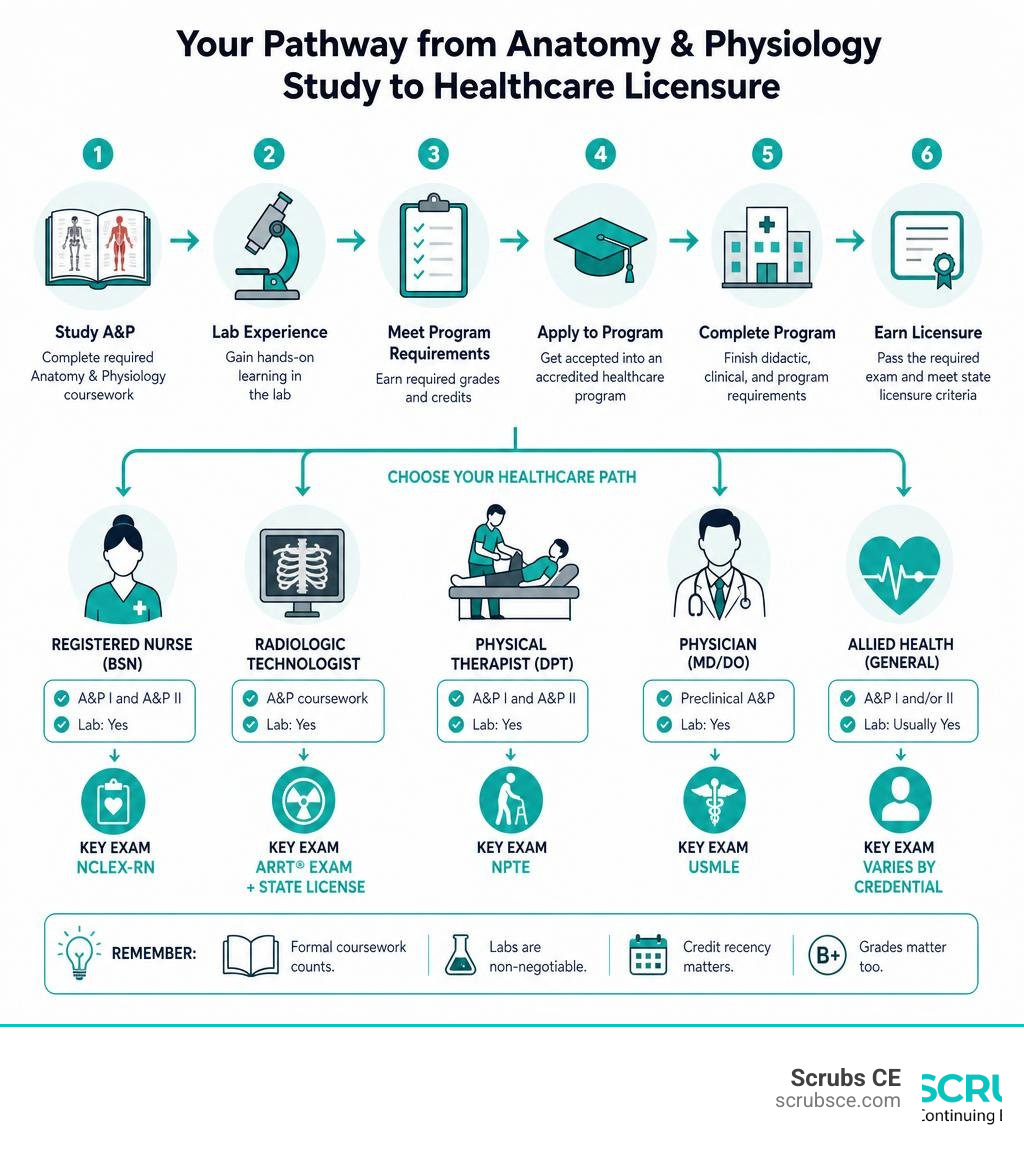
Here is a quick snapshot of what most healthcare programs require:
| Profession | Core A&P Requirement | Lab Required? | Key Exam |
|---|---|---|---|
| Registered Nurse (BSN) | A&P I and A&P II | Yes | NCLEX-RN |
| Radiologic Technologist | A&P coursework | Yes | ARRT® exam + state license |
| Physical Therapist (DPT) | Separate A&P I and II | Yes | NPTE |
| Physician (MD/DO) | Preclinical A&P | Yes | USMLE |
| Allied Health (general) | A&P I and/or II | Usually yes | Varies by credential |
A few things are true across almost every healthcare path:
- Formal coursework counts. Self-study alone almost never satisfies licensure prerequisites.
- Labs are non-negotiable for most clinical programs.
- Credit recency matters. Many programs reject A&P credits older than 7 to 10 years.
- Grades matter too. Competitive programs typically require a B or higher in both semesters.
If you have ever cracked open a textbook and immediately felt overwhelmed by terms like glomerular filtration rate or sartorius, you are in good company. Anatomy and physiology has a reputation for being one of the hardest gatekeepers in healthcare education — and for good reason. The volume of material is enormous, the terminology is dense, and the stakes are high. Your ability to demonstrate this knowledge is directly tied to your legal right to practice.
But here is the good news: the requirements themselves are not mysterious. Once you understand what each licensing body actually asks for, you can build a clear, manageable plan.
I’m Zita Ewert, and as the driving force behind Scrubs CE, I have spent years helping imaging professionals and allied health workers navigate the exact intersection of anatomy and physiology for dummies licensure requirements and real-world credential maintenance. I will walk you through what you actually need to know — no jargon, no guesswork.
Anatomy and physiology for dummies licensure requirements terms at a glance:
Demystifying Anatomy and Physiology for Dummies Licensure Requirements
To demystify these regulations, we must first look at how licensing boards view the human body. They do not see anatomy and physiology (A&P) as a dry academic hurdle. Instead, they view it as the scientific baseline for patient safety. Whether you are administering medication, taking a radiograph, or manipulating a joint, you are actively interacting with a complex biological machine containing roughly 37 trillion cells, 206 bones, and 11 distinct organ systems.
Academic prerequisites are strictly standardized across the United States. Licensing boards and professional accrediting bodies, such as the Commission on Collegiate Nursing Education (CCNE), set specific parameters for what constitutes acceptable foundational education. To gain a complete overview of what these core concepts entail, you can explore our guide on Everything You Need to Know About Anatomy and Physiology for Dummies.
In most cases, the standard requirement is a two-semester sequence: Human Anatomy and Physiology I and II. These courses must cover the six levels of body organization (chemical, cellular, tissue, organ, organ system, and organismal) and explain how the body maintains homeostasis—the dynamic balance that keeps us alive.
Pre-Licensure BSN and Nursing Program Standards
For aspiring Registered Nurses, the academic journey is highly structured. In a pre-licensure Bachelor of Science in Nursing (BSN) program, A&P is the gatekeeper sequence. You cannot advance to clinical courses like pharmacology, pathophysiology, or medical-surgical nursing without first proving you understand normal human structure and function.
For example, a typical pre-licensure BSN degree, such as the program offered at Grand Canyon University (GCU), requires 123 total credits. Of those, 84 credits are dedicated directly to the major. Before students can even touch those major credits, they must complete Human Anatomy and Physiology I and II, complete with their corresponding laboratory components.
These standards exist because nursing licensure exams, specifically the NCLEX-RN, test clinical judgment. You cannot recognize abnormal physiological changes in a patient if you do not understand normal baseline functions. The proof of this rigorous approach is in the results: GCU’s NCLEX first-time pass rate for its Phoenix, Arizona campus in 2024 was an impressive 97.17%.
Radiologic Technologist and Radiology Certification Requirements
For those entering the field of medical imaging, the requirements are regulated by the AMERICAN REGISTRY OF RADIOLOGIC TECHNOLOGISTS® (ARRT®). To earn ARRT® certification and registration, candidates must complete an accredited educational program that includes comprehensive instruction in anatomy and physiology.
Because Radiologic Technologists must precisely position patients and shield sensitive tissues from ionizing radiation, their grasp of structural anatomy must be exceptional. You cannot safely perform diagnostic imaging without knowing exactly where internal structures lie in relation to external landmarks.
To help you navigate this specific path, we have created A Comprehensive Guide to Radiologic Technologist Certification Requirements, which outlines how these academic requirements transition into professional credentials. Earning your national ARRT® credential is only half the battle; more than 75% of U.S. states also have specific state licensing laws that govern your legal authority to practice Radiology.
Academic Pathways vs. Self-Study for Licensure
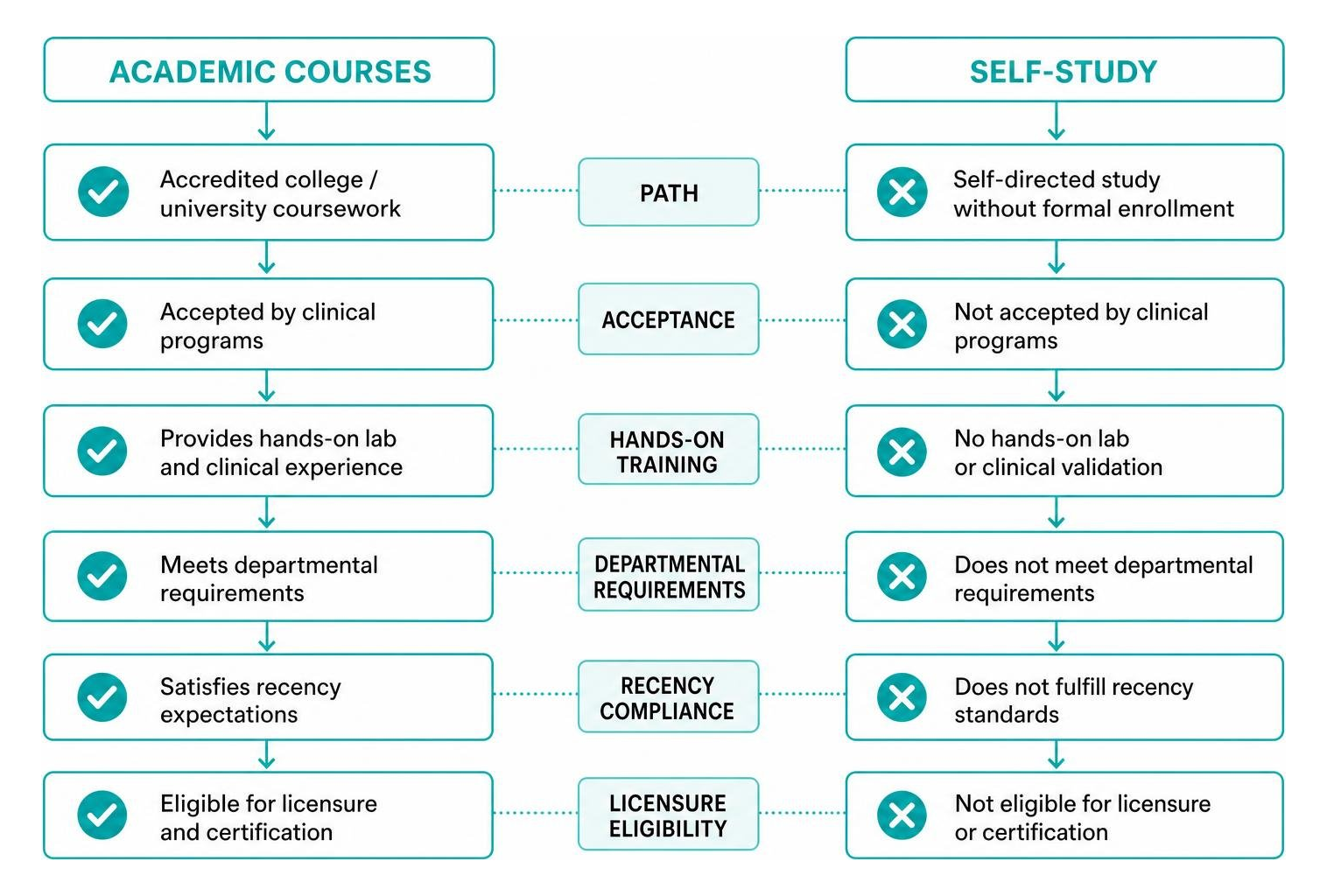
Many students wonder if they can bypass the classroom, study on their own, and simply test out of their science prerequisites. While self-study is an incredible tool for exam preparation, it has strict legal limitations when it comes to professional licensure.
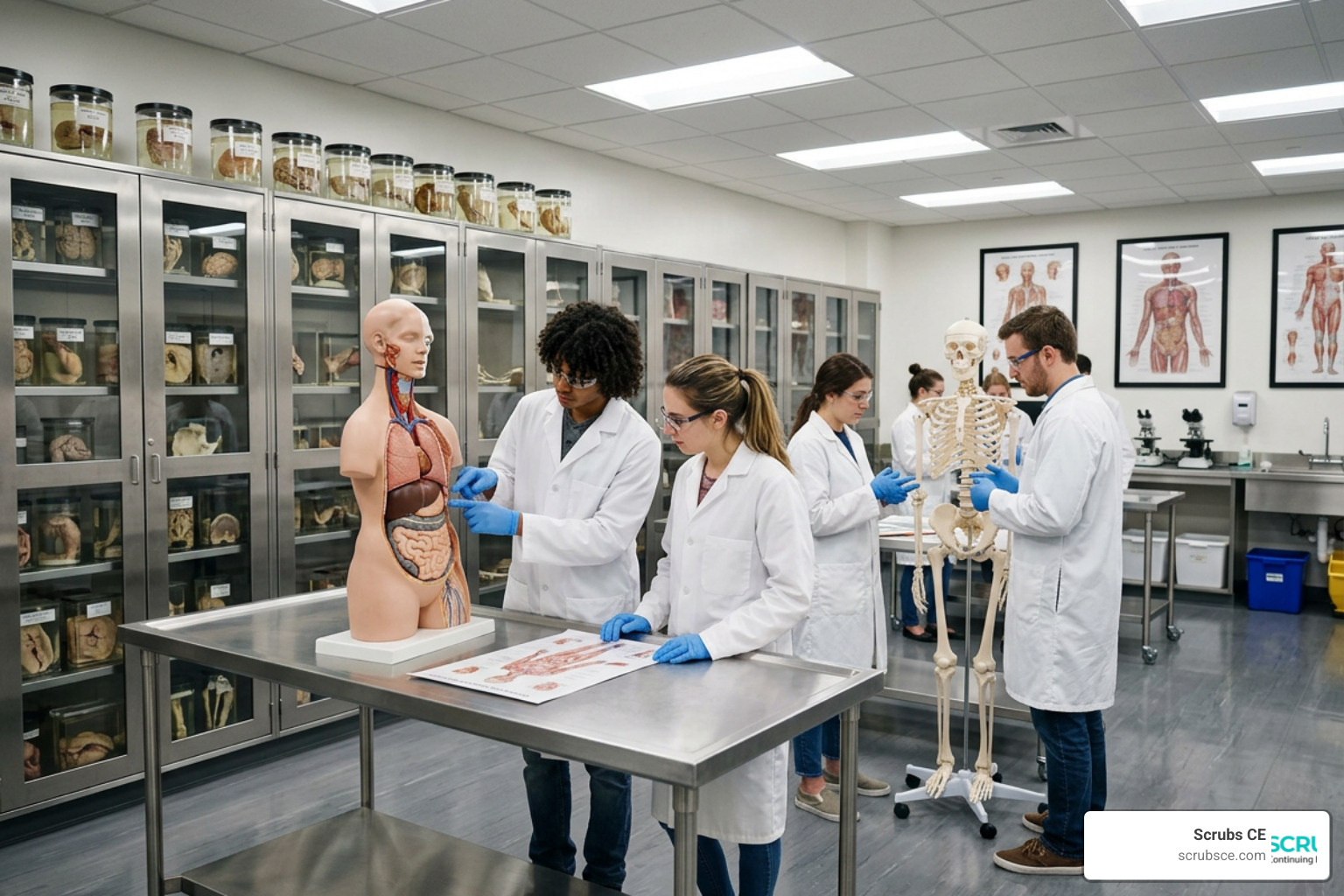
Clinical programs require academic transcripts from accredited institutions. They want to see that you have completed formal, structured coursework. The reason is simple: clinical safety requires hands-on validation. You cannot learn how to palpate a muscle group, locate a vein, or position a patient purely by reading a book on your couch.
Can Self-Study Satisfy Anatomy and Physiology for Dummies Licensure Requirements?
The short answer is no. While self-studying with books like Anatomy & Physiology All-in-One For Dummies is an excellent way to build confidence and ace your exams, self-study credentials alone do not satisfy professional licensure requirements.
Some institutions allow students to take the College-Level Examination Program (CLEP) or other equivalency exams to earn general education credits. However, highly competitive clinical programs—especially nursing, physical therapy, and Radiology—rarely accept CLEP credits for core lab sciences. They specifically require graded, multi-credit courses completed at an accredited college or university. For a detailed breakdown of how these courses are structured and evaluated, check out this guide on Anatomy and physiology courses: Careers & Certification ❓ .
Departmental Restrictions and Course Recency
If you are planning to apply to a specialized graduate program, such as a Doctor of Physical Therapy (DPT) program, the rules become even stricter. DPT admissions, which are processed through the Physical Therapist Centralized Application Service (PTCAS), have highly specific departmental restrictions.
Many DPT programs will not accept combined A&P courses. Instead, they require separate, dedicated semesters of Human Anatomy and Human Physiology, often insisting that these courses be taken within a biology, neuroscience, or integrated physiology department rather than a kinesiology or physical education department.
Furthermore, the “shelf-life” of your science credits is a major factor. Because medical science evolves and memory fades, most clinical programs enforce a strict 7-to-10-year recency rule. If you took A&P ten years ago, you will likely have to retake the entire sequence to qualify for admission or licensure.
Anatomy and Physiology on Professional Licensing Exams
Once you complete your coursework, you face the ultimate challenge: demonstrating your knowledge on your professional licensing exam. Whether you are sitting for the NCLEX-RN or the ARRT® registry, A&P forms the foundation of the entire test.
These exams do not simply ask you to label a diagram of the skeletal system. Instead, they present clinical scenarios that require applied physiological reasoning. For example, a question might ask how a change in normal renal physiology causes the specific symptoms of congestive heart failure. To answer correctly, you must understand how the urinary and cardiovascular systems interact to regulate blood pressure and fluid balance.
Core Topics Tested on the NCLEX-RN and ARRT® Exams
On these high-stakes exams, certain topics are prioritized because they directly impact patient safety.
- Fluid, Electrolyte, and Acid-Base Balance: This is heavily tested on the NCLEX-RN. You must understand how the kidneys filter approximately 180 liters of plasma daily to maintain homeostasis.
- Pharmacology and System Interactions: You must know how drugs affect the autonomic nervous system to predict side effects on the heart, lungs, and digestive tract.
- Cardiovascular Dynamics: The heart beats roughly 100,000 times per day, pumping 2,000 gallons of blood through 60,000 miles of vessels. Exams expect you to understand the electrical conduction system and blood flow pathways.
- Skeletal and Radiographic Anatomy: Essential for Radiology candidates, who must identify bones, joints, and organs on diagnostic images.
To streamline your preparation, you can utilize our comprehensive Anatomy and Physiology Study Material Guide 2026 July 🗨️ , which offers targeted study structures for these exact exam topics.
Study Strategies to Master Anatomy and Physiology for Dummies Licensure Requirements
To pass these exams on your first attempt, you must abandon passive study habits like highlighting and re-reading. Cognitive science shows that active recall—forcing your brain to retrieve information from memory—improves long-term retention by up to 50 percent compared to passive reading.
We recommend using spaced repetition flashcard systems (like Anki) to manage the massive volume of Latin terms and anatomical structures. Additionally, try the “protege effect”: teach a complex system, like the sliding filament theory of muscle contraction, to an empty room or a study partner. If you can explain it simply, you truly understand it.
To choose the best study companion for your specific learning style, take a look at our review of Anatomy and Physiology for Dummies Latest Edition Which Version Is Best for You.
Maintaining Competency: Continuing Education Requirements
Earning your initial license is a monumental achievement, but your professional journey does not end there. To keep your license active, you must prove that you are maintaining your clinical competency through Continuing Education (CE).
Different professions have different renewal cycles and credit requirements:
| Profession | CE Cycle | Credit Requirements | Key Focus Areas |
|---|---|---|---|
| Registered Nurse (RN) | Every 2 years | 20 to 30 contact hours | Clinical practice, pharmacology, patient safety |
| Radiologic Technologist | Every 2 years (Biennial) | 24 Category A or A+ credits | Radiation safety, patient care, advanced A&P |
| Physical Therapist (PT) | Every 2 years | 30 contact hours / CCUs | Orthopedics, neurology, rehabilitation |
Continuing Education for Radiologic Technologists
For Radiologic Technologists, the AMERICAN REGISTRY OF RADIOLOGIC TECHNOLOGISTS® (ARRT®) mandates that professionals earn 24 Category A or A+ continuing education credits every two years. These credits must be approved by a Recognized Continuing Education Evaluation Mechanism (RCEEM), such as the ASRT® (AMERICAN SOCIETY OF RADIOLOGIC TECHNOLOGISTS®).
As imaging technology becomes more sophisticated, advanced knowledge of cross-sectional anatomy and pathology is essential. To help imaging professionals meet these rigorous standards, we offer specialized courses like Anatomy for Radiographers, which are designed to satisfy your biennial CE requirements while directly improving your clinical imaging skills.
Continuing Education for Nursing and Allied Health
Nurses and other allied health professionals also face mandatory CE requirements that vary significantly by state. For instance, state nursing boards in Delaware, Georgia, Minnesota, and Utah have highly specific criteria regarding which out-of-state CE providers they will accept.
When choosing continuing education courses, always ensure your provider is fully accredited and approved by your state board. To find the highest-quality reference texts and study materials to support your ongoing professional development, you can consult our list of Anatomy Radiology Book Essentials Top Texts for Diagnostic Imaging.
Frequently Asked Questions about Anatomy and Physiology Licensure
Do online anatomy and physiology courses with virtual labs satisfy nursing licensure requirements?
It depends entirely on your target nursing program and state board. While many nursing schools accept online lectures, some highly competitive clinical programs strictly reject fully online lab credits, requiring physical “wet lab” or cadaver experiences. Always obtain written confirmation from your target program’s admissions office before enrolling in an online science course.
How long do anatomy and physiology credits remain valid for healthcare program admission?
In most cases, science prerequisite credits remain valid for 7 to 10 years. Because medical knowledge and clinical practices evolve, licensing boards and academic institutions want to ensure your foundational scientific knowledge is fresh and accurate before you begin clinical rotations.
What is the difference between national certification and state licensing for radiologic technologists?
National certification (such as that provided by the AMERICAN REGISTRY OF RADIOLOGIC TECHNOLOGISTS® or ARRT®) is a voluntary credential that proves you have met national standards of education and testing. State licensing, on the other hand, is a legal requirement mandated by individual state governments. You must often hold both to legally practice Radiology in your state.
Conclusion
Mastering anatomy and physiology for dummies licensure requirements does not have to be an overwhelming process. By understanding the academic standards of your chosen field, utilizing active study strategies, and keeping your credentials active through structured continuing education, you can successfully navigate every stage of your healthcare career.
At Scrubs CE, we are dedicated to supporting your professional development. We provide convenient, affordable, and fully accredited online continuing education courses designed to help you meet your licensure requirements on your own schedule.
If you are ready to fulfill your CE requirements with a high-quality, self-paced course that offers instant certification, explore our Practice Anatomy and Physiology for Dummies 3rd Ed Course today and take the next step in advancing your healthcare career!