

Why X-Ray Tech Certifications Are the Foundation of Your Radiology Career
X-ray tech certifications are the professional credentials that prove you have the education, ethics record, and exam scores needed to legally and safely perform diagnostic imaging. Here is a quick overview of what you need to know:
The main certifications and credentials at a glance:
| Credential | Issued By | Who It’s For |
|---|---|---|
| Radiography R.T.(R) | ARRT® | Entry-level radiographers (most common starting point) |
| Limited Scope (CLLRT) | State boards / AAH | Techs performing basic x-rays in a restricted setting |
| CT, MRI, Mammography | ARRT® (postprimary) | Experienced techs adding specialty credentials |
| CNMT | NMTCB | Nuclear medicine technologists |
| Sonography | ARDMS | Ultrasound / sonography specialists |
Over 360,000 people currently hold ARRT® credentials — making the American Registry of Radiologic Technologists® the undisputed national standard in this field.
Getting certified is not a one-time event. You also need to:
- Meet your state’s licensing requirements (rules vary widely)
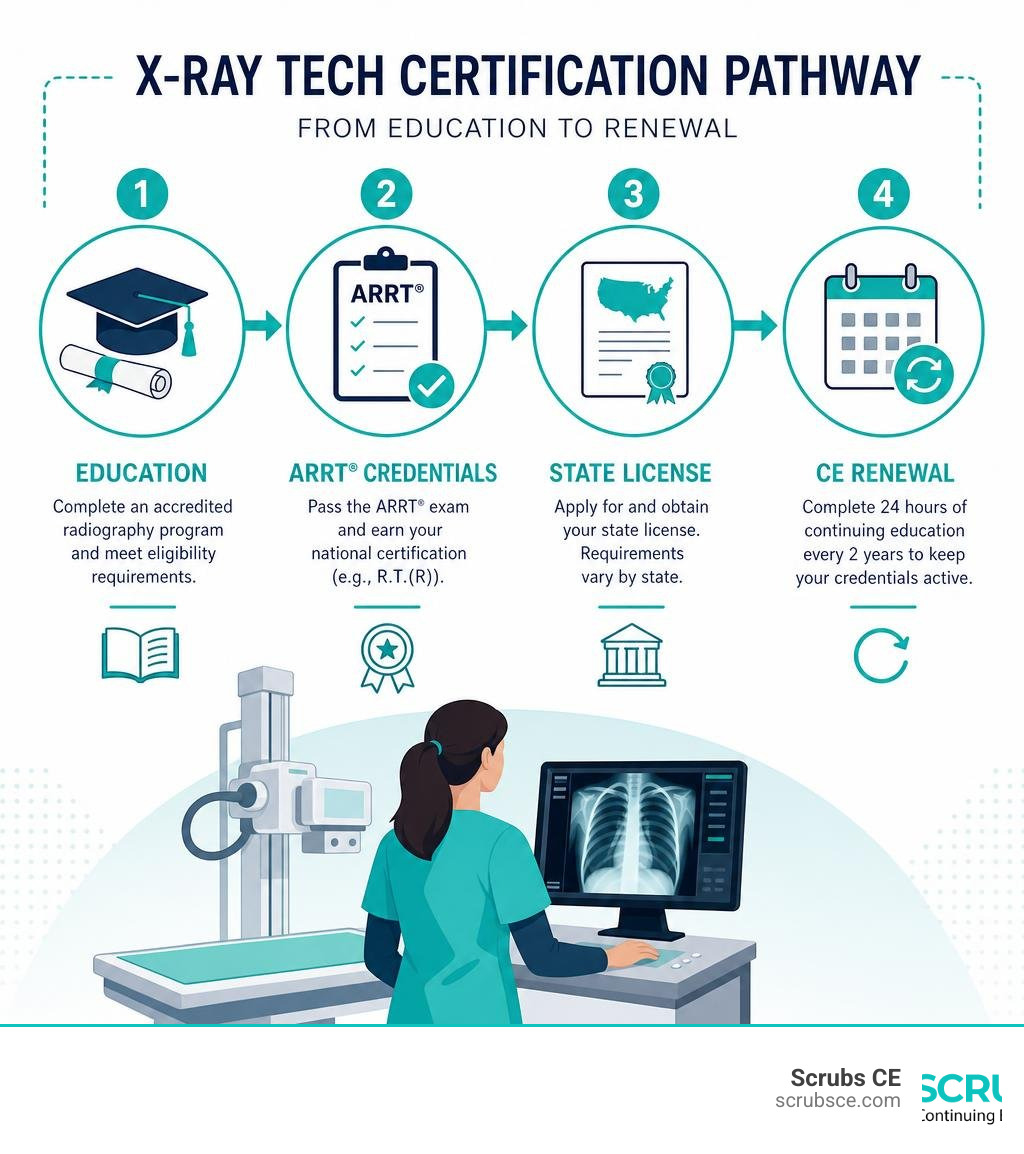
- Complete 24 hours of continuing education (CE) every two years to keep your ARRT® credentials active
- Pursue postprimary specialty credentials if you want to advance
Demand is strong and growing. The Bureau of Labor Statistics projects 6% job growth for radiologic technologists from 2023 to 2033, with roughly 16,000 job openings per year. As of July 2026, CT technologist vacancies have hit an all-time high of 19.4% — meaning certified, specialized techs are in serious demand.
I’m Zita Ewert, and as the leader of SCRUBS Continuing Education®, I’ve spent years helping radiologic technologists navigate x-ray tech certifications and the ongoing CE requirements that keep those credentials active. In this guide, I’ll walk you through every step — from choosing your first credential to maintaining it throughout your career.
Understanding ARRT® Certification vs. State Licensing

One of the most common points of confusion for those entering the Radiology field is the difference between national certification and state licensing. While they sound like the same thing, they serve completely different purposes.
National certification is administered by professional credentialing organizations, most notably the AMERICAN REGISTRY OF RADIOLOGIC TECHNOLOGISTS® (ARRT®). When you earn your ARRT® credentials, it means you have met rigorous national standards in education, ethics, and examination. It is a badge of professional competence recognized by employers and healthcare facilities across all fifty states.
State licensing, on the other hand, is the legal permission granted by an individual state’s government allowing you to work within that specific state. Every state has its own regulatory board, and their rules vary dramatically:
- States with strict licensing: States like California, New York, Texas, and Florida require you to hold a state-specific license. To get this license, you must show proof of your ARRT® certification and pay an licensing fee.
- States that accept ARRT® directly: Many states accept your national ARRT® registration as a direct substitute for a state exam, making the licensing process much faster.
- States with no licensing laws: A small handful of states (such as Alabama and Idaho) do not have state licensing laws for radiologic technologists. However, even in these states, almost all reputable employers and hospitals will still require national ARRT® certification as a condition of employment.
Navigating these dual requirements can feel overwhelming, but we have put together a detailed roadmap to help you streamline the process. You can read more about managing this journey in our guide on How to Get ARRT Certified Without Losing Your Mind.
Primary X-Ray Tech Certifications and Educational Pathways
Before you can sit for any national exam, you must complete the necessary educational and clinical requirements. To qualify for a primary ARRT® credential, you must earn an associate degree or higher from an institution accredited by an agency recognized by the ARRT®.
While your degree does not have to be specifically in radiologic sciences (for example, you could hold an associate degree in general science), you must complete an educational program in your chosen imaging discipline that is accredited by the Joint Review Committee on Education in Radiologic Technology (JRCERT).
A typical radiography program combines rigorous academic coursework with hands-on clinical training. In the classroom, you will study:
- Human anatomy and physiology
- Radiation physics and safety protocols
- Radiographic positioning and patient care
- Image production and digital evaluation
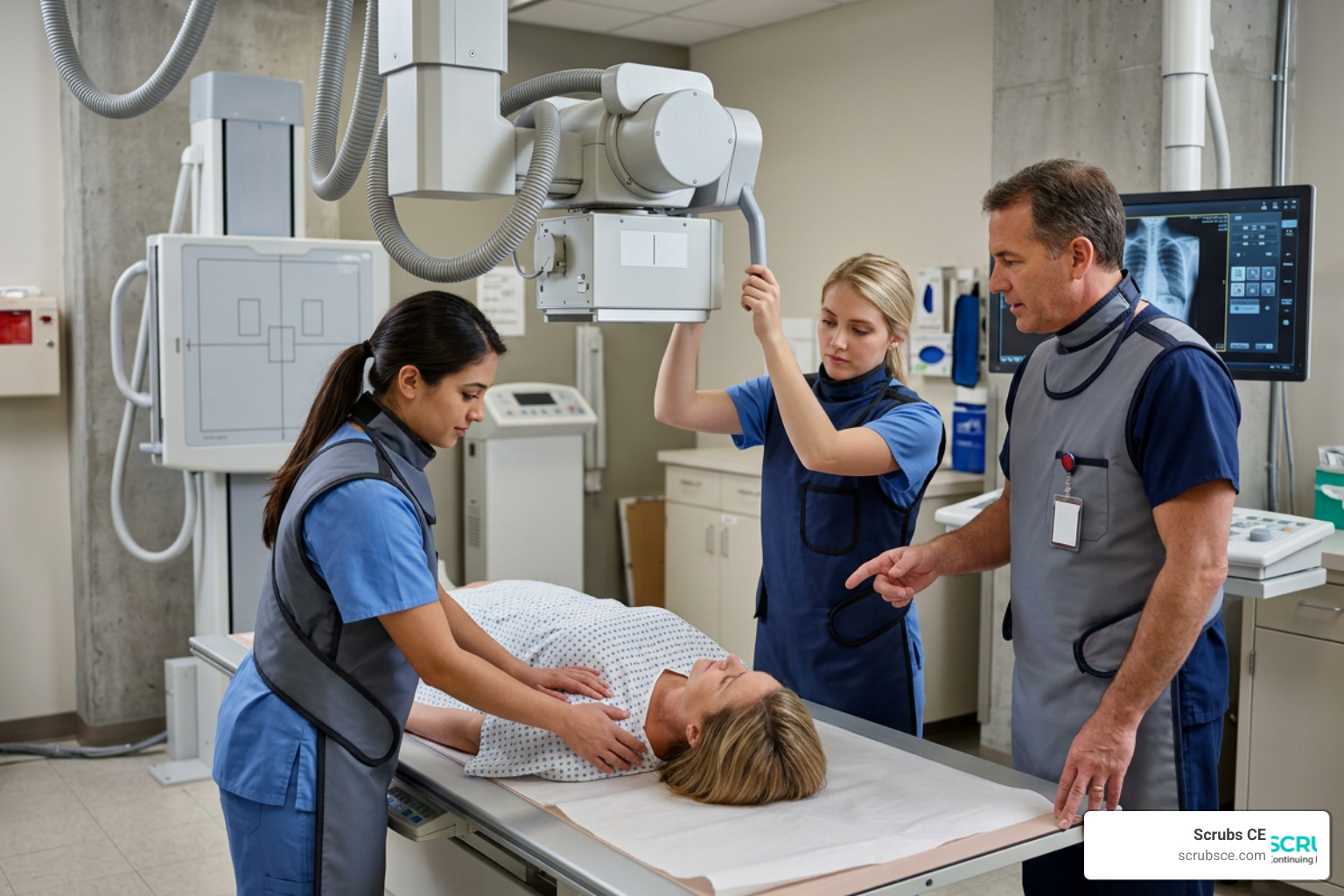
In the clinical lab, you will work under the direct supervision of licensed technologists and radiologists. You must document and master a strict checklist of clinical procedures—ranging from basic chest x-rays to complex fluoroscopic exams—before your program director can sign off on your ARRT® exam eligibility.
If you are looking for structured, accredited programs, you can explore options like the Radiologic Technology (X-Ray) (3760) program, which offers an excellent blending of academic and clinical instruction. If you are just starting to plan your academic journey, check out our guide on How to Start Your X-Ray Tech Education from the Comfort of Home.
Choosing the Right Primary X-Ray Tech Certifications
When starting out, most technologists choose Radiography as their primary discipline. The ARRT® evaluates candidates using what they call the “Equation for Excellence.” This framework ensures that every certified technologist meets three core requirements:
- Education: Completing both the didactic coursework and the clinical competencies required for your specific discipline.
- Ethics: Adhering to the ARRT® Standards of Ethics. This includes a background review to ensure candidates do not have disqualifying criminal records.
- Examination: Passing the comprehensive, computer-based national registry exam.
It is also important to stay ahead of changing standards. The ARRT® regularly updates its specifications to keep pace with technological advancements. For example, updated Didactic and Clinical Competency Requirements, Examination Content Specifications, and Task Inventories are scheduled to take effect on March 1, 2027. If you are currently enrolled in a program, make sure your study materials align with these upcoming curriculum changes.
Limited Scope vs. Full ARRT® Certification
If a full two-year associate degree program feels out of reach due to time or financial constraints, there is an alternative pathway: the Limited Scope Radiology Tech Certification, also known as a Certified Limited Licensed Radiology Technologist (CLLRT) or basic x-ray machine operator.
A limited scope certification can often be completed in as little as 8 to 12 months through vocational schools or community colleges. This fast-track option is designed to prepare you to perform basic, low-risk x-ray procedures in setting like urgent care clinics, physician offices, and orthopedic practices.
However, it is crucial to understand that a limited scope certification is not the same as a full ARRT® Radiography credential. To learn more about how to position yourself for success in either path, read our comprehensive guide on How to Become a Radiologist Technician and Launch Your Career.
Comparing Limited and Full X-Ray Tech Certifications
The differences between these two x-ray tech certifications come down to the scope of practice, safety protocols, and career mobility:
- Scope of Practice: Limited scope technologists are restricted to imaging specific, uncomplicated anatomical areas. These typically include the chest, extremities (hands, feet, arms, legs), and sometimes the skull or spine. They are strictly prohibited from performing advanced modalities, working with contrast media, or conducting fluoroscopic procedures. Full ARRT® certified technologists, by contrast, can perform any diagnostic radiography procedure on any part of the body.
- Clinical Environments: While full x-ray techs are highly sought after by major trauma hospitals and advanced imaging centers, limited scope techs primarily work in smaller, outpatient environments where high-volume, specialized imaging is not required.
- Career Advancement: Holding a limited scope certificate means your career path is generally restricted to basic radiography. You cannot transition into advanced modalities like CT, MRI, or Mammography without first returning to school to complete a full associate degree and earning your primary ARRT® credential.
State-by-State Licensing Requirements, Fees, and Renewals
Because state laws vary so widely, you must keep track of your local state board’s requirements, licensing fees, and renewal cycles. Failing to renew your state license on time can lead to expensive fines or even a temporary suspension of your right to practice.
The table below outlines the licensing details for four of the most populated states:
| State | Licensing Board | Initial Application Fee | Renewal Cycle | CE Requirements |
|---|---|---|---|---|
| California | California Department of Public Health (CDPH) | $75 | Biennial (Every 2 years) | 24 approved CE credits |
| New York | New York State Department of Health | $120 | Triennial (Every 3 years) | 24 approved CE credits |
| Texas | Texas Medical Board | $80 | Biennial (Every 2 years) | 24 approved CE credits |
| Florida | Florida Department of Health | $50 | Biennial (Every 2 years) | 24 approved CE credits |
Keeping up with these shifting state rules is a major part of professional compliance. For a complete, state-by-state breakdown of licensing boards, contact information, and specific renewal steps, refer to our Rad Tech License Renewal Complete Guide.
Career Advancement: Postprimary Credentials and Specialty Imaging
Once you have earned your primary ARRT® credential in Radiography, you have unlocked the door to career advancement. The ARRT® offers a structured “postprimary pathway” that allows you to specialize in advanced imaging modalities.
Specializing is one of the fastest ways to increase your earning potential and secure high-demand positions. To qualify for a postprimary credential, you must already hold an active primary ARRT® credential, complete 16 hours of structured education directly related to the specialty within the 24 months before you apply, and document a specific number of clinical procedures.
The most popular postprimary specialties include:
- Computed Tomography (CT): Utilizing rotating x-ray machines to create cross-sectional images of the body.
- Magnetic Resonance Imaging (MRI): Using powerful magnetic fields and radio waves to image soft tissues.
- Mammography (M): Specialized, low-dose x-ray imaging of the breast.
For a detailed look at how to map out your advanced career goals, read the official ARRT® Eligibility handbook.
There are also alternative certifying bodies for specific specialties. For example, if you want to focus on nuclear medicine, you might seek credentials from the Nuclear Medicine Technology Certification Board (NMTCB). If diagnostic medical sonography (ultrasound) is your goal, the American Registry for Diagnostic Medical Sonography (ARDMS) is the premier certifying organization.
Furthermore, other healthcare professionals often cross-train into Radiology. For instance, registered nurses working in imaging departments can pursue the Certified Radiology Nurse (CRN ®) credential to validate their specialized clinical skills. In industrial settings, technicians who work with non-destructive testing and industrial x-ray equipment often obtain the IRRSP: Radiation Safety Credential to comply with federal and state safety laws.
No matter which branch of medical imaging you choose, layering multiple credentials will make you highly competitive. You can read more about how these credentials compare in our A Comprehensive Guide to Radiologic Technologist Certification Requirements.
Job Outlook, Vacancy Rates, and Salary Benefits of X-Ray Tech Certifications
Earning additional x-ray tech certifications is not just about expanding your clinical skills—it also has a direct, positive impact on your paycheck and job security.
According to data from 2023, radiologic technologists earned an average salary of $76,020 per year. However, those who specialize in advanced modalities earn significantly more. For example, if you climb the ladder to become a Radiology Manager—overseeing department operations, staffing, and equipment compliance—you can expect an average annual salary ranging from $110,000 to $130,000, making it the highest-paying job in the radiologic technology field.
The job market in July 2026 is incredibly favorable for certified technologists. The industry is facing unprecedented staffing shortages, particularly in specialized departments. The vacancy rate for computed tomography (CT) reached an all-time high of 19.4% in 2025, up from 17.7% in 2023.
This means that facilities are actively competing for certified CT and MRI technologists, often offering sign-on bonuses, flexible scheduling, and premium travel assignments. Earning your primary and postprimary credentials ensures you are positioned to capitalize on these high-paying market demands.
Maintaining Your Credentials Through Continuing Education
Earning your ARRT® certification is a massive achievement, but it is only the first step. To keep your credentials active and maintain your legal right to practice, you must participate in ongoing professional development.
The ARRT® requires all registered technologists to complete 24 hours of continuing education (CE) every two years (known as your biennium). These CE credits must meet strict guidelines established by the American Society of Radiologic Technologists (ASRT®) or other recognized organizations to ensure the courses are relevant to patient care, radiation safety, and digital imaging technology.
Staying compliant does not have to be stressful. We have created a step-by-step guide to help you track your dates and understand which courses qualify; check out our ASRT CE Requirements Complete Guide.
At SCRUBS Continuing Education®, we specialize in providing convenient, affordable, and high-quality online CE courses designed specifically for busy radiologic technologists. Our courses offer instant grading and downloadable certificates, making it easier than ever to satisfy both your national ARRT® and state licensing requirements on your own schedule.
Frequently Asked Questions About X-Ray Tech Certifications
What is the ARRT® three-year rule for exam eligibility?
The ARRT® enforces a strict three-year limit to establish eligibility and pass your registry exam after you complete your educational program. The clock starts ticking the moment you graduate. Within this three-year window, you must submit a complete application, clear your ethics review, receive your Candidate Status Report, and successfully pass the exam. If you fail to do so within three years, you lose your eligibility and must completely repeat your educational and clinical requirements to apply again.
How many times can you attempt the ARRT® certification exam?
You are allowed a maximum of three exam attempts within a three-year period starting from the date your first exam window opens. If you do not pass the exam on your third attempt—or if your three-year eligibility window expires before you pass—you must requalify. Requalifying requires you to re-enroll in and complete an entire accredited educational program, including all didactic and clinical competencies.
Do traffic violations affect ARRT® ethics reviews?
Generally, minor traffic violations (like speeding tickets or parking fines) do not need to be reported to the ARRT® and will not impact your ethics review. However, you must report traffic violations if they are charged as misdemeanors or felonies, or if they involved drugs or alcohol (such as a DUI or DWI).
The ARRT® takes its professional standards seriously, completing approximately 1,730 ethics reviews in 2023. Fortunately, the vast majority of these reviews are resolved successfully; less than 1% (only 12 cases) resulted in the revocation of credentials. It is always best to be completely honest and report any potential issues early using the ARRT® pre-application ethics review process.
Conclusion
Navigating x-ray tech certifications requires careful planning, but the professional and financial rewards are well worth the effort. From choosing your primary radiography program to mastering advanced imaging modalities, each step you take builds a more secure and lucrative healthcare career.
At SCRUBS Continuing Education®, we are committed to supporting your professional development and long-term career success. When it comes time to renew your credentials, we are here to provide the hassle-free, budget-friendly learning options you need.
Explore our complete library of approved continuing education courses for x-ray technologists today, and take control of your career advancement with confidence!