Why Advanced Cardiac Imaging Is a Game-Changer for Your Career
Advanced cardiac imaging has transformed how clinicians diagnose and manage heart disease — and it’s one of the fastest-growing specialties in cardiovascular medicine.
If you’re looking for the top fellowship programs in this field, here’s a quick overview:
Top Advanced Cardiac Imaging Fellowship Programs at a Glance:
| Institution | Modalities Covered | Annual Study Volume |
|---|---|---|
| Vanderbilt University | CCT, CMR | 2,000+ CCT; 2,500–3,000 CMR |
| Columbia University | PET, CT, MRI, SPECT | 8,000+ studies |
| University of Minnesota | CCT, CMR | 2,100 CCT; 1,800 CMR |
| Saint Francis Hospital | CMR, CTA, Calcium Scoring | 11,000+ studies/year |
| Mayo Clinic Arizona | Echocardiography, TEE | 20,000+ TTEs; 1,400+ TEEs |
These programs train fellows to Level 3 competency across modalities like cardiac MRI, cardiac CT, echocardiography, and nuclear imaging — and prepare them for certifications like CBCCT and CBCMR.
Choosing the right program can shape your entire career trajectory. Whether you’re a cardiology fellow looking to specialize or an imaging professional seeking advanced credentials, the path starts with understanding what each program offers — and what it takes to get in.
I’m Zita Ewert, and as the leader of SCRUBS Continuing Education®, I’ve spent years helping imaging professionals navigate the fast-evolving landscape of advanced cardiac imaging through accredited, accessible courses. I’ll walk you through the top programs, certifications, and what to expect so you can make the most informed decision for your career.
Top-Tier Advanced Cardiac Imaging Fellowships and Institutions
When we talk about the “Ivy League” of Advanced cardiac imaging, we are looking for institutions that don’t just have the technology, but the sheer patient volume to ensure you see everything from common coronary artery disease to rare genetic cardiomyopathies.
Vanderbilt University Medical Center
Vanderbilt is widely considered to have one of the busiest Cardiovascular Magnetic Resonance (CMR) laboratories in the world. They perform over 2,000 Cardiac Computed Tomography (CCT) exams and between 2,500 and 3,000 clinical CMR studies annually. Their program is a powerhouse for those wanting to master structural heart disease, pre-pulmonary vein isolation, and adult congenital heart disease imaging.
Columbia University
If you are looking for a multimodality “deep dive,” Columbia University’s laboratories are hard to beat. They interpret over 8,000 studies per year across PET, CT, MRI, and SPECT. Their fellowship is unique because it often appoints fellows as “Instructors in Medicine” (Junior Faculty), providing a bridge between training and a full academic career.
Mayo Clinic and Cleveland Clinic
The Mayo Clinic (particularly the Arizona campus) is a world leader in echocardiography, performing over 20,000 transthoracic echocardiograms (TTEs) and 1,400 transesophageal echocardiograms (TEEs) annually. Meanwhile, the Cleveland Clinic remains a gold standard for integrating imaging with surgical and interventional planning.
For those looking to build a foundation before applying to these elite programs, we recommend reviewing Cardiac Imaging: The Requisites. It provides the essential knowledge base that top-tier programs expect their applicants to possess. You can also explore the Advanced Noninvasive Cardiac Imaging Fellowship details at Henry Ford, which offers a robust multimodality curriculum.
High-Volume Clinical Training Centers
Volume is the lifeblood of imaging competency. At Saint Francis Hospital, the throughput is staggering: they handle 11,000 cardiovascular imaging studies per year, averaging 25–30 cardiac CTAs and 6–9 CMRs every single day.
Similarly, the Minneapolis Heart Institute sees a daily volume of 8–10 CMR studies and up to 30 cardiac CTAs. These high-volume centers ensure that by the time you graduate, you aren’t just “comfortable” with the software—you are an expert.
Clinical vs. Research Focus When choosing a program, we always advise fellows to decide if they want a purely clinical path or a research-heavy one.
- Clinical Programs: Focus on high-volume interpretation and procedural guidance (like TAVR or Mitraclip planning).
- Research Programs (NIH T32-funded): These are often two-year programs. The first year is usually dedicated to protected research time, often funded by the National Institutes of Health (NIH), while the second year focuses on clinical Level 3 training.
For those interested in the invasive side of the heart, which often overlaps with advanced imaging, the Cardiac Catheterization Handbook is an invaluable resource for understanding how non-invasive imaging translates to the cath lab.
Specialized Advanced cardiac imaging Modalities
What separates “advanced” imaging from “standard” imaging? It’s the ability to look beyond simple anatomy and into the physics of blood flow and tissue characterization.
- 4D Flow MRI: This allows us to visualize and quantify blood flow in three dimensions over the cardiac cycle. It’s a game-changer for complex congenital heart disease and valvular regurgitation.
- FFR-CT (Fractional Flow Reserve by CT): This uses computational fluid dynamics to determine if a blockage in the coronary artery is actually causing a drop in blood pressure, potentially saving a patient from an unnecessary invasive procedure.
- PET/MRI Hybrids: Combining the metabolic data of PET with the structural definition of MRI is the “holy grail” for diagnosing cardiac sarcoidosis and inflammatory conditions.
- Strain Imaging: Using echocardiography or MRI to measure the “deformation” or stretching of the heart muscle, which can catch heart failure much earlier than a standard Ejection Fraction (EF) measurement.
To understand the technical pulse sequences and imaging planes required for these, we suggest consulting the latest Scientific research on Cardiac MRI.
Certification and Eligibility for Advanced cardiac imaging
Entering this field requires more than just interest; it requires a specific pedigree of training. Generally, these fellowships are open to:
- Graduates of US ACGME-accredited Cardiology fellowships.
- Foreign medical graduates who have completed equivalent training (often requiring J1 or H1B visa sponsorship).
- Radiology residents who wish to specialize specifically in the cardiovascular system.
The Certification Alphabet Soup
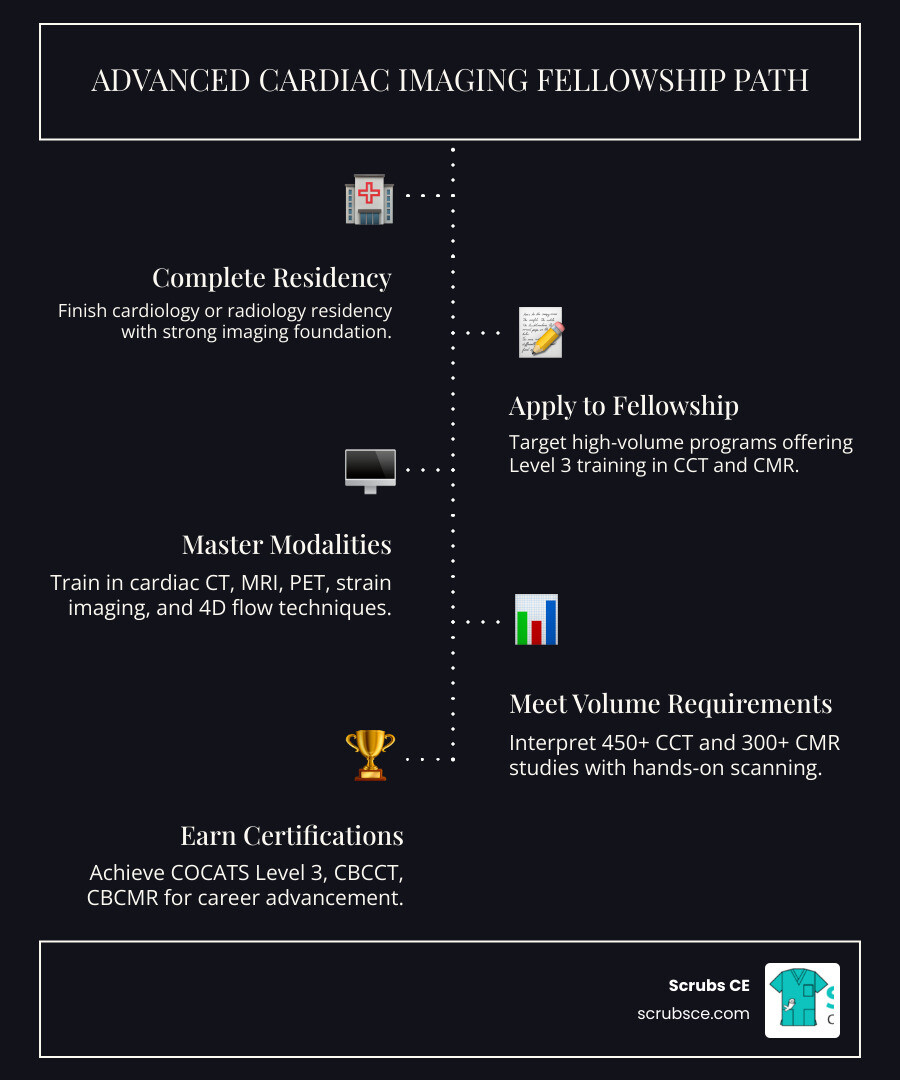
To be a leader in a lab, you need to achieve “Level 3” competency, which is the highest tier defined by COCATS (Core Cardiovascular Training Statement). This allows you not just to read the scans, but to run the entire imaging department.
Key certifications include:
- CBCCT: Certification Board of Cardiovascular Computed Tomography.
- CBCMR: Certification Board of Cardiovascular Magnetic Resonance.
- CBNC: Certification Board of Nuclear Cardiology.
For those focusing on the CT side of the house, our course on Cardiac & Vascular Computed Tomography is a great way to earn CE credits while mastering the material required for these boards.
Achieving Level 3 Competency
Level 3 isn’t just a title; it’s a “numbers game” that ensures you have seen enough cases to be considered an expert.
The Requirements for Level 3:
- Cardiac CT (CCT): Interpretation of at least 450 studies.
- Cardiac MRI (CMR): Interpretation of at least 300 studies.
- Hands-on Experience: You must spend a minimum of 50 hours performing “hands-on” scanning and post-processing. This means sitting at the workstation, using software to “segment” the heart and calculate volumes.
Quality assurance (QA) is also a major part of Level 3 training. We teach our students that understanding why an image looks “bad” (artifacts from metal, patient motion, or arrhythmias) is just as important as knowing how to read a “good” one. If you’re aiming for this, check out our Cardiac Interventional Radiography Certification Guide for a roadmap to success.
Geographic Distribution and Application Processes
Advanced cardiac imaging fellowships are distributed across the country, but they tend to cluster in major academic hubs.
- Northeast: Home to heavy hitters like Yale, Columbia, and Rutgers. These programs often have a strong focus on PET and multimodality integration.
- Midwest: The Mayo Clinic (Minnesota) and Cleveland Clinic (Ohio) dominate this region, offering some of the highest volumes in the world.
- South: Vanderbilt (Tennessee) and Emory (Georgia) are the primary anchors here, with Vanderbilt leading the charge in CMR.
- West: Cedars-Sinai and Stanford offer cutting-edge research in AI and 4D flow.
The Application Timeline
Most programs do not participate in a centralized match like general cardiology. Instead, you apply directly to the program.
- Deadlines: Usually fall between July and September for a start date in July of the following year.
- Materials: You’ll need a CV, a cover letter, and usually three letters of recommendation.
- Contacts: Reach out to the fellowship coordinators early. For example, Rutgers uses a dedicated email (advanced-imaging@rwjms.rutgers.edu) for their application process.
If you are a Radiology technologist or a nurse looking to transition into the interventional or imaging suite, knowing How to Get Certified in Cardiac Interventional Radiography can give you a significant leg up in the hiring process.
Frequently Asked Questions about Advanced cardiac imaging
What is the difference between standard and Advanced cardiac imaging?
Standard imaging usually refers to basic 2D echocardiography, EKG-gated stress tests, and perhaps basic chest CTs. Advanced cardiac imaging involves complex tissue characterization (like finding scar tissue with Late Gadolinium Enhancement in MRI), quantitative blood flow analysis (PET/MRI), and pre-procedural planning for structural heart interventions (TAVR/TMVR).
Can Radiology residents apply for these fellowships?
Yes! While most applicants come from a cardiology background, many top programs (like the University of Iowa) specifically state they train both “Radiology and Cardiovascular specialists.” The perspective of a Radiologist is highly valued, especially in the technical aspects of CT and MRI physics.
What are the typical career outcomes for graduates?
Graduates usually go one of three ways:
- Academic Medicine: Becoming a professor and director of an imaging lab at a university hospital.
- Private Practice: Joining a large cardiology group as the “imaging expert” who reads all the complex CTs and MRIs.
- Industry: Working for imaging vendors (like Siemens, GE, or Philips) to develop new hardware and software.
Conclusion
The journey into Advanced cardiac imaging is demanding, but the rewards are immense. You aren’t just taking pictures; you are providing the roadmap that surgeons and interventionalists use to save lives. Whether you are calculating the Agatston score on a CT or mapping myocardial fibrosis on an MRI, your role is pivotal.
At Scrubs CE, we are committed to supporting your professional development every step of the way. Whether you need to meet licensure requirements or simply want to stay at the cutting edge of your field, our high-quality, self-paced courses are designed for your busy schedule.
Ready to take the next step?
- Check out our Cardiology CME Ultimate Guide for a deep dive into continuing education.
- Browse Cardiac Interventional Radiology Courses to find the perfect course to advance your career today.
We’ve helped thousands of professionals achieve their career goals with instant certificates and affordable pricing. Let us help you become the leader your imaging lab needs.