
How to Renew Your CNA Certification

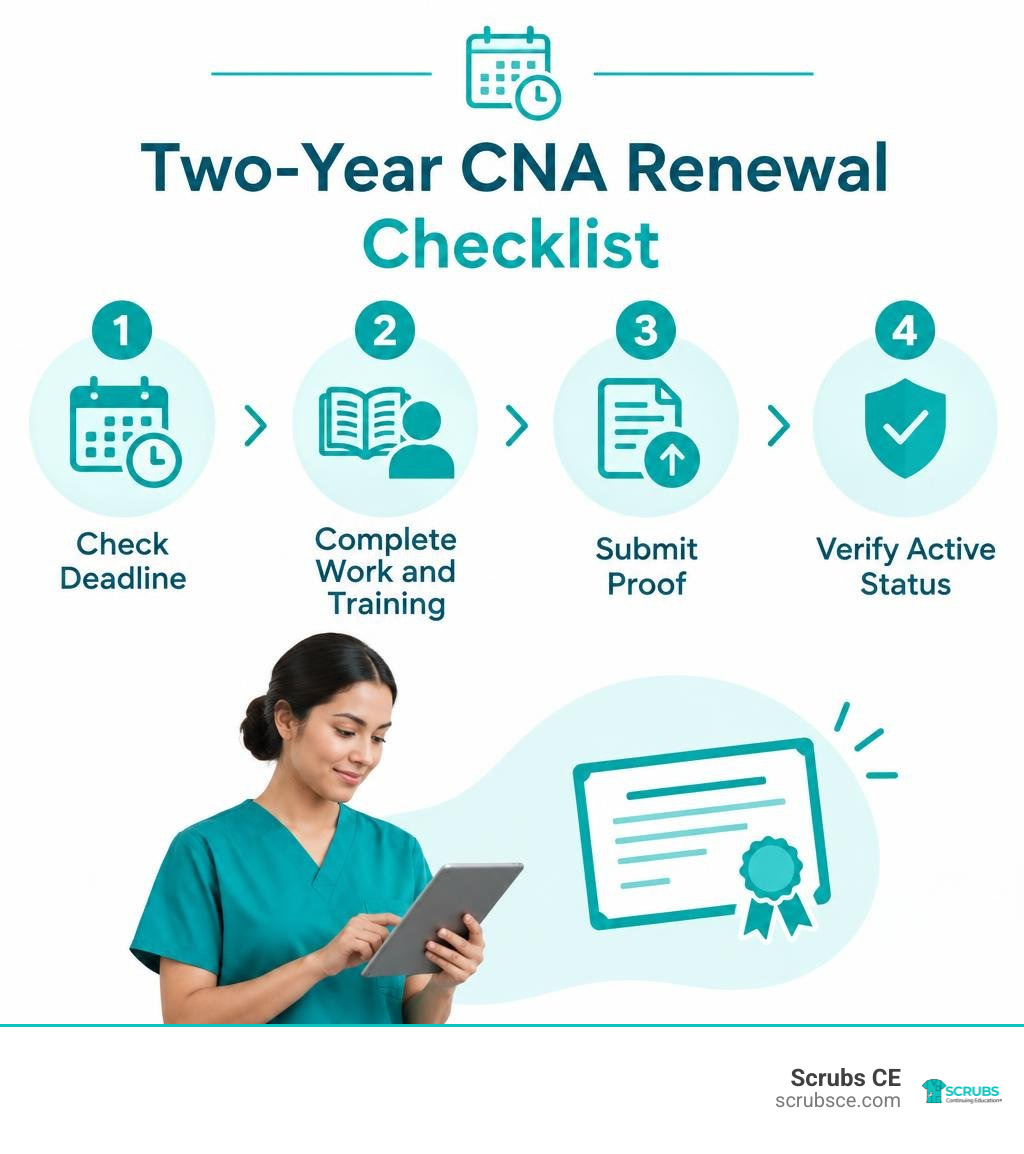
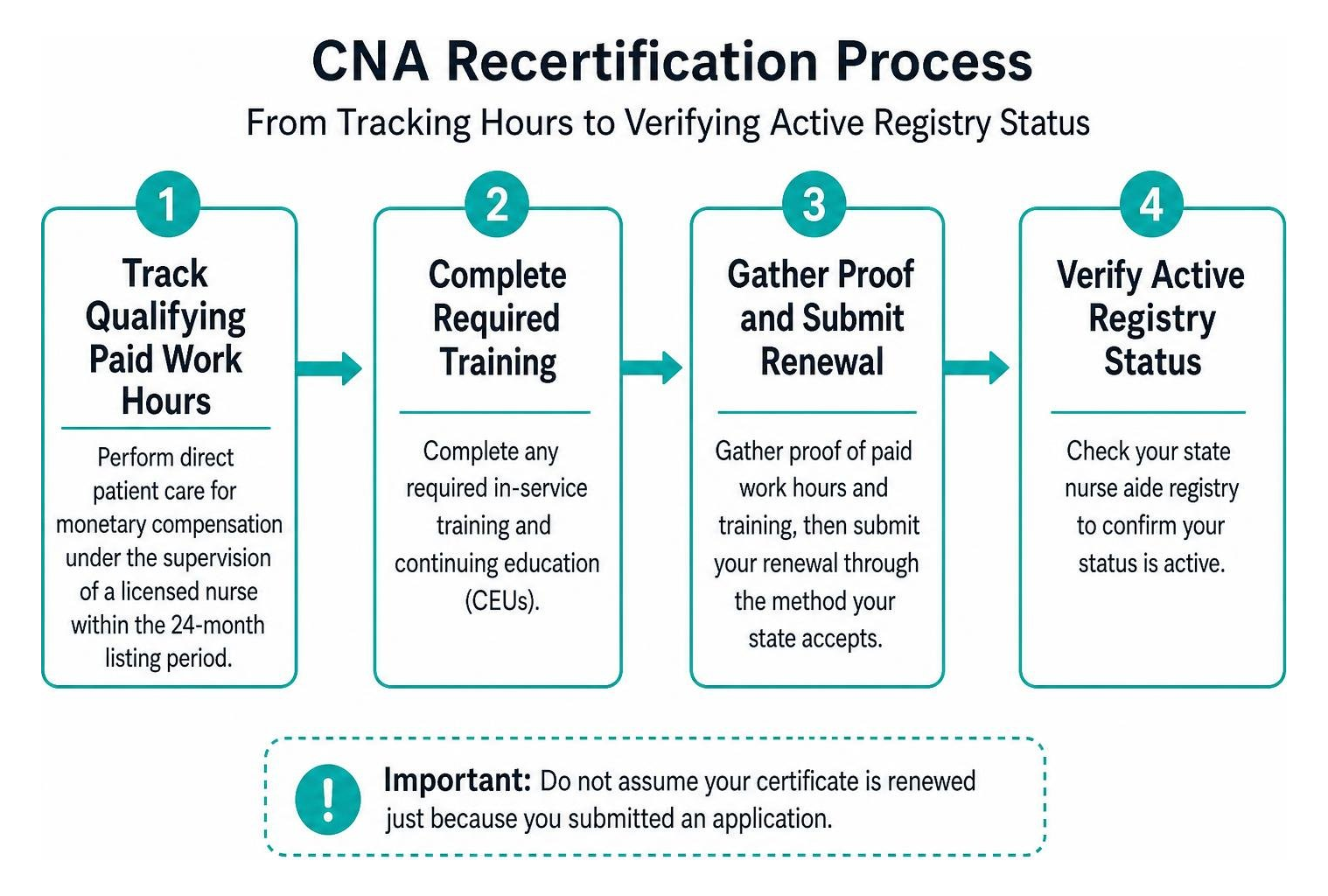
For CNA renewal, start by checking your expiration date and your state nurse aide registry’s rules. Complete any required paid work and in-service training, gather proof of both, then submit your renewal through the method your state accepts. Check the registry afterward to confirm your status is active. Do not assume your certificate is renewed just because you submitted an application.
Requirements vary by state. California requires 48 training hours over two years, while Texas requires 24. Some states also require employer verification, a background check, or a fee. If your certificate has expired, check your state’s reactivation rules before applying for a standard renewal.
I’m Zita Ewert, and my work at Scrubs CE focuses on making continuing education and licensure requirements easier for busy healthcare professionals to understand. I’ll help you sort out the state-specific details that matter for your CNA renewal.
Understanding General CNA Renewal Requirements and Steps

Navigating the recertification cycle does not have to be stressful when you break it down into manageable benchmarks. Across the United States, certified nursing assistant credentials generally follow a 24-month renewal cycle governed by state departments of health and federal regulations. While exact state mandates differ, maintaining an active status on your state nurse aide registry follows a uniform progression.
To maintain active status, you must demonstrate recent clinical practice, complete required continuing education units (CEUs), and submit your renewal packet before your current expiration date. Reviewing the basic steps to renew your CNA license helps you organize your timeline months in advance so you avoid unexpected processing delays.
Verifying Qualifying Paid Work Hours
A core federal and state requirement for nurse aide recertification is proof of recent nursing-related employment. Regulatory boards require that aides perform direct patient care for monetary compensation within the 24-month listing period under the supervision of a licensed nurse (such as a Registered Nurse or Licensed Practical Nurse).
- Paid Compensation: Volunteer work or caring for family members without formal employment does not count toward your hours.
- Direct Patient Care: Duties must include primary nursing tasks such as vitals monitoring, hygiene assistance, ambulation, and feeding.
- Minimum Hour Thresholds: Many states require as few as 8 hours of paid nursing services during the two-year window, while other jurisdictions evaluate broader clinical engagement.
- Supervision and Verification: The hours must be completed under direct or indirect RN supervision in a licensed facility, such as a long-term care center, hospital, or certified home health agency.
To make sure your clinical practice meets state standards, review the specific nurse aide certificate renewal guidelines before your supervising nurse signs off on your verification paperwork.
Completing In-Service Training and CEU Requirements
In addition to clinical hours, many states require certified nursing assistants to complete mandatory in-service training or approved CEUs during each two-year renewal cycle. These courses ensure that direct care providers remain sharp on clinical skills, emerging healthcare protocols, and resident safety.
Mandatory training topics frequently include:
- Resident Rights and HIPAA Compliance: Maintaining resident dignity, privacy, and confidentiality.
- Infection Control and Bloodborne Pathogens: Standard precautions, PPE guidelines, and sanitization protocols.
- Dementia and Alzheimer’s Care: Communication strategies, behavioral intervention, and memory care support.
- Emergency Response and CPR: Basic life support skills and facility evacuation measures.
- Specialized Clinical Updates: Specific mandates like Florida’s annual training on recognizing Venous Thromboembolism (VTE) and Deep Vein Thrombosis (DVT) signs and emergency response protocols.
Many healthcare systems provide these modules directly to staff, but aides can also use convenient, approved online methods for CNA renewal to finish their hours on their own schedule.
Submitting Your CNA Renewal Application Online or by Mail
Once you have accumulated your clinical hours and educational certificates, you must formally submit your application to your state registry. Most state licensing boards now prioritize paperless administration, offering secure web portals that process renewals faster than traditional postal routes.
- Online Portals: Digital platforms allow you to input employment history, upload CEU certificates in PDF format, and track application status in real time.
- Mail-In Submissions: When paper applications are required or preferred, complete all required state forms legibly, attach photocopies of supporting documents (never send originals), and send the packet via trackable mail.
- Deficiency Notices: If your application is missing an employer signature or proof of CEUs, state boards issue deficiency notifications. Providing a current email address on your application ensures you receive these notices immediately.
For aides balancing busy shift schedules, renewing your CNA license online saves valuable time and minimizes bureaucratic delays.
State-by-State Variations in Hours, Fees, and Verification
Because nursing assistant registries are managed at the state level under federal CMS guidelines, rules vary widely across jurisdictions. The table below outlines how selected states approach training hours, clinical practice thresholds, and administrative fees as of November 2026.
| State | In-Service / CEU Requirements | Minimum Paid Work Requirement | Standard Renewal Fee |
|---|---|---|---|
| California | 48 hours total (min. 12/year; up to 24 online) | Paid nursing care within 24 months | $0 (No state fee) |
| Texas | 24 hours (including geriatrics & dementia) | Documented paid work under RN supervision | $0 (No state fee) |
| Florida | 24 hours per biennium | 8 paid hours within 24 months | $55.00 |
| North Carolina | Facility-based employer training | 8 paid hours under RN supervision | $0 (No state fee) |
| Iowa | 12 hours/year employer in-service | 8 paid hours per 24-month period | Varies / Unspecified |
| Montana | Registry-aligned in-service standards | Paid nursing care within 24 months | $0 (No state fee) |
Key Differences Across Major State Registries
Understanding local regulations ensures smooth recertification:
- California: The California Department of Public Health (CDPH) enforces a strict 48-hour CEU requirement over the 2-year certification period. Aides must log at least 12 CEU hours each year, with a maximum of 24 hours earned through approved online independent study programs. Submissions are processed through the CDPH online portal or by mailing Form CDPH 283C.
- Texas: Managed via the Texas Unified Licensure Information Portal (TULIP), Texas Health and Human Services requires 24 hours of in-service education every two years, with mandatory coverage of geriatrics and dementia care. Applicants upload Form 5506 for employment verification.
- Florida: The Florida Board of Nursing and the Division of Medical Quality Assurance (MQA) require 24 hours of in-service education plus proof of paid nursing services within the last 24 consecutive months. Renewals are handled through the MQA portal.
- North Carolina: The North Carolina Nurse Aide I Registry requires at least 8 hours of paid, RN-supervised nursing services within the 24-month period. An RN must verify your hours through an online employment verification form. Private duty employment does not qualify.
- Maryland: Overseen by the Maryland Board of Nursing (MBON), Maryland uses a tiered system distinguishing CNA-I (requiring the NNAAP exam) from CNA-II credentials. Certification must be renewed every two years with verified paid employment. You can verify your active status through the Maryland CNA License Lookup – Verify Nurse Aide Registry.
- Iowa: In Iowa, direct care registry status is tied directly to qualifying work hours rather than standalone classroom CE courses, as detailed in the CNA License Renewal in Iowa (2026): Deadlines, Fees & CE guide.
Submission Deadlines and Fee Structures
Staying mindful of recertification deadlines protects you from delinquency fines or temporary workplace suspension. Many state platforms open the renewal window 90 days before your certificate expires. For example, the Montana Nurse Aide Registry allows aides to log into the online Montana Nurse Aide Registry portal up to three months early to complete their verification without risking an active status lapse.
Fee structures also vary:
- Zero-Fee States: States such as California, Texas, Montana, and North Carolina do not charge an administrative renewal fee for standard, timely submissions.
- Fee-Assessing States: Florida charges a standard pre-expiration renewal fee of $55.00 (which includes a statutory fee supporting unlicensed activity enforcement).
- Late Filing Penalties: If a Florida license expires, the renewal fee increases to $105.00 post-expiration, and climbs to $160.00 during the 120-day delinquent period.
- Employer Payment Methods: Many state portals offer employer voucher programs or “Other Payer Codes,” enabling healthcare facilities to pay renewal fees directly on behalf of their nursing staff.
Handling Lapsed Credentials, Reentry, and Expired Status

Life transitions, medical leave, or career pivots can sometimes lead to a lapsed nurse aide credential. If your certificate expires, your path back to active standing depends on how long the certificate has been expired and whether you maintained qualifying employment during that period.
When your certificate lapses, review this guide to renewing an expired CNA license to determine whether you qualify for simple administrative reactivation or must complete a formal competency evaluation.
Reactivating an Expired Certificate vs Standard CNA Renewal
A standard renewal applies only while your license is current and in good standing. Once the expiration date passes, your profile moves into a lapsed, delinquent, or inactive status.
- Grace Periods and Reactivation Windows: Most state boards establish a two-year reactivation window following expiration. If your certificate has been expired for less than 24 months, you can often reactivate it without starting your initial training over from scratch.
- Null and Void Status: Under state regulations (such as Florida Board of Nursing policies), certificates left unrenewed for more than two years past their expiration date become null and void. At that point, the credential cannot be reactivated through simple paperwork.
- Reentry Guidelines: If you are returning to healthcare after a break, consult our recertification guide for CNA reentry to evaluate your state’s specific reactivation pathways.
Retesting and Retraining Examination Pathways
When an aide cannot provide proof of qualifying paid clinical hours during the renewal period, registries require competency verification to confirm clinical skills.
- Competency Evaluation Exam Only: In California, a certificate expired for less than two years can be reactivated by submitting a reactivation application and passing the state Competency Evaluation Examination (both written and clinical skills portions). Similarly, Texas Option 4 allows retesting without requiring full classroom retraining.
- Retraining and Retesting: In Texas, an aide without documented work experience can choose Option 3: completing a state-approved Nurse Aide Training and Competency Evaluation Program (NATCEP)—consisting of 60 classroom hours and 40 clinical hours—followed by the state exam.
- State Testing Portals: Candidate testing processes are often administered through third-party vendors. For example, candidates preparing for Florida recertification testing can review testing standards through the Florida Nursing Assistant / Nurse Aide Test, FL CNA Exam resources to prepare for both the 60-question written examination and the five-skill practical assessment.
Background Checks, Information Updates, and Military Waivers
Regulatory oversight protects vulnerable patients, which is why state registries link renewal to criminal background screening and strict identity verification.
For a broader look at state policies, bookmark these CNA license renewal resources to stay informed on administrative rule changes.
Background Screening and Fingerprint Mandates
State health departments continuously update security standards to keep patient environments safe:
- Electronic Fingerprinting via Livescan: Under legislative mandates like Florida House Bill 975, CNAs renewing their licenses must submit electronic fingerprints through an approved Livescan service provider using the correct Originating Agency Identifier (ORI) number.
- Criminal History Repository Reviews: Registries screen state and FBI criminal databases alongside the federal Office of Inspector General exclusion lists.
- Employee Misconduct Registry Checks: State boards (including Texas HHSC) cross-reference applicants against Employee Misconduct Registries and Nurse Aide Registries to ensure no disqualifying findings of resident abuse, neglect, or property misappropriation exist.
Demographic Changes and Special Military Provisions
Keeping your personal details up to date ensures you receive important regulatory notices without interruption.
- Address Updates: Most state registries permit immediate address changes through their self-service web portals. Maintaining an updated email and mailing address prevents missed renewal reminders and deficiency letters.
- Legal Name Corrections: If your name has changed due to marriage, divorce, or court order, registries require official legal documentation (such as a marriage certificate, divorce decree, or updated Social Security card) before updating your record.
- Military Waivers and Expedited Processing: Active-duty military service members, veterans, and military spouses frequently qualify for special exemptions. In Texas, Option 5 provides prioritized renewal processing and fee waivers. Many states also extend renewal deadlines during active deployments and offer expedited reciprocity paths for military families relocating across state lines.
Frequently Asked Questions About Recertification
How far in advance can I submit my renewal application?
Most state nurse aide registries allow you to begin the recertification process up to 90 days (three months) prior to your certificate’s expiration date. Submitting your materials 60 to 90 days early provides enough time for your supervising nurse to sign the employment verification, for educational records to clear, and for registry staff to resolve any application deficiencies before your credential expires.
What happens if my CNA license has been expired for more than two years?
If your certificate has lapsed for more than two consecutive years without qualifying paid employment or reactivation, it typically becomes null and void. In most states, you must re-enroll in a state-approved Nurse Aide Training and Competency Evaluation Program (completing required classroom and clinical hours) and pass the state written and clinical skills competency exams to regain active certification.
Does private duty or unpaid caregiving count toward the work requirement?
In general, no. State registries require that nursing-related duties be performed for monetary compensation under the direct or indirect supervision of a licensed nurse (RN or LPN/LVN) within an approved healthcare facility or licensed agency. Private sitting, non-medical companion services, direct-hire private duty without agency RN oversight, and unpaid family caregiving do not meet state verification standards.
Conclusion
Keeping your nurse aide credential in good standing protects your career and ensures you remain eligible for direct patient care roles. By monitoring your expiration date, logging paid clinical hours under RN supervision, and finishing required in-service modules early, you can complete your renewal smoothly.
At Scrubs CE, we provide accessible, self-paced online continuing education courses designed to help busy healthcare workers stay compliant with state and federal regulations. Ready to complete your continuing education hours without the hassle? Visit Scrubs CE to keep your CNA status active with online renewal and complete your recertification on your schedule today.