
Ultimate Checklist for Radiology Certification Requirements
Why Certification in Radiology Is a Career-Defining Step

Certification in Radiology is the professional credential that proves you have the training, ethics record, and exam performance needed to work safely in medical imaging or radiation therapy. Here is a quick overview of the main pathways:
| Credential | Issued By | Who It’s For |
|---|---|---|
| Registered Technologist (R.T.) | AMERICAN REGISTRY OF RADIOLOGIC TECHNOLOGISTS® | Radiologic technologists |
| Limited Licensed R.T. (CLLRT) | State boards / accredited organizations | Entry-level imaging roles |
| Board Certification (ABR) | American Board of Radiology | Physicians (Radiologists) |
| Certified Radiology Nurse (CRN®) | Radiologic Nursing Certification Board | Registered nurses in imaging |
| European Diploma in Radiology (EDiR) | European Board of Radiology | International Radiologists |
More than 360,000 people currently hold ARRT® credentials alone — and that number keeps growing. Yet high-demand specialties like computed tomography still show vacancy rates as high as 19.4%, meaning credentialed professionals are in serious demand right now.
Whether you are just starting out, switching specialties, or trying to keep your current license active, knowing exactly what each certification requires can save you months of confusion — and money.
I’m Zita Ewert, and as the leader of SCRUBS Continuing Education®, I have spent years helping radiologic technologists navigate the requirements for certification in Radiology — from initial ARRT® exam prep to biennial continuing education renewals. This checklist is designed to give you everything you need in one place, so you can spend less time researching and more time advancing your career.
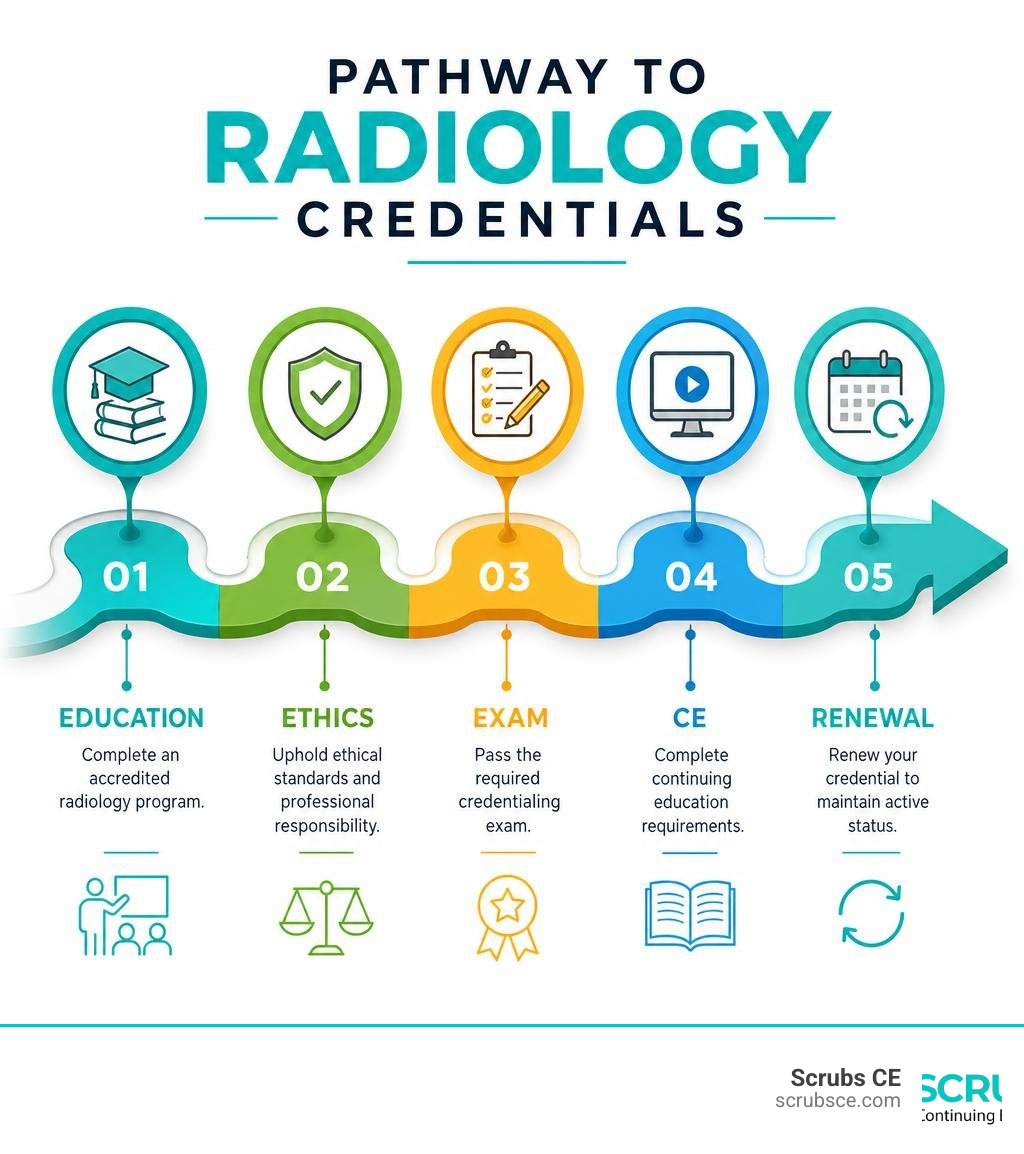
Understanding ARRT® Certification in Radiology
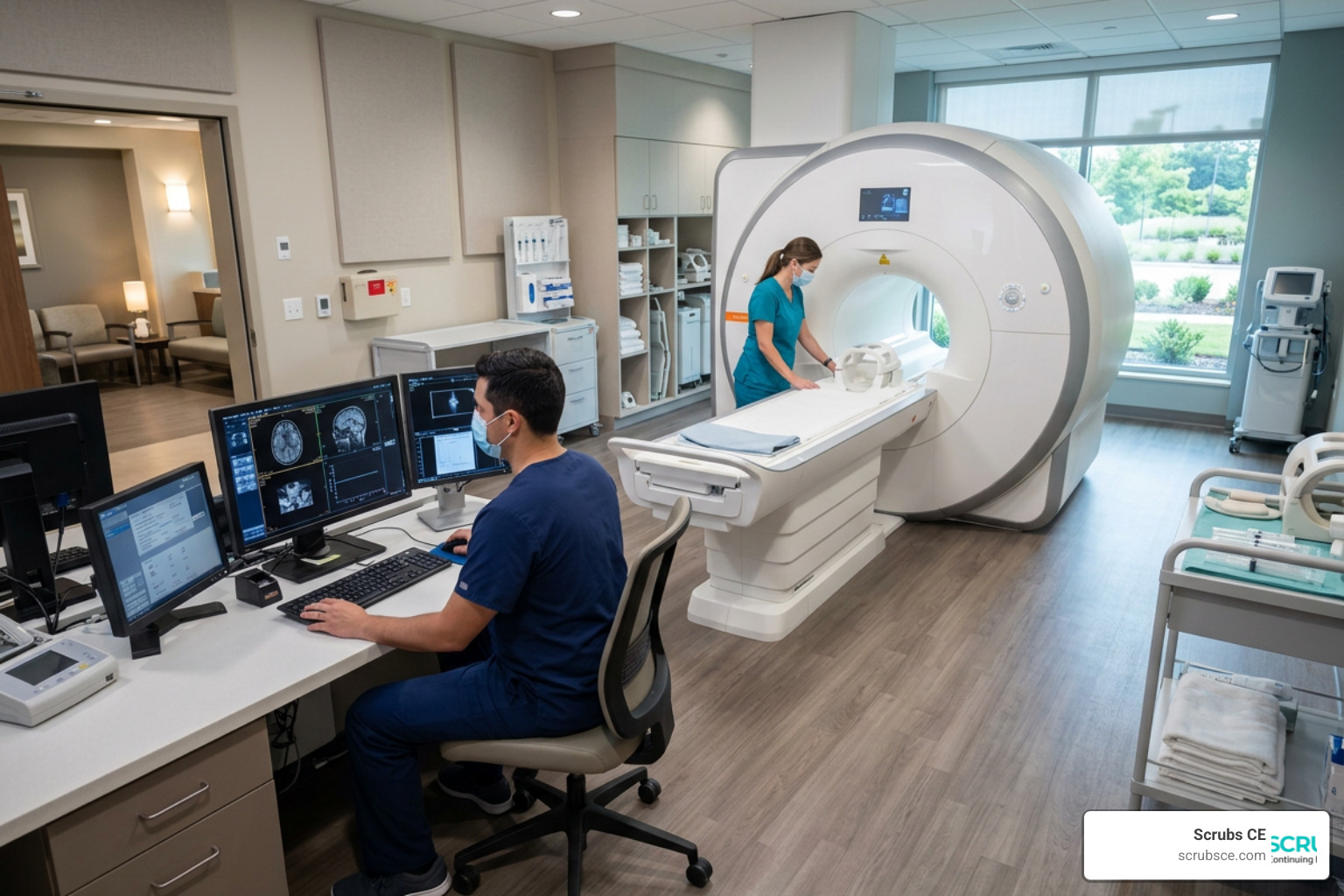
When we talk about earning a national certification in Radiology, the conversation almost always starts with the AMERICAN REGISTRY OF RADIOLOGIC TECHNOLOGISTS® (ARRT®). It is the gold standard for medical imaging professionals.
While some states do not legally mandate a national license, the vast majority of healthcare employers, state licensing agencies, and federal regulators do. Holding these credentials tells your future employers that you are deeply committed to providing exceptional patient care and maintaining high professional standards.
What is the AMERICAN REGISTRY OF RADIOLOGIC TECHNOLOGISTS® (ARRT®)?
The AMERICAN REGISTRY OF RADIOLOGIC TECHNOLOGISTS® (ARRT®) is the world’s largest credentialing organization for medical imaging and radiation therapy. With over 360,000 active registrants, the ARRT® tests and certifies technologists across 14 distinct disciplines.
Earning your ARRT® credential is not a one-time event; it is an ongoing commitment to your career. It ensures you have met the rigorous standards of education, ethical conduct, and examination necessary to perform complex imaging procedures safely. To understand the baseline requirements for technologists, you can read A Comprehensive Guide to Radiologic Technologist Certification Requirements.
The Difference Between a Certificate and a Certification in Radiology
It is incredibly common to confuse a certificate with a certification, but they mean very different things in the healthcare industry:
- Certificate: This is an academic document awarded by an educational institution (like a community college or technical school) when you complete a specific course of study or curriculum. For example, you might earn a certificate in basic X-ray machine operation.
- Certification: This is a formal credential awarded by an independent professional trade group or registry (like the ARRT®) after you prove your clinical competence by passing a comprehensive exam and meeting strict ethical and educational benchmarks.
A certificate shows you completed a class; a national certification in Radiology proves you are legally and clinically qualified to treat patients. If you want to dive deeper into this process, check out our guide on How to Get ARRT Certified Without Losing Your Mind.
Checklist of ARRT® Certification Requirements
To help you stay organized, we have mapped out the core eligibility requirements for both primary and postprimary pathways.
| Requirement | Primary Pathway | Postprimary Pathway |
|---|---|---|
| Minimum Education | Associate degree or higher from an accredited institution | Already hold an ARRT® primary credential |
| Program Completion | Complete an ARRT®-approved program in your chosen discipline | Complete 16 hours of structured education |
| Ethics Verification | Pass the ARRT® ethical review process | Maintain active, ethical ARRT® registration |
| Clinical Experience | Document all required clinical procedures and competencies | Log specific clinical procedures for the target modality |
| Examination | Pass the computer-based exam with a score of 75 or higher | Pass the specialty credential exam with a score of 75 or higher |
Core Eligibility: Education, Ethics, and Examination
To qualify for your primary ARRT® exam, you must fulfill three core components:
- Education: You must earn an associate degree (or higher) from an institution accredited by an agency recognized by the ARRT®. Your educational program must be ARRT®-approved and completed within three years of submitting your application.
- Ethics: The ARRT® enforces a strict Code of Ethics. If you have a misdemeanor, felony, or military court-martial on your record, we highly recommend submitting an ethics pre-application review before you even enroll in an imaging program. This ensures you won’t complete your schooling only to find out you are ineligible to test.
- Examination: You must pass the official registry exam for your chosen discipline.
For state-specific insights on how these rules apply in local markets, read our article on ARRT Certification Florida.
Step-by-Step Guide to Applying and Passing the ARRT® Exam
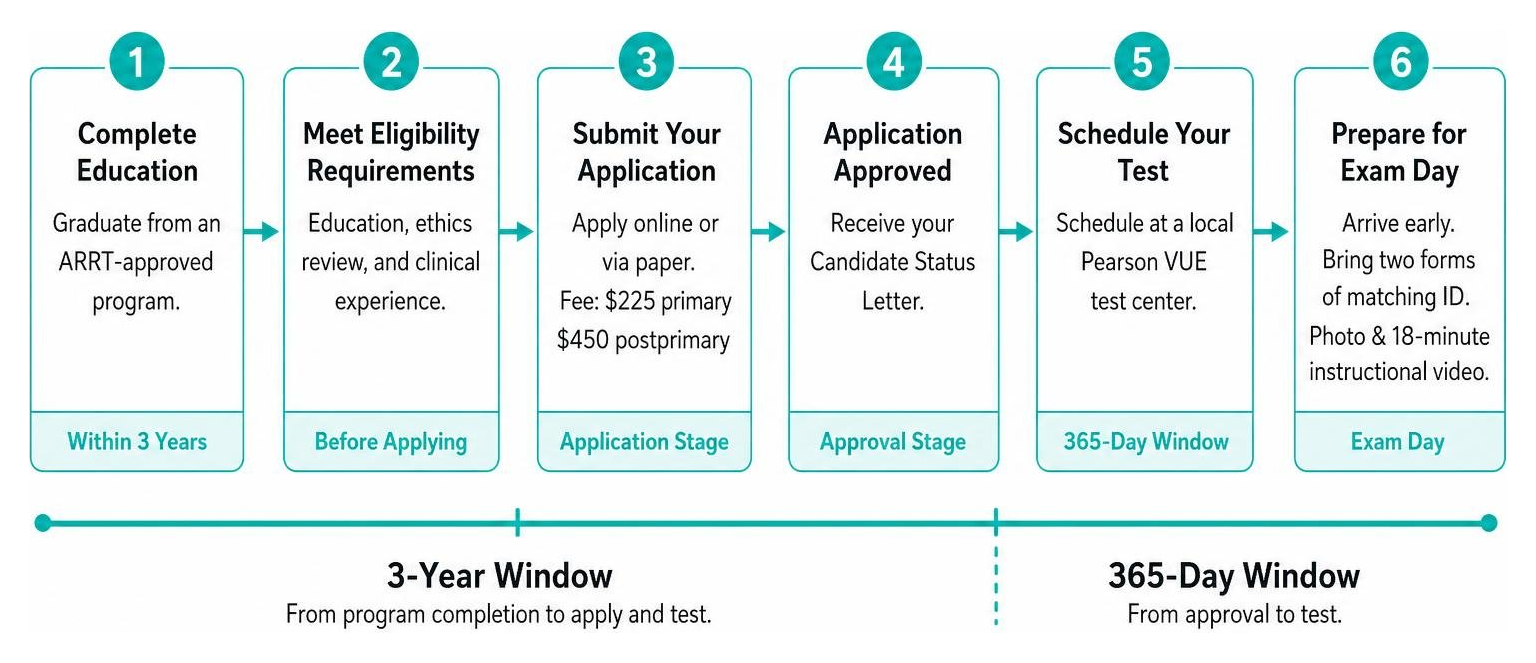
Once you complete your approved educational program, you have a three-year window to apply and take your exam. Here is how the process works:
- Submit Your Application: Complete your application online or via paper. The fee is $225 for primary pathways and $450 for postprimary pathways.
- Schedule Your Test: Once approved, you will receive a Candidate Status Letter. You have a 365-day testing window to schedule and take your exam at a local Pearson VUE test center.
- Prepare for Exam Day: Arrive early. You will need to check in, provide two forms of matching ID, take a digital photo, and watch an 18-minute instructional video.
- The Scoring System: The ARRT® exam uses a scaled scoring system ranging from 1 to 99. You must achieve a minimum score of 75 to pass.
- Attempts and Time Limits: You are allowed a maximum of three attempts to pass the exam within a three-year period. If you fail all three times, you must complete remedial education before you can apply to test again.
Continuing Education (CE) and Recertification Guidelines
Obtaining your certification in Radiology is just the beginning. To maintain your active registration status with the ARRT®, you must complete ongoing continuing professional development:
- The Biennial Requirement: Technologists must complete 24 hours of continuing education (CE) every two years (known as your biennium). These must be Category A or A+ credits approved by a Recognized Continuing Education Evaluation Mechanism (RCEEM) like the ASRT®.
- Continuing Qualifications Requirements (CQR): Every 10 years, the ARRT® requires you to complete a CQR process. This is not a pass-or-fail exam, but rather a self-assessment designed to highlight any knowledge gaps you might have developed over the decade. You will then be prescribed targeted CE courses to address those gaps.
At Scrubs CE, we specialize in providing convenient, affordable online CE courses to help you meet these exact requirements without interrupting your busy work schedule.
Advanced and Alternative Pathways
The beauty of a career in medical imaging is that you do not have to stay in one place. Once you have a foundational credential, you can “layer” additional certifications to expand your career opportunities and boost your salary.
Primary, Postprimary, and Limited Licensed Credentials
There are multiple entry points and advanced tracks in the field of Radiology:
- Primary Credentials: These are for first-time candidates and include disciplines like Radiography (general X-ray), Nuclear Medicine Technology, Radiation Therapy, and Diagnostic Medical Sonography.
- Postprimary Credentials: If you are already certified in a primary discipline, you can earn postprimary credentials in high-demand specialties like Magnetic Resonance Imaging (MRI), Computed Tomography (CT), and Mammography. This pathway requires you to complete 16 hours of structured education and log specific clinical procedures. Learn how to master these transitions with our guides: Mammography Mastery: Achieving Your ARRT Certification, Beginner’s Guide to Computed Tomography Technician Certification, and the Cardiac Interventional Radiography Certification Guide.
- Limited Licensed Radiology Tech (CLLRT): Often called a limited-scope X-ray tech, this is an excellent entry-level pathway. It allows you to perform basic diagnostic X-ray exams on specific parts of the body (like the chest, hands, or feet) under direct supervision. It requires a shorter educational program and is a fantastic stepping stone to a full R.T. credential.
American Board of Radiology (ABR) and ABPS Board Certification for Physicians
If you are a medical doctor (MD or DO) looking to practice as a Radiologist, your certification pathway goes through a completely different set of governing bodies:
- The American Board of Radiology (ABR): The ABR is a member of the American Board of Medical Specialties (ABMS). To become board-certified, residents must complete a transitional year (PGY-1), a four-year accredited residency, and pass two major exams: the computer-based Qualifying (Core) Exam (usually taken after 36 months of residency) and the Certifying Oral Exam (taken at least 12 months after residency). For official guidelines on studying and preparing, visit the American Board of Radiology Core Exam Guide and explore their overall Diagnostic Radiology Certification Requirements.
- American Board of Physician Specialties (ABPS): The Board of Certification in Radiology (BCR), a division of the ABPS, has been certifying physicians since 1986. They offer board certification to physicians who complete an accredited diagnostic Radiology residency and pass both a written and oral exam. This certification is valid for eight years. You can find more details at the Diagnostic Radiology Board Certification | ABPS page.
Other Pathways for Certification in Radiology
Depending on your specific clinical interests or geographical location, you might look into these alternative certifying bodies:
- ARDMS: The American Registry for Diagnostic Medical Sonography is the premier certifying body specifically for ultrasound professionals.
- NMTCB: The Nuclear Medicine Technology Certification Board specializes exclusively in nuclear medicine credentials.
- EDiR: The European Diploma in Radiology is a prestigious, internationally recognized qualification endorsed by the European Society of Radiology (ESR). It standardizes radiological education across borders, making it easier for international Radiologists to practice globally. Find out more at the EDiR – European Board of Radiology portal.
- Osteopathic Pathway (AOBR): Osteopathic physicians (DOs) can obtain board certification through the American Osteopathic Board of Radiology. This pathway requires participating in the four-component Osteopathic Continuous Certification (OCC) process. Learn more about their specialty offerings at the Radiology – American Osteopathic Board of Radiology page.
Certified Radiology Nurse (CRN®) Credential Requirements
Nurses play an incredibly vital role in modern medical imaging departments, particularly in interventional Radiology, CT, and MRI. The Certified Radiology Nurse (CRN®) credential, managed by the Radiologic Nursing Certification Board (RNCB), validates this unique clinical expertise.
To be eligible for the CRN® exam, a registered nurse must:
- Hold a current, unrestricted RN license.
- Have practiced a minimum of 2,000 hours in Radiology nursing within the past three years.
- Complete 30 contact hours of continuing education applicable to Radiology nursing within the 24 months prior to the exam (with at least 15 hours specifically focused on Radiology nursing).
The CRN® credential is valid for four years. For complete application instructions, fees, and exam blueprints, download the official Certified Radiology Nurse (CRN ®) Guidelines.
Frequently Asked Questions about Certification in Radiology
How many CE hours are required to maintain ARRT® certification?
To maintain active ARRT® certification and registration, you must complete 24 hours of continuing education (CE) every two years. These credits must be Category A or A+ and must be documented during your designated two-year biennium.
What is the passing score for the ARRT® exam?
The passing score on any ARRT® registry exam is a scaled score of 75. The scoring scale ranges from 1 to 99, and you are allowed a maximum of three attempts within a three-year period to pass.
Which Radiology certifications are currently in the highest demand?
Specialized postprimary modalities are experiencing unprecedented demand. Computed tomography (CT) currently has the highest vacancy rate in the industry, reaching an all-time high of 19.4%. Earning certifications in CT, MRI, and Mammography is one of the fastest ways to increase your earning potential and job security.
Conclusion

Earning and maintaining your certification in Radiology is a lifelong commitment to professional excellence, safety, and superior patient care. While the administrative steps, exam prep, and continuing education requirements can feel overwhelming, they are the building blocks of a highly rewarding, secure, and lucrative healthcare career.
Whether you are preparing for your very first ARRT® exam, cross-training into a new modality like CT or MRI, or managing your biennial CE requirements, you do not have to do it alone.
At Scrubs CE, we are dedicated to supporting your professional development. We offer high-quality, self-paced online continuing education courses with instant certificates to help you meet your state licensing and ARRT® requirements seamlessly.
Ready to fulfill your continuing education requirements and take the next step in your career? Explore our convenient, self-paced online CE courses today and keep your career moving forward!