
The Best Ways to Get Your Nuclear Medicine CE Credits for Free
How Nuclear Medicine Technologists Can Get CE Credits for Free in 2026

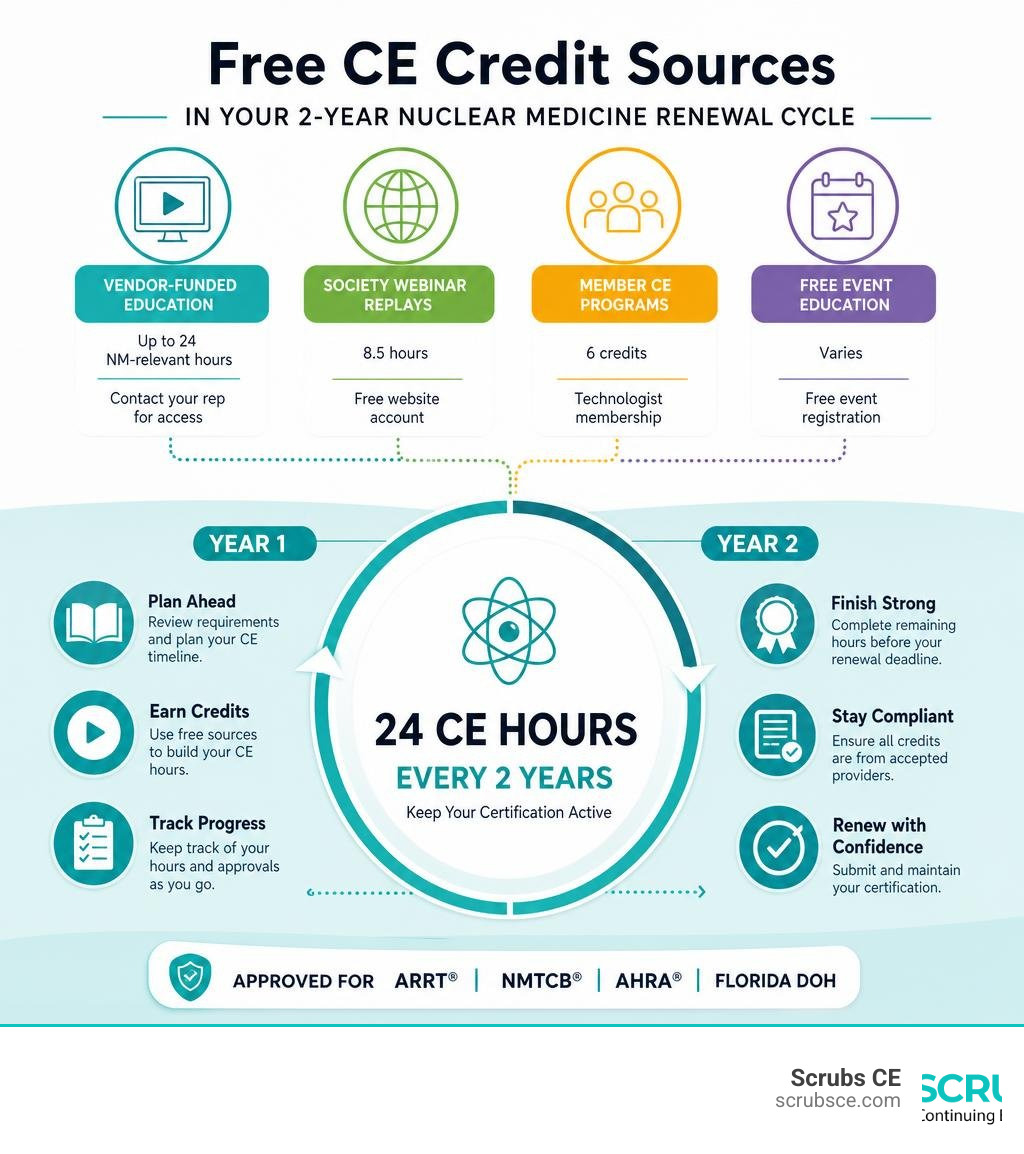
Free continuing education credits for nuclear medicine technologists are available right now — and you can access a significant portion of your 24-hour biennial requirement without spending a dime.
Here are the top sources to know about:
| Source | Free Credits Available | Access Requirement | Accepted By |
|---|---|---|---|
| Curium (nucmeded.org) | Up to 24 NM-relevant hours | Contact Curium rep for promo code | ARRT®, NMTCB®, AHRA®, Florida DOH |
| SNMMI | 8.5 hours | Free website account | ARRT®, NMTCB® (VOICE-approved) |
| ASNC | 6 credits | $80/year technologist membership | ARRT®, NMTCB® |
| Cardinal Health (NPHS) | Varies | Free event registration | ARRT®, NMTCB® (via SNMMI) |
Nuclear medicine technologists need 24 CE hours every two years to keep their certification active — whether through ARRT® (the AMERICAN REGISTRY OF RADIOLOGIC TECHNOLOGISTS®), NMTCB, or both. That’s a recurring cost of time and money if you don’t know where to look.
The good news? Between vendor-funded courses, society webinar replays, and member CE programs, it’s genuinely possible to cover most — or even all — of your renewal credits for free. The catch is knowing which sources are legitimate, what approval mechanisms they use, and how to access them before catalogs change or replays expire.
I’m Zita Ewert, and as the leader of SCRUBS Continuing Education®, I’ve spent years helping radiologic technologists — including nuclear medicine specialists — navigate free continuing education credits for nuclear medicine technologists and find affordable, accredited paths to renewal. In this guide, I’ll walk you through exactly where to find free credits, how to register, and how to make sure every hour counts toward your certification.
Discover more about free continuing education credits for nuclear medicine technologists:
- Nuclear medicine myocardial perfusion
- cardiology cme
- Radiology cme
Where to Find Free Continuing Education Credits for Nuclear Medicine Technologists in 2026
The most reliable free CE sources usually fall into four buckets:
- Manufacturer-funded education
- Professional society webinars
- Journal CE or member-included CE
- Live virtual events approved through recognized CE mechanisms
The key is not just finding a course that says “free.” The key is finding a course that is accepted for your credential, gives you a usable certificate, and fits your renewal cycle. A free course that does not count is just a very long video with homework. Nobody needs that.
| CE Source Type | Estimated Free Credits | Access Requirement | Common Format | What to Verify |
|---|---|---|---|---|
| Manufacturer-funded CE | Up to 24 NM-relevant hours from major catalogs | Account, representative access, or promo code | Self-paced video, quiz, certificate | Category A language, expiration date, certificate download |
| Society webinar replays | About 8.5 free hours from major society replays | Free website account | Recorded webinar and post-test | VOICE or Category A approval, replay availability |
| Member-included journal CE | About 6 credits from major nuclear cardiology options | Paid technologist membership | Journal article, post-test, evaluation | ARRT® claim option, NMTCB acceptance |
| Live virtual CE events | Varies throughout 2026 | Event registration | Live webinar, attendance verification | Whether the event is CE or non-CE |
For a broader renewal overview, see our guide: Stay Current, Stay Certified: Essential Nuclear Medicine Continuing Education.
Curated Free CE Sources: What Counts and What to Verify
A legitimate CE activity should clearly state:
- Credit amount
- Credit type, such as Category A
- Approval organization or mechanism
- Activity expiration date
- Whether it is accepted by ARRT® or NMTCB
- Whether it provides a downloadable certificate
- Any state-specific recognition, such as Florida or California wording
Look for terms like ARRT® Category A, SNMMI-TS VOICE, or approval through a recognized continuing education evaluation mechanism. If you are unsure, check your credentialing body or state board before investing the time.
Common free CE formats include:
- Self-paced video modules
- Webinar replays
- Live virtual lectures
- Journal article CE
- Post-test and evaluation activities
- Vendor-sponsored education portals
How Many Free CE Credits Are Currently Available
As of June 2026, the major free or free-access CE opportunities include:
- Curium: Research indicates up to 48 free CE credits overall, including 46 free video CE hours, with about 24 hours especially relevant to nuclear medicine technologists.
- SNMMI: About 8.5 free CE hours are available to non-members through webinar replays.
- ASNC: About 6 CE credits are available to members; technologist membership has been listed at $80 per year.
- Cardinal Health educational events: Availability varies by live event and replay status.
Important: catalogs change. A course available today may expire next month, and a live webinar may not become an on-demand CE activity later. If you see a good free CE course that fits your scope, take it before your future self has to panic-search at 11:47 p.m. before renewal.
Free vs. “Included With Membership” CE
Not all “free CE” is truly no-cost.
There are three common categories:
- Truly free: No payment required; you may only need a website account.
- Included with membership: No per-course fee, but membership costs money.
- Free with access code or affiliation: A promo code, representative, employer, or event registration may be needed.
Membership-included CE can still be valuable, especially if you also use the society’s journals, guidelines, meeting discounts, or professional resources. But if your only goal is the lowest possible cost per credit, calculate the effective cost per hour.
For example, if a membership costs $80 and includes 6 credits, that works out to about $13.33 per credit if you use it only for CE.
The Best Free CE Options by Source
The best free CE strategy is to mix sources. Use vendor-funded courses for core nuclear medicine topics, society replays for current practice updates, and member-included CE for specialty content like nuclear cardiology or PET.
Curium: Manufacturer-Funded Nuclear Medicine CE
Curium’s nuclear medicine education offerings are one of the strongest free sources because they are designed specifically for nuclear medicine professionals.
What makes this source useful:
- Self-paced online courses
- 24/7 access
- Category A credit language
- Recognition by AHRA and the Florida Department of Health Bureau of Radiation Control, according to available provider information
- Course assessments and certificates
- Nuclear medicine-relevant topics
Common topic areas may include:
- Radiopharmacy
- Radiation safety
- Instrumentation
- Quality control
- Nuclear medicine procedures
- Patient and regulatory safety
The limitation is access. Some courses may require a promo code or help from a representative. If you cannot immediately enroll, contact the provider’s support channel or ask your department whether your facility already has access.
Best for: technologists who want free, self-paced nuclear medicine CE and can plan ahead.
Watch for: course expiration dates, access codes, and whether every course in the catalog is relevant to your credential.
SNMMI: Free Webinar Replays and VOICE-Approved Education
SNMMI is especially important because of the SNMMI-TS VOICE approval mechanism. VOICE-approved CE is widely recognized in nuclear medicine and is especially relevant when you need nuclear medicine-specific documentation.
Research shows SNMMI has offered about 8.5 free CE hours for non-members through webinar replays.
Typical topics include:
- Molecular imaging
- Radiopharmaceuticals
- USP <825>
- Infection and inflammation imaging
- Targeted alpha therapy
- Nuclear medicine practice updates
How to use this option:
- Create a website account.
- Search for free webinar replays or education activities.
- Confirm the activity offers CE, not just education.
- Complete the replay and post-test if required.
- Download and save your certificate.
Best for: technologists who want no-cost, credible, nuclear medicine-specific education.
Watch for: replay expiration dates and whether the activity is CE-bearing or non-CE.
ASNC: Nuclear Cardiology CE for Members
ASNC is a strong option if your work involves nuclear cardiology, myocardial perfusion imaging, cardiac PET, stress testing, or lab accreditation. Research shows ASNC offers about 6 free CE credits for members, with technologist membership listed at $80 per year.
These are not always “free” in the no-cost sense, but they can be included as part of membership.
Common topic areas include:
- Nuclear cardiology
- PET
- Myocardial perfusion
- Myocardial blood flow
- Stress testing
- Cardiac amyloidosis
- Journal-based education
Many ASNC CE activities use a journal article plus post-test format. Research indicates some activities require a 75% passing score and allow technologists to claim ARRT® credit, with NMTCB acceptance noted by the provider.
For a detailed walkthrough, see this helpful external resource: ASNC member CE walkthrough.
Best for: technologists working in nuclear cardiology or PET.
Watch for: membership cost, course difficulty, and whether the credit fits your needed category.
Cardinal Health and Live Educational Events
Cardinal Health offers educational events and webinars in nuclear medicine and related areas. Some CE activities are provided through SNMMI and approved by SNMMI-TS VOICE for Category A credit.
Potential topics include:
- Lymphatic mapping
- Sentinel lymph node biopsy
- USP <825>
- Radiochemical purity testing
- Infection imaging
- Targeted alpha therapy
- Radiopharmaceutical supply and production
The important distinction: some events are CE-bearing, and some are educational only. Before attending, check whether the event provides CE credit and whether it is accepted by ARRT® and NMTCB.
Best for: technologists who like live virtual education and current practice updates.
Watch for: registration deadlines, attendance requirements, and whether a replay will provide CE.
How to Register for and Complete Free Continuing Education Credits for Nuclear Medicine Technologists
Finding the course is half the battle. Claiming the credit correctly is the other half.
For a complete renewal planning resource, see our Nuclear Medicine CE Credits Guide 2026.
Step 1: Confirm the Approval Before You Start
Before you click “start course,” look for the approval statement.
For ARRT®, the safest language usually includes Category A or A+ credit through an approved mechanism. ARRT® refers to the AMERICAN REGISTRY OF RADIOLOGIC TECHNOLOGISTS®.
For NMTCB, confirm the activity is relevant to your certification and accepted for CNMT renewal. If you hold NMTCB(CT), research indicates 12 of the 24 credits must be CT-specific.
For state licensure, verify local rules. Florida and California can have specific expectations, and California nuclear medicine technologists may need credits that map to defined scopes.
Check the certificate wording for:
- Your name
- Provider name
- Course title
- Completion date
- Number of credits
- Approval statement
- Credit category
- Activity ID, if available
Step 2: Create the Right Account or Request Access
Depending on the source, you may need:
- A free website account
- Society login credentials
- Member number
- Employer access
- Promo code
- Email verification
- Event registration
Use the same name that appears on your credentialing records. “Mike” on one certificate and “Michael A. Thompson” on another can create unnecessary audit headaches.
Also check browser compatibility. Some older CE platforms can be picky about pop-ups, video completion tracking, or mobile viewing.
Step 3: Complete the Activity and Pass the Test
Free CE often requires more than passive watching. Common requirements include:
- Watching the full video
- Entering an attendance code
- Reading a journal PDF
- Passing a post-test
- Completing an evaluation
- Selecting the right credit type
- Claiming credit as a technologist
Passing scores vary. Research examples include:
- 75% minimum for some journal CE activities
- 80% minimum for some tutorial-style CE activities
- Up to three attempts for some post-tests
Do not close the browser until the course confirms completion. If there is a “claim credit” button, click it. If there is an evaluation, complete it. The quiz may be done, but the certificate may not generate until the evaluation is submitted. CE platforms enjoy making us earn the final click.
Step 4: Save Proof for Audits and Renewal
Create a digital folder for each biennium. Save:
- PDF certificates
- Provider transcripts
- Course descriptions
- Approval statements
- Emails confirming completion
- Screenshots only as backup, not your primary proof
Name files clearly, such as:
2026-03-15_Radiopharmacy_1.0_CategoryA.pdf2026-05-02_PETCT_Safety_2.0_VOICE.pdf
ARRT® and NMTCB may not ask for every certificate every cycle, but if you are audited, you will be very glad you kept them. Future you deserves snacks and organized PDFs.
Will Free Nuclear Medicine CE Credits Be Accepted by ARRT®, NMTCB, and State Licensing Boards?
Usually, yes, if they meet the correct approval rules. “Free” does not make a CE credit less valid. The approval mechanism and documentation matter more than the price.
Learn more about accepted CE options here: Nuclear Medicine CE.
ARRT® Acceptance Basics
ARRT® technologists generally need 24 credits every two years. For nuclear medicine technologists, credits typically need to be Category A or A+ and appropriate for the credential.
Check for:
- Category A or A+ wording
- Approval by a recognized CE evaluation mechanism
- Correct completion date within your biennium
- Certificate listing the number of credits
- Relevance to your discipline or assigned CQR needs
If you are completing ARRT® Continuing Qualifications Requirements, or CQR, free CE may help only if it matches your prescribed CE areas. Do not assume a general nuclear medicine webinar satisfies a specific CQR prescription.
NMTCB Acceptance Basics
NMTCB certificants also generally need 24 CE hours during the renewal cycle. Credits should be relevant to nuclear medicine practice or the specific credential being renewed.
Important NMTCB considerations:
- CNMT credits should support nuclear medicine practice.
- NMTCB(CT) requires CT-specific credit as part of the total requirement.
- Specialty credentials may have additional rules.
- Nuclear cardiology specialty requirements can differ from standard CNMT renewal.
If a course is VOICE-approved, Category A, or clearly accepted by NMTCB, that is helpful. Still, save the certificate and approval statement.
State Licensing Board Limitations
State rules can be stricter than national credentialing rules.
Examples to watch:
- California may require specific nuclear medicine scope categories, such as therapy, radiopharmacy, imaging, and non-imaging.
- Florida may recognize certain approved CE providers or mechanisms.
- Employers may require CE topics tied to accreditation, safety, or department policy.
Before relying on free credits for state renewal, check your board’s current rules. If your state requires a certain number of credits in radiation safety or a specific nuclear medicine scope, a free cardiology webinar may not fill that box.
Topics Covered by Free CE and How to Match Them to Your Scope, CQR, or Career Goals

Free CE is useful, but it can be random. One month you find three radiopharmacy webinars. The next month, everything is cardiac PET. That is why matching topics to your actual renewal needs matters.
For a broader learning roadmap, visit our Nuclear Medicine Education Guide 2026.
Nuclear Medicine Core Topics
Good free CE often covers core nuclear medicine subjects such as:
- Radiopharmaceuticals
- Radionuclides
- Instrumentation
- Image production
- Emission tomography
- Radiation biology
- Radiation safety
- Radiation regulations
- Dose optimization
- Quality assurance
- Patient safety
These topics are especially valuable because they are directly connected to daily nuclear medicine practice. If you are building a 24-credit plan, prioritize core topics first.
Nuclear Cardiology and PET Topics
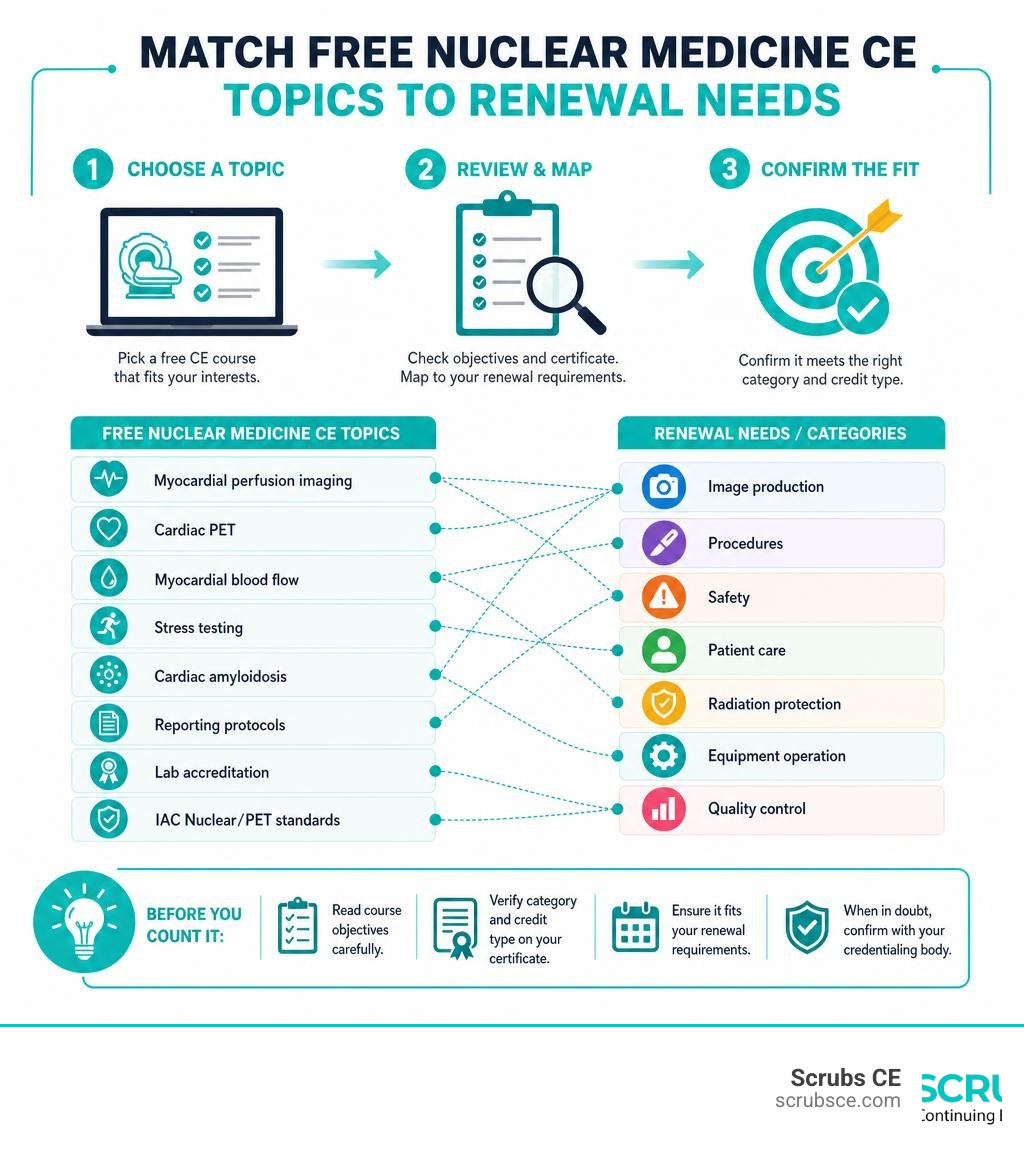
Nuclear cardiology CE is especially useful if you perform or support myocardial perfusion imaging, PET myocardial blood flow, stress testing, or cardiac PET procedures.
Common topics include:
- Myocardial perfusion imaging
- Cardiac PET
- Myocardial blood flow
- Stress testing
- Cardiac amyloidosis
- Reporting protocols
- Lab accreditation
- IAC Nuclear/PET standards
For a focused overview, see Nuclear Medicine Myocardial Perfusion.
These credits can be excellent for technologists in cardiac-focused labs, but if your renewal requires general nuclear medicine or CT-specific content, verify the fit before depending on them.
CQR and Structured Education Fit
ARRT® CQR can be more specific than standard biennial CE. If you receive prescribed CE, you may need credits in areas such as:
- Image production
- Procedures
- Safety
- Patient care
- Radiation protection
- Equipment operation
- Quality control
Free CE can help, but you need to map each course carefully. A course title alone is not enough. Review the course objectives and certificate details.
If you need structured education or CQR-specific coverage, paid self-paced CE may be more predictable because the course descriptions often list category valuations more clearly.
Smart Ways to Fill the Gaps When Free CE Is Not Enough
A free-first plan is smart. A free-only plan can be risky.
Free CE is excellent for reducing cost, but it may not cover every topic, credential, state requirement, or deadline. When you need predictable completion and audit-ready documentation, a paid course can be the cleaner option.
Browse available options in our Nuclear Medicine CE Category.
Pros of Relying on Free CE
Free CE can be a great strategy because it offers:
- Lower out-of-pocket cost
- Flexible webinar and replay formats
- Access to current clinical topics
- Vendor-funded education
- Society-level expertise
- A good way to start your biennium early
- Supplemental credits for general renewal
Free CE is especially useful during the first year of your renewal cycle. If you collect credits early, you have time to fix gaps later.
Cons of Relying Only on Free CE
The downsides are real:
- Catalogs change without much warning.
- Replays expire.
- Some courses require promo codes.
- Some credits are member-only.
- Certificates may not be instant.
- Topic coverage can be uneven.
- CQR categories may not match.
- State scope requirements may not be fully covered.
- Non-CE webinars can look very similar to CE webinars.
The biggest risk is discovering too late that you have 18 credits, but only 10 count toward what you actually need. That is the CE version of buying batteries and realizing your device takes the other kind.
When a Paid Course Makes More Sense
Paid CE is often worth it when you need:
- Credits quickly before renewal
- Instant certificates
- A predictable number of credits
- CQR-specific content
- CT-specific credits
- Textbook-based learning
- Audit-ready documentation
- A course available on your schedule
At Scrubs CE, we focus on convenient, affordable, self-paced continuing education with certificates that help professionals document completion confidently.
Good options include:
- Nuclear Medicine and PET/CT 8th Ed. CH E-Book Test
- Essentials of Nuclear Medicine and Molecular Imaging E-Book Test
You can also explore broader planning help in our Radiology CE Courses Complete Guide and Earn CE Credits Complete Guide.
Frequently Asked Questions About Free Continuing Education Credits for Nuclear Medicine Technologists
How many CE credits do nuclear medicine technologists need every two years?
Most nuclear medicine technologists need 24 CE hours every two years for ARRT® and/or NMTCB renewal.
If you hold additional credentials, requirements may change. For example, NMTCB(CT) requires CT-specific credits as part of the renewal total. Specialty credentials may also have separate rules.
Always check your personal renewal requirements, not just the general rule.
Can I complete all 24 nuclear medicine CE credits for free?
Possibly, but it depends on timing, access, topic fit, and your state rules.
In June 2026, major free or included sources can add up to more than 24 potential credits if you qualify for access. However:
- Some courses may not be nuclear medicine-relevant.
- Some may require membership.
- Some may require a promo code.
- Some may expire before you complete them.
- Some may not match CQR or state scope requirements.
Our recommendation: build a free-first plan, then use paid CE to fill any remaining gaps.
What should I check before taking a free CE course?
Before starting any free CE activity, check:
- Is it approved for ARRT® Category A or A+ credit?
- Is it accepted by NMTCB?
- Is it VOICE-approved if you need nuclear medicine-specific recognition?
- Does your state board accept it?
- Does it match your renewal cycle dates?
- Does it provide a certificate?
- What score is required to pass?
- Are there limits on test attempts?
- Does the course expire soon?
- Does it fit your CQR, CT, or scope requirements?
If the answer is unclear, pause before taking the course. Ten minutes of verification can save you two hours of unusable CE.
Conclusion: Build a Free-First CE Plan, Then Use Reliable Paid CE to Finish Strong
The best strategy for free continuing education credits for nuclear medicine technologists is simple:
- Start early in your biennium.
- Collect free credits from reliable sources.
- Verify ARRT®, AMERICAN REGISTRY OF RADIOLOGIC TECHNOLOGISTS®, NMTCB, and state acceptance before you begin.
- Save every certificate.
- Use paid, self-paced CE to finish any missing requirements.
Free CE can take you a long way, especially through manufacturer-funded courses, society webinars, and member-included education. But when deadlines, CQR, CT-specific credits, or state scope rules get involved, having a reliable paid backup plan is the difference between calm renewal and “why did I wait until Sunday night?”
We are here to help you stay current, stay certified, and keep your CE plan simple.
Start here: Explore nuclear medicine continuing education options