
Why CE Credits for Nuclear Medicine Technologists Matter More Than Ever
Staying on top of CE credits for nuclear medicine technologist certification renewal is one of the most important — and often most stressful — parts of working in this field. Miss a deadline, choose the wrong course type, or fail a random audit, and your hard-earned credentials could be placed on probation or suspended entirely.
Here is the quick answer most technologists need:
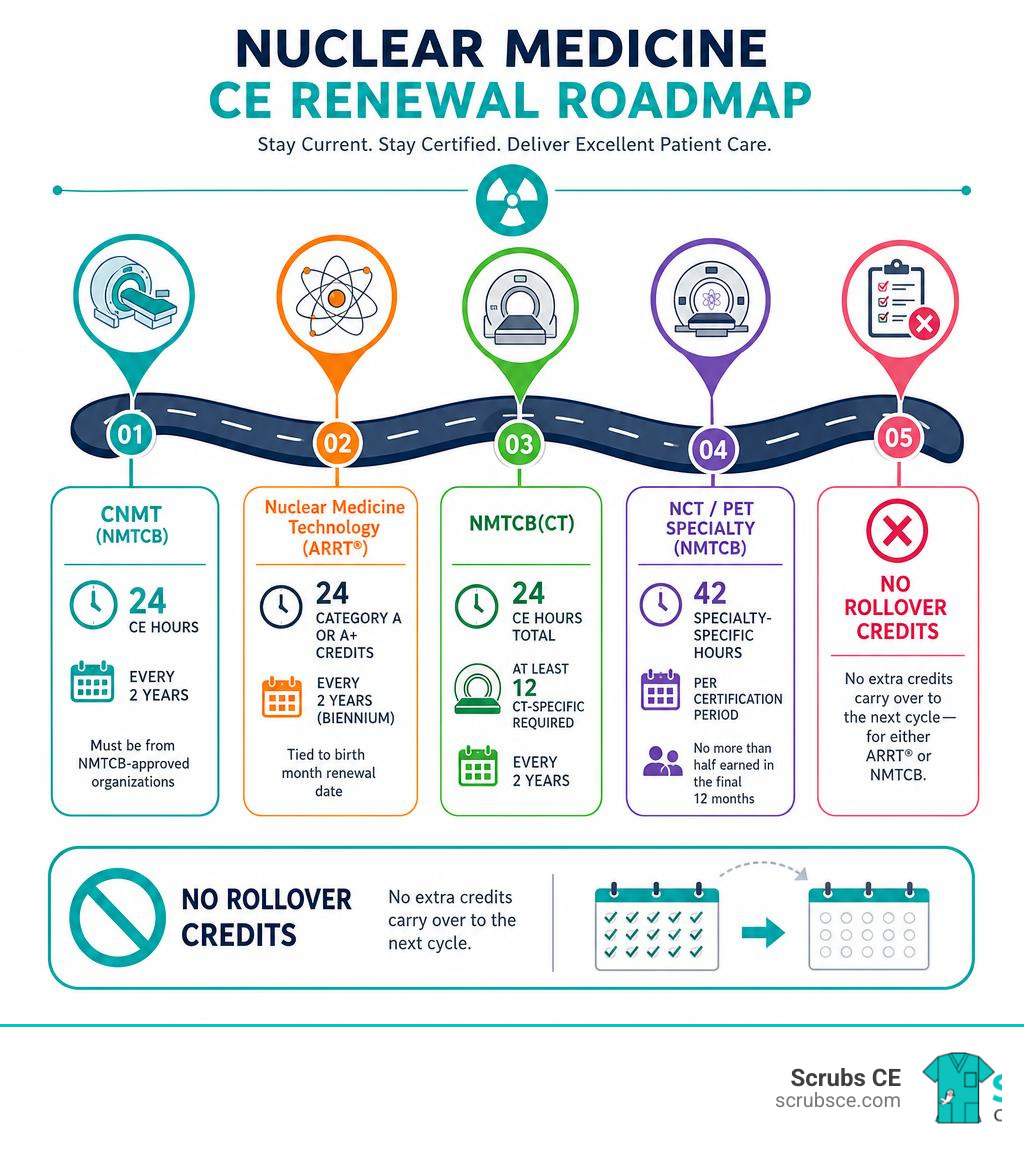
| Credential | Credits Required | Cycle | Special Rules |
|---|---|---|---|
| CNMT (NMTCB) | 24 CE hours | Every 2 years | Must be from NMTCB-approved organizations |
| Nuclear Medicine Technology (ARRT®) | 24 Category A or A+ credits | Every 2 years (biennium) | Tied to birth month renewal date |
| NMTCB(CT) | 24 CE hours total | Every 2 years | At least 12 must be CT-specific |
| NCT / PET Specialty (NMTCB) | 42 specialty-specific hours | Per certification period | No more than half earned in the final 12 months |
| California NM License | 24 credits across 4 categories | Per renewal cycle | Must include Imaging, Non-Imaging, Radiopharmacy, and Therapy credits |
No extra credits carry over to the next cycle — for either ARRT® or NMTCB.
The knowledge base in nuclear medicine keeps expanding. New hybrid imaging technologies, updated radiation safety regulations, and evolving clinical protocols mean that ongoing education is not just a compliance checkbox — it is genuinely essential for safe, high-quality patient care.
Whether you hold a CNMT, an NMTCB(CT), or an ARRT® Nuclear Medicine Technology registration, the rules around what counts, how much you need, and how to document it properly can get complicated fast.
This guide breaks it all down clearly so you can plan your renewal with confidence.
I’m Zita Ewert, and I’ve spent my career helping imaging professionals navigate the continuing education landscape — including CE credits for nuclear medicine technologist credential maintenance — as the leader of Scrubs Continuing Education®, an accredited provider of Category A and A+ credits recognized by ARRT®, NMTCB®, and other major certification bodies. Let’s walk through everything you need to know to stay current, stay certified, and stay confident in your practice.
Essential ce credits for nuclear medicine technologist terms:
- Nuclear medicine myocardial perfusion
- cardiology cme
- Radiology cme
CE Credits for Nuclear Medicine Technologist: 2026 Requirements at a Glance
Navigating the landscape of continuing education (CE) as a nuclear medicine technologist (NMT) requires keeping a close eye on multiple regulatory clocks. In May 2026, the baseline expectation remains clear: most national credentials require 24 CE credits every two years. However, the specific rules change depending on whether your credentials are held with the Nuclear Medicine Technology Certification Board (NMTCB), the AMERICAN REGISTRY OF RADIOLOGIC TECHNOLOGISTS® (ARRT®), or specific state licensing boards like California’s.
| Certifying Body | Core CE Requirement | Accepted Credit Types | Audit/Compliance Notes |
|---|---|---|---|
| NMTCB (CNMT) | 24 hours every 2 years | Approved by recognized organizations (VOICE, ARRT® Category A/A+, etc.) | random audits; 60 days to respond; $65 reinstatement fee for non-compliance |
| ARRT® | 24 credits every 2-year biennium | Category A or A+ only | Birth-month deadline; $50 probation fee if missed |
| NMTCB(CT) | 24 hours every 2 years | Must include at least 12 CT-specific credits | Tied to primary CNMT cycle |
| NCT / PET Specialty | 42 specialty hours | Cardiac/PET specific; equivalent to 6 hours/year | No more than half of the credits can be earned in the final 12 months |
| California RHB | 24 credits every 2 years | Must meet category-specific scopes (Imaging, Non-Imaging, Radiopharmacy, Therapy) | Required to practice in CA; strictly monitored |
Failing to meet these requirements within your designated cycle creates an immediate audit risk, which can lead to probation, reinstatement fees, or even suspended licenses. Furthermore, neither the ARRT® nor the NMTCB allows you to “rollover” excess credits. If you earn 30 credits in this cycle, those extra 6 credits cannot be applied to your next biennium.
NMTCB Requirements for CNMT, NMTCB(CT), NCT, PET, and NMAA
The NMTCB has established strict guidelines to ensure that certified technologists maintain their clinical competence over time. For the standard Certified Nuclear Medicine Technologist (CNMT) credential, you must complete 24 continuing education hours during each two-year cycle. These hours must be approved by NMTCB-recognized organizations.
For those holding advanced or specialty credentials, the requirements become more targeted:
- NMTCB(CT): If you hold this computed tomography credential, you must still complete 24 CE credits, but at least 12 of those credits must be specific to CT imaging.
- NCT (Nuclear Cardiology Technologist) & PET (Positron Emission Tomography): Under the updated NMTCB continuing competence policy, specialty recertification can be achieved by documenting 42 hours of specialty-specific CE (equivalent to 6 hours per year over the 7-year certification period). To prevent “last-minute cramming,” no more than half of these specialty hours (21 credits) can be obtained in the 12 months immediately preceding your credential expiration.
- NMAA (Nuclear Medicine Advanced Associate): These advanced practitioners must complete 24 AMA-approved Category 1 CE hours per cycle.
What doesn’t count? It is important to note that the NMTCB does not accept Basic Life Support (BLS) or CPR training for CE credit. However, Advanced Cardiac Life Support (ACLS) and Pediatric Advanced Life Support (PALS) certifications are recognized, granting 6 CE hours each per two-year cycle (with a maximum of 9 combined credits if you complete both).
If you choose to take college courses at an accredited post-secondary school, the NMTCB grants 16 CE hours per semester credit (and 12 CE hours per quarter credit) for courses passed with a grade of “C” or better. If you fail to meet your CE requirements, you will face a $65 reinstatement fee and be placed on probation.
ARRT® Requirements for Nuclear Medicine Technologists
For technologists registered with the AMERICAN REGISTRY OF RADIOLOGIC TECHNOLOGISTS®, the CE biennium is tied directly to your birth month. You must earn 24 Category A or A+ CE credits every two years. These credits must be approved by a Recognized Continuing Education Evaluation Mechanism (RCEEM) or an ARRT®-recognized state licensing agency.
If you miss your deadline, the ARRT® places you on CE probation for six months. To regain active status, you must complete your missing credits during this probation window and submit a probation report along with a $50 fee.
To protect yourself in the event of a random audit, you must maintain original physical or digital documentation of all your CE certificates for at least five years from the date of completion.
Specialty and CQR Requirements That May Add Targeted CE
Every 10 years, ARRT®-registered technologists must complete the Continuing Qualifications Requirements (CQR) process. This is designed to highlight professional gaps and guide your ongoing learning.
The CQR process begins with a Structured Self Assessment (SSA), which is an 80-question, timed assessment (80 minutes) covering four primary content areas:
- Patient Care (10 questions, up to 4 potential prescribed CE credits)
- Safety (10 questions, up to 5 potential prescribed CE credits)
- Image Production (10 questions, up to 6 potential prescribed CE credits)
- Procedures (50 questions, up to 21 potential prescribed CE credits)
Based on your performance, you may be prescribed targeted CE to address specific knowledge gaps, up to a maximum of 36 prescribed CE credits. For more details on this assessment, you can review the ARRT® Nuclear Medicine Technology SSA specifications.
Approved CE Organizations and How to Verify Course Acceptance
Before spending your time and money on a CE course, you must verify that the credits are approved by an organization recognized by your registry.

To ensure your certificate is audit-ready, it must display:
- Your full name and professional credentials
- The pre-printed date of course completion
- The exact course title and unique reference number
- The approved CE sponsor name and authorized signature
- The approving RCEEM or state licensing agency (e.g., ASRT®)
- The number of credits and their category designation (Category A or A+)
Which CE Credits Count for NMTCB and ARRT® Renewal
Both registries accept Category A and Category A+ credits approved by RCEEMs (such as the ASRT®). Additionally, NMTCB accepts VOICE (Verification of Involvement in Continuing Education) credits.
State-approved CE credits also count toward national registry requirements, provided you held an active license in that state at the time you completed the course. For dual-credentialed technologists, choosing hybrid courses that cover both Radiology and nuclear medicine concepts (such as PET/CT or SPECT/CT) is an excellent way to satisfy multiple requirements simultaneously.
How to Choose CE Credits for Nuclear Medicine Technologist Renewal
To make sure your selected courses will be accepted without any issues, run through this quick checklist before you enroll:
- [ ] Registry Verification: Is the course approved by an ARRT®-recognized RCEEM or an NMTCB-approved organization?
- [ ] Modality Match: Does the course content align with your specific credentials (e.g., does it include CT-specific credits for NMTCB(CT) or cardiac-specific credits for NCT)?
- [ ] State Compliance: If you practice in California, does the course clearly list the credit breakdown across the state’s four mandatory categories?
- [ ] CQR Alignment: If you are completing your CQR cycle, does the course satisfy your prescribed targeted CE requirements?
- [ ] Active Course Status: Is the course’s approval active on the day you plan to take the test? (CE courses have expiration dates, and credits cannot be awarded for expired courses).
State Licensing Differences, Including California Nuclear Medicine CE Categories
While national registries set a baseline, state licensing boards often have their own unique requirements. This is particularly true in California, where the Radiologic Health Branch (RHB) strictly regulates the scope of practice and continuing education for nuclear medicine technologists.

California Nuclear Medicine CE Credit Categories Explained
California law defines specific scopes of practice for nuclear medicine technologists, including diagnostic in vivo/in vitro tests, imaging procedures, generator and reagent kit utilization, and internal radioactive material therapy.
Because of these distinct scopes, California requires that your 24 CE credits be distributed across four specific categories. For example, a comprehensive 24-credit course like our Clinical Nuclear Medicine Applications package is carefully structured to meet these exact state guidelines by distributing its credits as follows:
- Imaging: 9 credits
- Non-Imaging: 5 credits
- Radiopharmacy: 5 credits
- Therapy: 5 credits
When renewing a California license, your CE certificates must explicitly show this category-specific breakdown to be accepted.
How Other States Treat Nuclear Medicine CE Credits
Most other states align their CE requirements directly with the national ARRT® or NMTCB biennial cycles. However, some states maintain their own independent licensing portals, unique renewal deadlines, or specific caps on certain types of training. For instance, some states place strict limits on how many “on-site applications training” hours you can claim (often capped at 8 credits per biennium), while placing no limits on academic or accredited online CE courses. Always check with your local state Radiology board to verify any state-specific mandates, such as mandatory ethics or patient safety modules.
Best Course Topics for Nuclear Medicine CE Credit
Selecting the right topics not only makes the renewal process easier but also helps you stay current with the latest advancements in the field. You can explore our full range of options at the Nuclear Medicine CE course hub.
High-Value Clinical Topics for Everyday NMT Practice
To support your daily practice, look for courses that focus on core nuclear medicine principles, such as radiopharmaceutical safety, pediatric radiation protection, and advanced scintigraphy.
A great place to start is our guide on Starting Your Career: A Guide to Nuclear Medicine Technologist Courses, or you can dive into comprehensive textbooks like the Essentials of Nuclear Medicine and Molecular Imaging. These resources offer deep dives into:
- Dose optimization and ALARA (As Low As Reasonably Achievable) protocols
- Oncology imaging and infection localization
- Gastrointestinal, genitourinary, and endocrine imaging procedures
CT, PET/CT, and SPECT/CT Topics for Dual-Credentialed Technologists
As hybrid imaging systems become the standard of care, dual-credentialed technologists must stay proficient in both modalities. This is especially true for NMTCB(CT) holders, who must earn at least 12 CT-specific credits every two years.
Courses like Nuclear Medicine and PET/CT or Nuclear Medicine: The Requisites are perfect for mastering:
- CT attenuation correction and cross-sectional anatomy
- PET/CT and SPECT/CT fusion imaging protocols
- CT contrast safety and adverse reaction management
Nuclear Cardiology and Myocardial Perfusion CE
For those focusing on cardiac imaging, keeping up with the latest stress testing and perfusion protocols is essential. Specialty credentials like the NCT require 42 hours of specialty-specific CE over your certification period.
To meet these requirements, consider specialized educational materials such as the Nuclear Medicine Myocardial Perfusion course, which covers:
- Myocardial blood flow measurements using PET
- Pharmacological stress testing protocols and ECG interpretation
- Lab safety and cardiac radiotracer selection
How to Earn, Track, and Document Nuclear Medicine CE Efficiently
Earning your ce credits for nuclear medicine technologist renewal does not have to be a stressful, last-minute rush. By using a structured approach, you can easily manage your requirements throughout your two-year cycle.
How to Document CE Credits for Nuclear Medicine Technologist Audits
If you are selected for a random audit by the ARRT® or NMTCB, you will typically have 60 days to submit your documentation. To ensure you pass without any issues, keep a dedicated digital folder containing all your completion certificates. Each certificate must clearly show your name, the completion date, the course title, the approved credits (Category A or A+), the sponsor’s name, and the unique CE reference number. You must keep these records on file for at least five years.
Smart Ways to Complete 24 Credits Without Overbuying
One of the most efficient ways to earn your credits is by choosing comprehensive, multi-credit courses. Instead of buying several small 1- or 2-credit modules, you can fulfill your entire 24-credit requirement with a single, high-quality course.
We offer several all-in-one packages, which you can find in our Product Category: Nuclear Medicine CE and Nuclear Medicine Test Courses sections. These courses let you study at your own pace, take a single open-book exam, and receive an instant certificate upon passing. This approach saves you time and ensures you meet your requirements without overspending.
What Happens If You Miss Your CE Deadline?
If you miss your renewal deadline, both the ARRT® and NMTCB offer a grace period, but it comes with penalties:
- ARRT® Probation: You will be placed on a six-month CE probation. You must complete your missing credits during this window and submit a $50 probation fee.
- NMTCB Probation: You will have six months to complete your missing hours and must pay a $65 reinstatement fee.
- Suspension and Lapsed Status: If you do not complete your credits during the probation period, your credentials will be suspended or revoked. To regain active status, you may have to pay additional fees, complete extra CE hours, or even retake your primary registry exams.
Frequently Asked Questions About Nuclear Medicine CE Credits
How Many CE Credits Do Nuclear Medicine Technologists Need Every Two Years?
Most nuclear medicine technologists need 24 CE credits every two years. This applies to both CNMT certificants under the NMTCB and Registered Technologists in Nuclear Medicine Technology under the ARRT®. These credits must be Category A or A+ and approved by recognized organizations.
Do NMTCB(CT) Technologists Need CT-Specific CE Credits?
Yes. If you hold the NMTCB(CT) credential, at least 12 of your 24 required biennial CE credits must be specific to CT imaging. The remaining 12 credits can be general nuclear medicine or other Radiology-related topics.
Can Extra CE Credits Be Carried Into the Next Renewal Cycle?
No. Neither the ARRT® nor the NMTCB allows you to carry forward extra CE credits into the next biennium. Any credits earned beyond your required 24 will expire at the end of your current cycle.
Conclusion
Managing your ce credits for nuclear medicine technologist renewal does not have to be a chore. By understanding your registry’s specific requirements, keeping track of your deadlines, and choosing high-quality, comprehensive courses, you can maintain your credentials with ease.
At Scrubs CE, we are committed to making your continuing education as simple and stress-free as possible. We offer a wide variety of self-paced, affordable online courses designed specifically for nuclear medicine technologists, complete with instant certificate generation to help you meet your deadlines on time.
Ready to complete your renewal credits? Learn more and find the perfect course for your needs by reading our guide, Stay Current, Stay Certified: Essential Nuclear Medicine Continuing Education, or visit our Nuclear Medicine Continuing Education catalog today to get started!