

Why Nuclear Medicine Infection Imaging Is a Game-Changer for Diagnosing Hidden Infections
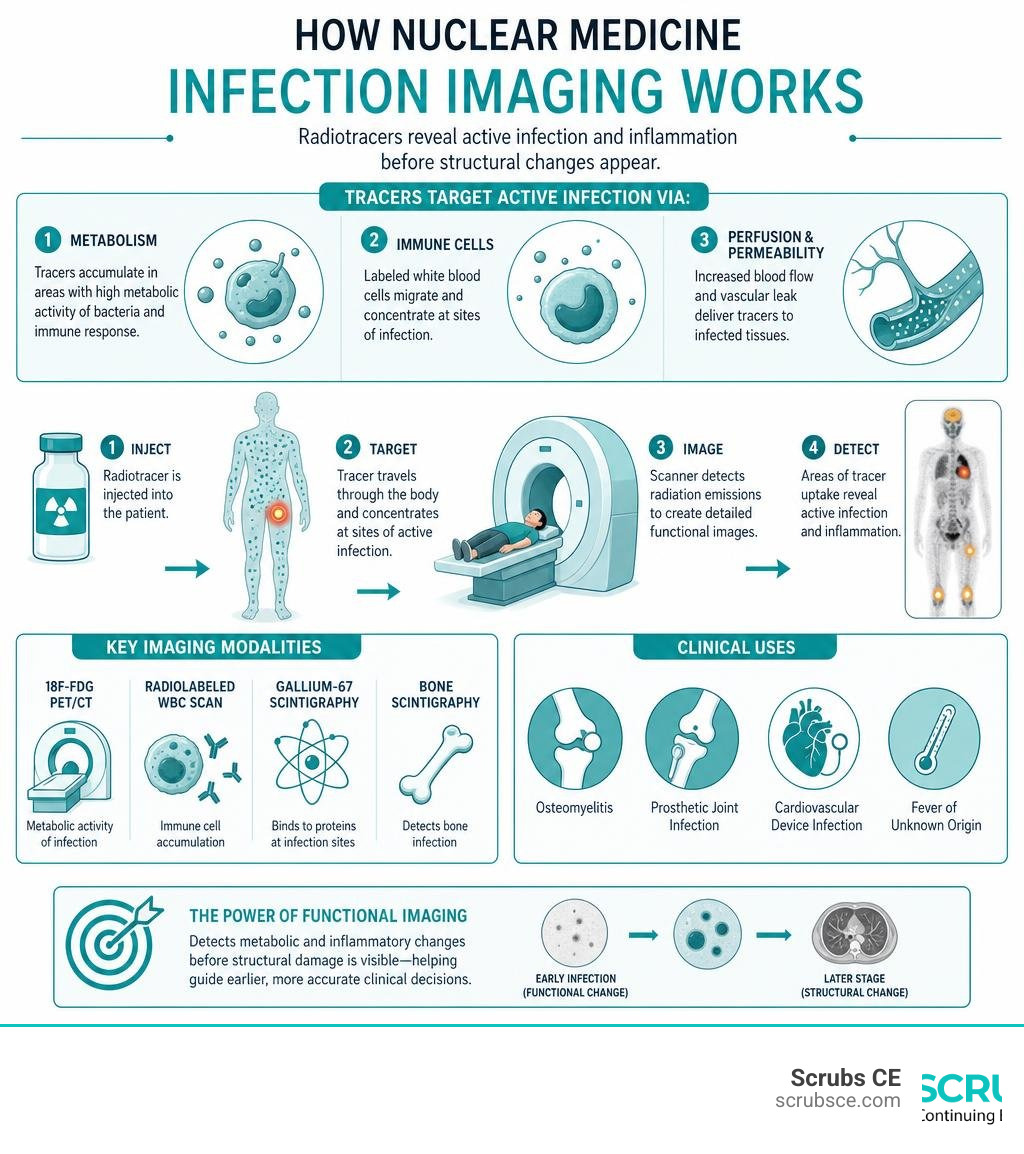
Nuclear medicine infection imaging uses radioactive tracers to detect infection and inflammation anywhere in the body — often before structural changes appear on CT or MRI.
Quick answer: What is nuclear medicine infection imaging?
| Feature | Details |
|---|---|
| What it is | A functional imaging technique using radiopharmaceuticals to detect infection and inflammation |
| How it works | Radiotracers accumulate at sites of active infection via metabolic activity, immune cell migration, or vascular permeability |
| Main modalities | 18F-FDG PET/CT, radiolabeled WBC scans, Gallium-67 scintigraphy, bone scintigraphy |
| Key advantage | Detects metabolic changes before structural damage is visible |
| Common uses | Osteomyelitis, prosthetic joint infection, cardiovascular device infection, fever of unknown origin |
Managing infections in complex patients is getting harder. More comorbidities. More implanted devices. More antibiotic-resistant organisms. Structural imaging like CT and MRI can show anatomy — but they often can’t tell you whether what they see is active infection, sterile inflammation, or post-surgical change.
That’s where nuclear medicine steps in.
Because metabolic abnormalities happen before visible structural damage, functional imaging can catch infections earlier and with greater specificity than conventional imaging alone. For example, 18F-FDG PET/CT achieves a sensitivity of 96% for chronic osteomyelitis — and when combined with radiolabeled WBC SPECT/CT, the two together approach nearly 100% specificity for cardiovascular infections.
This guide covers everything you need to know: the radiopharmaceuticals, the protocols, the clinical applications, and the emerging tracers that are pushing the field forward.
I’m Zita Ewert, leader of SCRUBS Continuing Education® and a specialist in developing accredited imaging courses — including nuclear medicine infection imaging — for radiologic technologists and nuclear medicine professionals. Whether you’re maintaining your ARRT® credentials or expanding your clinical knowledge, this guide is built to help you stay current and confident.
Nuclear medicine infection imaging helpful reading:
- Nuclear medicine myocardial perfusion
- Nuclear medicine continuing education
- Radiology CME
Principles of Nuclear Medicine Infection Imaging
To understand how nuclear medicine infection imaging works, we have to look at how the human body responds to a microbial invasion. When pathogens invade, they trigger a complex host immune response. This biological cascade involves localized hyperperfusion (increased blood flow), enhanced vascular permeability (leaky blood vessels), and the rapid recruitment of white blood cells (leukocytes) to the site of conflict.
Traditional structural imaging techniques like CT or MRI rely on anatomical changes, such as bone destruction or fluid collections, which can take weeks to develop. Functional nuclear medicine imaging, however, targets the physiological processes themselves. According to the comprehensive clinical reference on Nuclear Medicine Infection Assessment, Protocols, and Interpretation – StatPearls – NCBI Bookshelf, functional alterations always precede anatomical destruction. By utilizing radiopharmaceuticals that mimic metabolic substrates or bind directly to active immune cells, nuclear medicine can pinpoint active infection sites while structural anatomy still appears completely normal.
Tracer localization generally occurs through three main pathways:
- Direct Chemotaxis: Radiolabeled white blood cells actively migrate to the infection site.
- Metabolic Uptake: Cells with high metabolic demands, such as activated macrophages and neutrophils, rapidly consume glucose analogs like 18F-FDG.
- Increased Vascular Permeability: Radiotracers bind to circulating proteins (like transferrin) and leak into the interstitial space at the site of inflammation.
Key Radiopharmaceuticals and Imaging Modalities
Selecting the right radiopharmaceutical depends on the clinical question, the suspected location, and the chronicity of the infection. The table below outlines the core modalities utilized in modern clinical practice.
| Modality | Radiopharmaceutical | Primary Mechanism | Best Clinical Indications | Major Limitations |
|---|---|---|---|---|
| FDG PET/CT | 18F-Fluorodeoxyglucose | High glucose metabolism in inflammatory cells | Spinal osteomyelitis, FUO, vascular graft infections | Lacks specificity; accumulates in tumors and sterile inflammation |
| WBC Scan | 111In-Oxine or 99mTc-HMPAO labeled leukocytes | Active migration of white blood cells to infection site | Prosthetic joint infections, peripheral osteomyelitis, IBD | Requires blood handling; 3-hour labeling process; lower resolution |
| Gallium Scan | 67Ga-Citrate | Iron analog; binds to transferrin and lactoferrin | Spinal osteomyelitis (when MRI/PET unavailable) | Multi-day protocol; high radiation dose; bowel excretion |
| Bone Scintigraphy | 99mTc-MDP | Binds to hydroxyapatite crystals (osteoblastic activity) | Excluding osteomyelitis in unviolated bone | Low specificity; positive in trauma, arthritis, and surgery |
For technologists looking to master these modalities, exploring a structured Nuclear Medicine CE program is an excellent way to dive deeper into the physics and acquisition protocols of each tracer.
Gallium-67 Citrate and Bone Scintigraphy
Historically, Gallium-67 (67Ga) citrate was a cornerstone of infection imaging. Gallium acts as an iron analog, binding tightly to circulating transferrin. At sites of infection, it leaks through fenestrated capillaries and binds to lactoferrin, which is present in high concentrations within neutrophils and bacterial walls.
While highly sensitive, gallium scans are logistically challenging. They require imaging at 24, 48, and sometimes 72 hours post-injection, and normal bowel excretion can obscure abdominal pathology. However, when combined with bone scintigraphy, a gallium-67 scan has a sensitivity and specificity of over 90% for diagnosing spinal osteomyelitis.
Bone scintigraphy using Technetium-99m methylene diphosphonate (99mTc-MDP) measures osteoblastic activity. A triple-phase bone scan—consisting of dynamic flow, immediate blood pool, and delayed static imaging—is incredibly sensitive for detecting early osteomyelitis within 2 to 3 days of onset, compared to 2 to 3 weeks for plain radiographs. Its primary limitation is specificity; any process causing bone turnover (fractures, degenerative joint disease, or recent surgery) will show increased uptake. To learn more about standard bone imaging protocols, check out the Essentials of Nuclear Medicine and Molecular Imaging course.
Radiolabeled Leukocytes (WBC Scans)
Radiolabeled leukocyte imaging, or a “tagged WBC scan,” is widely considered the gold standard for many musculoskeletal and soft-tissue infections. This technique involves drawing the patient’s blood, isolating the white blood cells, labeling them in vitro with either Indium-111 (111In) oxine or Technetium-99m (99mTc) HMPAO, and re-injecting them into the patient. The entire labeling process takes approximately 3 hours and demands strict quality control to prevent misadministration.
- 99mTc-WBCs offer superior spatial resolution and a lower radiation dose, making them ideal for peripheral musculoskeletal imaging.
- 111In-WBCs are preferred for abdominal and pelvic infections because 111In does not exhibit the normal renal or gastrointestinal excretion seen with 99mTc.
When bone marrow hyperplasia or post-surgical remodeling is present, a WBC scan is often paired with a 99mTc-sulfur colloid bone marrow scan. Because sulfur colloid accumulates in normal bone marrow but WBCs accumulate in both marrow and infection, a “mismatch” (increased WBC uptake without corresponding sulfur colloid uptake) is highly specific for active infection. Technologists can study these complex dual-isotope protocols further in the Nuclear Medicine The Requisites 2 course.
18F-FDG PET/CT
Fluorine-18 fluorodeoxyglucose (18F-FDG) is a glucose analog taken up by cells via glucose transporters (GLUT) and phosphorylated by hexokinase. Because activated inflammatory cells (neutrophils, macrophages, and lymphocytes) rely heavily on glycolysis, they demonstrate intense FDG uptake.
18F-FDG PET/CT offers several advantages over traditional planar and SPECT imaging:
- High Spatial Resolution: PET technology provides exceptional image clarity.
- Rapid Protocol: Imaging is completed within 1 to 2 hours post-injection, avoiding the multi-day delays of gallium or the complex blood handling of WBC scans.
- Quantification: Standardized Uptake Values (SUV) allow clinicians to objectively monitor treatment response.
However, because tumor cells and sterile post-surgical inflammation also consume glucose rapidly, strict patient preparation is required to minimize physiological background activity. Technologists interested in mastering PET acquisition parameters and advanced reconstruction algorithms can refer to Nuclear Medicine and PET CT 2.
Clinical Applications in Musculoskeletal and Cardiovascular Infections
Osteomyelitis and Diabetic Foot Infections
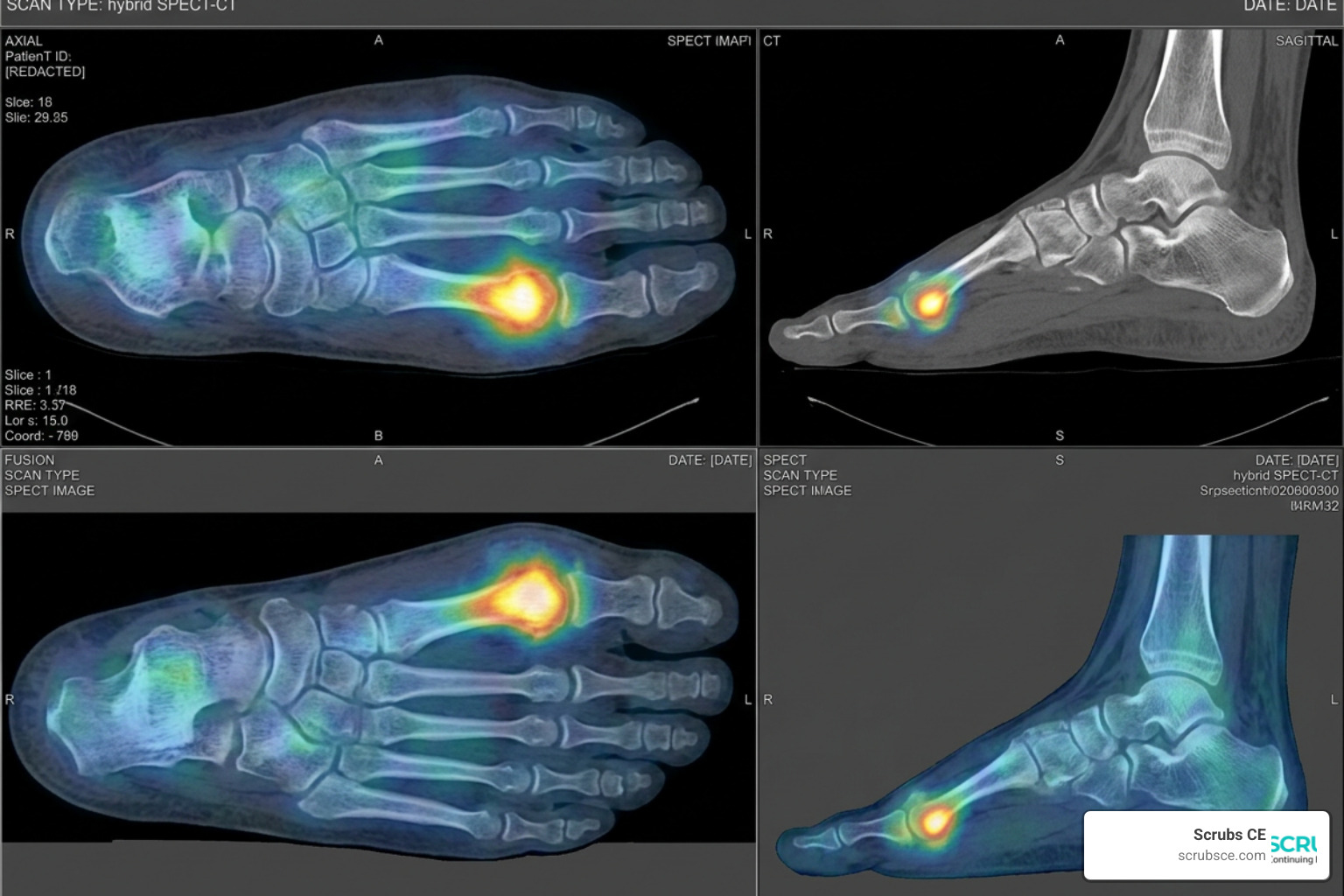
Diagnosing diabetic foot osteomyelitis (DFO) is one of the most common clinical challenges in infectious disease. It is particularly difficult to differentiate active bone infection from neuropathic osteoarthropathy (Charcot joint), as both conditions present with localized warmth, swelling, and bone remodeling.
According to the Appropriate Use Criteria for the Use of Nuclear Medicine in Musculoskeletal Infection Imaging, choosing the right test depends heavily on the presence of underlying hardware or bone violation:
- Native Bone: A triple-phase bone scan has an excellent negative predictive value; if it is negative, osteomyelitis can be confidently ruled out.
- Charcot Joint / Violated Bone: A combined radiolabeled WBC and 99mTc-sulfur colloid scan is the imaging modality of choice. This dual-tracer approach achieves an accuracy of 86% to 98% by showing discordant uptake in infected areas.
- FDG PET/CT: Demonstrates high diagnostic accuracy, with a sensitivity of 100% and accuracy of 93.8% for Charcot joint infections compared to MRI (76.9% and 75%, respectively).
For professionals looking to understand how cardiovascular perfusion imaging protocols intersect with systemic inflammatory conditions, we recommend reviewing our Nuclear Medicine Myocardial Perfusion resource.
Cardiovascular Device and Prosthetic Joint Infections
Infections involving cardiovascular implantable electronic devices (CIEDs), prosthetic valves, and vascular grafts carry high morbidity and mortality. Structural imaging is often limited in these scenarios due to metallic susceptibility artifacts on MRI and the inability of CT to differentiate post-operative fluid from active infection.
As highlighted in Using Nuclear Medicine Imaging Wisely in Diagnosing Infectious Diseases – PMC:
- Infective Endocarditis: 18F-FDG PET/CT can diagnose approximately 40% of patients with systemic emboli in cardiovascular infections, even in the absence of clinical symptoms. Because of this, FDG PET/CT and radiolabeled WBC SPECT/CT have been formally integrated into the European Society of Cardiology (ESC) diagnostic guidelines.
- Vascular Graft Infections: WBC SPECT/CT has a significantly higher pooled sensitivity and specificity than 18F-FDG PET/CT or CT angiography. However, when combined, a 18F-FDG PET/CT and radiolabeled WBC SPECT/CT protocol yields nearly 100% specificity.
- Prosthetic Joint Infections (PJI): While WBC/sulfur colloid imaging remains the historical gold standard, FDG PET/CT is increasingly used due to its high sensitivity and ability to normalize within 3 to 4 months post-surgery, whereas bone scans can remain falsely positive for up to a year.
The Role of Nuclear Medicine Infection Imaging in Fever of Unknown Origin
Fever of Unknown Origin (FUO) is defined as a prolonged fever (>3 weeks) without a clear diagnosis despite a week of intense in-hospital investigation. The etiology of FUO typically falls into three categories: infections, non-infectious inflammatory diseases (such as vasculitis), or malignancies.
Rather than being used as a last resort, 18F-FDG PET/CT is now recommended early in the diagnostic algorithm of FUO. Because FDG accumulates in tumors, active infections, and autoimmune inflammatory lesions, a single whole-body PET/CT scan can localize a diagnostic target in 46% to 90% of cases. Identifying a focal “hot spot” allows clinicians to perform targeted biopsies, avoiding blind invasive procedures and accelerating treatment. To keep your licensing current while learning about these systemic imaging strategies, explore our Stay Current Stay Certified Essential Nuclear Medicine Continuing Education guide.
Advanced Hybrid Techniques: SPECT-CT and PET-CT
The evolution of nuclear medicine from planar imaging to hybrid tomographic imaging (SPECT-CT and PET-CT) represents a massive leap forward in diagnostic accuracy. Planar imaging provides a two-dimensional projection, making it incredibly difficult to determine whether a focus of increased tracer uptake lies within the bone cortex, the marrow, or the adjacent soft tissue.
Hybrid imaging solves this by fusing functional metabolic data with high-resolution anatomical CT data in a single session:
- Precise Anatomical Localization: SPECT-CT allows clinicians to differentiate between cellulitis (soft-tissue infection) and underlying osteomyelitis (bone infection), which completely changes the surgical and antibiotic management.
- Attenuation Correction: The CT component generates an attenuation map, correcting for tissue density variations and significantly improving image quality and quantification.
- Artifact Identification: Hybrid imaging helps identify false-positive tracer accumulation caused by physiological variants, bowel activity, or metallic implants.
To stay competitive in modern imaging departments, nuclear medicine technologists must understand the technical nuances of hybrid systems. For a comprehensive overview of licensing requirements and advanced hybrid imaging courses, refer to our Nuclear Medicine CE Credits Guide 2026.
Emerging Radiotracers and Future Directions
While current tracers like 18F-FDG are highly sensitive, they suffer from a fundamental limitation: they target the host’s inflammatory response rather than the pathogen itself. This makes it difficult to differentiate an active bacterial infection from sterile inflammation (such as post-operative healing, active gout, or autoimmune flare-ups) or tumor recurrence.
The “holy grail” of nuclear medicine infection imaging is the development of pathogen-specific tracers that only accumulate in viable, multiplying microorganisms, as discussed in the expert consensus paper Expert opinions in nuclear medicine: Finding the “holy grail” in infection imaging.
Pathogen-Specific Nuclear Medicine Infection Imaging
Several highly promising pathogen-specific radiopharmaceuticals are currently in development and clinical trials:
- [124I]FIAU-PET/CT: Labeled 2′-fluoro-2′-deoxy-1-beta-D-arabinofuranosyl-5-iodouracil ([124I]FIAU) is a substrate for bacterial thymidine kinase (TK), an enzyme distinct from human thymidine kinase. A pilot study published in Imaging of Musculoskeletal Bacterial Infections by [124I]FIAU-PET/CT | PLOS One demonstrated that [124I]FIAU-PET/CT can directly image bacterial infections in musculoskeletal tissue within 2 hours of injection, showing zero uptake in sterile inflammation or degenerative arthritis.
- 18F-Fluorodeoxysorbitol (18F-FDS): Sorbitol is a sugar alcohol specifically metabolized by Enterobacteriaceae (such as E. coli and Klebsiella). Research highlighted in Infection-specific PET imaging with 18F-fluorodeoxysorbitol and 2-[18F]F-ρ-aminobenzoic acid: An extended diagnostic tool for bacterial and fungal diseases shows that 18F-FDS yields a 7-fold increase in tracer accumulation in Enterobacteriaceae infections compared to sterile controls, allowing clinicians to identify specific bacterial families non-invasively.
- 2-[18F]F-p-aminobenzoic acid (18F-FPABA): This tracer targets the bacterial folic acid pathway. Because human cells do not synthesize folate, 18F-FPABA demonstrates an outstanding infection-to-sterile-inflammation ratio of up to 7.95, making it a highly specific tool for broad bacterial and fungal detection.
Next-Generation Camera Systems and LAFOV PET/CT
Technological advancements in hardware are also transforming the field. Large Axial Field-of-View (LAFOV) PET/CT scanners—often called “total-body PET”—cover the entire patient in a single bed position.
The clinical advantages of LAFOV PET/CT for infection imaging are profound:
- Ultrafast Scanning: A complete whole-body scan can be completed in 2 to 3 minutes, which is invaluable for pediatric patients or those in severe pain who cannot lie still.
- Ultra-Low Dose Imaging: LAFOV systems can acquire diagnostic-quality images with a fraction of the standard radiotracer dose, significantly reducing patient radiation exposure.
- Delayed Imaging: Technologists can image patients 4 to 5 half-lives after injection, allowing background activity to clear and enhancing the signal-to-noise ratio in low-grade, chronic infections.
- PET-MRI Fusion: Combining PET with MRI provides exquisite soft-tissue contrast with minimal radiation, offering a massive diagnostic advantage for pediatric osteomyelitis and cardiac sarcoidosis.
To learn more about the career trajectory and educational requirements for operating these advanced molecular imaging systems, explore our Starting Your Career A Guide to Nuclear Medicine Technologist Courses.
Frequently Asked Questions
What are the common pitfalls and false positives in infection imaging?
The most common pitfall in nuclear medicine infection imaging is distinguishing active infection from sterile inflammation. 18F-FDG accumulates in any tissue with high glycolysis, leading to false positives in:
- Recent Surgical Sites: Post-operative inflammation can cause intense FDG uptake for up to 3 to 4 months.
- Malignancies: Tumors consume glucose rapidly and can mimic focal infections.
- Fractures and Bone Remodeling: Bone scintigraphy and gallium scans will show uptake in healing fractures or degenerative joint disease.
- Antibiotic Suppression: Prior antibiotic therapy can reduce the inflammatory response, leading to false-negative results on WBC scans.
How does patient preparation differ for FDG PET versus other modalities?
Patient preparation is critical for 18F-FDG PET/CT because high circulating insulin or blood glucose will drive the tracer into skeletal muscle rather than the infection site.
- Standard FDG PET Prep: Requires at least a 6-hour fast, a low-carbohydrate diet the day prior, and strict blood glucose control (ideally <200 mg/dL). High-impact exercise must be avoided for 24 hours.
- Cardiac FDG PET Prep: To suppress normal myocardial glucose uptake (allowing the clinician to see focal device infections or endocarditis), patients must follow a high-fat, zero-carbohydrate diet for 24 to 72 hours, followed by a 12-hour fast.
- WBC and Gallium Scans: Generally require no dietary restrictions, though gallium scans may require laxatives to clear normal bowel excretion before abdominal imaging.
Why is hybrid imaging preferred over planar scintigraphy?
Planar scintigraphy produces flat, 2D images that lack depth, making it incredibly difficult to localize a hot spot. Hybrid imaging (SPECT-CT and PET-CT) fuses functional data with structural CT anatomy, allowing the reading physician to pinpoint exactly which anatomical structure is infected. This drastically reduces false positives, improves diagnostic specificity, and provides the surgical team with a precise roadmap for intervention.
Conclusion
Nuclear medicine infection imaging is an indispensable tool in modern clinical medicine. By targeting the functional, metabolic, and cellular pathways of disease, nuclear medicine allows us to detect hidden infections long before structural damage appears on traditional scans. As hybrid imaging techniques like SPECT-CT and PET-CT continue to mature, and as pathogen-specific tracers move closer to widespread clinical use, our ability to deliver highly personalized, targeted patient care will only grow.
For radiologic technologists and nuclear medicine professionals, staying at the forefront of these technological shifts is essential. At SCRUBS Continuing Education®, we are committed to providing high-quality, self-paced, and affordable online courses. Our curriculum is designed to help you easily fulfill your ARRT® (AMERICAN REGISTRY OF RADIOLOGIC TECHNOLOGISTS®) and state licensure requirements while advancing your clinical skills.
Ready to expand your expertise and secure your next set of CE credits? Explore Nuclear Medicine Continuing Education Courses on ScrubsCE.com today!