
Is Becoming an MRI Tech the Right Career Move for You?

Becoming an MRI tech is one of the fastest ways to build a well-paying, stable healthcare career — without spending a decade in school.
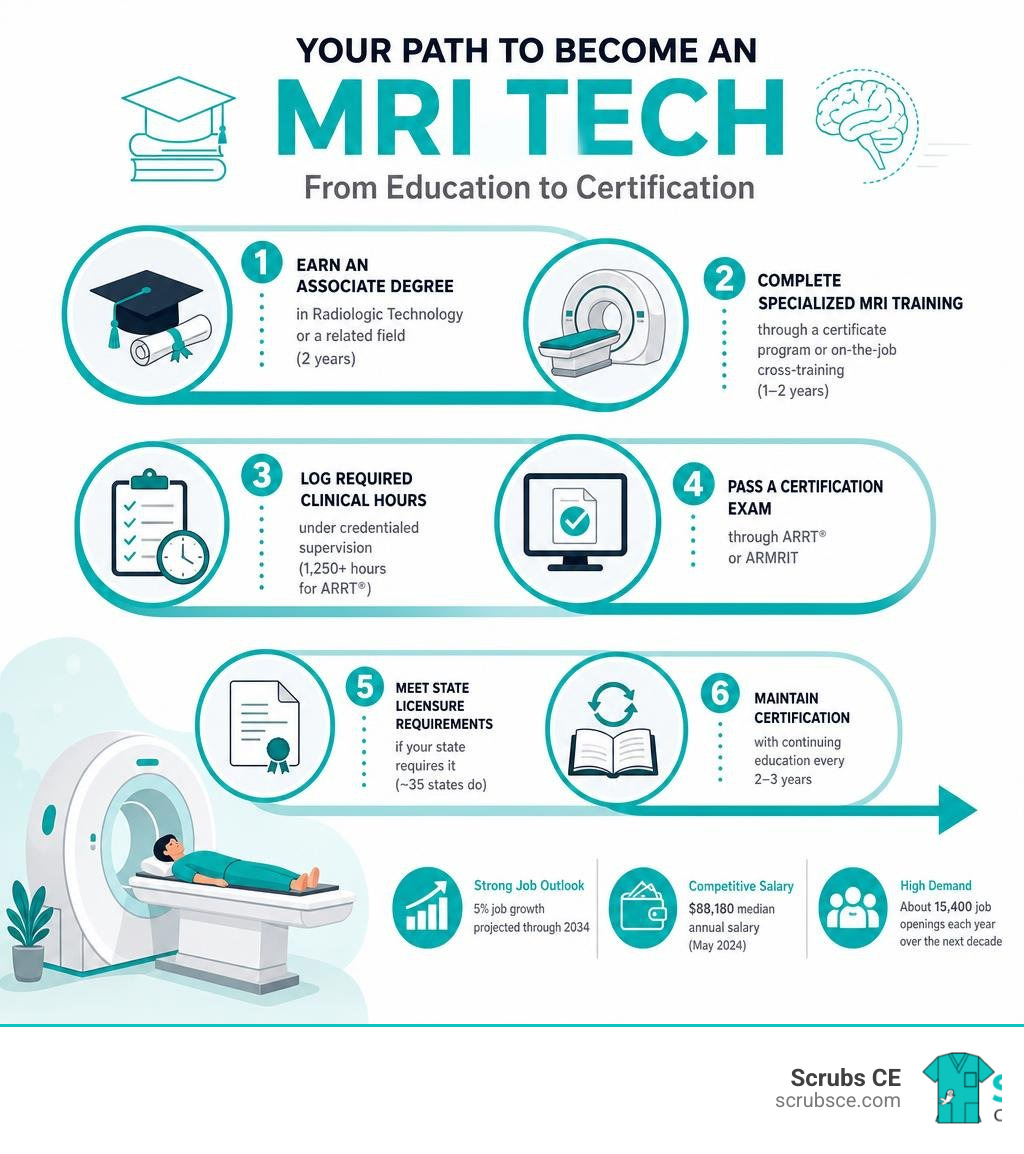
Here’s a quick snapshot of how to do it:
- Earn an associate degree in Radiologic Technology or a related field (2 years)
- Complete specialized MRI training through a certificate program or on-the-job cross-training (1–2 years)
- Log required clinical hours under credentialed supervision (1,250+ hours for ARRT®)
- Pass a certification exam through ARRT® or ARMRIT
- Meet state licensure requirements if your state requires it (~35 states do)
- Maintain certification with continuing education every 2–3 years
The demand is real. The Bureau of Labor Statistics reports a $88,180 median annual salary for MRI technologists as of May 2024, with 5% job growth projected through 2034 — faster than average. About 15,400 job openings are expected each year over the next decade.
And unlike many high-paying healthcare roles, MRI technology doesn’t use ionizing radiation. MRI scanners use magnetic fields and radio waves — making it one of the safer imaging modalities for both patients and practitioners.
Whether you’re a working radiologic technologist looking to cross-train, or you’re just starting your healthcare journey, there’s a clear path forward.
I’m Zita Ewert, and as the leader of SCRUBS Continuing Education®, I’ve spent years helping imaging professionals navigate becoming an MRI tech — from initial certification to ongoing CE requirements. Let me walk you through everything you need to know.
What is an MRI Technologist? (Duties, Skills, and Daily Workflow)

At its core, a magnetic resonance imaging (MRI) technologist is a highly trained healthcare professional who operates advanced scanners to capture detailed, cross-sectional images of a patient’s internal anatomy. Physicians and radiologists rely on these high-resolution images to diagnose everything from traumatic brain injuries and spinal cord disorders to liver cancers and cardiovascular issues.
Unlike traditional X-ray or CT scanners, which utilize ionizing radiation, MRI machines use powerful magnetic fields and radiofrequency pulses. This technology relies on the resonant frequency properties of atoms (mostly hydrogen protons) within the human body to generate detailed anatomical mapping. Because of this, the role is highly technical. In fact, an MRI technologist controls no less than 70 different imaging parameters during a scan, compared to only 4 to 6 parameters in standard radiography.
Learn more about the evolving role of MRI technologists to see how modern advancements like wider machine bores and artificial intelligence are shaping daily clinical workflows.
Core Responsibilities and Patient Care
An MRI technologist’s shift is a dynamic mix of advanced technology and compassionate patient care. On average, you will spend about 60% of your day interacting directly with patients and 40% sitting at the operator console adjusting sequences. Your typical clinical responsibilities include:
- Rigorous Safety Screening: Because the MRI magnet is always “on,” you must screen every patient, staff member, and piece of equipment for ferromagnetic objects. This is a life-or-death responsibility; failing to identify an internal pacemaker, aneurysm clip, or even a stray metal hairpin can result in catastrophic injuries.
- Patient Support and Positioning: Many patients feel anxious or highly claustrophobic inside the scanner bore. You will use immobilization devices, explain the loud knocking sounds of the gradient coils, and provide continuous reassurance to help them remain completely still.
- Contrast Agent Administration: When high-contrast vascular or tissue definition is required, you will screen the patient’s renal function, establish intravenous (IV) access, and safely administer gadolinium-based contrast media.
- Collaboration with Radiologists: You will review physician orders, select the correct imaging protocols, and consult with radiologists to ensure the captured scans provide the exact diagnostic answers needed.
These clinical guidelines are structured around the national standards outlined in the ASRT® Magnetic Resonance Curriculum guidelines, ensuring that every technologist practices safe, standardized medicine.
Essential Skills for Becoming an MRI Tech
To thrive as an MRI technologist, you need a balanced blend of hard and soft skills:
- Technical Aptitude: You must feel comfortable navigating complex software, troubleshooting system calibrations, and understanding the dense physics of magnetic resonance.
- Strong Communication and Empathy: You will interact with patients who are in pain, frightened, or confused. Being able to explain complex procedures in simple, calming language is vital.
- Physical Stamina: Expect to spend long hours on your feet, lifting or positioning patients, and moving heavy imaging coils.
- Critical Thinking & Attention to Detail: Every patient’s anatomy is unique. You must possess the analytical skills to adjust scanning sequences on the fly to obtain the highest-quality diagnostic images.
The Educational Pathways to Becoming an MRI Tech
When planning your journey into this field, you will find that there is no single “correct” educational pathway. Instead, you can choose a route that aligns with your current educational background and professional goals. However, regardless of the path you select, you must ensure your program is accredited by a recognized agency like the Joint Review Committee on Education in Radiologic Technology (JRCERT) or the American Registry of Magnetic Resonance Imaging Technologists (ARMRIT).
To explore accredited schools and educational requirements in your region, check out this guide on How to Become an MRI Technician: Schools 2026 June. You can also review specific clinical benchmarks on our MRI Training Requirements page.
Let’s break down the two primary educational routes.
The Radiography-First Route (Postprimary Pathway)
This is the most traditional and highly recommended pathway. Many working technologists choose this route because it provides exceptional long-term career flexibility.
In this pathway, you first earn an associate degree in Radiologic Technology (or a related imaging field) and pass the primary registry exam to become a registered Radiologic Technologist, R.T.(R)(ARRT)®. Once you are working in Radiology, you can cross-train into MRI. This transition involves taking structured educational courses in MRI physics and anatomy while simultaneously logging clinical hours at your place of employment or through an advanced certificate program.
According to the U.S. Bureau of Labor Statistics Radiologic and MRI Technologists Outlook, most MRI technologists enter the specialty with less than five years of experience in a related imaging occupation, illustrating just how common and accessible this cross-training pathway is.
Direct MRI Programs (Primary Pathway)
If you know with absolute certainty that you only want to work with magnetic resonance and have no interest in taking X-rays, you can choose a direct, primary MRI program.
These dedicated programs allow you to earn an associate degree or an advanced certificate directly in MRI technology without prior radiography credentials. For example, the highly respected Mayo Clinic Magnetic Resonance Imaging Program is a 12-month professional course of study that includes classroom instruction, lab training, and over 900 hours of clinical experience at their world-class medical facilities.
If you are considering this direct route, you can read about the competitive enrollment prerequisites and safety screenings on the Mayo Clinic’s page detailing How to Apply to Mayo Clinic MRI Program.
Comparing Primary and Postprimary Pathways
| Feature | Primary Pathway (Direct MRI) | Postprimary Pathway (Radiography First) |
|---|---|---|
| Prerequisites | High school diploma/GED & college prerequisites | Associate degree in Radiologic Technology (or Nuclear Medicine/Sonography) |
| Prerequisite Credentials | None required | ARRT® or NMTCB primary certification |
| Program Duration | 12 to 24 months | 3 semesters (advanced certificate) or on-the-job cross-training |
| Clinical Hours Required | Varies by program (typically 900+ hours) | 1,250+ documented clinical hours |
| Career Flexibility | Restricted solely to MRI environments | Highly flexible; can easily transition back to X-ray, CT, or mammography |
| Job Market Advantage | Faster entry into the MRI specialty | Highly preferred by hospitals looking for multi-modality technologists |
Certification, Licensure, and Safety Standards
Once you complete your educational program, the next major milestone is securing your professional credentials. In the medical imaging industry, national certification is the gold standard. Most major hospital networks and outpatient imaging facilities will not consider hiring an uncertified technologist.
To stay updated on industry standards, exam preparation, and local hiring trends, you can explore our dedicated resources under the Tag: MRI.
AMERICAN REGISTRY OF RADIOLOGIC TECHNOLOGISTS® (ARRT®) Credentials
The AMERICAN REGISTRY OF RADIOLOGIC TECHNOLOGISTS® is the premier national credentialing organization for medical imaging professionals in the United States. Earning your R.T.(MR)(ARRT)® credential requires satisfying three strict criteria:
- Education: Meeting the associate degree requirement and completing an approved MRI didactic curriculum.
- Ethics: Demonstrating good moral character and complying with the ARRT® Standards of Ethics.
- Examination: Passing the rigorous ARRT® MRI registry exam.
The registry exam consists of 200 questions administered over a 3.5-hour testing window. It is widely considered one of the toughest postprimary exams due to its heavy focus on advanced physics, sequence parameters, and spatial localization. You must achieve a scaled score of 75% or higher to pass.
American Registry of Magnetic Resonance Imaging Technologists (ARMRIT) Credentials
The American Registry of Magnetic Resonance Imaging Technologists (ARMRIT) offers an alternative national certification pathway. Unlike the ARRT®, which historically grew out of ionizing radiation modalities, ARMRIT was established in 1991 to recognize MRI as a completely distinct specialty.
To sit for the ARMRIT exam, you must graduate from an ARMRIT-approved MRI program or document at least 2,000 hours of clinical MRI experience under the direct supervision of a licensed physician. You can find detailed application instructions and safety standards by downloading the ARMRIT Candidate Handbook and Application.
Continuing Education Requirements for Becoming an MRI Tech
Earning your credentials is not a one-time achievement; it represents a lifelong commitment to professional development. Both major credentialing bodies require regular continuing education (CE) to ensure you stay up to date with evolving safety protocols and technological updates:
- ARRT® Requirements: You must complete 24 CE credits every two years (biennium) and complete the Continuing Qualifications Requirements (CQR) process every 10 years.
- ARMRIT Requirements: You must earn 24 MRI-specific Continuing Medical Education (CME) credits every three years.
To make meeting these standards as easy as possible, we offer specialized online courses designed to satisfy both registries. You can browse our approved courses on the MRI CE for ARMRIT ARRT page or access our comprehensive library of CE for MRI Technologists.
State Licensure and Safety Regulations
In addition to national certification, you must navigate state-specific licensing. Currently, approximately 35 states require formal state licensure to practice as an MRI technologist, with many of these states directly recognizing ARRT® or ARMRIT credentials as the primary qualifying criteria.
Beyond legal licensing, MRI technologists must maintain strict adherence to clinical safety regulations:
- The 5 Gauss Line: This is the boundary marking where the magnetic field strength becomes strong enough to pull loose ferromagnetic objects (like oxygen tanks, wheelchairs, or keys) toward the scanner bore, turning them into deadly projectiles.
- MR-Conditional Equipment: Any auxiliary equipment brought into the scan room—such as patient monitors, IV poles, or ventilators—must be officially rated as “MR-conditional” to prevent malfunctions or thermal injuries.
- RF Thermal Burns: The radiofrequency pulses used during scanning can create electrical currents in patient tissue, leading to severe RF burns. Technologists must ensure proper patient insulation, padding, and positioning.
To master these critical clinical protocols, we highly recommend reading the Essentials of MRI Safety course. You can also order a physical copy of the study guide through our Product: Essentials of MRI Safety Book Test Mailed page.
Salary Expectations, Job Outlook, and Career Advancement
One of the most compelling reasons to pursue a career in MRI technology is the outstanding balance of financial compensation, job stability, and opportunities for professional growth.
MRI Technologist Salary and Job Growth
According to data from the U.S. Bureau of Labor Statistics Radiologic and MRI Technologists Outlook, the median annual wage for MRI technologists was $88,180 in May 2024. The lowest 10% of earners in the field brought home around $61,000, while the top 10% of highly experienced or specialized technologists earned well over $107,000 annually.
Your earning potential is also heavily influenced by your work environment:
- Outpatient Care Centers: These facilities represent the highest-paying sector, boasting a median annual wage of $128,290.
- Hospitals (State, Local, and Private): Hospitals employ approximately 59% of all MRI technologists and offer highly stable, long-term employment with a median annual wage of $84,110.
With an overall projected job growth rate of 5% through 2034, the job market remains incredibly robust, driven largely by an aging baby boomer population requiring advanced diagnostic imaging for chronic medical conditions.
Career Advancement and Specializations
Once you have established yourself as a certified MRI technologist, you can leverage your experience to pursue several lucrative career paths:
- Travel MRI Technologist: By taking short-term contract assignments (typically 13 weeks) through healthcare staffing agencies, travel techs can earn between $2,000 and $3,000 per week, often with tax-free housing stipends.
- Magnetic Resonance Safety Officer (MRSO): You can specialize in clinical safety administration, overseeing facility safety protocols and advising on complex implant compatibility.
- Clinical Applications Specialist: Working directly for major imaging equipment manufacturers, applications specialists travel to clinical sites to train local staff on newly installed hardware and software.
- Department Manager or Director: With experience and additional leadership training, you can transition into administrative management, overseeing entire Radiology departments.
If you are ready to expand your professional horizons and prepare for these advanced roles, explore our self-paced Online MRI Courses to build your technical expertise.
Frequently Asked Questions About Becoming an MRI Tech
How long does it take to become an MRI tech?
The timeline depends on your chosen pathway. If you pursue a direct primary associate degree, it typically takes 2 to 4 years. If you are already a registered Radiologic Technologist, you can transition into MRI through an advanced certificate program or on-the-job training in 12 months or less.
Can you become an MRI tech without a degree?
No. The ARRT® requires all candidates to hold an associate degree or higher from an accredited institution to be eligible for certification. While the degree does not have to be specifically in radiologic science, you must complete an accredited imaging program alongside your general education.
Is the ARRT® MRI registry exam difficult?
Yes. It is widely considered the most challenging postprimary exam in the imaging sciences due to its dense focus on advanced physics, mathematical equations, and spatial localization. However, with systematic study, passing is highly achievable.
To build your confidence and master the material, we recommend studying the comprehensive Magnetic Resonance Imaging course. You can also access our digital preparation materials directly through the Product: Magnetic Resonance Imaging CH E-Book Test page.
Conclusion
Becoming an MRI tech is a profoundly rewarding career move that combines cutting-edge computer science, advanced clinical physics, and compassionate, hands-on patient care. With excellent starting salaries, robust job security, and shorter educational requirements than nursing or physical therapy, it represents one of the best professional opportunities in modern healthcare.
At Scrubs CE, we are fully committed to supporting you at every stage of your imaging career. Whether you are studying for your initial registry exam, cross-training into a new modality, or looking for convenient, affordable ways to satisfy your biennial CE requirements, our self-paced online courses are designed to fit seamlessly into your busy schedule.
Are you ready to take the next step toward clinical excellence? Explore MRI CE Courses at Scrubs CE today and power your professional success!