

What Are MRI Tech Job Duties? A Complete Overview
Understanding MRI tech job duties is essential whether you are entering the field, hiring for your department, or maintaining your professional edge as a working technologist. The role is far more complex than simply operating a scanner — it spans patient safety screening, advanced equipment operation, contrast media administration, image quality evaluation, and detailed administrative documentation, all within a single shift.
Here is a quick snapshot of the core responsibilities:
| Duty Category | Key Tasks |
|---|---|
| Patient Care | Screen for contraindications, explain procedures, position patients, monitor comfort |
| Safety Protocols | Enforce Zone IV access, check for ferromagnetic implants, provide hearing protection |
| Equipment Operation | Adjust scan parameters (TR, TE, FOV), select coils, operate power injectors |
| Contrast Administration | Start IVs, inject gadolinium-based agents, monitor for adverse reactions |
| Image Production | Evaluate diagnostic quality, correct artifacts, transfer images to PACS |
| Administrative Tasks | Review physician orders, update electronic medical records, log procedures |
| Collaboration | Work alongside radiologists to refine protocols and confirm diagnostic quality |
According to federal occupational data, reviewing physician orders and conducting pre-scan safety screening interviews both score a perfect 100 out of 100 in task importance — meaning the most critical part of the job often happens before the scanner even turns on.
The median annual wage for MRI technologists was $88,180 in May 2024, with those working in outpatient care centers earning a median of $128,290. Employment is projected to grow 5 percent from 2024 to 2034, faster than the average for all occupations, with roughly 15,400 job openings projected each year over the decade.
I’m Zita Ewert, and as the leader of SCRUBS Continuing Education®, I’ve spent years helping imaging professionals navigate the regulatory, clinical, and career dimensions of MRI tech job duties — from ARRT® exam prep to state licensure renewal. In this guide, I’ll walk you through every major responsibility of the role so you know exactly what the job demands and how to stay sharp in it.
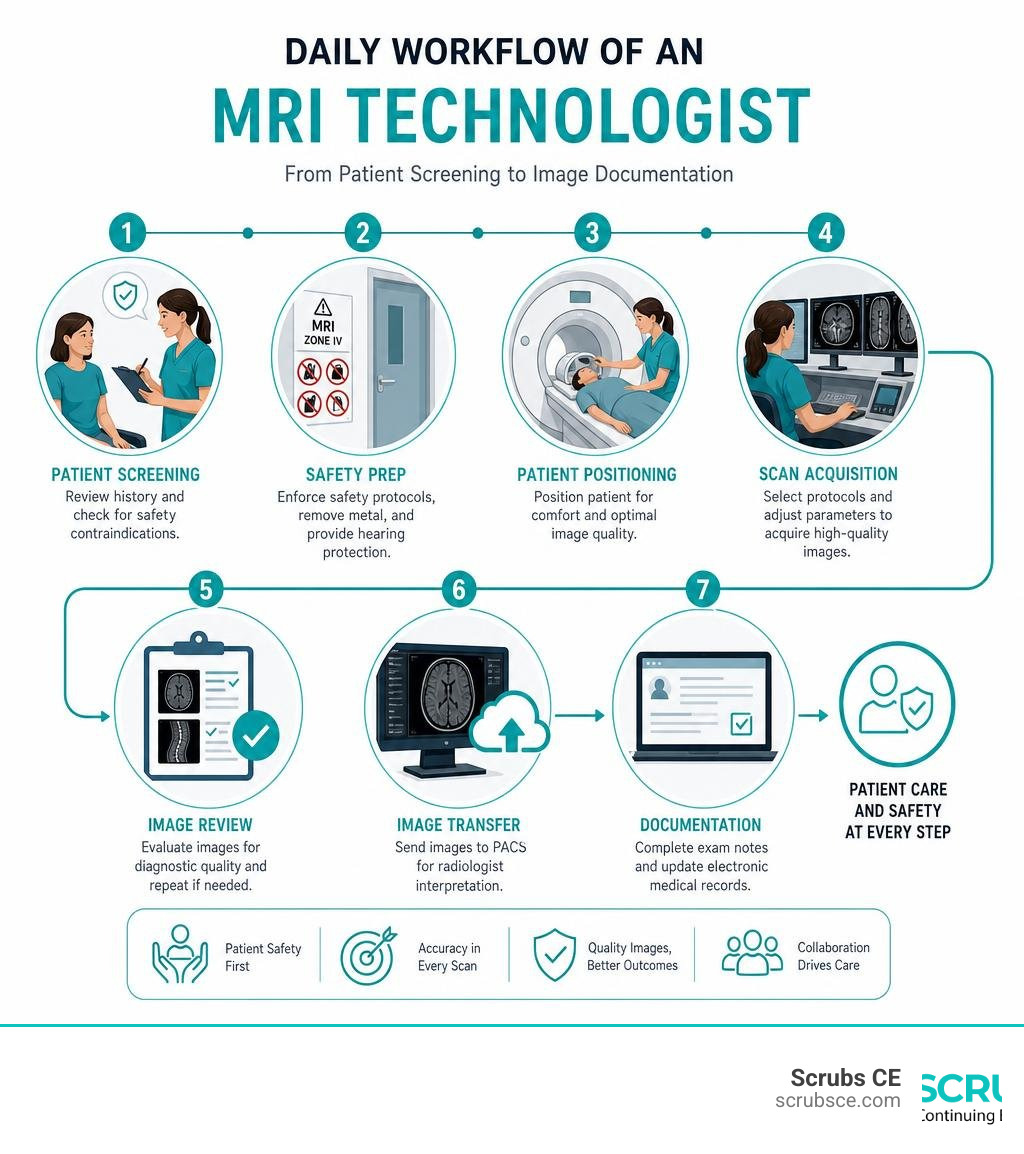
Mri tech job duties word guide:
Primary MRI Tech Job Duties and Daily Workflow
The daily routine of an MRI technologist is a highly structured, sequence of clinical and technical operations. No two days are identical, but every single patient encounter requires a meticulous, step-by-step workflow to ensure diagnostic accuracy and patient comfort.
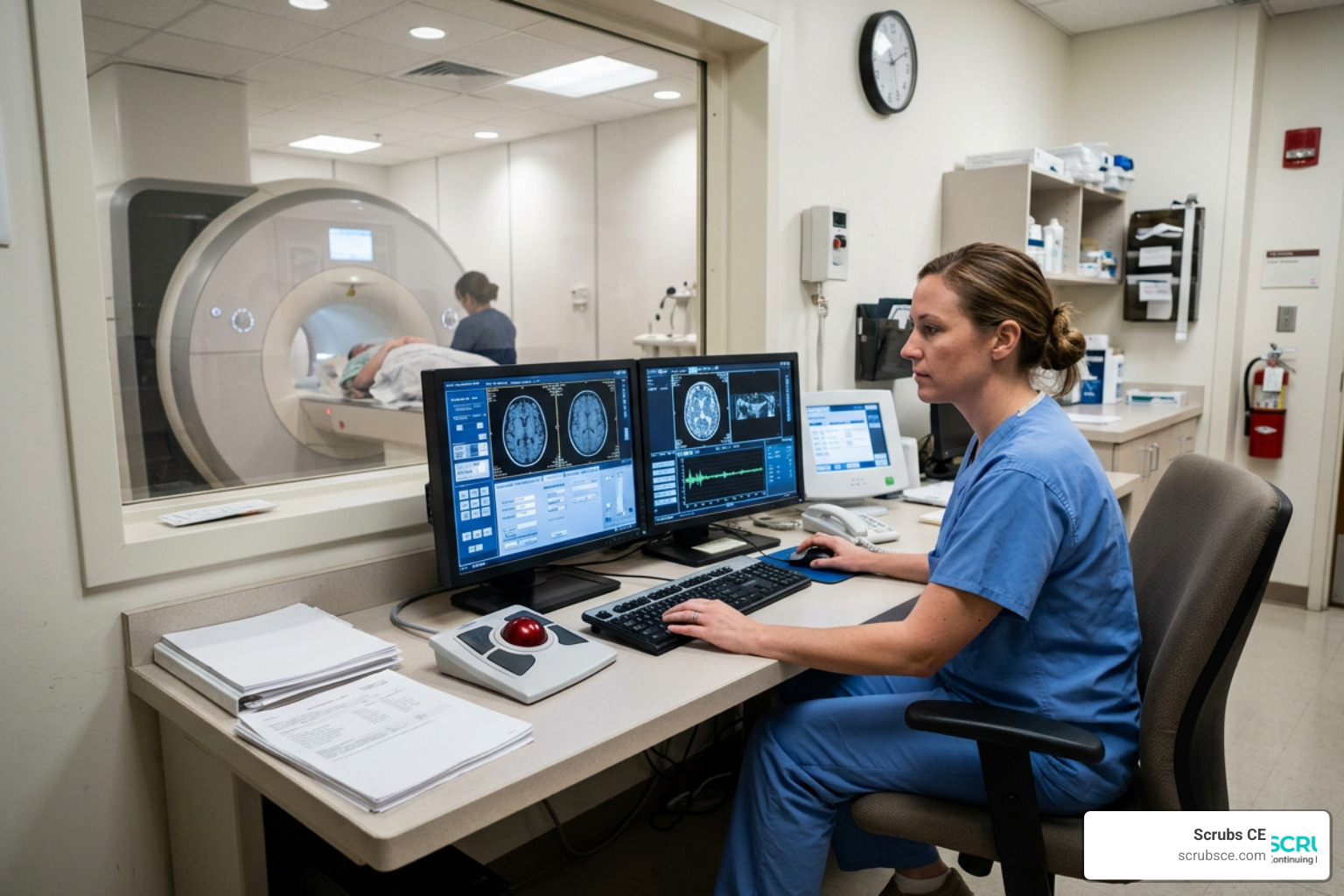
The workflow begins long before the patient lies down on the scanner table. Here is how a typical daily routine unfolds:
- Reviewing Physician Orders: The technologist’s first responsibility is to carefully evaluate the incoming physician orders. This step ensures that the requested exam matches the patient’s clinical history and symptoms. Any discrepancy requires immediate clarification with the ordering physician or the reading radiologist.
- Reviewing Patient Medical History: Understanding the patient’s background is essential. Technologists review electronic medical records (EMR) to identify pre-existing conditions, past surgeries, and potential contraindications.
- Selecting and Verifying Protocols: Based on the clinical indication, the technologist selects the appropriate scanning protocol (such as a specific sequence set for a brain scan for Multiple Sclerosis, or a dynamic abdominal sequence).
- Preparing the Patient: This involves explaining the procedure in plain, reassuring language, answering questions, and helping the patient change into MR-safe scrubs or gowns.
- Patient Positioning and Coil Selection: Proper positioning is critical for both patient comfort and image quality. The technologist must select the correct receiver coil (e.g., head, knee, shoulder, or torso coil) and position it precisely over the target anatomy. They utilize cushions, pads, and immobilization devices to help the patient remain completely still throughout the scan.
- Operating the Scanner and Evaluating Quality: Once the scan begins, the technologist monitors the acquisition from the control console, evaluating each sequence in real time to check for patient motion, artifacts, and diagnostic completeness.
To learn more about the complete clinical scope of this role, check out our What Does an MRI Tech Do? Guide. For a deeper dive into standard occupational tasks as defined by federal databases, you can also review the 29-2035.00 – Magnetic Resonance Imaging Technologists profile on O*NET OnLine.
Patient Safety, Comfort, and Magnetic Field Screening Protocols
Operating a high-field-strength magnet (typically 1.5 Tesla or 3.0 Tesla) is a massive responsibility. Because the MRI magnet is always on, safety is the absolute highest priority within the Radiology department. The screening process is where safety actually happens, and the technologist serves as the primary gatekeeper.
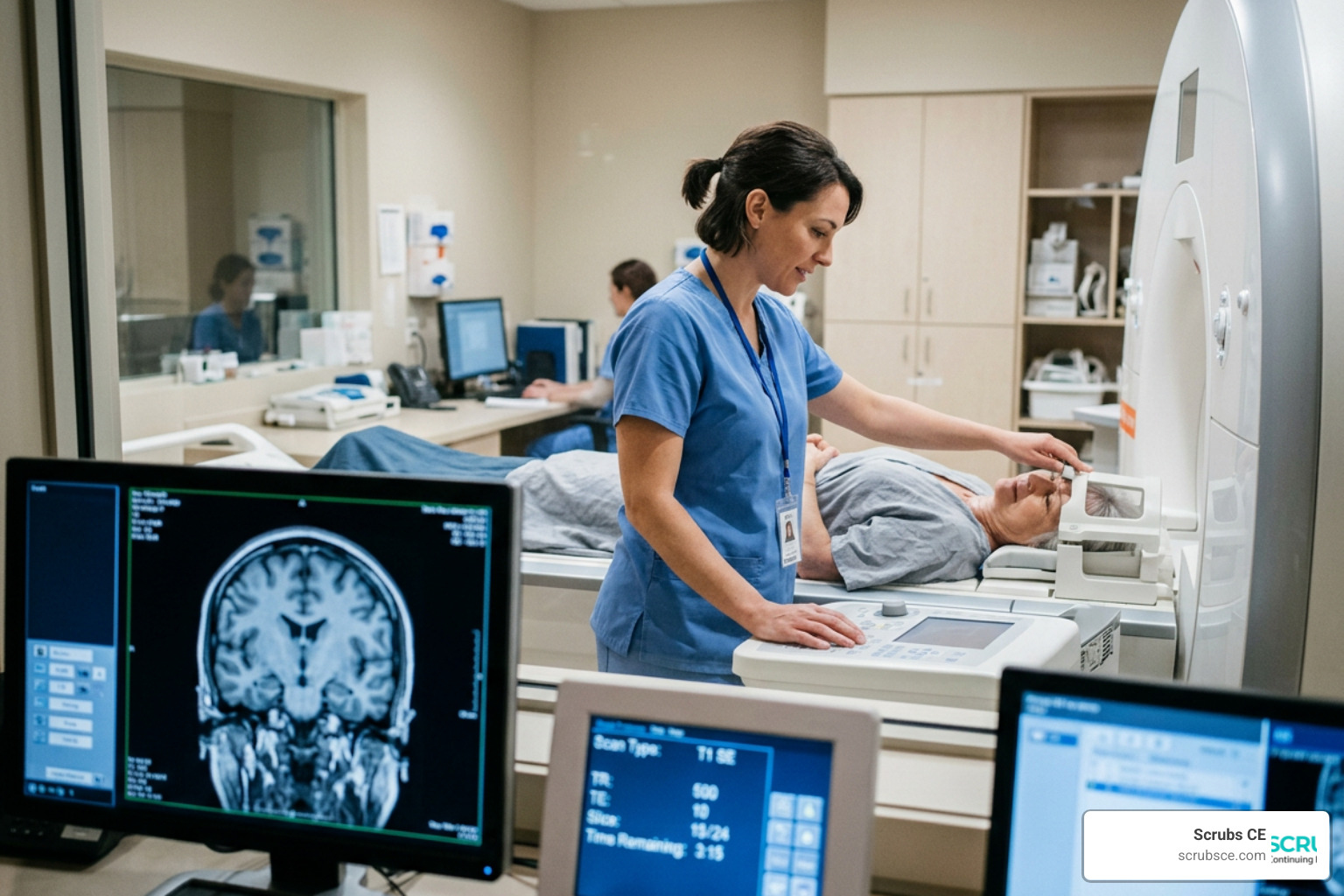
Strict Screening Protocols
Every patient, family member, and healthcare worker must undergo a rigorous screening process before entering the magnet room (designated as Zone IV). The technologist must conduct detailed screening interviews to identify:
- Ferrous (magnetic) implants, shrapnel, or foreign bodies.
- Cardiac pacemakers, implantable cardioverter-defibrillators (ICDs), and neurostimulators.
- Cochlear implants or prosthetic heart valves.
- Metallic tattoos or permanent makeup, which can contain iron oxide pigments and present a thermal burn risk.
- Pregnancy status.
If an implant is present, the technologist must research the exact make and model of the device to determine if it is MR-Safe, MR-Conditional (requiring specific scanner settings), or MR-Unsafe.
Managing Patient Comfort and Anxiety
An MRI scanner can be an intimidating environment. The bore is narrow, and the gradient coils produce loud knocking and buzzing noises that can easily exceed 100 decibels. Technologists must manage patient psychological comfort by:
- Providing appropriate hearing protection (earplugs or specialized MR-safe headphones with music).
- Addressing claustrophobia through clear communication, breathing exercises, and constant reassurance via the intercom system.
- Offering panic buttons so patients can signal for immediate assistance if they feel overwhelmed.
To master these critical safety principles and protect your patients from RF-induced heating and the projectile “missile effect,” consider studying the Essentials of MRI Safety Book Test Mailed to earn valuable continuing education credits.
Technical Skills, Equipment Operation, and Administrative Tasks
An MRI technologist is both a compassionate caregiver and a highly skilled technical specialist. Operating a computerized MRI console requires a solid foundation in imaging physics, cross-sectional anatomy, and clinical pathology.
Equipment Operation and Parameter Manipulation
Modern MRI scanners are highly customizable. Technologists do not simply push buttons; they actively manipulate scan parameters to optimize image quality. Key adjustments include:
- TR (Repetition Time) and TE (Echo Time): Controlling these timing parameters determines the contrast of the image (e.g., T1-weighted, T2-weighted, or Proton Density).
- FOV (Field of View) and Slice Thickness: Adjusting these parameters balances spatial resolution against the signal-to-noise ratio (SNR) and total scan time.
- Coil Selection: Choosing and placing the right surface or volume coils to maximize signal reception from the specific body part being imaged.
Contrast Media Administration
Many MRI exams require the use of intravenous contrast agents, such as gadolinium-based contrast media, to highlight vascular structures, tumors, or inflammation. Technologists are responsible for:
- Screening patients for renal function (reviewing eGFR and creatinine levels) to prevent complications like Nephrogenic Systemic Fibrosis (NSF).
- Establishing intravenous (IV) access.
- Loading and programming power injectors to deliver contrast at precise flow rates and volumes.
- Monitoring the patient closely during and after the injection for any signs of an adverse allergic reaction.

Administrative and Quality Control Responsibilities
Beyond direct clinical care, technologists must manage a variety of administrative and technical maintenance tasks to keep the department running smoothly:
- Quality Control (QC): Performing daily and weekly phantom scans to test scanner calibration, center frequency, and signal-to-noise ratio, logging the results to comply with regulatory standards.
- Information Systems: Entering patient data, tracking procedure codes, and managing billing charges in Radiology Information Systems (RIS), electronic medical records (EMR), and legacy platforms like AS400.
- PACS Management: Verifying, post-processing, and transferring completed diagnostic images to the Picture Archiving and Communication System (PACS) for radiologist review.
Specialized Clinical Roles and Advanced Career Paths
As the medical imaging field evolves in 2026, many MRI technologists choose to specialize in distinct clinical niches. These advanced pathways offer unique professional rewards, higher compensation, and a break from routine outpatient scanning.
| Clinical Pathway | Primary Focus | Key Specialized Duties |
|---|---|---|
| Pediatric MRI | Imaging infants, children, and adolescents | Advanced pediatric communication, specialized immobilization, coordination with pediatric anesthesia teams |
| Interventional MRI | Real-time imaging guidance during minimally invasive procedures | Maintaining a sterile field within the MRI suite, assisting with real-time biopsy guidance, monitoring patient vitals |
| Magnetic Resonance Safety Officer (MRSO) | Safety leadership, risk management, and compliance | Managing access control to Zones III and IV, developing safety policies, training non-MRI staff, evaluating implant safety |
Specialized MRI Tech Job Duties in Pediatrics and Interventional Imaging
In Pediatric MRI, the technologist’s primary challenge is securing patient cooperation without movement. This requires exceptional communication skills, child-friendly explanations, and sometimes coordinating with anesthesia or sedation teams for younger patients. Special immobilization devices and specialized pediatric coils are frequently utilized.
In Interventional MRI, technologists work directly alongside interventional radiologists. They assist with minimally invasive procedures, such as MR-guided biopsies, tumor ablations, or localized drug deliveries. The technologist must maintain a sterile field inside the magnet room, manage MR-compatible surgical tools, and execute rapid, real-time imaging sequences to guide the physician’s needle or probe.
Career Advancement and MRI Tech Job Duties as an MRSO
For experienced technologists, becoming a Magnetic Resonance Safety Officer (MRSO) represents a major career milestone. The MRSO acts as the clinical safety supervisor for the entire imaging facility.
Key responsibilities of an MRSO include:
- Designing and enforcing access control barriers between Zone III (the control room) and Zone IV (the scanner room).
- Serving as the ultimate authority on whether complex, conditional implants can be safely scanned.
- Educating and training nurses, anesthesiologists, environmental services staff, and emergency responders on magnetic field safety.
- Developing emergency evacuation and magnet quench protocols.
Education, ARRT® Certification, and Physical Demands
Becoming an MRI technologist requires structured academic training, rigorous clinical experience, and professional credentialing.
Educational Pathways and Credentialing
The standard pathway to entering the profession includes:
- Academic Degree: Completing an associate or bachelor’s degree program in radiologic technology or a dedicated MRI program.
- Clinical Experience: Completing extensive clinical rotations. Under the updated guidelines established by the AMERICAN REGISTRY OF RADIOLOGIC TECHNOLOGISTS® (ARRT®), candidates must document a minimum of 21 different procedures with at least 125 total repetitions. Crucially, the ARRT® strictly prohibits the use of remote scanning to fulfill these clinical requirements; physical, in-person presence in the scan room is mandatory.
- Certification and Licensure: Passing the registry examination to earn the R.T.(MR)(ARRT®) credential. While state licensing laws vary, most employers and hospital networks require active ARRT® certification as a condition of employment.
To explore these educational pathways and strategies for long-term clinical success, read our guide on The Ultimate Guide to Becoming an MRI Tech and Attracting Success. Detailed national employment data and educational standards can also be referenced in the Radiologic and MRI Technologists : Occupational Outlook Handbook: : U.S. Bureau of Labor Statistics.
Physical Demands of the Role
While MRI is a high-tech specialty, it is also a physically demanding job. Technologists must possess the physical stamina to handle a variety of taxing activities throughout an 8- to 12-hour shift:
- Heavy Lifting: Positioning and transferring patients who are injured, elderly, or non-ambulatory. The job description typically requires the ability to perform heavy lifting of up to 100 pounds maximum, with frequent lifting or carrying of objects weighing up to 50 pounds.
- Prolonged Standing: Technologists spend the majority of their workdays on their feet, walking between the control console and the magnet room. Investing in high-quality, supportive footwear is a must!
- Ergonomic Strain: Reaching over the wide bores of modern scanners to position coils and secure patients can place repetitive strain on the back, neck, and shoulders if proper body mechanics are not used.
Frequently Asked Questions about MRI Technologist Responsibilities
What are the most critical day-to-day responsibilities of an MRI technologist?
The most critical day-to-day responsibilities are patient safety screening, proper positioning, and real-time image quality evaluation. Because the magnetic field is always active, conducting a rigorous safety screening to exclude ferromagnetic objects is paramount to preventing catastrophic accidents. Additionally, technologists must manipulate scanner parameters to ensure the images produced are of high diagnostic quality for the reading radiologist.
Do MRI technologists administer contrast dye?
Yes. Administering gadolinium-based contrast agents intravenously is a standard duty for many MRI technologists. This involves reviewing the patient’s renal function (eGFR), establishing IV access, programming automated power injectors, and monitoring the patient for any signs of an adverse allergic reaction.
What are the physical demands of working in an MRI department?
The role requires significant physical stamina. Technologists spend most of their shifts standing and walking. They must also be capable of heavy lifting (up to 100 pounds maximum) to safely transfer and position patients, as well as lift heavy receiver coils and accessories.
Conclusion
The role of an MRI technologist is a dynamic, highly rewarding blend of advanced physics, clinical expertise, and direct patient care. From conducting life-saving safety screenings to manipulating complex scan parameters and comforting anxious patients, these professionals are vital to the modern healthcare team.
As technology advances through 2026 and beyond — with larger scanner bores, artificial intelligence integration, and complex interventional procedures — staying updated on the latest protocols and safety standards is essential.
Whether you are looking to renew your state license, maintain your ARRT® registration, or expand your clinical knowledge, we are here to support your professional development. Explore our convenient, self-paced, and affordable online courses at the CE for MRI Technologists portal on SCRUBS CE® to meet your continuing education requirements and take the next step in your imaging career.