

What Does an MRI Tech Do? Here’s the Short Answer
What does an MRI tech do is one of the most common questions from people exploring healthcare careers — and for good reason. It’s a role that blends advanced technology with hands-on patient care.
Here’s a quick overview:
| Core Responsibility | What It Involves |
|---|---|
| Operate MRI scanners | Use magnetic fields and radio waves to create detailed images of internal organs and tissues |
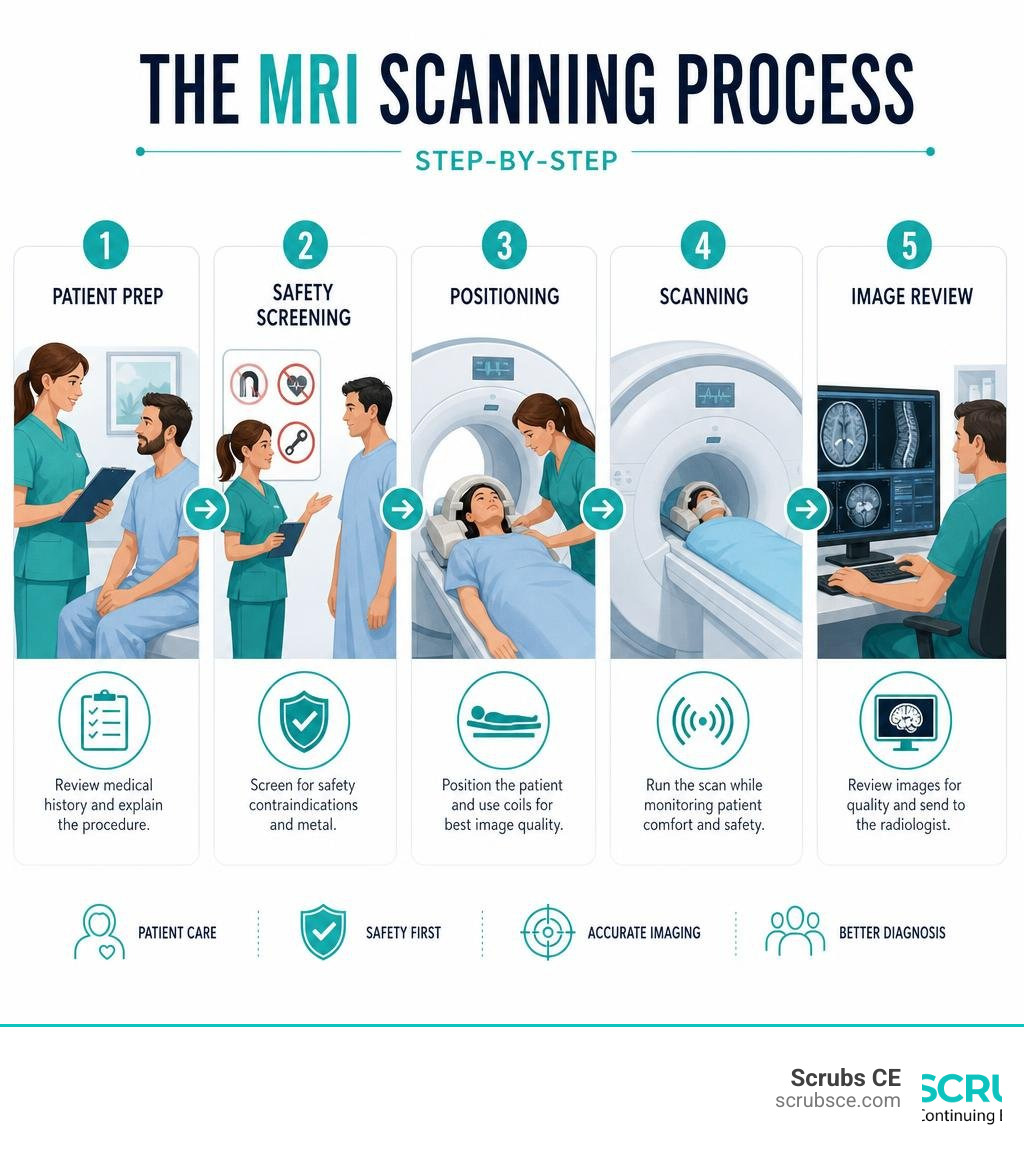
| Prepare patients | Review medical history, explain the procedure, and screen for safety contraindications |
| Position patients | Place patients correctly based on the body part being imaged |
| Administer contrast agents | Inject IV gadolinium when ordered to enhance image clarity |
| Monitor safety and comfort | Watch for patient distress and manage noise, anxiety, and claustrophobia |
| Inspect image quality | Review scans in real time and repeat sequences if needed |
| Document and collaborate | Record findings and work with radiologists and physicians to support diagnosis |
MRI technologists are essential members of the diagnostic healthcare team. Their work helps detect conditions ranging from brain tumors and spinal injuries to Alzheimer’s disease — often before symptoms become severe. According to the U.S. Bureau of Labor Statistics, the median annual wage for MRI technologists was $88,180 in May 2024, with employment projected to grow 5% through 2034.
I’m Zita Ewert, and as the leader of SCRUBS Continuing Education®, I’ve spent years helping imaging professionals — including MRI techs — understand what does an MRI tech do at every stage of their career, from initial certification through advanced CE requirements. This guide pulls together everything you need to know, whether you’re entering the field or maintaining your credentials.
What Does an MRI Tech Do? Roles and Daily Responsibilities
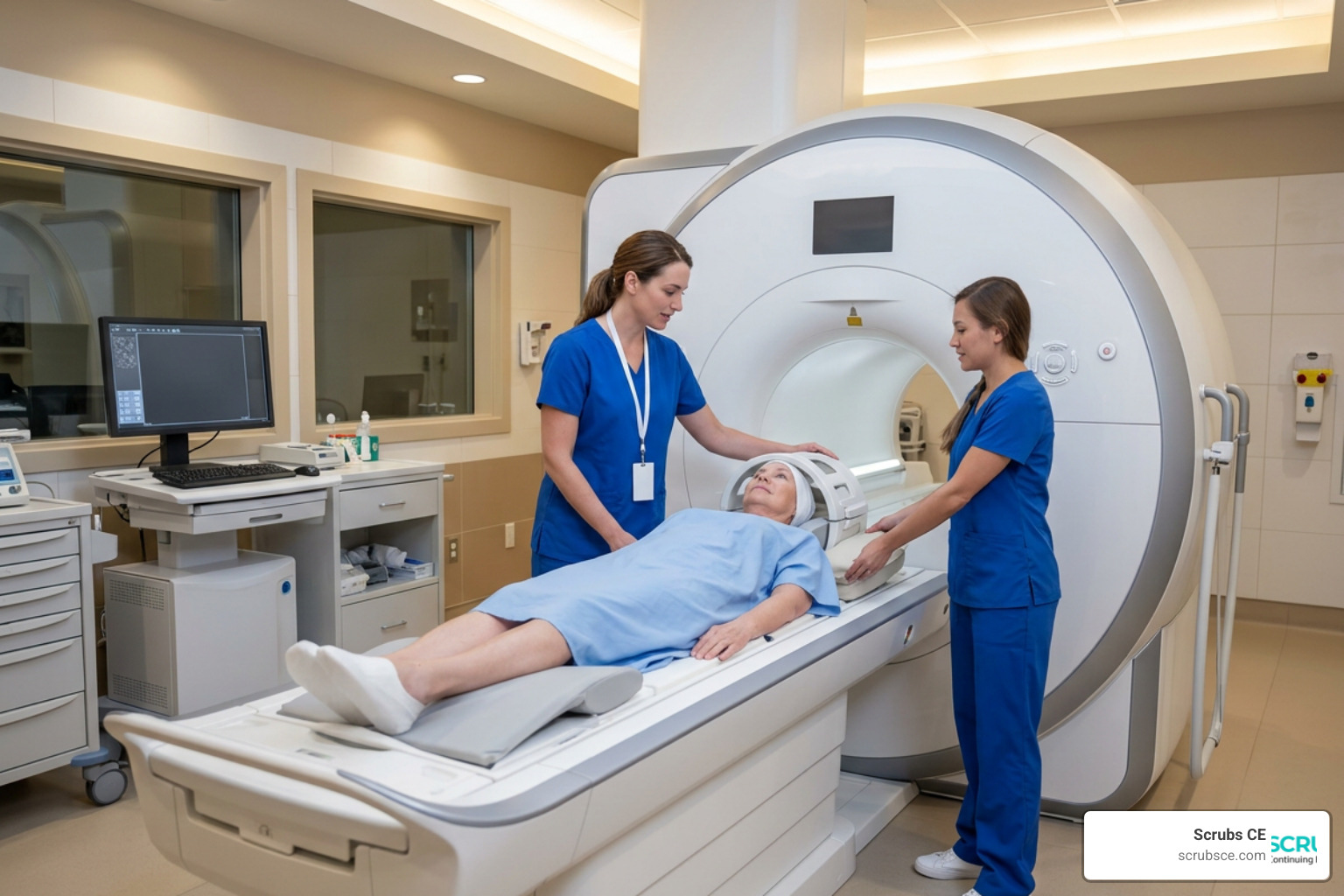
At its core, the role of a Magnetic Resonance Imaging (MRI) technologist is to capture high-resolution, cross-sectional images of the human body. Unlike traditional X-rays or CT scans, which rely on ionizing radiation, MRI technology utilizes powerful magnetic fields and radiofrequency waves to excite hydrogen atoms in the body’s tissues.
As these atoms return to their normal state, they emit signals that the scanner’s computer translates into exceptionally detailed 3D visuals. To explore the highly standardized task lists and formal occupational parameters of this career, you can review the detailed O*NET OnLine MRI Technologists Profile.
The daily responsibilities of an MRI tech extend far beyond simply pressing a button on a computer console. Technologists must possess a deep, practical understanding of human anatomy and pathology. They need to know exactly how a healthy brain, spine, knee, or liver should look on screen so they can recognize abnormalities in real time.
If a patient moves or an image appears blurry, the technologist must immediately troubleshoot the issue, adjusting scanner parameters or repeating sequences to ensure the final images are of diagnostic quality for the reading radiologist.
A Day in the Life: What Does an MRI Tech Do on a Typical Shift?
A typical shift for an MRI technologist is , highly structured, and deeply collaborative. While the exact workflow can vary depending on whether you work in a bustling trauma hospital or a quiet outpatient imaging center, most days follow a similar rhythm:
- Morning Quality Control (QC): Before the first patient arrives, the technologist must calibrate the MRI equipment. This involves running daily “phantom scans” (scanning a standardized object filled with water and organic compounds) to verify the scanner’s magnetic field homogeneity, signal-to-noise ratio, and spatial resolution.
- Reviewing Physician Orders: Every scan must match a precise medical order. Technologists review these orders to determine the correct protocol (e.g., a brain scan with or without contrast, or a specific musculoskeletal joint protocol).
- Safety Screening and Medical History: This is perhaps the most critical step of the day. The technologist conducts a thorough screening interview with each patient, documenting medical history, checking for internal metallic implants, and assessing kidney function if contrast is required.
- Patient Positioning and Coil Placement: The tech guides the patient into the scanner room and helps them lie down on the table. They place specialized receiver coils (which act as antennae to collect the radio signals) over the specific anatomical area being imaged, such as the head, shoulder, or pelvis.
- Running the Scan: From the operator’s console outside the magnet room, the technologist programs the computer and initiates the imaging sequences. They monitor the progress closely, watching the images construct in real time on their monitors.
- Contrast Media Administration: If the protocol calls for contrast, the tech will start an intravenous (IV) line and administer a gadolinium-based contrast agent, often using a synchronized power injector to time the contrast flow perfectly with the scan sequences.
- Image Quality Inspection and Documentation: Once the scan is complete, the tech inspects the images for clarity, archives them to the PACS (Picture Archiving and Communication System), and documents the procedural notes for the radiologist.
As technology evolves, the daily workflow continues to shift. To see how recent innovations like artificial intelligence and wider scanner bores are changing the day-to-day experience of technologists, check out our insights on the MRI Tech in 2025: Bigger Bores and Better Brains.
Patient Safety and Comfort: What Does an MRI Tech Do to Ensure a Smooth Scan?
Because MRI scanners use incredibly strong magnets (typically 1.5 Tesla to 3.0 Tesla or higher), safety is the absolute highest priority. The magnetic field is always on, even when the machine is not actively scanning.
Technologists are the gatekeepers of the MRI suite, which is divided into strict safety zones. Zone IV is the actual magnet room, and the tech must ensure that no ferromagnetic materials (such as oxygen tanks, hairpins, keys, or certain jewelry) ever enter this space. If a heavy metal object gets too close, the “missile effect” can occur, pulling the object toward the scanner with lethal force.
Beyond physical safety, technologists must actively manage patient comfort and anxiety. MRI machines are notoriously loud; the rapid switching of gradient coils creates knocking and buzzing noises that can exceed 100 decibels. Technologists mitigate this by providing patients with earplugs or specialized, MRI-safe headphones playing music.
Claustrophobia is another major hurdle. Sliding into a narrow, brightly lit tube for 30 to 60 minutes can be incredibly stressful for many patients. A great MRI tech uses excellent communication and empathy to ease these fears. They explain exactly what the patient will hear and feel, maintain constant voice contact via an intercom system, and provide a “squeeze bulb” panic button that the patient can press to immediately stop the scan if they feel overwhelmed. Technologists also monitor the patient’s vital signs and physical comfort throughout the entire procedure.
How to Become an MRI Technologist: Education, Training, and Certification
Becoming an MRI technologist is a highly rewarding career path that requires a deliberate blend of academic study, clinical practice, and professional credentialing. If you are trying to map out your journey into this field, you can find a comprehensive roadmap in The Ultimate Guide to Becoming an MRI Tech and Attracting Success.
Educational Pathways and Clinical Training
There are two primary educational pathways to enter this profession:
- The Radiography-First Path (Post-Primary): Many technologists begin by earning an associate or bachelor’s degree in radiologic technology. After completing their program and passing their primary radiography registry, they gain clinical experience and complete specialized, post-primary MRI training to cross-train into magnetic resonance imaging.
- The Direct MRI Path (Primary): Alternatively, students can enroll directly in an Associate of Applied Science or Bachelor of Science program in MRI technology. These direct programs combine general education requirements with dedicated MRI physics, anatomy, and clinical coursework.
Regardless of the pathway, clinical rotations are a cornerstone of your education. Students typically spend hundreds of hours (often around 400 hours) in hospital and clinic settings under direct supervision. During these rotations, you will learn the practical application of MRI physics—such as how Repetition Time (TR) and Echo Time (TE) parameters affect T1 and T2 image contrast—and how to recognize and correct common image artifacts.
For those looking to dive deeper into these foundational concepts, we recommend exploring MRI Training 101: Learn MRI Basics as well as our detailed breakdown of MRI Training Requirements. To see an example of a highly structured, hospital-based training curriculum, you can also review the Mayo Clinic MRI Career Overview.
ARRT® and ARMRIT Certification Requirements
To practice legally and secure employment in most healthcare facilities, technologists must obtain professional certification. The two primary credentialing bodies in the United States are:
- The AMERICAN REGISTRY OF RADIOLOGIC TECHNOLOGISTS® (ARRT®): This is the most widely recognized credentialing organization. To earn the ARRT® (MR) credential, candidates must meet strict educational requirements, document a specific set of clinical competencies, and pass a comprehensive registry examination covering patient care, safety, physical principles, and sequence parameters.
- The American Registry of Magnetic Resonance Imaging Technologists (ARMRIT®): This registry specializes exclusively in MRI technology and is an excellent pathway for those who have graduated from ARMRIT®-approved MRI programs.
Once certified, the learning doesn’t stop. To maintain active registration and ensure they remain at the forefront of patient safety and imaging technology, technologists must complete mandatory continuing education (CE) credits. For example, the ARRT® requires 24 CE credits every two years.
At Scrubs CE, we specialize in providing convenient, self-paced, and affordable MRI CE Courses designed to help you easily meet these requirements and advance your career.
MRI Technologist vs. Radiologic Technologist: Key Differences
While both roles operate within the broader field of Radiology, it is common for patients and prospective students to confuse MRI technologists with radiologic technologists (often called X-ray techs). Understanding the operational and technological differences is key to choosing the right career path.
| Feature | Radiologic Technologist (R.T.) | MRI Technologist (R.T.(MR) or ARMRIT) |
|---|---|---|
| Primary Technology | Ionizing radiation (X-rays) | Strong magnetic fields and radiofrequency waves |
| Primary Exams | Bone fractures, chest X-rays, mammography, fluoroscopy | Soft tissue imaging, brain, spine, joints, cardiac, and abdominal organs |
| Image Dimension | Primarily 2D flat projection images | High-resolution 3D and multi-planar cross-sectional images |
| Radiation Risk | Requires lead shielding and active radiation monitoring | Zero ionizing radiation risk; high risk of magnetic attraction/thermal issues |
| Exam Duration | Very fast (usually 5 to 15 minutes) | Moderate to long (usually 30 to 90 minutes) |
| Contrast Media | Barium or iodinated contrast (oral or IV) | Gadolinium-based contrast agents (IV) |
The key difference lies in the underlying physics. Radiologic technologists use X-rays to capture structural images, which requires them to wear radiation monitoring badges and utilize lead shielding to minimize exposure. MRI technologists, on the other hand, manage the unique safety challenges of a powerful magnetic field.
Because MRI scans take much longer and require the patient to remain perfectly still inside a small space, MRI techs generally spend more individual, face-to-face time with each patient compared to X-ray techs. For a broader look at the medical imaging landscape, you can read the official BLS Occupational Outlook Handbook.
Job Outlook, Salary, and Work Environments for MRI Techs
The job market for MRI technologists is exceptionally strong. As the older population grows and the prevalence of chronic diseases rises, the demand for sophisticated, non-invasive diagnostic procedures continues to climb.
Salary and Job Growth Projections
According to the U.S. Bureau of Labor Statistics, the median annual wage for MRI technologists was $88,180 in May 2024. The lowest 10% of earners made less than $63,000, while highly experienced technologists or those working in specialized outpatient care centers earned upwards of $110,000 to $128,000 annually.
Overall employment in this sector is projected to grow faster than the average for all occupations over the next decade, resulting in thousands of new job openings each year.
Work Environments and Schedules
MRI technologists have the flexibility to work in a variety of healthcare settings:
- Hospitals (approx. 59% of jobs): Hospital-based technologists often work in environments, handling emergency room traumas, inpatient scans, and scheduled outpatient procedures. Because hospitals operate 24/7, these roles may require evening, overnight, weekend, or on-call shifts.
- Outpatient Imaging Centers: These facilities typically offer more predictable, daytime schedules. The patient volume is often high, but the cases are generally more routine (such as elective orthopedic or neurological scans).
- Specialty Clinics and Oncology Centers: Working in specialized environments, such as cancer care, allows technologists to focus on highly detailed, protocol-driven imaging. In these settings, techs may also assist with clinical trials and advanced research projects. To learn more about what this looks like in practice, explore the Moffitt Cancer Center Career Compass.
Frequently Asked Questions About MRI Technologists
How long does it take to become an MRI technologist?
The timeline depends on your chosen educational path. If you are already a registered radiologic technologist, you can often complete a specialized MRI certificate program in about 12 months. If you are starting from scratch, earning an associate degree in MRI technology typically takes 2 to 4 years, which includes your academic coursework and required clinical training hours.
What are the physical and emotional demands of being an MRI tech?
Physically, MRI technologists spend long periods on their feet, walking between the control console and the magnet room. They must also be able to physically assist, lift, and position patients who may have limited mobility.
Emotionally, the job requires a high degree of patience and empathy. You will frequently work with patients who are in pain, highly anxious, claustrophobic, or seriously ill. Managing these high-stress situations while maintaining a calm, reassuring demeanor can be emotionally demanding but deeply rewarding.
Can you become an MRI technologist without a prior degree?
No, you cannot become an ARRT® certified MRI technologist without an associate degree (or higher) from an accredited institution. The AMERICAN REGISTRY OF RADIOLOGIC TECHNOLOGISTS® (ARRT®) requires all candidates to hold at least an associate degree to sit for their registry exams. However, this degree does not necessarily have to be in radiologic science; you can complete an associate degree in another field and then complete an approved MRI educational program.
Conclusion
Understanding what does an MRI tech do reveals a dynamic, intellectually stimulating career that sits at the perfect intersection of advanced technology and compassionate patient care. From running morning quality control scans to comforting an anxious patient through a complex 3D brain scan, MRI technologists are vital to modern medicine.
At Scrubs CE, we are dedicated to supporting your professional development. We provide high-quality, self-paced online continuing education courses with instant certificates to help you meet your licensure requirements and advance your career with ease.
Whether you are looking to expand your clinical knowledge with the industry-standard MRI in Practice 5th Ed. course or need to complete your biennial registry credits, explore our complete catalog of Scrubs CE MRI CE Courses today to keep your career moving forward!