
What You Need to Know Before Taking the MRI Tech Test

The MRI tech test is the certification exam you must pass to work as a licensed Magnetic Resonance Imaging technologist in the United States. Here is a quick overview of what to expect:
The two main MRI certification exams:
| Exam | Administered By | Total Questions | Results |
|---|---|---|---|
| ARRT® MRI Registry | AMERICAN REGISTRY OF RADIOLOGIC TECHNOLOGISTS® via Pearson VUE | 230 (200 scored + 30 pilot) | Provided after testing |
| ARMRIT MRI Exam | American Registry of Magnetic Resonance Imaging Technologists via PSI | Computer-based | Immediate |
The four content areas on the ARRT® MRI exam:
- Image Production – 106 questions (53% of the exam)
- Procedures – 57 questions (28.5%)
- Safety – 21 questions (10.5%)
- Patient Care – 16 questions (8%)
Passing this exam is a major career milestone, but it can feel overwhelming. The physics alone — from the Larmor equation to K-space — is dense. Add in safety protocols, clinical procedures, and state licensing rules, and it is a lot to keep straight.
The good news? The exam has a clear blueprint. When you know exactly what is tested and how many questions each section carries, studying becomes much more focused and manageable.
This guide walks you through everything: the two certification pathways, exam content, safety topics, clinical requirements, and how to maintain your credentials after you pass.
I’m Zita Ewert, and I lead Scrubs Continuing Education, where I have spent years helping imaging professionals navigate the MRI tech test and the continuing education requirements that follow. My team and I work directly with the ARRT® and ARMRIT frameworks every day to make sure our courses keep you certified and practice-ready.
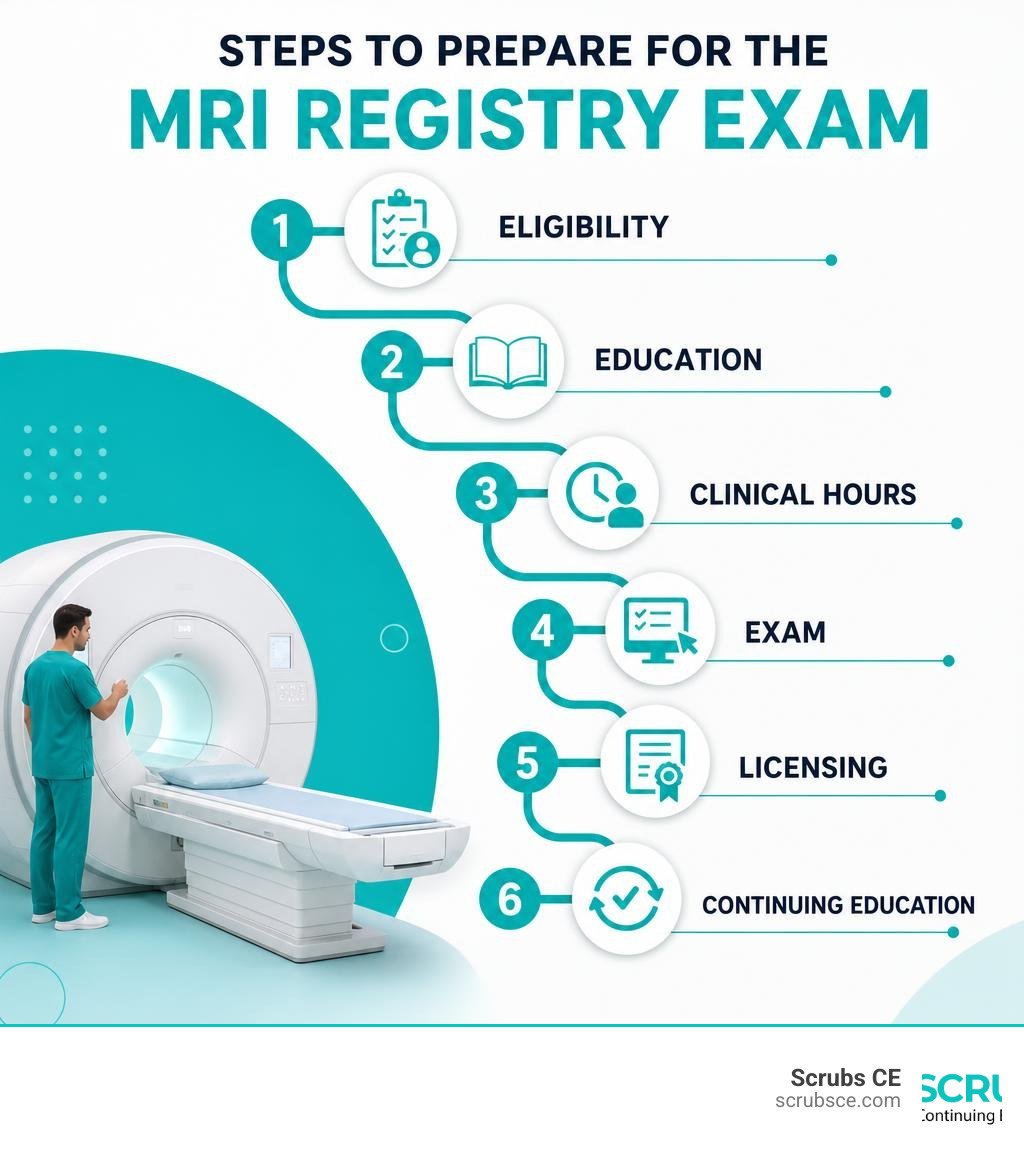
Navigating the ARRT® and ARMRIT MRI Tech Test Pathways

When you decide to pursue a career in magnetic resonance imaging, the first fork in the road is choosing your credentialing body. In the United States, two primary organizations certify MRI technologists: the AMERICAN REGISTRY OF RADIOLOGIC TECHNOLOGISTS® (ARRT®) and the American Registry of Magnetic Resonance Imaging Technologists (ARMRIT).
While both credentials are widely respected, they represent fundamentally different philosophies of medical imaging. The ARRT® views MRI as an advanced specialty that sits within the broader umbrella of Radiology. ARMRIT, on the other hand, was established on the premise that MRI is a highly specialized field utilizing non-ionizing radiation, and therefore should be treated as a distinct specialty entirely separate from traditional Radiology modalities like X-ray.
Choosing between them dictates your educational requirements, clinical training hours, and how you will prepare for your mri tech test. Understanding what each pathway requires will help you determine the best fit for your clinical background and career goals. If you are curious about the day-to-day responsibilities of this profession, you can read more in our What Does an MRI Tech Do Guide.
To help visualize how these two pathways compare, review this structural comparison:
Primary vs. Postprimary Eligibility for ARRT® Certification
For those pursuing certification through the ARRT®, there are two main entry points: the primary eligibility pathway and the postprimary eligibility pathway.
- The Primary Pathway: This is designed for students who are entering the medical imaging field for the first time. Candidates must complete an ARRT®-approved associate degree (or higher) program specifically in MRI. This pathway integrates both the academic coursework and the hands-on clinical requirements into a cohesive, multi-year curriculum.
- The Postprimary Pathway: This is the most common route for established imaging professionals. If you already hold supporting ARRT® credentials in radiography, nuclear medicine technology, radiation therapy, or sonography, you can cross-train into MRI.
The postprimary pathway is also open to professionals holding credentials from other recognized registries. For example, certified sonographers registered through the American Registry for Diagnostic Medical Sonography (ARDMS) or nuclear medicine technologists certified by the Nuclear Medicine Technology Certification Board (NMTCB) can transition into MRI. These candidates can request online account access through the ARRT® portal to begin tracking their requirements.
Regardless of your supporting credential, the postprimary pathway requires you to complete 16 hours of structured education and document extensive clinical experience. To learn more about building this foundational knowledge, check out our guide on MRI Training 101 Learn MRI Basics. You can also view the official Magnetic Resonance Imaging Clinical Competency Requirements clinical competency standards to see exactly what clinical tasks you must perform.
ARMRIT Direct Entry and Cross-Training Requirements
For individuals who do not wish to study traditional ionizing radiation modalities like X-ray, ARMRIT offers a direct entry pathway. Because MRI uses magnetic fields and radiofrequency pulses rather than harmful radiation, ARMRIT argues that requiring students to learn radiography is an unnecessary barrier to entry.
To qualify for the ARMRIT mri tech test, candidates must meet one of the following eligibility criteria:
- Approved Program Graduates: Graduation from an ARMRIT-approved MRI program that includes a minimum of 1,000 hours of clinical MRI experience.
- Cross-Trained Allied Health Professionals: Candidates with an active license or registry in an allied health field (such as nursing, physical therapy, or ultrasound) who have documented at least 1,000 hours of clinical MRI experience under the supervision of a board-certified physician.
- On-the-Job Training (OJT): Historically, up to 90% of MRI technologists were trained on the job. ARMRIT accommodates this through an equivalency clause requiring four years of full-time clinical MRI experience (equivalent to approximately 8,000 hours of hands-on scanning) and a high school diploma or equivalent.
If you are planning to apply for the ARMRIT exam, you can download the official application guidelines directly from the ARMRIT Application Guidelines document to verify your eligibility.
State-Specific Licensing and Career Outlook
Once you pass your mri tech test, you must navigate state-specific licensing laws. While national certification through the ARRT® or ARMRIT is universally demanded by employers, some states require a separate state-level license to practice.
The regulatory landscape varies significantly by state:
- No State License Required: The majority of states do not require a specific state license for MRI technologists, meaning your national ARRT® or ARMRIT certification is sufficient to gain employment.
- Strict State Licensing: States like California (regulated by the California Department of Public Health – CDPH), Texas (regulated by the Texas Medical Board), and New Jersey have rigorous licensing boards. You must submit your national credentials to receive a state license before you can legally operate an MRI scanner.
- Expanding Recognition: States like Washington have recently updated their regulations to explicitly include ARMRIT certification as a valid pathway for state licensure, matching the long-standing acceptance of ARRT® credentials.
The career outlook for MRI technologists is exceptionally strong. According to the Bureau of Labor Statistics, the national median salary for MRI technologists is $88,180 per year, with job demand projected to grow at 6% annually. High-paying states like California and Massachusetts frequently offer salaries exceeding $100,000, making this a highly lucrative specialty. For those looking to maximize their earning potential, traveling contracts offer a fantastic opportunity. Discover how to break into this market with The Ultimate Guide to High-Paying Travel MRI Tech Jobs.
Exam Blueprints: What is Covered on the Registry Exams?
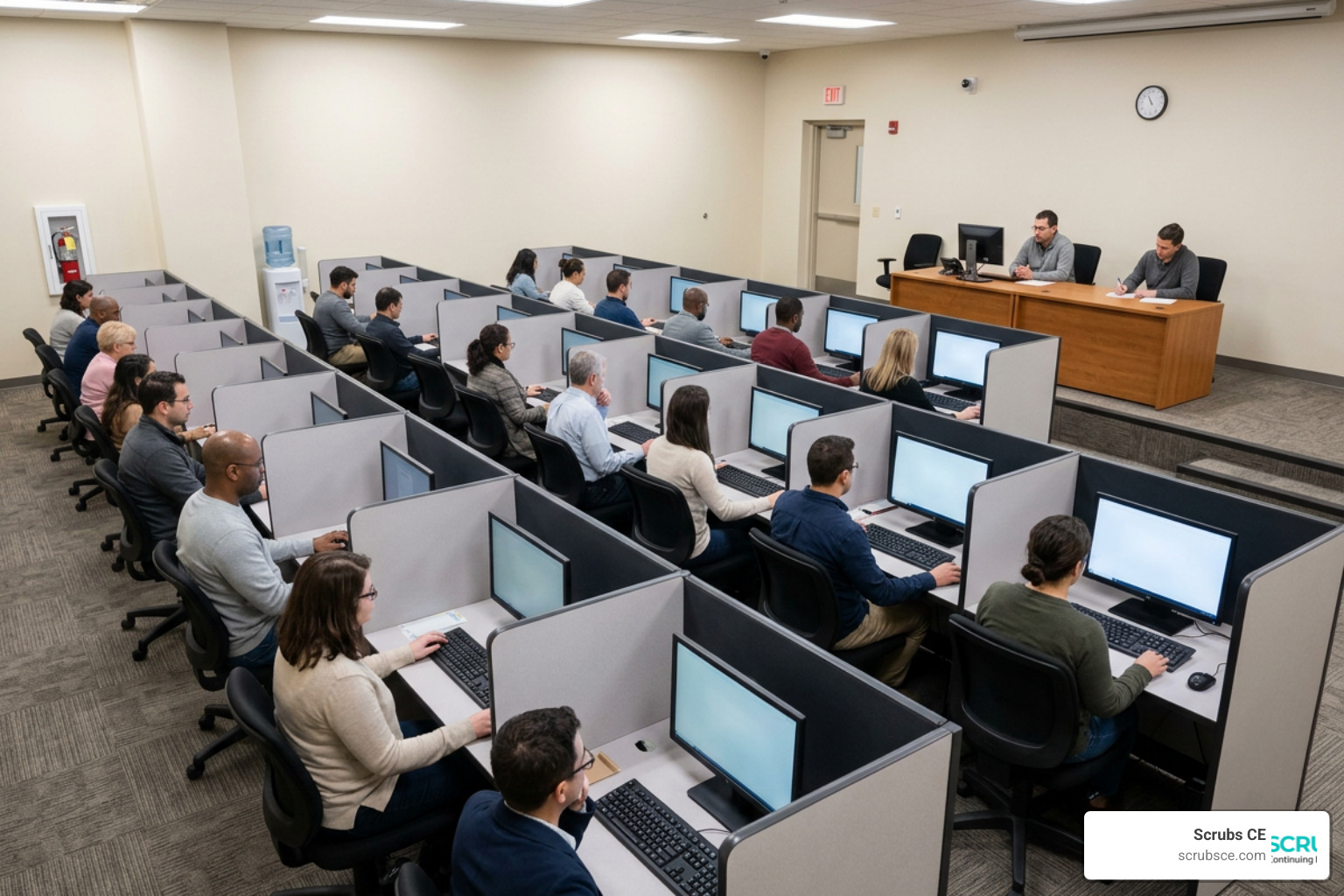
To successfully pass your mri tech test, you must study according to the exam blueprints. Both the ARRT® and ARMRIT exams are highly technical, but they distribute their questions differently. Knowing the exact weight of each section allows you to study smarter, prioritizing high-yield topics over minor details.
Core Content Categories of the ARRT® MRI Tech Test
The ARRT® MRI exam is administered via computer-based testing at Pearson VUE centers. Effective for exams taken after February 1, 2025, the test features exactly 200 scored questions and an additional 30 unscored pilot questions, bringing the total length of the exam to 230 questions. You will have a total of four hours to complete the test.
The scored questions are strictly divided across four content categories:
- Image Production (106 questions – 53% of the exam): This is the largest and most challenging section. It covers the physical principles of image formation, pulse sequences (such as spin echo, gradient echo, and inversion recovery), data acquisition, K-space mapping, image artifacts, and quality control.
- Procedures (57 questions – 28.5% of the exam): This section tests your knowledge of clinical scanning protocols, patient positioning, and cross-sectional anatomy across three regions: Neurological (head, neck, spine), Body (thorax, abdomen, pelvis), and Musculoskeletal.
- Safety (21 questions – 10.5% of the exam): This category focuses on patient screening, managing electromagnetic fields (static, RF, and gradient), and responding to emergencies.
- Patient Care (16 questions – 8% of the exam): This covers basic patient interactions, communication, monitoring, contrast media pharmacology (including checking eGFR and creatinine values to prevent Nephrogenic Systemic Fibrosis), and infection control.
To review the complete, official breakdown of these categories, you can download the Magnetic Resonance Imaging Content Specifications syllabus. If you need structured help mastering these complex physics topics, explore our Online MRI Courses designed to simplify difficult concepts.
What to Expect on the ARMRIT MRI Tech Test
The ARMRIT certification exam is administered via computer-based testing through PSI testing centers, which offer over 1,000 locations globally, as well as remote proctoring options using ExamSoft software.
The ARMRIT exam focuses heavily on treating MRI as a specialized field. The test blueprint covers:
- MRI Physics & Instrumentation: The mechanics of the scanner, gradient coils, RF coils, and the physical behavior of hydrogen protons in a magnetic field.
- Clinical Applications: Choosing the correct pulse sequences and parameters (such as TR, TE, and Flip Angle) to optimize image contrast.
- Bio-Effects and Safety: Managing the biological effects of strong magnetic fields, preventing RF burns, and establishing rigorous screening protocols.
- Cross-Sectional Anatomy: Identifying complex anatomical structures in the axial, sagittal, and coronal planes.
You can download the official candidate handbook and review the full exam outline in the ARMRIT Candidate Handbook document.
High-Yield Safety Concepts and Clinical Competencies
Safety is the single most critical aspect of operating an MRI scanner. Unlike X-ray or CT machines, which only emit radiation when the exposure button is pressed, an MRI scanner’s static magnetic field is always on. This creates a continuous, invisible force that requires constant vigilance.
Crucial MRI Safety Protocols: Ferrous Objects, RF Burns, and Cryogens
When preparing for your mri tech test, you must master three major safety hazards:
1. Ferromagnetic Projectile Hazards
Any object containing iron, nickel, or cobalt can become a high-velocity projectile when brought near the scanner. Severe injuries and fatalities have occurred when oxygen tanks, wheelchairs, or cleaning equipment were pulled into the magnet bore. To manage this risk, facilities are divided into four distinct MR Safety Zones:
- Zone I: Fully accessible to the general public (e.g., the main entrance or waiting room).
- Zone II: The transition zone where patients are greeted and screened under supervision.
- Zone III: The restricted access control room. Only screened patients and MR-personnel are allowed.
- Zone IV: The magnet room itself. Absolutely no unscreened objects or personnel may enter.
Every device or implant must be classified according to FDA labeling guidelines:
| Safety Label | Description | Symbol |
|---|---|---|
| MR Safe | The item poses no hazards in any MR environment (usually non-metallic, plastic, or glass). | Green square |
| MR Conditional | The item can safely enter the scanner room only under highly specific conditions (e.g., field strength, gradient limits). | Yellow triangle |
| MR Unsafe | The item is known to pose hazards in all MR environments (e.g., ferrous oxygen tanks, pacemaker models not cleared for MRI). | Red circle with a diagonal slash |
For more details on managing safety as an assistant or technologist, refer to the Imaging Assistant, Magnetic Resonance Content Specifications document.
2. Radiofrequency (RF) Burns
The radiofrequency pulses used during a scan can cause tissue heating. If a patient’s skin touches the bore of the magnet, or if their hands are clasped creating a closed conductive loop, they can experience severe RF burns. Technologists must use specialized foam pads to insulate the patient and prevent direct skin-to-skin contact. Modern scanners feature larger bores to help reduce claustrophobia and minimize the risk of patients touching the sides. Read more about these safety advancements in MRI Tech in 2025 Bigger Bores and Better Brains.
3. Cryogen Safety and Quench Emergencies
Superconducting MRI magnets use liquid helium (cryogens) cooled to near absolute zero (-452°F) to maintain their magnetic field. A quench is the rapid boil-off of this liquid helium, which causes the scanner to lose its superconductivity and magnetic field.
A quench should only be initiated manually in a life-threatening emergency (e.g., a person is pinned to the magnet by a heavy iron object and is suffocating). If a quench occurs, the helium gas must vent safely outside. If the vent pipe fails, helium gas can fill the magnet room, displacing oxygen and creating an extreme asphyxiation and pressure hazard.
Meeting the 2025-2026 Clinical Competency Requirements
To qualify for the ARRT® mri tech test, candidates must complete a rigorous list of clinical competencies. The ARRT® updated these requirements, and candidates graduating during 2025 or 2026 have the option to use either the older 2020 standards or the new 2025 standards.
Under the 2025-2026 clinical guidelines, candidates must document:
- 7 Mandatory General Patient Care Procedures: Including CPR/Basic Life Support certification, patient transfer, and sterile/aseptic technique.
- 8 Mandatory MRI Safety Requirements: Including screening patients, checking implant safety, and understanding emergency shutdown procedures.
- 17 Mandatory MR Imaging Procedures: Hands-on scans performed on actual patients (e.g., brain, cervical spine, knee, abdomen).
- 11 Elective MR Imaging Procedures: Selected from a list of 30 specialized scans (e.g., MR angiography, temporomandibular joints, breast imaging). Up to 5 of these electives can be performed on healthy volunteers rather than clinical patients.
- 7 Mandatory Quality Control Procedures: Including center frequency, transmitter gain, and spatial resolution checks using a QC phantom.
The ARRT® allows specific tasks, such as venipuncture for contrast administration, to be simulated if an actual patient procedure is unavailable. For instance, the ARRT® officially approves practicing needle sticks on an artificial forearm or even a grapefruit to satisfy the sterile technique simulation requirement!
To view the complete list of mandatory clinical tasks, you can access the official Magnetic Resonance Imaging Clinical Competency Requirements clinical guidelines.
Frequently Asked Questions About the MRI Registry Exam
How many questions are on the ARRT® and ARMRIT exams?
The ARRT® MRI registry exam consists of 230 total questions (200 scored questions and 30 unscored pretest/pilot questions). Candidates are given exactly 4 hours of testing time. The ARMRIT exam is also a comprehensive computer-based test, administered nationally and internationally, focusing entirely on MRI physics, safety, and clinical procedures.
What is the passing score for the MRI registry?
For the ARRT® exam, the passing threshold is a scaled score of 75. This is not a simple percentage (e.g., answering 75% of questions correctly), but rather a scaled score that accounts for the varying difficulty of different exam versions. ARMRIT exams are administered via computer-based testing, and candidates receive their results immediately upon completing the test.
How do I maintain my MRI certification after passing?
Once you pass your mri tech test, the learning doesn’t stop! To maintain your active registry status, you must complete regular continuing education:
- ARRT® Requirements: Certified technologists must complete 24 Category A continuing education (CE) credits every two years (biennial renewal).
- ARMRIT Requirements: Certified technologists must complete 24 Continuing Medical Education (CME) credits specifically focused on MRI topics every three-year renewal period.
Fulfilling these requirements keeps your scanning skills sharp and ensures you remain compliant with state and national licensing boards. To find convenient, self-paced courses that satisfy both registries, check out our CE for MRI Technologists library.
Conclusion
Preparing for the mri tech test is a challenging but highly rewarding journey. Whether you choose the ARRT® or ARMRIT pathway, success comes down to understanding the exam blueprints, mastering high-yield safety concepts, and staying committed to your clinical training.
At Scrubs CE, we are dedicated to supporting your professional development at every stage of your career. We offer convenient, affordable, and self-paced online continuing education courses with instant certificates, helping you meet your licensure requirements and stay ahead in this fast-growing medical specialty.
Ready to launch your career and secure long-term clinical success? Explore The Ultimate Guide to Becoming an MRI Tech and Attracting Success to take your next big step today!