
Pass Your ARRT® CT Exam on the First Try Using Online Prep
How to Choose an Online CT Registry Review

Start with the ARRT® CT exam content specifications, then choose an online review that matches them. Look for focused lessons, cross-sectional anatomy images, practice questions with explanations, and timed exams that show where you need more work. Check the access period and price against your study schedule. If you also need CE credits, confirm which course option includes them before you buy.
Online prep can help you study around shifts, but it does not replace the clinical experience, structured education, and other requirements for ARRT® CT certification. This guide will help you compare review options and build a practical plan for exam day.
I’m Zita Ewert, the leader behind SCRUBS Continuing Education®, where I help imaging professionals find clear, affordable online learning. I bring that experience to this guide so you can compare CT Registry review online options without wasting time or money.
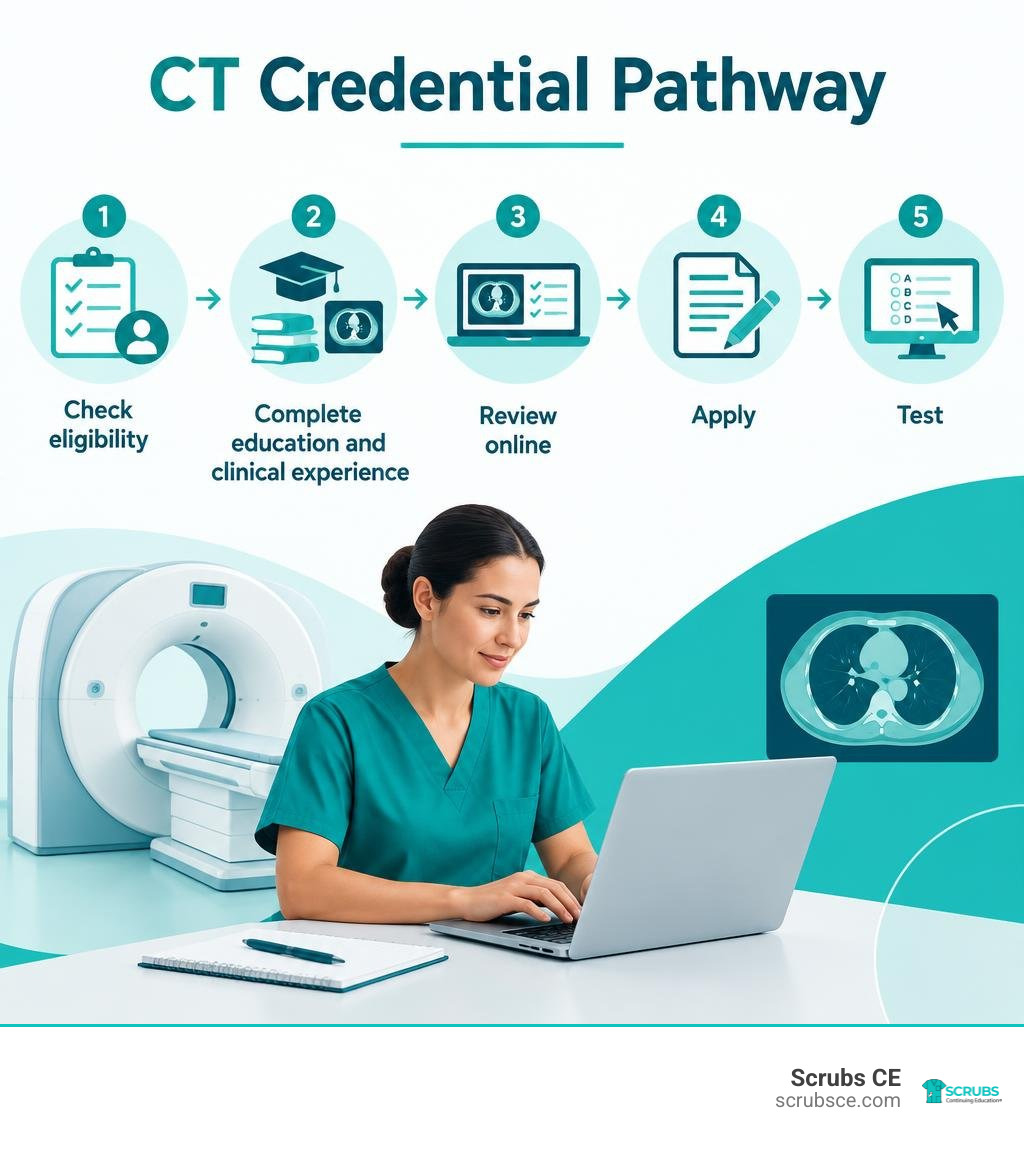
Must-know ct registry review online terms:
A strong online review also helps you build a realistic study schedule. Start by mapping your exam date backward, then assign each content area to a specific week. For example, spend the first week on patient care and safety, the second on image production and physics, and the third on cross-sectional anatomy and pathology. Use the final week for full-length timed exams and targeted review of your weakest areas. This approach keeps your preparation structured and reduces last-minute cramming. For additional context on credentialing pathways, the ARRT® postprimary computed tomography requirements outline the official eligibility and documentation steps.
ARRT® CT Certification Requirements and Exam Content
Earning your advanced credential through the AMERICAN REGISTRY OF RADIOLOGIC TECHNOLOGISTS® establishes professional mastery in advanced diagnostic imaging. The postprimary pathway is specifically designed for technologists seeking specialization beyond their initial qualifications.
To qualify for the postprimary credential in Computed Tomography, candidates must hold primary certification and registration with the ARRT® in Radiography, Nuclear Medicine Technology, or Radiation Therapy. In addition, candidates must maintain full compliance with the ARRT® Standards of Ethics throughout their professional careers. Navigating the road to ARRT® certification and what to expect requires balancing clinical shifts with didactic coursework.
Understanding the specific CT technologist requirements helps ensure every qualification is documented and submitted without delay.
Clinical Experience and Structured Education Requirements
The ARRT® postprimary pathway requires candidates to log both structured education and clinical experience. Technologists must complete at least 16 hours of structured education aligned with ARRT® exam content specifications.
Key requirements include:
- Structured Education: Minimum of 16 credit hours covering core content specifications, completed within the 24 months preceding application submission.
- Clinical Repetition: Documenting mandatory and elective clinical competencies across diverse procedural categories (e.g., head/neck, spine, chest, abdomen/pelvis, musculoskeletal, and vascular).
- Clinical Documentation Tool: Utilizing the ARRT® online clinical experience tool to record scan competencies verified by certified supervisors.
- ARRT® Task Inventory: Ensuring all logged procedural competencies correspond directly to tasks outlined in the official clinical experience documents.
For technologists starting their postprimary journey, reviewing a beginner’s guide to computed tomography technician certification provides clear direction for logging scans and satisfying didactic requirements.
ARRT® CT Exam Content Specifications
The examination evaluates your knowledge across fundamental imaging domains. Every question is structured to verify technical competence, safety compliance, and patient care management in busy Radiology suites.
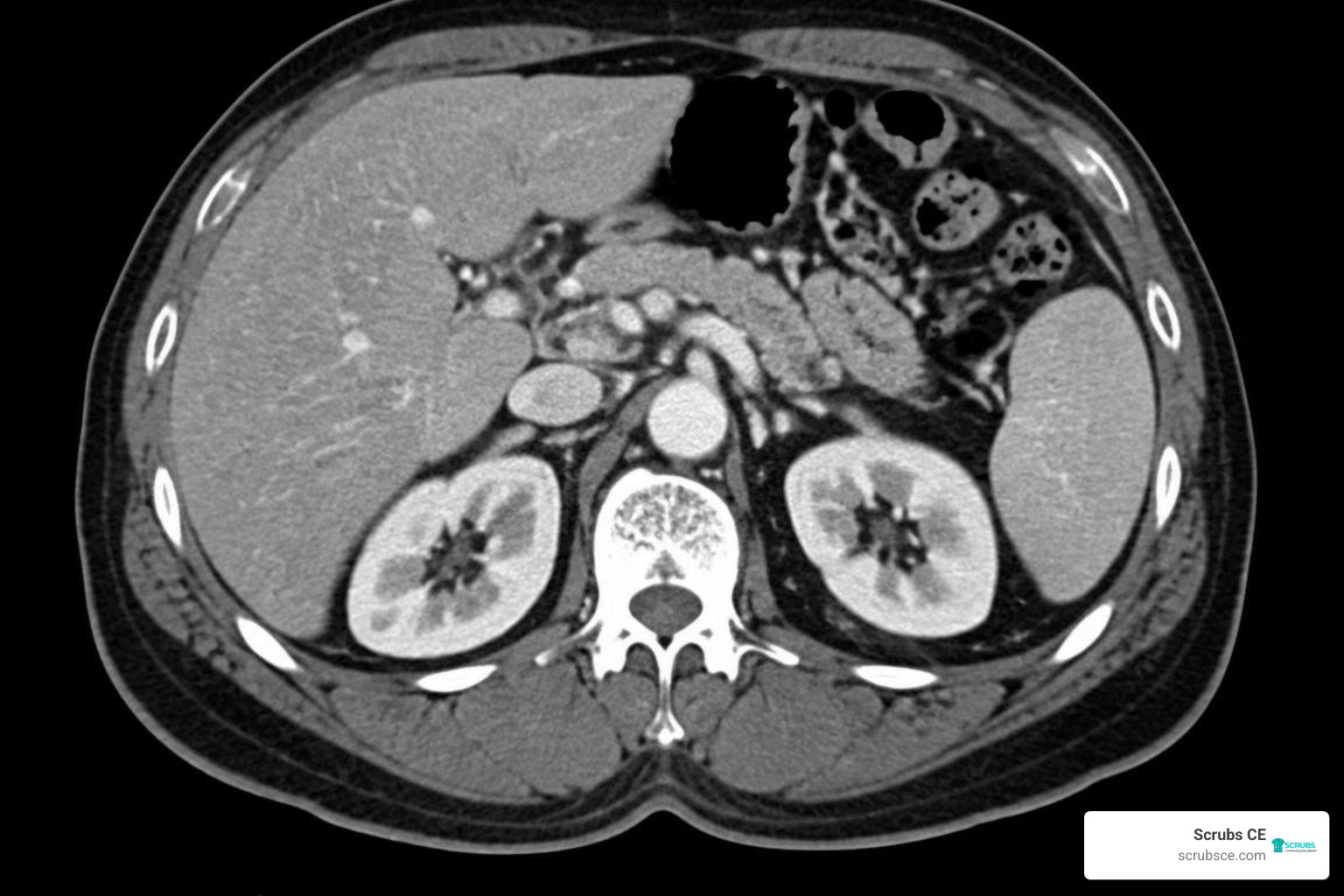
The exam content is divided into five core sections:
- Patient Care: Patient assessment, vital signs, contrast administration, venipuncture techniques, and emergency response.
- CT Procedures: Protocol selection, positioning, scan parameters, cross-sectional anatomy, and clinical indications.
- CT Image Production: Image processing, beam geometry, reconstruction algorithms, spatial resolution, and artifact reduction.
- CT Pathology: Identifying acute pathology, abnormal vascular findings, and trauma on cross-sectional images.
- CT Radiation Dose & Safety: Dose metrics (CTDIvol, DLP, SSDE), optimization protocols, and shielding practices.
To organize your study materials across these domains, explore everything radiologic techs need for a successful ARRT® registry review.
Essential Features of a High-Yield CT Registry Review Online Course
Choosing an online preparation program requires evaluating its instructional tools, question bank quality, and realistic exam simulation capabilities. A high-yield study platform should balance theoretical concepts with realistic test simulations.

A comprehensive online prep platform should provide:
- 140+ Focused Review Topics: Comprehensive modules breaking down complex physics, dose calculations, and scan parameters into clear lessons.
- 800 Practice Questions: A comprehensive question bank matching the difficulty, verbiage, and clinical scenarios seen on the national registry.
- 5 Full-Length Mock Exams: Timed and untimed practice testing configurations that simulate authentic testing interfaces.
- Detailed Answer Rationales: In-depth explanations clarifying why correct answers are right and why distractors are incorrect.
- Post-Exam Performance Analytics: Detailed diagnostics highlighting knowledge gaps across specific subcategories.
Visual Learning Tools and Cross-Sectional Anatomy
Cross-sectional anatomy is central to the CT exam. Quality test prep platforms feature 60+ cross-sectional anatomy images illustrating axial, sagittal, and coronal planes.
Reviewing visual materials enhances spatial orientation across multi-planar reconstructions (MPR) and maximum intensity projections (MIP). Candidates must quickly identify anatomy, recognize acute pathology, and distinguish image artifacts from real clinical findings.
Timed Exam Simulations and Knowledge Tracking
Pacing is essential during standardized testing. Practicing under timed conditions develops test-taking endurance and helps manage the time allotted per question.
Diagnostic tracking tools highlight weak areas, showing whether you need to spend extra time studying image production physics or contrast administration timing.
Comparing Study Options and Pricing for CT Exam Preparation
Technologists require flexible study plans that fit unpredictable clinical shifts. Review options range from short-term refreshers to full unlimited subscriptions.
| Review Plan Option | Access Duration | Practice Resources | CE Credit Inclusions | Ideal Candidate |
|---|---|---|---|---|
| Unlimited Course Access | Permanent / Unlimited | 800 Questions, 5 Exams, 140+ Topics | 6.25 ARRT® Category A Credits | Technologists preparing for first-attempt success |
| Monthly Subscription | 30-Day Auto-Renew | 800 Questions, 5 Exams, 140+ Topics | Access during active cycle | Technologists on a defined, accelerated schedule |
| 14-Day CQR Refresher | 14 Days Access | 800 Questions, 5 Exams, Mobile App | Core review content | Certified techs completing Continuing Qualifications Requirements |
Educators and clinical imaging directors can also access dedicated institutional portals to support student cohorts and track progress across clinical rotations. For ongoing learning and maintenance requirements, technologists can explore our computed tomography CE complete guide.
Choosing the Right Subscription Plan for CT Registry Review Online
Selecting a study plan comes down to your personal timeline and exam date:
- Unlimited Access ($65 one-time): Provides long-term access, comprehensive review modules, full question banks, and integrated CE credits.
- One-Month Access ($35/month): Designed for technologists on an intensive 30-day study plan before testing.
- 14-Day CQR Refresher ($20): Ideal for certified professionals completing Continuing Qualifications Requirements (CQR).
Many platforms also allow you to build custom modular courses if you only need practice with specific topics like radiation dose optimization or physics.
Earning Category A CE Credits Through CT Registry Review Online Study
Balancing exam preparation with license renewal requirements helps maximize your study time. High-yield review options bundle 6.25 ARRT® Category A CE credits with unlimited access.
To earn these credits, technologists must achieve a post-examination score of 80% or higher. Integrating these credits allows you to earn necessary CT CEU credits while studying for your board exam. Discover the best CE for CT technologists to keep your state licenses and credentials fully compliant.
Frequently Asked Questions About ARRT® CT Exam Preparation
What is the passing score for the ARRT® CT exam?
The ARRT® uses a scaled scoring system ranging from 1 to 99, with a scaled score of 75 required to pass. A scaled score of 75 reflects overall performance across all tested categories, rather than a raw percentage of 75%.
How much time is needed to prepare for the CT registry exam?
Most radiologic technologists prepare over a period of 4 to 8 weeks. Dedicating 1 to 2 hours daily to reviewing 20 to 30 practice questions and targeted study modules builds confidence and helps you retain challenging physics concepts.
Can I earn CE credits while studying for my CT registry exam?
Yes. Select online review programs award 6.25 ARRT® Category A CE credits when you complete the review curriculum and achieve a score of 80% or higher on the post-course assessment.
Conclusion
Passing your postprimary CT registry exam on the first attempt comes down to structured prep and consistent practice. Combining high-yield practice questions, cross-sectional anatomy modules, and timed mock exams helps turn complex physics and protocol details into second nature on test day.
At Scrubs CE, we provide self-paced, accessible educational tools to help imaging professionals advance their careers with confidence. Explore our comprehensive computed tomography certification resources to start preparing today.