
Everything Nurses Need to Know About IV Therapy CE Requirements
Understanding State and National Standards for IV Therapy CE
Navigating continuing education rules can feel overwhelming because individual Nurse Practice Acts vary significantly by jurisdiction. When selecting an educational track, nurses must distinguish between two primary pathways: state-mandated training and national post-licensure certification.
State nursing boards define exactly what clinical actions fall within an individual’s scope of practice. For instance, the Florida Board of Nursing establishes clear guidelines for post-licensure intravenous education, requiring extensive curriculum hours before a Licensed Practical Nurse (LPN) can initiate peripheral lines or administer specific medications. Other states have established their own regulatory frameworks that mandate board-approved coursework before performing venipunctures or handling central venous lines.
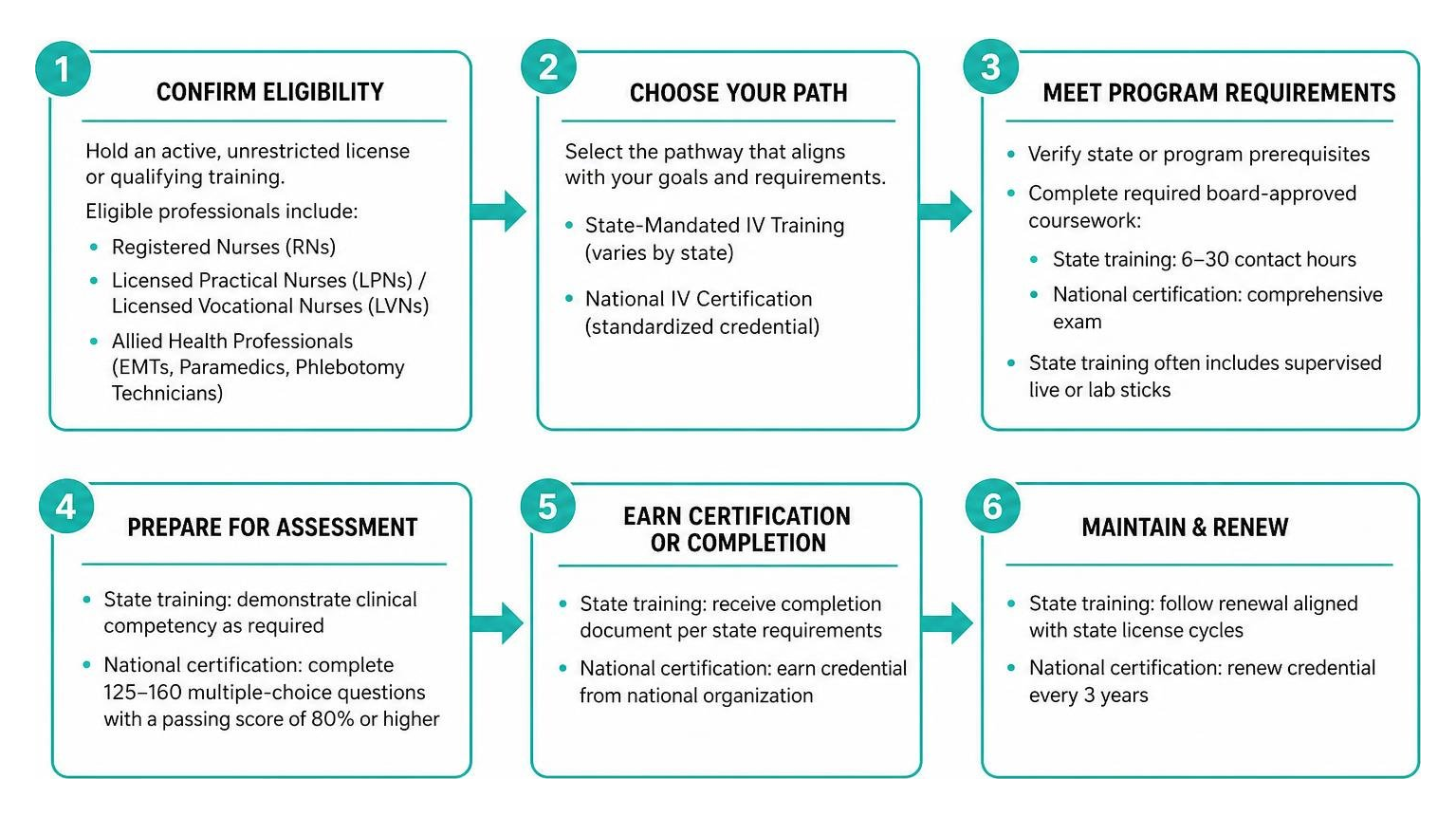
National credentials offer an alternative or complementary credentialing pathway. Standardized national credentials, such as those established for practical and vocational nurses, demonstrate advanced competency across jurisdictions. These national exams provide standardized benchmarks of knowledge, often requiring candidates to complete between 125 and 160 multiple-choice questions with a passing threshold of 80% or higher.
| Feature | State-Mandated IV Training | National IV Certification |
|---|---|---|
| Primary Authority | State Boards of Nursing (e.g., Florida) | National Credentialing Organizations |
| Scope of Recognition | Enforced specifically within the state | Recognized across multiple states and employers |
| Typical Course Length | 6 to 30 contact hours | Comprehensive exam based on standard curriculum |
| Clinical Practice | Often requires supervised live or lab sticks | Focuses on standardized cognitive testing |
| Renewal Period | Aligned with state license cycles | Typically renewed every 3 years |
Who Is Eligible for IV Therapy Certification?
Eligibility depends entirely on the program level and the underlying healthcare license. Most IV education programs require active, unrestricted licensure as a prerequisite.
Eligible professionals generally include:
- Registered Nurses (RNs): RNs frequently enroll to refresh peripheral insertion skills, master difficult vascular access, or learn specialized protocols for central venous access devices (CVADs).
- Licensed Practical Nurses (LPNs) and Licensed Vocational Nurses (LVNs): For practical nurses, completion of approved training often unlocks an expanded scope of practice, permitting peripheral line placement and antibiotic administration under RN supervision.
- Allied Health Professionals: Depending on individual state practice acts, emergency medical technicians (EMTs), paramedics, and phlebotomy technicians may enroll in targeted courses to develop or sharpen their cannulation skills.
Before starting any program, participants must present proof of active professional licensure or formal medical training.
Core Clinical Curriculum and Skill Competencies
A comprehensive IV curriculum bridges theoretical pathophysiology with hands-on technical execution. Because venipuncture leaves zero room for error, programs focus heavily on patient safety, fluid balance, and aseptic discipline.
Core didactic and practical subjects include:
- Vascular Anatomy and Site Selection: Identifying suitable veins in the upper extremities (such as the cephalic, basilic, and median cubital veins) while avoiding areas of flexion, compromised tissue, or lymph node dissections.
- Catheter Sizing and Equipment Selection: Choosing appropriate catheter gauges (from 14-gauge for rapid trauma resuscitation to 22- or 24-gauge for fragile pediatric or geriatric veins) and assembling primary and secondary infusion sets.
- Aseptic Technique and Venipuncture Execution: Mastering standard precautions, skin antisepsis (such as chlorhexidine gluconate application), precise needle insertion angles (10 to 30 degrees), advancing the catheter over the needle, and smooth stylet retraction.
- Infusion Calculations and Flow Control: Calculating gravity drip rates in drops per minute (drops/min) by multiplying the total volume in milliliters by the drop factor of the tubing, then dividing by the total infusion time in minutes. Modern instruction also emphasizes programming volumetric infusion pumps and microbore smart pumps.
- Central Venous Access Management: Best practices for caring for Peripherally Inserted Central Catheters (PICCs), tunneled lines, and implanted ports, including sterile dressing changes, needleless connector scrub protocols, and heparin/saline flushes.
Managing Clinical Complications in an IV Therapy CE Course
A critical element of advanced training is recognizing and immediately mitigating vascular access complications. Educational programs train clinicians to spot signs of tissue injury before lasting harm occurs:
- Infiltration: When non-vesicant solutions leak into surrounding subcutaneous tissue, causing localized swelling, pallor, and coolness. Nurses learn systematic staging tools to guide line removal, limb elevation, and thermal compress applications.
- Extravasation: The inadvertent administration of a vesicant drug (such as dopamine or specific antineoplastics) into peri-vascular space. Courses teach emergency stopping procedures, aspiration techniques, and specific antidote administration.
- Phlebitis: Inflammation of the vein wall marked by redness, warmth, pain, and a palpable cord along the vein path. Training emphasizes using the Infusion Nurses Society (INS) Phlebitis Scale to identify early symptoms.
- Infection Control: Adhering to Centers for Disease Control and Prevention (CDC) guidelines regarding skin prep, dressing integrity, and timely removal of compromised peripheral access to prevent catheter-related bloodstream infections (CRBSBs).
- Air Embolism and Fluid Overload: Spotting systemic emergencies, executing immediate interventions (such as placing a patient in Trendelenburg position on their left side if an air embolism is suspected), and monitoring vital signs for cardiac and pulmonary stress.
Essential Hands-On Skills and Hours Required
While didactic lessons cover essential theory, clinical confidence requires practical repetition. Most hybrid programs divide their curriculum between independent study and hands-on simulation labs.
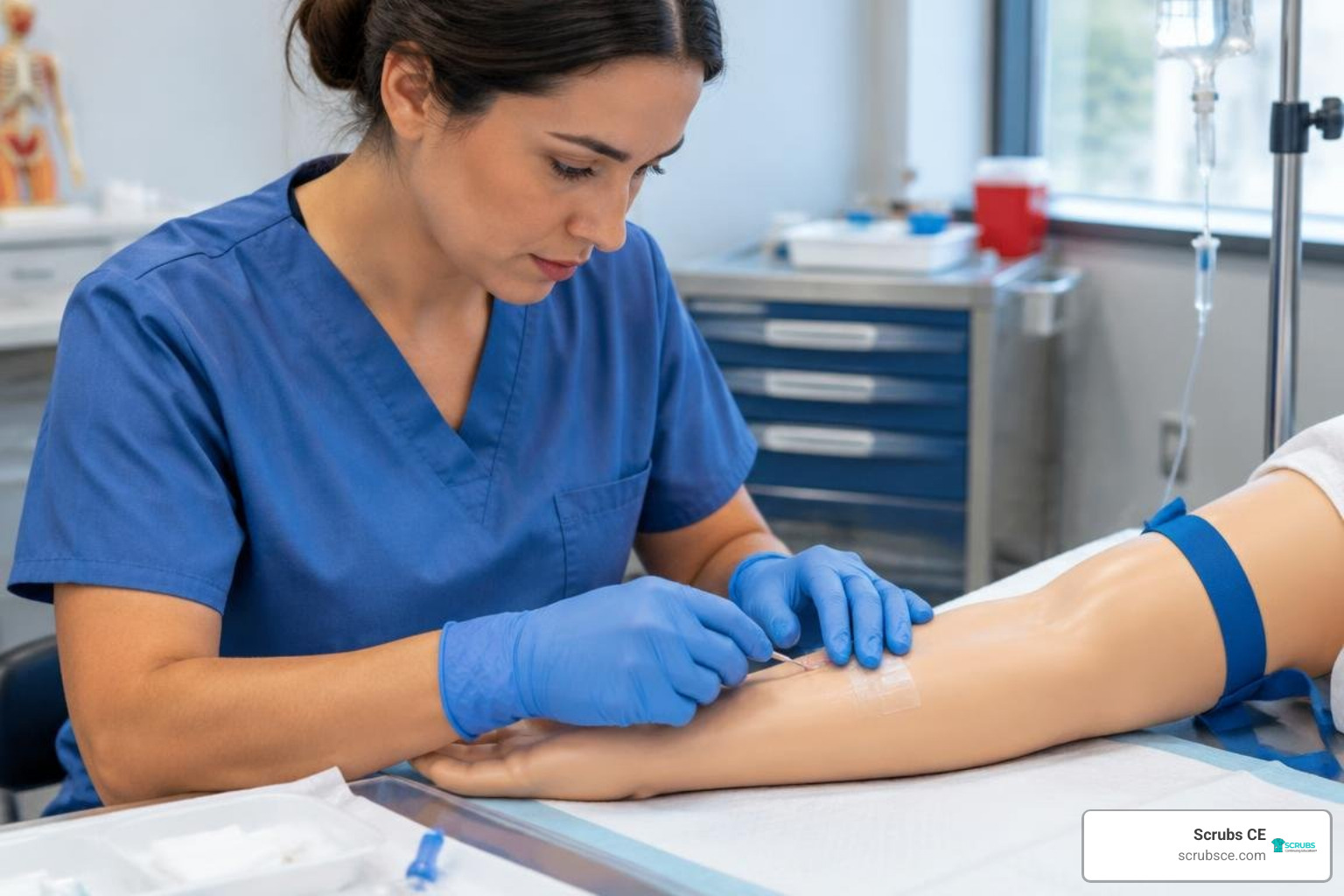
Students practice venous cannulation on lifelike simulation arms featuring synthetic veins and simulated blood flashback. Many programs require a defined number of verified sticks—often requiring documentation of at least 3 successful cannulations—before granting a certificate. For structured institutional courses, hands-on lab sessions typically run between 6 and 8 hours under the direct observation of experienced clinical educators.
Course Formats, Total Hours, and Certification Costs
Continuing education courses in vascular access vary widely in length, format, and cost. Depending on career goals and state mandates, nurses can choose from several educational tracks:
- Comprehensive Hybrid Programs (30 Hours): Often designed to satisfy comprehensive state board mandates, such as Florida’s 30-hour curriculum, combining roughly 24 hours of online theory with 6 hours of in-person skills practice. These courses typically award 30 Continuing Education Units (CEUs).
- Intensive Skills Certificates (6 to 7 Hours): Focused 1-day workshops, such as a 7-hour allied health training or a 6-hour certificate program, which usually retail around $300.00 to $349.00 and provide practical lab instruction.
- National Examination Pathways: For LPN/LVNs pursuing standardized national recognition, the NAPNES credentialing pathway involves a $100.00 registration fee plus a $60.00 testing fee for the initial online exam attempt (with retests priced around $50.00).
Clinicians evaluating their state relicensure needs can explore California nursing CEU options for license renewal to identify approved online courses that satisfy mandatory contact hours while expanding clinical proficiency. For broader context on national standards, the Infusion Nurses Society publishes evidence-based guidelines that inform many state curricula and certification exams.
Validity, Renewal, and Maintaining Your IV Therapy CE Credential
IV therapy credentials are rarely permanent; they require ongoing maintenance to ensure adherence to changing clinical standards.
Most national IV therapy credentials remain valid for a period of 3 years from the date of issue. Educational boards and testing agencies typically send out renewal notifications 6 months prior to expiration. To recertify, clinicians must submit proof of ongoing practice hours, complete updated continuing education units, or pass a recertification examination. Maintaining an organized record of certificates prevents lapse of credentials and ensures compliance during employer audits.
Career Benefits and Advanced Clinical Opportunities
Completing dedicated IV therapy continuing education provides immediate professional returns. For both entry-level and experienced clinicians, mastery of vascular access directly enhances clinical competence and career mobility.

Key career advantages include:
- Immediate Bedside Confidence: Reducing failed venipunctures reduces patient anxiety, minimizes vascular trauma, and avoids treatment delays.
- Specialty Unit Readiness: Emergency rooms, intensive care units, and surgical floors actively seek staff who can quickly establish reliable peripheral access during acute resuscitations.
- Outpatient Infusion and Oncology Pathways: The growth of outpatient clinics, ambulatory surgery centers, and home infusion agencies has increased demand for nurses certified in central line management and targeted drug infusions.
- Expanded Earning Potential: While wage increases vary by facility, possessing documented IV competencies broadens employment opportunities and qualifies nurses for advanced clinical ladder roles.
Frequently Asked Questions About IV Certification
How many CEUs do you earn from an IV therapy course?
The number of contact hours earned depends on the program scope. Focused 1-day workshops typically award 6 to 7 CEUs (or 0.60 to 0.70 CEUs depending on measurement units), while comprehensive state-approved programs yield up to 30 CEUs upon completing both the online theory and practical skills segments.
Can LPNs start IV lines after completing IV certification?
In many states, completing a board-approved IV therapy course permits LPNs and LVNs to insert peripheral catheters, hang hydration solutions, and administer designated intravenous medications. However, this scope is always regulated by the state Nurse Practice Act and often requires direct or indirect RN supervision.
How long does an IV therapy certification remain valid?
Standard national certifications generally remain active for 3 years. State-mandated course completion certificates generally satisfy board requirements indefinitely, though healthcare facilities often mandate annual skills competency check-offs to maintain clinical privileges.
Conclusion
Mastering vascular access and infusion management is a cornerstone of safe, high-quality patient care. Whether you are an LPN looking to expand your clinical scope or an RN sharpening advanced skills, pursuing a structured IV education pathway reinforces your clinical judgment, minimizes complication rates, and advances your career.
At Scrubs CE, we are dedicated to helping healthcare professionals thrive through accessible, self-paced online education. If you are also expanding your technical diagnostic credentials, explore our comprehensive Radiology CE library, featuring courses designed to meet national registry standards and approved for ARRT® and ASRT® credentials under the AMERICAN REGISTRY OF RADIOLOGIC TECHNOLOGISTS®.