

What Are CE Credit Hours and Why Do They Matter?
CE credit hours are the standard unit used to measure time spent in approved continuing education activities — and they’re required by licensing boards and certifying bodies across dozens of professions to keep credentials active.
Here’s a quick snapshot of what you need to know:
| Profession | CE Hours Required | Cycle Length |
|---|---|---|
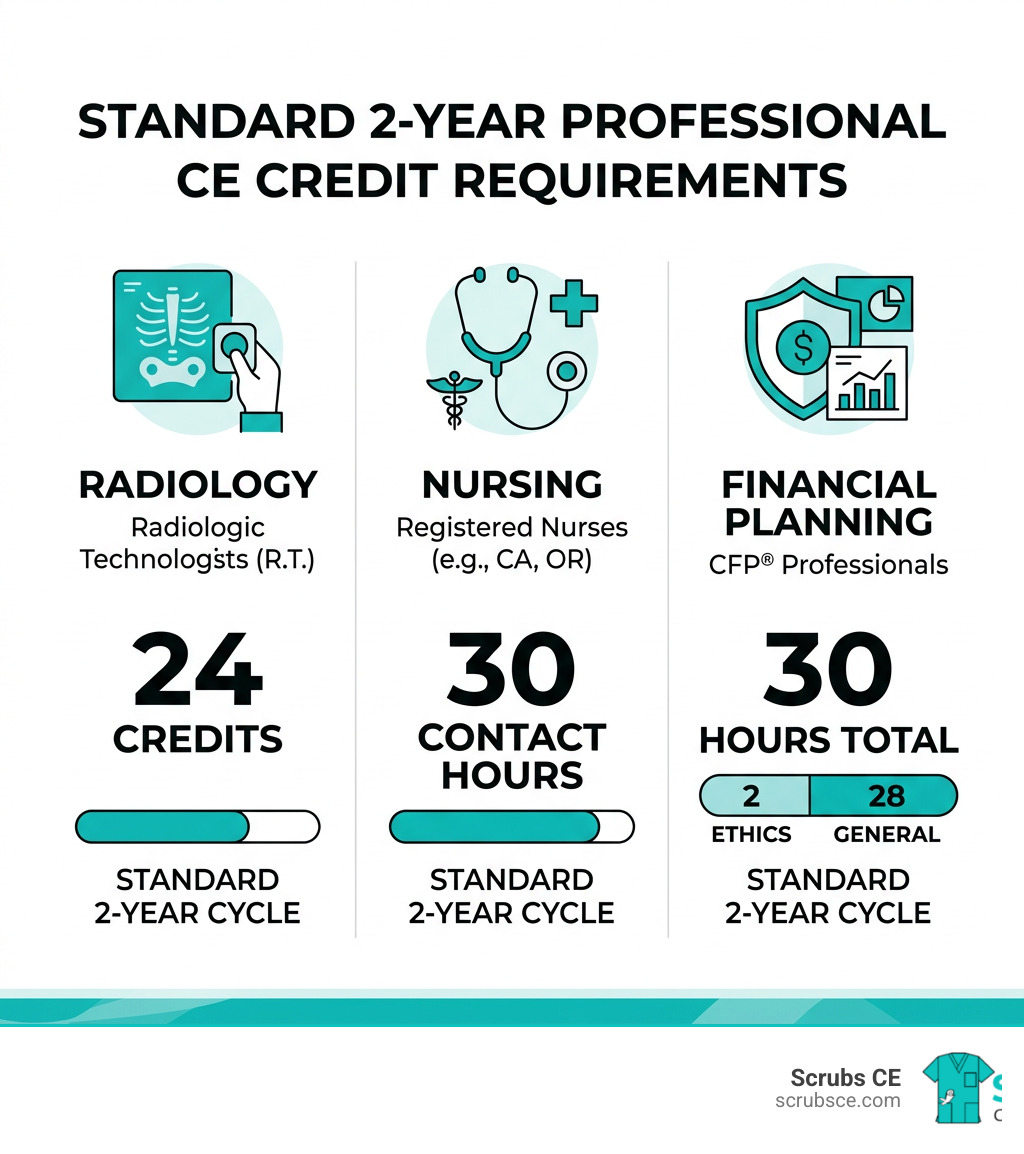
| Radiologic Technologists (R.T.) | 24 credits | 2 years |
| Registered Nurses (CA, OR) | 30 contact hours | 2 years |
| CFP® Professionals | 30 hours (2 Ethics + 28 General) | Reporting period |
| LEED Green Associate | 15 CE hours | 2 years |
| LEED AP with Specialty | 30 CE hours | 2 years |
| CIM® Designation Holders | 30 hours (20 PD + 10 Compliance) | 2 years |
The basic rule: one hour of approved instruction typically equals one CE credit. But the details — what counts, how to calculate credits for non-traditional activities, and how to report them — vary widely by profession and state.
That’s where things get complicated fast.
Whether you’re a radiologic technologist trying to decode ARRT requirements or a nurse sorting through state-specific mandates, understanding how CE credits are measured and tracked is essential to staying licensed and avoiding penalties.
I’m Zita Ewert, and as the leader behind SCRUBS Continuing Education®, I’ve spent years helping imaging professionals navigate CE credit hours — from ARRT-approved Category A courses to state-specific fluoroscopy training. I’ll walk you through everything you need to know to stay compliant with confidence.
CE credit hours terms simplified:
Understanding CE Credit Hours and Professional Requirements
At its core, continuing education is about more than just checking a box. It is a commitment to professional development, ensuring that practitioners in high-stakes fields—like healthcare, finance, and green building—stay current with the latest safety protocols and technical advancements. For most of us, this means maintaining a license through a specific number of CE credit hours earned within a set timeframe, often referred to as a “biennium” or reporting cycle.
In Radiology, for instance, the American Registry of Radiologic Technologists (ARRT) mandates that professionals engage in ongoing learning to provide the best patient care. If you are looking for the specifics, you can find more info about CE credit requirements to see how these rules apply to your specific modality. These ARRT Education Requirements are designed to ensure that every R.T. is equipped with up-to-date knowledge.
Typical Credit Totals for CE Credit Hours
While the “one hour equals one credit” rule is a good baseline, the total number of hours you need depends entirely on your job title and location.
- Nursing: In states like California and Oregon, Registered Nurses (RNs) and Licensed Vocational Nurses (LVNs) typically need 30 contact hours every two years.
- Radiology: Most R.T.s must earn 24 approved CE credit hours per biennium. However, if you are a Registered Radiologist Assistant (R.R.A.), that requirement jumps to 50 credits.
- Financial Planning: CFP® professionals are required to complete 30 hours each reporting period. This includes a very specific breakdown: 2 hours of Ethics and 28 hours covering “Principal Topics.”
- LEED Professionals: A LEED Green Associate needs 15 hours (3 of which must be LEED-specific), while a LEED AP with a specialty needs 30 hours (6 of which must be LEED-specific).
Variations in Reporting Periods
One of the biggest “gotchas” in professional licensure is the deadline. Not everyone follows a simple January-to-December calendar.
For ARRT professionals, your “biennium” is linked to your birth month. Your credits must be completed by the last day of the month before your birth month, and reported by the end of your birth month. It’s a bit like a birthday present to yourself—except the present is a renewed license and the wrapping paper is a stack of certificates.
Other organizations, like GBCI (for LEED), use a two-year cycle that ends exactly one day before the two-year anniversary of when you earned your credential. To keep your sanity, we always recommend checking your official Guide to Maintaining Your ARRT Credential or logging into your specific board portal to confirm your exact dates.
How to Calculate and Convert CE Credit Hours
Calculating your CE credit hours isn’t always as simple as looking at a clock. Different activities are weighted differently. In the medical and dental fields, the “contact hour” is the gold standard. Usually, 50 to 60 minutes of organized clinical instruction equals one contact hour.
However, many boards allow for quarter-hour increments. For example, if a dental CE activity is 15 minutes long, it might count as 0.25 credits. But beware: activities shorter than 15 minutes often count for exactly zero. If you’re in the imaging field, you might be wondering how many hours you specifically need for your state; you can learn more about X-ray CE credits to get a clearer picture of your requirements.
Academic Course Conversions
If you’re heading back to school, those college credits can often be converted into CE credit hours. This is one of the most efficient ways to knock out a large chunk of requirements at once. The standard conversion used by many bodies, including the ARRT and MDCB, looks like this:
| Academic Credit Type | CE Credit Equivalent |
|---|---|
| 1 Semester Credit | 16 CE Credits |
| 1 Quarter Credit | 12 CE Credits |
This 16:1 ratio is a lifesaver for those pursuing advanced degrees. According to the MDCB Credit Hour Assignments, academic courses are capped at 15 CEUs per cycle for medical dosimetrists, so always check your specific “cap” before assuming all your college credits will count.
Calculating Credits for Alternative Activities
You don’t always have to be a student to earn credits; sometimes, being the teacher or the author pays off.
- Authorship: Writing a peer-reviewed article can net you significant credits. For LEED professionals, an article is worth 3 hours, and a book is worth 10. For medical dosimetrists, being a primary journal author can earn you 10 credits.
- Presentation Development: If you are developing a brand-new, novel presentation for a conference, you can often earn 2-3 credits for every hour of the actual presentation. This accounts for the hours of research and slide-deck-building you did behind the scenes.
- Volunteering: Some organizations allow you to count volunteer hours, though these are often capped (e.g., LEED allows volunteering to account for up to 50% of your total hours).
To make sure you’re getting the most out of your time, read our details on earning CE credits for a deep dive into these alternative methods.
Qualifying vs. Non-Qualifying Activities for CE Credits
Not all learning is created equal in the eyes of a regulatory board. To count toward your license, an activity must usually be “approved” or “accredited” by a recognized body.
In Radiology, we look for “Category A” or “Category A+” credits. These are activities evaluated and approved by a Recognized Continuing Education Evaluation Mechanism (RCEEM). If you’re looking for high-quality, pre-approved options, you can explore Radiology CE courses that take the guesswork out of the process.
Acceptable Formats for CE Credit Hours
Gone are the days when you had to fly to a hotel ballroom to earn your credits (unless you really want the continental breakfast). Most boards now accept a variety of formats:
- Webinars and Live Online Events: These often count as “live” credits because they allow for real-time interaction.
- Self-Study and Directed Readings: This is our specialty at Scrubs CE. You read a module or book, take a post-test, and earn your certificate.
- Academic Coursework: As mentioned, these offer the biggest “bang for your buck” in terms of credit hours.
For those who prefer the flexibility of learning from home, ARRT Continuing Education Online options provide a convenient way to stay current.
Common Exclusions and Non-Qualifying Content
We often get asked, “I went to a lunch-and-learn hosted by a vendor; does that count?” Usually, the answer is no. Most boards have strict rules against proprietary or promotional content. If the main goal of the session is to sell a specific brand of X-ray tube or a new financial software, it won’t qualify for CE credit hours.
Other common exclusions include:
- Basic Business Skills: Learning how to use Excel or improve your office filing system generally doesn’t count toward professional licensure.
- Repeat Courses: Most organizations, including the USGBC (LEED) and ARRT, will not let you count the exact same course twice in the same reporting cycle.
- Client Seminars: Teaching a “Financial Planning 101” class to your clients typically doesn’t count for your own professional CE, as the content is considered too basic.
You can see a full list of these “no-nos” in the MDCB non-qualifying activities guide, which serves as a great benchmark for other professions too.
Reporting, Documentation, and Compliance Mandates
Earning the credits is only half the battle; you also have to prove you did it. Most professionals are required to keep their certificates of completion for at least one to two years after their reporting cycle ends in case of an audit.
For some, reporting is automated. If you take a course through a specific institute, they might report it directly to your board. For others, like LEED professionals using a USGBC account reporting system, you must manually log into your “Credentials” account and select “Report CE Hours.”
State-Specific and Regulatory Mandates
In recent years, many states have moved away from “general” credits and toward specific mandates. This means a portion of your CE credit hours must cover topics the state deems critical for public safety.
- Oregon: Since 2021, Oregon RNs and LPNs must complete 2 hours of cultural competency education every renewal, plus a one-time 6-hour requirement in pain management. You can find the full list on the Oregon Board of Nursing requirements page.
- California: California has specific requirements for implicit bias training and, for Nurse Practitioners, gerontology and Schedule II controlled substances. If you’re working in the Golden State, check out everything you need to know about California CE to stay on top of these shifting rules.
- Texas: Texas physicians have a “Life of the Mother Act” requirement, which is a one-time mandatory course on pregnancy-related medical emergencies.
Consequences of Non-Compliance and Audits
What happens if you miss your deadline? In a word: trouble.
Most boards conduct random audits. For example, CSI (for CIM® holders) and GBCI (for LEED) audit a specific percentage of applicants every year. If you can’t produce the documentation, you could face fines, license suspension, or be forced into a “re-entry” program. In Radiology, failing to meet your biennial requirements could lead to your “Certification and Registration” being listed as “Not Renewed,” which effectively stops you from working. To avoid this, keep a close eye on California CE requirements or your specific state’s rules.
Frequently Asked Questions about CE Credit Hours
How do carry-over policies work for excess credits?
In most cases, you cannot carry over extra credits. If you need 24 hours and you earn 40, those extra 16 hours usually disappear when your new cycle starts. However, there are exceptions. CIM® designation holders, for instance, can carry over up to 20 Professional Development credits (but zero Compliance credits). Always check your specific board’s policy before you “over-achieve.”
What is the difference between a CEU and a contact hour?
Technically, one Continuing Education Unit (CEU) is defined as 10 contact hours. However, in many healthcare fields, the terms are used interchangeably to mean one hour of instruction. Always look at the decimal point: if a board asks for “2.4 CEUs,” they likely mean 24 contact hours.
Can I count the same course twice in one cycle?
Almost universally, the answer is no. The goal of CE credit hours is to promote ongoing and new learning. Taking the same “Radiation Safety 101” course every year doesn’t help you grow, so boards typically only allow you to claim a specific course once per biennium.
Conclusion
Navigating the maze of CE credit hours can feel like a full-time job, but it doesn’t have to be a headache. At Scrubs CE, we’ve made it our mission to provide affordable, high-quality, and—most importantly—convenient online courses. We provide instant certificates the moment you pass your exam, so you’re never left biting your nails as a deadline approaches.
Whether you are a Radiology technologist looking to satisfy your biennium requirements or a nurse in California needing specialized training, we are here to help you meet your licensure requirements and advance your career.
Ready to get started? Fulfill your requirements with California Combos and see how easy staying compliant can be.