

Why Nuclear Medicine Quality Control Is the Foundation of Safe, Accurate Imaging
Nuclear medicine quality control is the systematic process of testing, calibrating, and documenting the performance of imaging and non-imaging equipment to ensure accurate diagnoses and patient safety.
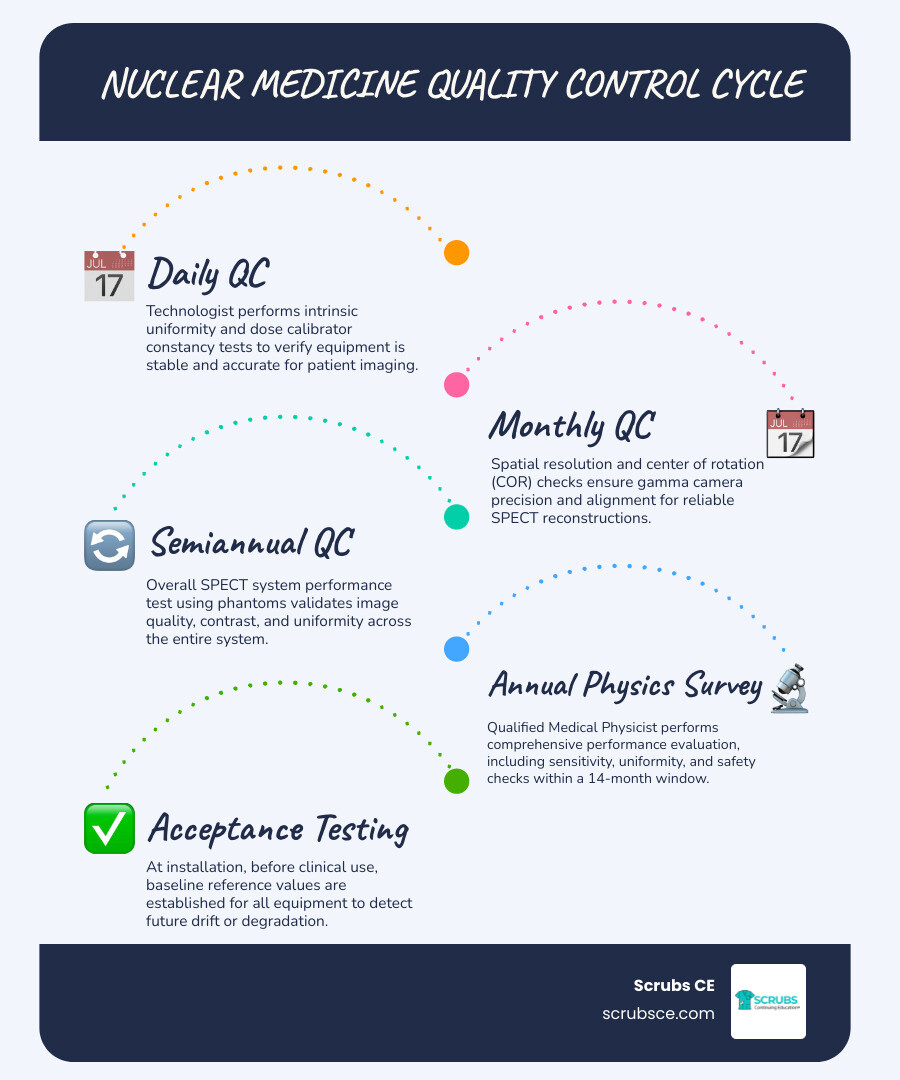
Here is a quick overview of what a compliant QC program requires:
| QC Area | Who Is Responsible | Minimum Frequency |
|---|---|---|
| Intrinsic or system uniformity | Nuclear medicine technologist | Daily |
| Dose calibrator constancy | Nuclear medicine technologist | Daily |
| Spatial resolution | Nuclear medicine technologist | Monthly |
| Center of rotation (COR) | Nuclear medicine technologist | Monthly |
| Overall SPECT system performance | Nuclear medicine technologist | Semiannually |
| Annual physics survey | Qualified Medical Physicist (QMP) | Annually (within 14 months) |
| Acceptance testing | Qualified Medical Physicist (QMP) | At installation, before clinical use |
| Compliance oversight | Supervising physician | Ongoing |
A single undetected calibration drift or a tiny collimator defect can compromise a patient’s diagnosis — and put your facility’s accreditation at risk. Patient radiation doses from nuclear medicine procedures can range from 0.3 mSv to 20 mSv for a single exam, which means poorly calibrated equipment does not just produce bad images — it exposes patients to unnecessary radiation without diagnostic benefit.
The ACR’s 2024 Nuclear Medicine Quality Control Manual sets clear standards for testing frequencies, personnel responsibilities, and documentation requirements. These rules exist for one reason: to make sure the equipment you rely on actually works the way it should, every single day.
I’m Zita Ewert, and through my work leading Scrubs Continuing Education®, I’ve spent years helping nuclear medicine technologists and imaging professionals understand the regulatory standards — including nuclear medicine quality control requirements — that protect both patients and careers. In this guide, I’ll break down exactly what your facility needs to stay compliant, who is responsible for what, and how to build a QC program that holds up under an ACR Validation Site Survey.
Nuclear medicine quality control vocab to learn:
- Nuclear medicine radiation safety
- Nuclear medicine technologist courses
- Nuclear medicine continuing education
The Core Components of Nuclear Medicine Quality Control
To run a high-performing imaging department in July 2026, we must look at quality control not as a series of isolated, annoying checkboxes, but as an integrated, proactive system. In clinical imaging, Quality Assurance (QA) is our proactive, process-focused shield that prevents defects before they occur. On the flip side, Quality Control (QC) is our reactive, product-focused tool used to identify and fix physical equipment issues.
A complete quality program requires a dedicated Quality Management Team (QMT), a comprehensive Quality Manual, standardized clinical workflows, and meticulous record keeping. By tracking our QC results longitudinally—such as plotting daily dose calibrator values on a graph—we can easily spot subtle, long-term performance drifts that might be completely invisible during a single day’s scan.
Establishing a Documented Quality Management System
The foundation of any accredited facility is a documented Quality Management System (QMS). According to the ACR, a successful QMS cannot rest on the shoulders of just one person. It requires a unified Quality Management Team consisting of:
- The Supervising Physician: Who holds ultimate responsibility for clinical compliance.
- The Qualified Medical Physicist (QMP): Who provides advanced technical and safety oversight.
- The QC Technologist: Who executes the day-to-day operational testing.
This team must maintain a formal Quality Manual that contains clear Standard Operating Procedures (SOPs) for every piece of equipment, emergency protocols, and corrective action workflows. For a deep dive into the official framework, you can review the Physician’s Section Technologist’s Section Medical Physicist’s Section guidelines provided directly by the ACR.
Aligning with ACR, NEMA, and EANM Standards
Local compliance is only half the battle. Our programs must align with major international and national bodies, including the National Electrical Manufacturers Association (NEMA), the American Association of Physicists in Medicine (AAPM), and the European Association of Nuclear Medicine (EANM).
To see how these standards translate globally, we can look at the International Atomic Energy Agency’s (IAEA) QUANUM (Quality Management in Nuclear Medicine) project. In international audits, the average conformance level was found to be 75%, highlighting that even established facilities have room to improve when standardizing their processes.
For clinical teams looking to refine their protocols according to European benchmarks, the EANM’s guide on QUALITY CONTROL OF NUCLEAR MEDICINE INSTRUMENTATION AND PROTOCOL STANDARDISATION offers an incredible technical reference. Keeping up with these shifting international guidelines is also a core focus of our professional training, which we detail in our Nuclear Medicine Education Guide 2026.
Acceptance Testing vs. Annual Physics Surveys
A common point of confusion for clinical teams is distinguishing between acceptance testing and routine annual physics surveys. Both are essential, but they serve entirely different purposes in the lifecycle of our imaging instruments.
Pre-Clinical Acceptance Testing and Baselines
Acceptance testing is a highly rigorous, comprehensive suite of measurements performed by a QMP immediately after equipment installation and before the system is ever used on a patient.
During this process, the physicist verifies that the system meets or exceeds the manufacturer’s technical specifications. This is also when we establish our baseline reference values. These baseline values act as our “scientific truth” for all future routine performance testing. If a detector or a crystal is ever replaced during a major repair, we must perform a new round of acceptance-level testing to establish a new baseline.
Annual Physics Surveys and the 14-Month Window
Once a system is in clinical use, it must undergo a comprehensive annual physics survey. The ACR understands that scheduling a physicist exactly on the 365-day anniversary of the last survey can be a logistical nightmare. Because of this, they allow a grace period of up to 14 months between surveys.
During this annual check, the QMP evaluates key parameters to ensure the system has not degraded. For example, system sensitivity between multiple detectors must be tested to ensure they are within 5% of each other. If you are preparing for your next inspection or looking to understand the physics behind these calculations, keeping your credentials sharp is vital. You can explore our Nuclear Medicine CE Credits Guide 2026 to find courses that cover these advanced physics concepts.
Routine Testing Frequencies for Imaging and Non-Imaging Equipment
Routine testing is our frontline defense against image degradation and dosing errors. Different instruments require different testing tempos to keep our diagnostic workflows safe and accurate.
Daily and Monthly Gamma Camera and SPECT-CT Nuclear Medicine Quality Control
For our gamma cameras, nuclear medicine quality control dictates that we perform intrinsic or system uniformity testing every single day of use. This daily flood check ensures that the detector provides a uniform image in response to a uniform flux of radiation, protecting us from interpreting a detector defect as a patient lesion. If you are operating a hybrid SPECT-CT system, a daily CT warm-up and basic functionality check must also be performed according to the manufacturer’s recommendations.
On a monthly basis, we must evaluate:
- Spatial Resolution: To ensure the system can still resolve fine anatomical details. (Weekly testing is strongly recommended for older analog cameras).
- Center of Rotation (COR): Checked monthly to maintain the mechanical and software alignment of our SPECT systems, preventing blurry or distorted tomographic reconstructions.
To understand how these daily and monthly checks directly impact advanced clinical imaging, read our breakdown in The SPECT CT Scan Explained How This Advanced Imaging Works.
Dose Calibrator and Non-Imaging Instrument Calibration
We cannot talk about safety without discussing the dose calibrator. Because these ionization chambers determine the exact amount of radioactivity we inject into our patients, their calibration must be flawless.
Our routine dose calibrator QC schedule includes:
- Constancy (Daily): Checked every morning using a long-lived reference source (like Cobalt-57 or Cesium-137) to ensure the reading is reproducible. Day-to-day readings must agree within 10%.
- Accuracy (Annually): Checked using NIST-traceable standards to ensure the calibrator reads the true activity within a 5% limit.
- Linearity (Quarterly): Checked to ensure the calibrator reads accurately across a wide range of activities (from tens of Gigabecquerels down to Megabecquerels). Linearity variations must remain within 10%.
- Background Readings (Daily): Monitored to prevent contamination errors. Any background reading increase of more than 10% must be immediately investigated.
Maintaining these tight tolerances is a key element in keeping our patients safe during their procedures. For practical tips on managing patient care alongside these technical calibrations, check out our guide on How to Keep Patients Safe and Calm During Nuclear Medicine Scans.
Defining Roles: Technologist vs. Medical Physicist Responsibilities
A successful quality program relies on a clear division of labor between the nuclear medicine technologist and the Qualified Medical Physicist. Each plays a distinct, complementary role on our multidisciplinary team.
Daily and Routine Tasks of the Nuclear Medicine Technologist
The nuclear medicine technologist is the everyday guardian of quality. Because they operate the equipment daily, they are responsible for:
- Performing daily intrinsic or system uniformity floods.
- Running daily dose calibrator constancy and background checks.
- Executing monthly COR and spatial resolution tests.
- Performing high-count flood corrections as directed by the physicist.
If you are a technologist looking to build a strong foundation in these daily responsibilities or looking to transition into this rewarding field, our resource on Starting Your Career A Guide to Nuclear Medicine Technologist Courses is an excellent starting point.
The Crucial Oversight of the Qualified Medical Physicist
While technologists handle daily operations, the Qualified Medical Physicist provides high-level scientific oversight. The QMP is responsible for:
- Conducting the comprehensive annual physics survey.
- Reviewing the technologist’s daily and monthly QC logs to spot long-term trends.
- Recommending specific repairs or corrective actions.
- Meeting with the supervising physician and QC technologist to review the program’s overall effectiveness.
The supervising physician is responsible for making sure the facility complies with the physicist’s recommendations. To stay up to date on these professional standards and fulfill your licensing requirements, you can access our targeted coursework via our Nuclear Medicine CE portal.
Troubleshooting Common Artifacts and Documenting Corrective Actions
Even the best-maintained systems will occasionally fail a QC test. Knowing how to identify artifacts and handle deviations is what separates a standard imaging department from an exceptional one.
Identifying Uniformity, Resolution, and Alignment Issues
When a daily uniformity check fails, we must look for common physical culprits:
- Photopeak Drift: Scintillation crystals are highly sensitive to temperature. If the room’s temperature changes faster than 5°C per hour, the photopeak can drift, or the crystal itself can crack, creating a sharp, cold-line artifact on our images.
- PMT Uncoupling: Photomultiplier tubes (PMTs) can occasionally uncouple from the crystal, creating an air gap that loses the light signal and shows up as a circular cold spot.
- Collimator Defects: Dropping or dinging a collimator can bend its lead septa, creating localized artifacts that destroy our system uniformity.
Catching these issues early is particularly critical in highly sensitive cardiac scans, which we discuss in our clinical review of Nuclear Medicine Myocardial Perfusion imaging.
Implementing and Recording Corrective Actions in Nuclear Medicine Quality Control
If any QC test reveals a performance deviation outside of acceptable limits, we must take immediate action:
- Stop Clinical Use: The affected instrument must be taken out of service immediately.
- Document the Issue: Record the failure in your permanent, non-erasable QC logs.
- Initiate Repairs: Contact a qualified service engineer to perform corrective maintenance.
- Re-Test Before Clinical Use: Once repaired, the QMP or a trained designee must perform follow-up testing to verify the system is safe for patients.
All service logs, physicist reports, and corrective actions must be kept on file. These records are the first things inspectors will look for during an ACR Validation Site Survey. To understand how clinical pathology and rigorous imaging protocols intersect, you can read our article on Infection and Inflammation in Nuclear Medicine Imaging.
Frequently Asked Questions about Nuclear Medicine Quality Control
What is the difference between intrinsic and extrinsic uniformity tests?
| Parameter | Intrinsic Uniformity | Extrinsic (System) Uniformity |
|---|---|---|
| Collimator | Removed (detector crystal is bare) | Attached (clinically used collimator) |
| Radioactive Source | Point source (<1 mL volume) | Flat sheet source (flood phantom) |
| Primary Isotope | Technetium-99m (Tc-99m) | Cobalt-57 (Co-57) |
| What It Tests | Crystal and PMT performance | Collimator integrity and overall system |
| Source Placement | 5 times the detector’s useful width away | Placed directly on the collimator face |
How often must dose calibrator linearity and accuracy be tested?
Dose calibrator accuracy must be tested at installation and at least annually thereafter using a NIST-traceable standard. Linearity must be tested at installation and quarterly. Linearity is typically evaluated using either the decay method (measuring a high-activity Technetium-99m source over several days down to 11 MBq) or the shield method (using calibrated lead-lined sleeves to simulate radioactive decay in a matter of minutes).
Who is ultimately responsible for quality control compliance in a facility?
While the QMP and the QC technologist perform the physical measurements, the supervising physician is ultimately responsible for ensuring compliance with all quality control standards and medical physicist recommendations. This joint accountability is central to maintaining our ACR accreditation.
To learn more about keeping your professional credentials compliant without breaking the bank, read our helpful guide on The Best Ways to Get Your Nuclear Medicine CE Credits for Free.
Conclusion
Standardizing our nuclear medicine quality control protocols is not just about passing audits; it is about guaranteeing that every scan we perform is safe, accurate, and reliable. By maintaining a rigorous QC schedule, keeping detailed records, and fostering clear communication within our Quality Management Team, we protect our patients and elevate our clinical practice.
For imaging professionals looking to stay certified and advance their careers, staying up to date on these technical standards is essential. At Scrubs CE®, we provide high-quality, self-paced online continuing education courses designed to help you meet your licensure requirements with ease.
Our courses are structured to help you maintain your credentials with the AMERICAN REGISTRY OF RADIOLOGIC TECHNOLOGISTS® (ARRT®), the ASRT®, and various state licensing boards, providing instant certificates upon completion. To learn more about our educational offerings, visit our Stay Current Stay Certified Essential Nuclear Medicine Continuing Education guide.
Ready to simplify your professional development and master the latest standards in Radiology and nuclear medicine? Check out our comprehensive, self-paced courses and earn your credits today at Scrubs CE Continuing Education.