

Overview of Nuclear Medicine Online Courses and Program Types
Navigating the landscape of nuclear medicine education requires understanding the different academic pathways available. Whether you are entering the healthcare field for the first time or transitioning from general Radiology, distance learning options are designed to meet varying educational backgrounds.
When exploring options, programs generally fall into three primary categories:
- Associate Degrees (A.A.S. or A.S.): Typically offered by community colleges, these 2-year programs require around 75 credit hours. They combine foundational sciences with core nuclear medicine instruction and local clinical rotations.
- Bachelor’s Degrees (B.S.): Offered by four-year universities, these comprehensive programs provide deeper training in advanced molecular imaging, management, and research, preparing graduates for leadership roles.
- Post-Primary Certificates: Designed specifically for licensed radiologic technologists (such as X-ray or CT techs) who want to cross-train into nuclear medicine without repeating basic general education coursework.
For candidates taking their first steps, our guide on Starting Your Career: A Guide to Nuclear Medicine Technologist Courses details how these structural pathways map to long-term career success.
Post-Primary Certificates and Nuclear Medicine Online Courses
For credentialed radiologic technologists, post-primary certificate programs offer the fastest bridge into nuclear medicine. Because these students already understand patient care, medical ethics, and general imaging physics, distance programs focus purely on specialized nuclear subjects.
These accelerated pathways feature online lectures paired with structured clinical hours at regional hospitals. In many distance certificate programs, didactic instruction covers radiation safety, radiopharmacy, and nuclear instrumentation, directly aligning with the AMERICAN REGISTRY OF RADIOLOGIC TECHNOLOGISTS® (ARRT®) and Nuclear Medicine Technology Certification Board (NMTCB) post-primary exam requirements.

For professionals focusing specifically on radioisotopes, specialized options like the Nuclear Pharmacy Certificate Program provide targeted training. The Nuclear Regulatory Commission (NRC) requires 200 hours of formal classroom instruction in basic radioisotope techniques combined with 500 hours of practical handling experience to qualify as an Authorized Nuclear Pharmacist. Modern distance programs utilize self-paced learning management platforms and interactive virtual drop-in labs to evaluate hands-on competency remotely.
Continuing Education and Specialization Nuclear Medicine Online Courses
For active nuclear medicine technologists (NMTs), staying certified requires ongoing professional development. Practicing technologists must complete continuing education (CE) credits biennially to maintain state licensure and credentials with the ARRT® or NMTCB.
Online CE courses offer flexible avenues to master rapidly advancing imaging technologies. Learn more about maintaining your credentials in our comprehensive Nuclear Medicine CE Credits Guide 2026.
Core topics covered in continuing education courses include:
- SPECT/CT and PET/CT Hybrid Imaging: Advanced attenuation correction, co-registration techniques, and multi-modality protocol standardization.
- Radiotheranostics and Targeted Therapy: Emerging diagnostic-therapeutic pairings, such as Lutetium-177 treatments for prostate cancer and neuroendocrine tumors.
- Organ-Specific Scintigraphy: Specialized clinical applications including Infection and Inflammation in Nuclear Medicine Imaging and complex Nuclear Medicine Myocardial Perfusion protocols.
Top Institutions Offering Hybrid and Distance NMT Education
Finding an accredited online or hybrid NMT program requires comparing delivery formats, cohort sizes, and clinical arrangement policies. Because nuclear medicine involves handling unsealed radioactive materials, every legitimate entry-level program uses a hybrid approach—delivering lectures online while managing clinical hours locally.
| Institution / Platform | Program Format | Target Audience | Key Features & Strengths |
|---|---|---|---|
| Pitt Community College | 1-Year Accelerated Hybrid | Entry-level & Career Changers | Self-paced online lectures combined with regional hospital clinical rotations. |
| Bronx Community College (CUNY) | Online Certificate Track | Licensed X-ray / CT Techs | Designed to solve regional technologist shortages by cross-training existing radiologic workers. |
| Purdue University | Distance Certificate | Pharmacists & Pharmacy Students | Fulfills 200-hour NRC didactic requirement with live virtual drop-in lab evaluations. |
| Brighton and Sussex Medical School (BSMS) | Postgraduate MSc / PGDip / PGCert | Physicians, Physicists, & Senior Techs | GMC-approved distance learning program covering advanced clinical nuclear medicine; requires annual UK exams. |
| IAEA (DATOL & VirRAD Platforms) | Self-Paced E-Learning | Global Health Professionals | Free international training modules covering basic sciences, radiopharmacy, and 3D virtual lab simulations. |
| TU Delft | 9-Week Online MOOC | Engineers & Health Physicists | Specialized course focusing on radioisotope production, decay mechanics, and chemical separation techniques. |
Accelerated Certificates and Associate Degrees
Accelerated hybrid programs offer an efficient route to entering the workforce. Programs like the one offered by Pitt Community College deliver an intense 1-year curriculum where didactic coursework (such as nuclear physics, health physics, and radiobiology) is completed entirely online. Students secure clinical placement at pre-approved local healthcare facilities near their place of residence.
Distance learning options allow community colleges to address critical healthcare labor shortages. For instance, Bronx Community College launched an online NMT certificate program specifically tailored to help registered radiologic technologists transition into nuclear medicine without leaving their current jobs. This approach expands the technologist pool in underserved areas by forming local hospital partnerships.
When selecting an accelerated track, cohort sizes are frequently restricted—often to as few as 15 students per year—to maintain high faculty-to-student ratios and guarantee quality clinical site placements. Review our Nuclear Medicine Education Guide 2026 for an in-depth look at program selection criteria.
Advanced Postgraduate and International Programs
For clinicians, physicists, and senior technologists seeking advanced master’s-level expertise, international academic institutions offer flexible distance options.
- Postgraduate Degrees: Programs like the Nuclear Medicine MSc at BSMS provide flexible 60-credit (PGCert), 120-credit (PGDip), and 180-credit (MSc) pathways. Distance learners access live interactive seminars and recorded lectures from anywhere in the world, traveling to campus only for required annual May examinations.
- Radiation Protection Training: The International Atomic Energy Agency (IAEA) offers specialized online modules, such as their 20-hour course on Radiation Protection in Nuclear Medicine. This course addresses international safety standards, pediatric dose optimization, and safety protocols for hybrid PET/CT scanners.
- Radionuclide Production: Universities like TU Delft offer technical short courses focused on backend radiochemistry. Their 9-week online course, Radionuclide Production | TU Delft Learning for Life, covers production facility engineering, cyclotron mechanics, and chemical separation processes.
Core Curriculum, Clinical Training, and Prerequisites
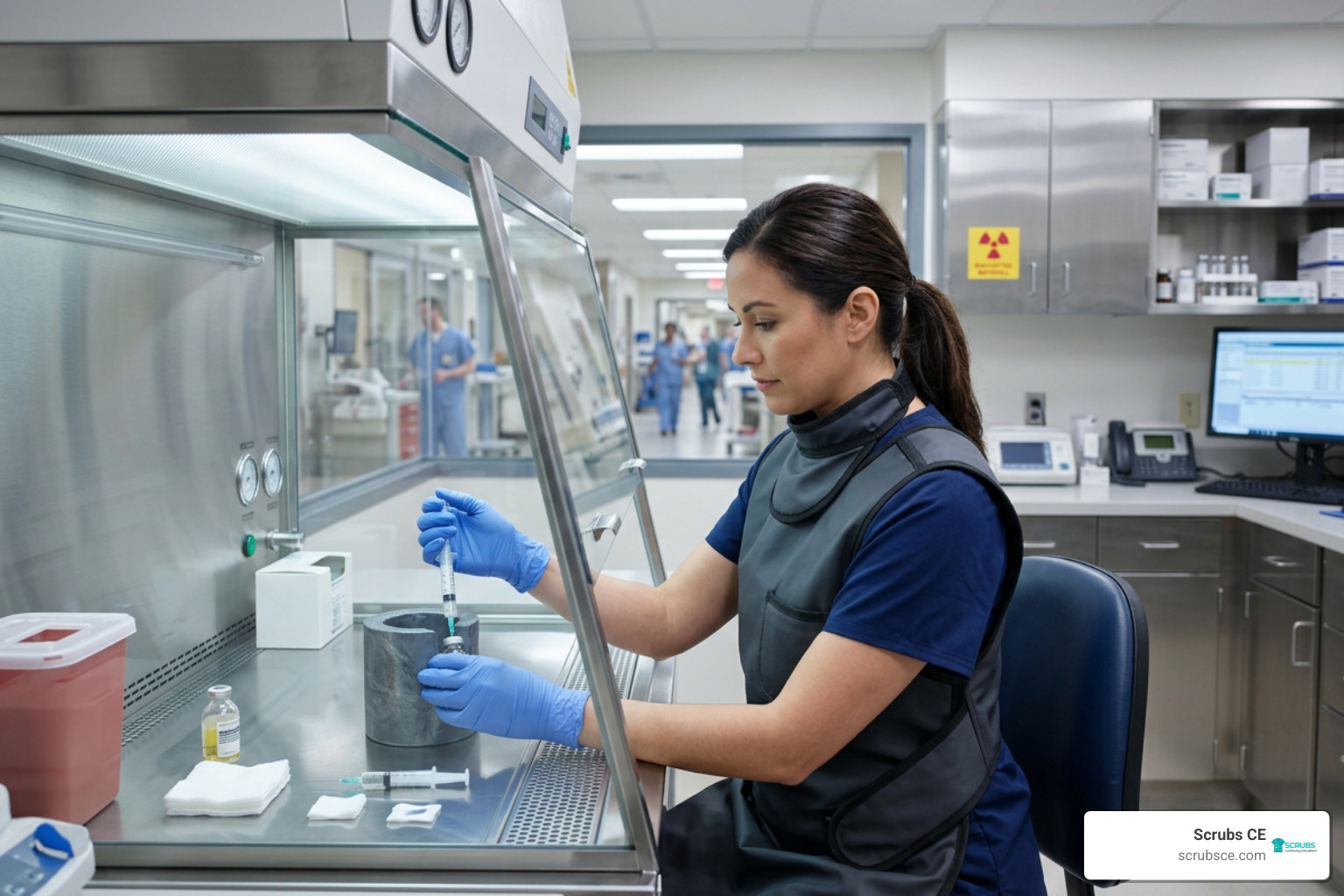
Whether enrolled in a distance certificate or a hybrid associate degree, students complete a standardized core curriculum combined with intensive practical training.
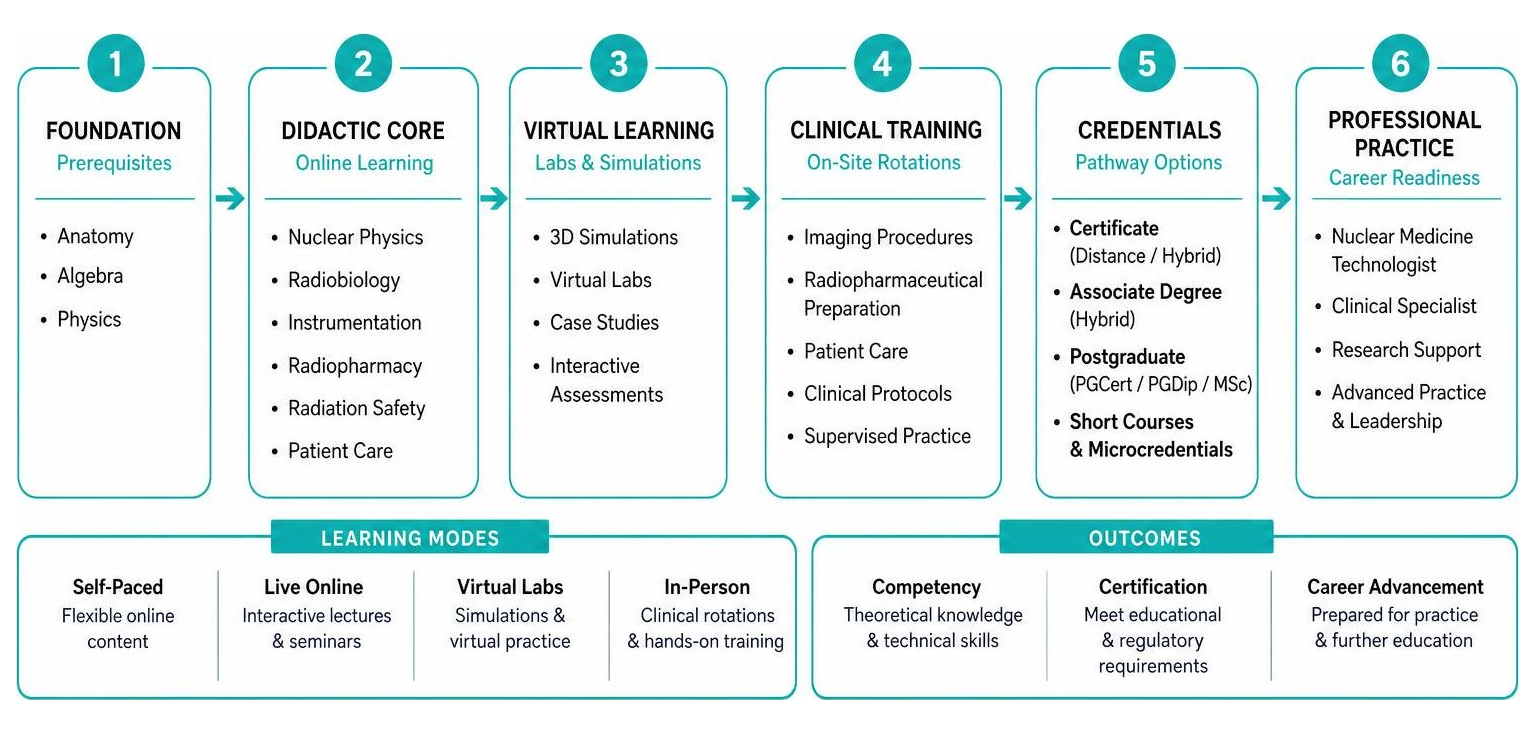
Didactic Coursework and Radiation Safety
The classroom component of nuclear medicine education establishes a foundation in both physical sciences and clinical protocols.
Key subjects in the core curriculum include:
- Nuclear Physics and Radiation Decay: Alpha, beta, and gamma emissions, decay equations, half-life calculations, and radionuclide parent-daughter equilibrium equations.
- Radiopharmacy and Radiopharmacology: Preparation, quality control, and mechanism of action for diagnostic and therapeutic radiopharmaceuticals (such as Technetium-99m and Fluorine-18).
- Instrumentation and Quality Control: Operation of gamma cameras, SPECT, PET scanners, dose calibrators, and well counters.
- Radiation Biology and Safety: Biological effects of ionizing radiation, ALARA (As Low As Reasonably Achievable) principles, personnel dosimetry, waste disposal, and decontamination procedures.
Comprehensive textbooks like Essentials of Nuclear Medicine and Molecular Imaging serve as primary resources throughout these academic modules. Furthermore, learning How to Keep Patients Safe and Calm During Nuclear Medicine Scans remains a critical clinical skill taught alongside technical physics.
To bridge classroom theory and practical lab work, open-access resources provide interactive virtual simulations. For example, the IAEA offers a Human Health Campus – Virtual Course in Radiopharmacy (VirRAD). This platform allows students to practice entering hot labs, performing generator elutions, calculating doses, and handling radioactive waste inside a risk-free 3D virtual laboratory.
Clinical Rotation Placement and Hands-on Requirements
While lectures are easily delivered over the internet, nuclear medicine cannot be learned entirely behind a screen. Clinical competency requires real-world experience injecting radiopharmaceuticals, positioning patients under gamma cameras, and operating imaging workstations under direct preceptor supervision.
Most hybrid programs manage clinical placements in one of two ways:
- School-Affiliated Networks: The institution places students inside a pre-established network of local hospital partners and outpatient diagnostic centers.
- Student-Facilitated Placement: Distance learners outside the school’s immediate region identify a local hospital willing to enter an official clinical affiliation agreement.
Be aware of geographic restrictions before enrolling. Due to varying state authorization laws and board rules, distance programs may not be authorized to establish clinical training sites in every state (for instance, certain distance programs cannot host clinical rotations in New York, New Jersey, or Maryland). Always verify that a program can support clinical placement in your home state before submitting an application.
Career Outlook, Salary Expectations, and Credentialing
Entering the field of nuclear medicine offers robust career stability and competitive financial rewards. According to national labor statistics, nuclear medicine technologists earn a national median annual wage of $101,370. In high-cost-of-living regions like California, median annual salaries reach as high as $162,380.
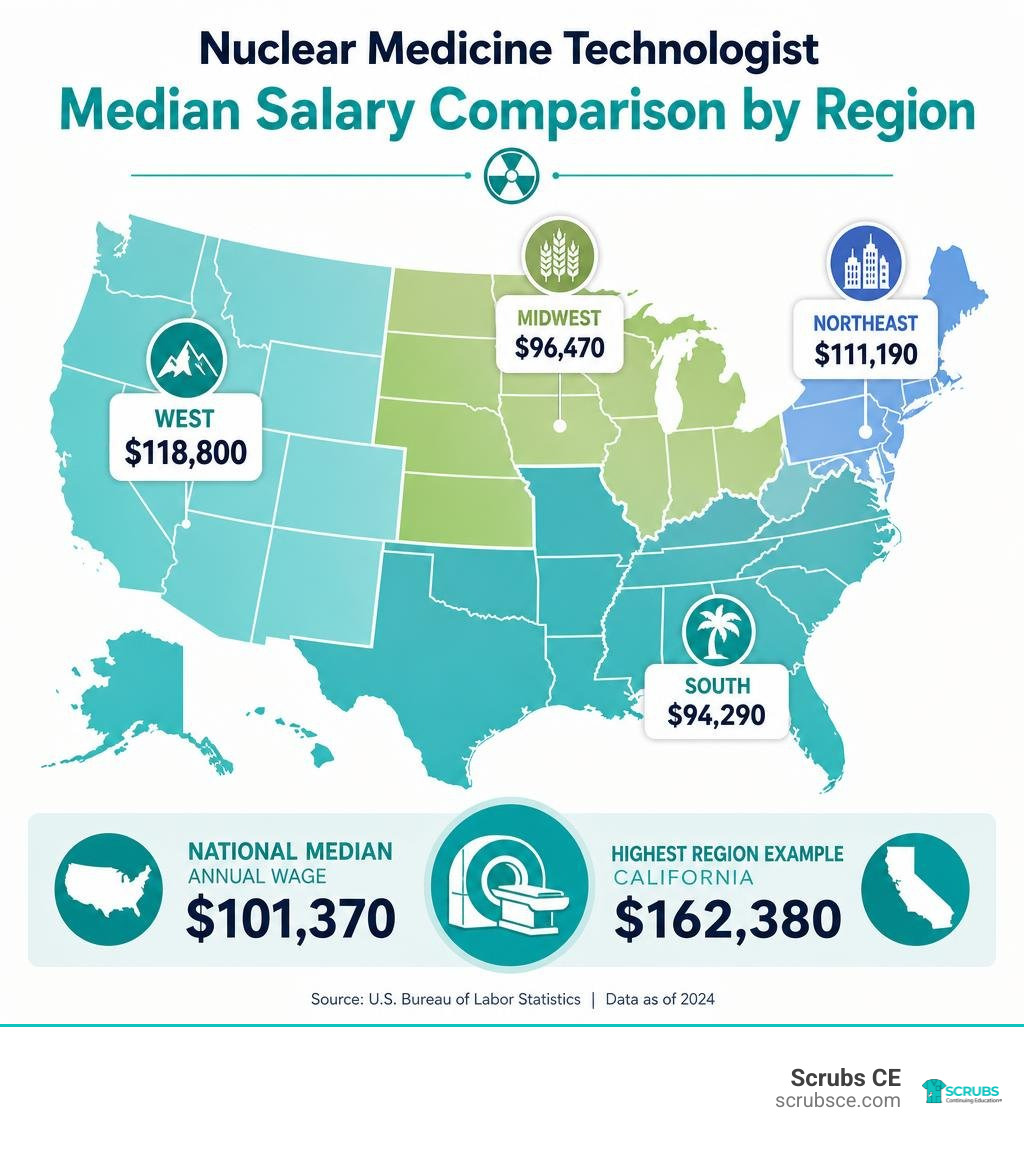
To practice professionally, graduates must earn national certification. The primary credentialing bodies recognized across the United States are:
- The AMERICAN REGISTRY OF RADIOLOGIC TECHNOLOGISTS® (ARRT®)
- The Nuclear Medicine Technology Certification Board (NMTCB)
In addition to national certification, over 30 states mandate official state licensure to operate radiation-emitting equipment and handle radiopharmaceuticals.
Because job availability is heavily tied to regional healthcare infrastructure, checking local job boards within driving distance is recommended before selecting a training program. Once certified, maintaining your license requires active ongoing education. Technologists can keep credentials up to date by reviewing resources on how to Stay Current Stay Certified Essential Nuclear Medicine Continuing Education.
Frequently Asked Questions About Nuclear Medicine Programs
Can nuclear medicine programs be completed 100% online?
No entry-level program leading to primary certification can be completed 100% online. While all academic lectures, physics modules, and radiopharmacy coursework can be taken online, accredited programs require hands-on, in-person clinical rotations at an approved hospital or imaging center. Only non-clinical post-graduate modules or continuing education credits for currently certified technologists can be completed entirely online.
What are the typical prerequisites for online NMT programs?
Prerequisite requirements depend on the credential level:
- For Associate/Bachelor’s Degrees: General high school diploma or equivalent, college-level Human Anatomy & Physiology (with lab), College Algebra, General Chemistry, Physics, and English Composition with a minimum cumulative GPA of 2.5 to 3.0.
- For Post-Primary Certificates: Active primary credential from the ARRT® in Radiography (R), Radiation Therapy (T), or Magnetic Resonance Imaging (MR), alongside an active CPR/BLS certification.
How much do online nuclear medicine programs cost?
Tuition rates vary significantly by institution type:
- Community Colleges: Associate degrees range from $76 to $150 per credit hour, bringing total tuition costs to approximately $6,000–$12,000.
- Public Universities: In-state tuition for bachelor’s degrees or post-primary certificates ranges between $12,000 and $25,000.
- Private Institutions: Accelerated private university certificate or degree programs cost between $600 and $1,275 per credit hour, with total tuition reaching $30,000–$50,000+.
Financial aid options include federal Direct Loans, Pell Grants, GI Bill® benefits, hospital employer tuition reimbursement programs, and professional society scholarships.
Conclusion
Choosing the right Nuclear medicine online courses or hybrid program comes down to aligning your current healthcare experience with your long-term career goals. Whether you are an experienced X-ray technologist cross-training through a post-primary certificate, a newcomer earning a hybrid associate degree, or a certified professional seeking specialized continuing education, flexible distance learning models make expanding your qualifications more attainable than ever.
As you plan your educational journey, clinical hands-on competency and maintained credentialing are the twin pillars of a successful imaging career. Once you enter the clinical field, keeping your certifications active shouldn’t be stressful or expensive. At Scrubs CE, we provide self-paced, affordable online courses with instant certificates to help imaging professionals effortlessly meet state licensure and ARRT® renewal requirements. Explore our complete course library today on our Nuclear Medicine Continuing Education page to keep your career moving forward!