
Start Your ARRT® Registry Review With a Clear Plan

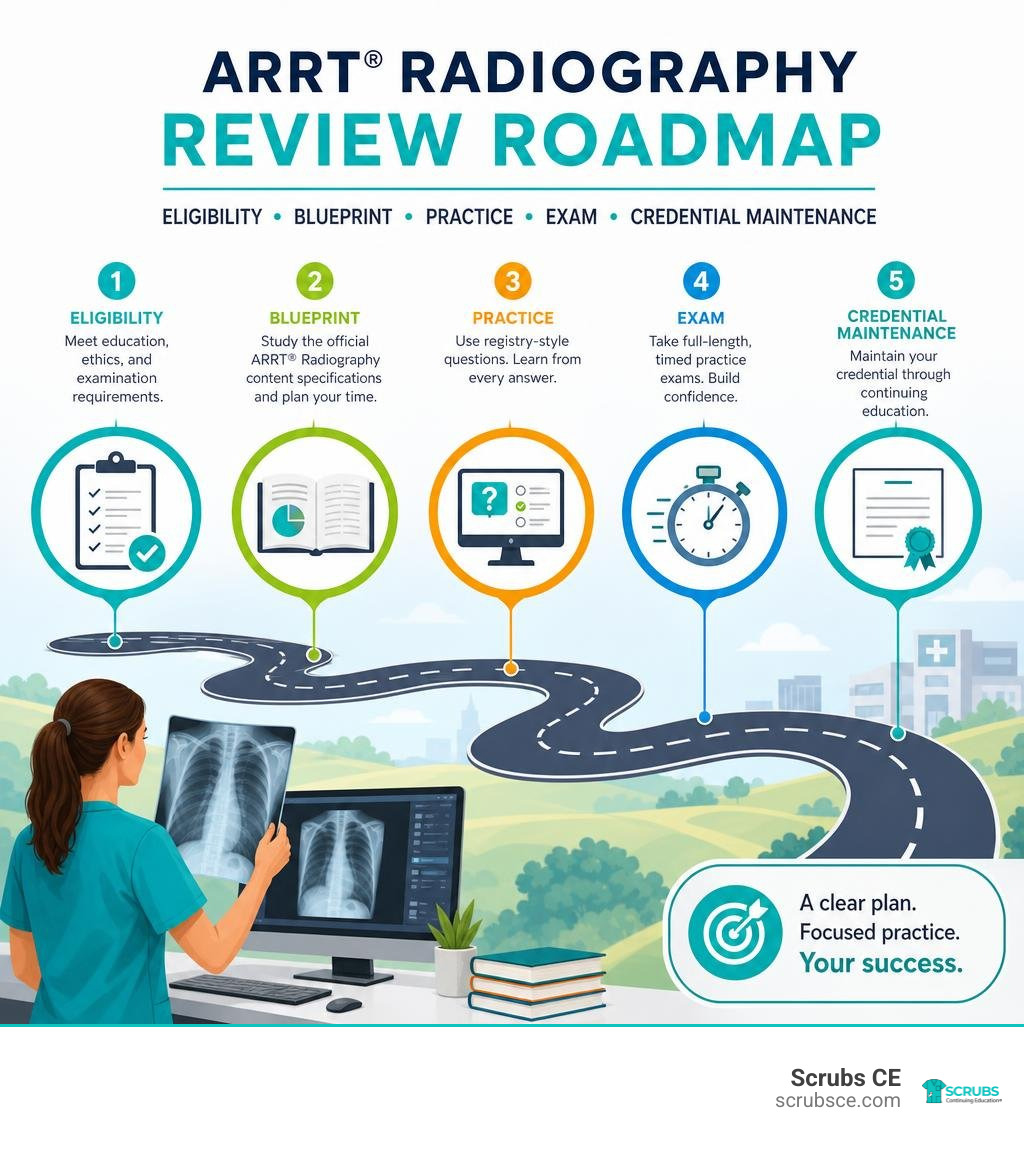
A successful ARRT® registry review starts with the official ARRT® Radiography content specifications, not a random stack of notes. Build a short study plan around the tested areas, use practice questions to find weak spots, and take timed exams so the computer-based format feels familiar before test day.
- Confirm that you meet the education, ethics, and examination requirements.
- Download the current ARRT® exam blueprint and divide study time across each content area.
- Practice active recall with registry-style questions, then review why each answer is right or wrong.
- Schedule full-length timed practice sessions to improve pacing and reduce exam-day stress.
The ARRT® Radiography examination has 200 questions and tests entry-level knowledge in patient care, safety, image production, and procedures. Your program prepares you for the profession; a focused review helps you turn that knowledge into reliable exam decisions.
I’m Zita Ewert, and I lead SCRUBS Continuing Education®, where I help imaging professionals find practical, accredited learning for licensure, career growth, and ARRT® registry review. My work centers on making continuing education and Radiology exam preparation clearer, more accessible, and easier to fit into a demanding clinical schedule.
Terms related to ARRT® registry review:
ARRT® Radiography Eligibility and Examination Requirements

Earning national credentials from the AMERICAN REGISTRY OF RADIOLOGIC TECHNOLOGISTS® is a major career milestone. To qualify to sit for the examination via the primary eligibility pathway, candidates must satisfy three core pillars: education, ethics, and examination. When determining what are the requirements to be a radiologic technologist, candidates must ensure their academic records, clinical logs, and character backgrounds align with the official ARRT® RULES AND REGULATIONS .
Educational Milestones and Clinical Competencies
Candidates pursuing the primary pathway must complete an educational program accredited by an agency recognized by ARRT®. In addition to finishing the didactic curriculum, candidates must earn an associate degree or higher. This degree does not have to be specifically in radiologic technology, but it must be conferred by an accredited institution.
Clinical readiness is verified through mandatory didactic and clinical competency evaluations. You must perform mandatory and elective imaging procedures under direct and indirect supervision, logging entries for head, spine, pelvis, thorax, abdomen, and extremity views. Program directors verify these competencies before approving examination applications. Reviewing a comprehensive guide to radiologic technologist certification requirements helps ensure every log entry meets registry standards.
Ethics Review Process and Background Screening
ARRT® enforces strict ethical criteria to protect patient welfare. When completing your Eligibility application, you must report background infractions, including misdemeanor or felony convictions, drug- or alcohol-related driving offenses, military court-martials, and any disciplinary action against a professional license.
If you have potential violations on your record, you can submit an Ethics Review Pre-Application before or during your schooling for a $100 nonrefundable fee. In 2024, ARRT® processed approximately 1,309 ethics reviews, with 98% resulting in candidates maintaining their eligibility. Resolving potential flags early ensures your examination window opens smoothly upon graduation.
Eligibility Time Limits and Attempt Regulations
Regulations establish a standardized three-year eligibility window. Candidates must establish exam eligibility within three years of finishing the professional component of their educational program.
Once approved, candidates have up to three examination attempts within a three-year period starting from their initial exam window. If a candidate does not pass within three attempts or three years, they forfeit eligibility and must complete an accredited educational program again. Understanding how to get ARRT® certified without losing your mind lets you structure test dates strategically rather than rushing into an attempt unprepared.
Core Study Strategies for Your ARRT® Registry Review

A comprehensive review requires deliberate, active learning techniques. Simply highlighting textbooks leads to passive recognition rather than actual clinical recall. Utilizing a structured review tool like the radiography prep ch book test mailed gives you physical reference guides to master core formulas, physics concepts, and patient care workflows.
Structuring Content Around the ARRT® Registry Review Blueprint
ARRT® designs examination content specifications based on nationwide practice analyses. The four primary testing domains include:
- Patient Care: Ethical and legal standards, interpersonal communication, infection control, pharmacology, contrast administration, and patient monitoring.
- Safety: Radiation physics, radiobiology, beam limitation, shielding practices, dosimetry, and regulatory exposure limits.
- Image Production: Technical factor selection (mAs, kVp), exposure index calibration, digital image processing, artifact recognition, and equipment quality assurance.
- Procedures: Positioning accuracy, anatomy visualization, central ray alignment, pathology adjustments, and fluoroscopic examinations.
High-Yield Practice Questions for ARRT® Registry Review Success
Practicing with realistic test questions prepares you for the cognitive demand of registry day. The exam evaluates not just factual recall, but your ability to analyze clinical scenarios and make procedural decisions.
| Study Strategy | Daily Time Commitment | Active Engagement Level | 30-Day Knowledge Retention |
|---|---|---|---|
| Passive Textbook Reading | 2–3 Hours | Low (Mental fatigue, skimming) | 20% – 30% |
| Active Flashcards (Spaced Repetition) | 30–45 Minutes | High (Forced memory retrieval) | 65% – 75% |
| Targeted Scenario-Based Q-Banks | 1–2 Hours | High (Clinical problem-solving) | 80% – 90% |
| Timed Full-Length Mock Exams | 3.5 Hours (Weekly) | Very High (Simulates pacing & endurance) | 85% – 95% |
When completing practice questions, analyze every option thoroughly. Determine why the correct option applies clinically and why the alternative distractors are incorrect.
Avoiding Common Preparation Pitfalls
- Passive Skimming: Reading chapters without testing yourself creates an illusion of competence. Use self-quizzing after every section.
- Neglecting Radiation Protection Math: Avoid skipping inverse square law, direct square law, and grid conversion calculations. Write out formulas repeatedly until they become second nature.
- Ignoring Positioning Details: Memorize anatomy profile views, central ray angulation, and criteria for determining rotation on diagnostic radiographs.
- Cramming Before Test Day: Last-minute cramming elevates cortisol and hampers working memory. Conclude heavy studying 24 to 48 hours before the test to let your mind rest.
Understanding ARRT® Exam Formats, Question Types, and Accommodations
The ARRT® Radiography examination is administered at Pearson VUE testing centers. Familiarizing yourself with the interface using the ultimate checklist for Radiology certification requirements prevents interface confusion on test day.
Question Formats and Exam Structure
The Radiography exam includes 200 scored questions assessing foundational knowledge and cognitive application, along with pilot questions evaluated for future exams. Candidates have an allocated time limit of 3.5 hours for the exam itself, preceded by a brief computer tutorial and an agreement screen.
The test utilizes multiple modern item formats:
- Standard Multiple-Choice: Four options with a single best answer.
- Multiple-Select: Items asking you to select two or more correct answers from a list.
- Image and Illustration Analysis: Interpreting radiographs, anatomy diagrams, or equipment setups to identify structures, pathology, or positioning errors.
- Drag-and-Drop / Sorted Lists: Arranging clinical steps or radiographic workflow procedures in proper chronological order.
- Video Items: Evaluating dynamic imaging sequences to identify functional movement or fluoroscopic timing.
Requesting ADA Testing Accommodations
ARRT® complies with the Americans with Disabilities Act (ADA) by offering testing accommodations for candidates with documented physical, cognitive, or learning disabilities. Accommodations are evaluated by Paradigm Testing.
Requests must be submitted concurrently with your initial certification application before your examination window is assigned. You must submit comprehensive diagnostic records, professional evaluations, and a personal statement outlining functional limitations. Accommodations cannot be granted retroactively once a test appointment is scheduled or completed.
Post-Primary Pathways and Long-Term Credential Maintenance
Passing the primary radiography registry provides a foundation for advanced specialization. Technologists frequently expand their clinical scope by preparing for advanced credentials through specialized study, such as using an ARRT® MRI registry review how to pass on your first try guide, or pursuing advanced breast imaging with mammography mastery achieving your ARRT® certification.
Continuing Qualifications Requirements (CQR) Process
For technologists earning their credentials on or after January 1, 2011, certifications follow a 10-year time-limited structure subject to Continuing Qualifications Requirements (CQR). The CQR framework includes three phases completed across a three-year compliance window:
- Professional Profile: Documenting your clinical practice history and routine procedure volume.
- Structured Self-Assessment (SSA): An objective evaluation identifying knowledge areas requiring clinical updates.
- Prescribed Continuing Education: Targeted educational credits assigned to address any identified knowledge gaps.
To maintain active status outside of the 10-year CQR milestone, technologists must also complete their standard biennial ARRT® CE renewal by earning 24 accepted continuing education credits every two years.
Structured Self-Assessment (SSA) and Prescribed CE
The Structured Self-Assessment is not a pass/fail test; it is an evaluation tool designed to identify professional development needs. For radiography, the SSA consists of 80 timed questions covering patient care (10 questions), safety (20 questions), image production (20 questions), and procedures (30 questions).
Reviewing official documents such as the Radiography Structured Self-Assessment 2027 outline helps technologists prepare for these evaluations. If your SSA indicates areas below target competency, ARRT® assigns targeted continuing education courses to fulfill your CQR requirements. Technologists may also elect to skip the SSA and complete the maximum prescribed continuing education allocation (up to 36 CE credits) during their three-year window.
Frequently Asked Questions about the ARRT® Exam
How many questions are on the ARRT® Radiography examination?
The examination features 200 scored questions assessing knowledge in patient care, safety, image production, and procedures. It may also include unscored pilot questions used to validate items for future exams. ARRT® converts raw results into scaled scores ranging from 1 to 99, with a scaled score of 75 required to pass.
What happens if I do not pass the ARRT® exam on my first attempt?
If you do not achieve a passing score on your first attempt, you may reapply for a subsequent examination window. ARRT® rules permit up to three examination attempts within a three-year eligibility period. Candidates should review their score report breakdown, identify lower-scoring domains, and complete structured practice questions before retaking the test.
How far in advance must ADA accommodations be requested?
ADA accommodation requests must be submitted simultaneously with your initial examination application before your exam window is generated. Paradigm Testing reviews diagnostic reports and documentation to assign appropriate accommodations (such as extended testing time or private testing rooms) before exam scheduling authorization is issued.
Conclusion
Earning your professional credential from the AMERICAN REGISTRY OF RADIOLOGIC TECHNOLOGISTS® is the defining step in launching your diagnostic imaging career. By structuring your study timeline around official ARRT® content specifications, practicing with scenario-based question formats, and avoiding common preparation pitfalls, you can enter the testing center with confidence.
Once certified, maintaining clinical expertise through accredited education ensures long-term career growth. We at Scrubs CE support your professional path with convenient, self-paced courses designed to help you satisfy your biennial requirements and CQR milestones. When you are ready to earn required credits for license renewal or advanced modality preparation, explore continuing education courses for imaging professionals to keep your healthcare career moving forward.