
How to Renew Your CNA License Online in Less Than an Hour
How to Renew Your CNA License Without Wasting Time

To renew your CNA certification, check your state nurse aide registry for your deadline and requirements, then gather proof of paid work and any required training. Submit the renewal form through the state’s portal if online renewal is available, pay any fee, and check the registry afterward to confirm your status is active.
If your records are ready, the online application may take less than an hour. Approval can take longer, and some states require a paper form instead.
I’m Zita Ewert, and I lead continuing education at Scrubs CE, where I help healthcare professionals understand credential requirements. My experience making renewal guidance clear and practical shapes this CNA license renewal guide; your state registry remains the final source for its rules.
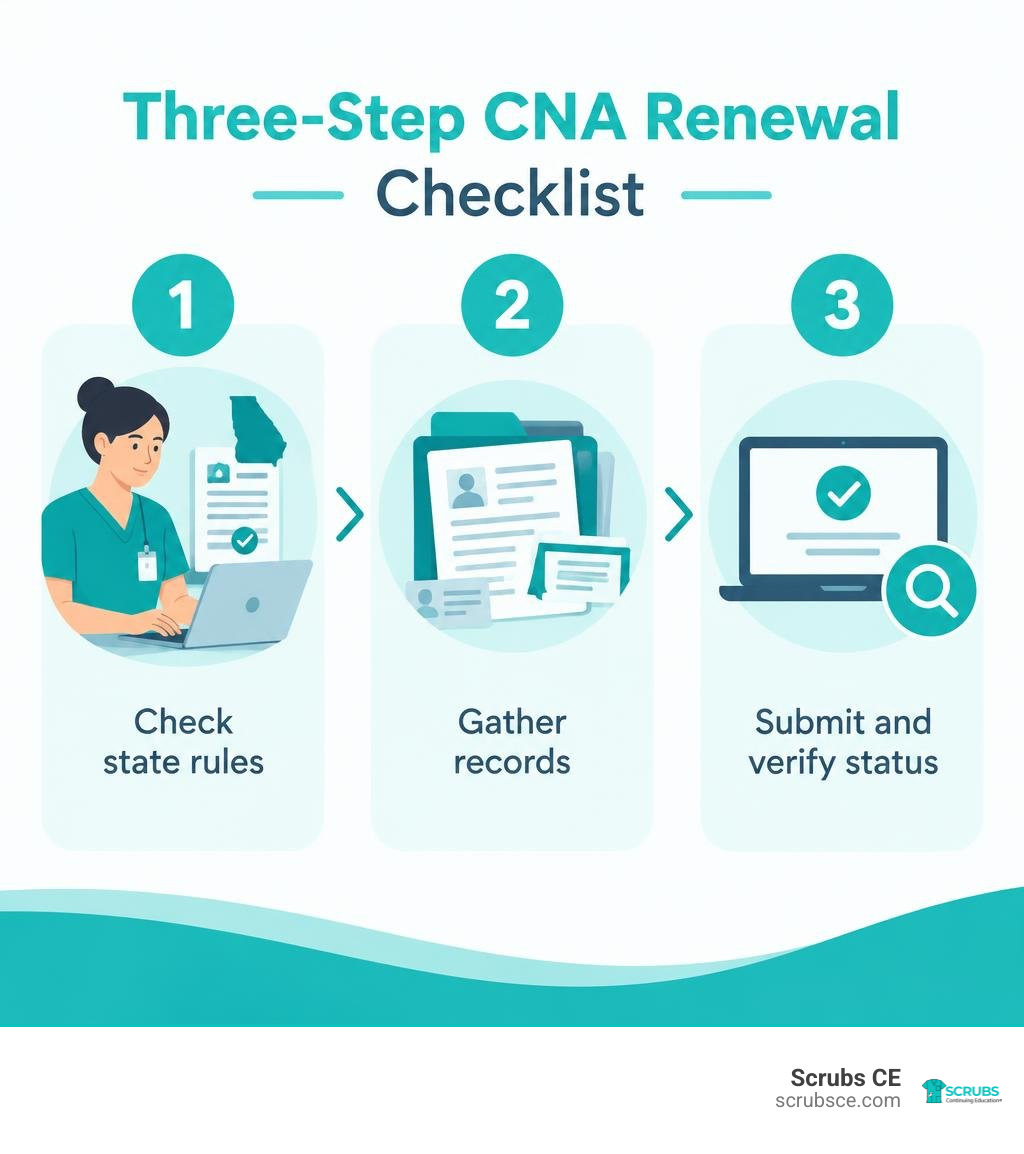
The Step-by-Step Process for Fast CNA License Renewal
Completing your renewal does not need to feel like an uphill battle. With digital portals replacing sluggish mail-in packets across most state boards, we can complete the digital submission in a single sitting. When you understand how to renew your CNA license in simple steps, the entire online portion typically takes less than 30 to 45 minutes.
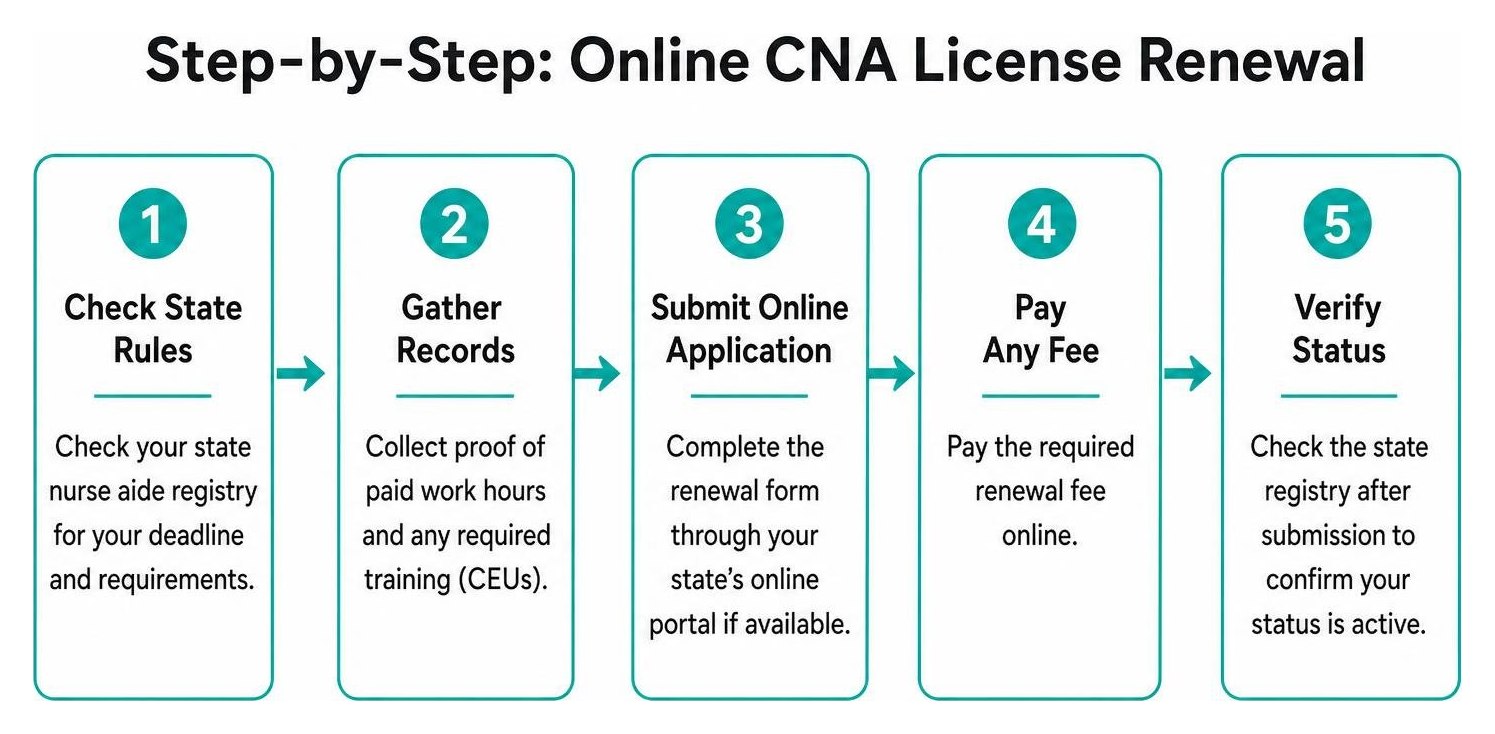
Step 1: Gather Proof of Paid Work Hours and CEUs
Before opening your state’s licensing portal, collect all mandatory paperwork into a single digital folder. Having these files organized as PDFs or high-resolution images prevents session timeouts while you are filling out forms.
Prepare the following items:
- Proof of Paid Employment: Recent pay stubs, W-2 forms, or an official signed letter from your Director of Nursing (DON) or Human Resources department verifying you performed nursing-related tasks for pay.
- Continuing Education Units (CEUs): Completion certificates from state-approved providers displaying course titles, contact hours, completion dates, and provider accreditation numbers.
- State Identification: A clear copy of your driver’s license, state ID, or passport.
- Active Registry Details: Your current CNA certificate number, Social Security Number, and your unique NCSBN ID if your state utilizes universal tracking.
Step 2: Access Your State Registry Portal Online

Once your documents are organized, navigate to your state’s nurse aide registry or Department of Health licensing portal. Systems like Wisconsin’s LicensE or Massachusetts’ Health Profession Licensing System require you to authenticate your account using an existing profile. If your state uses Nursys for registry tracking, you can quickly look up your official license number and record status before starting. Ensure your name and login credentials match your state profile exactly to prevent verification delays.
Step 3: Complete Electronic Verification and Pay Registry Fees
Follow the on-screen prompts to input your clinical hours, upload your CEU certificates, and confirm your background screening details. While some jurisdictions process renewals free of charge, standard state renewal fees range between $0 and $50. If you are renewing in Florida, standard pre-expiration processing is $55 (plus a $5 statutory fee), whereas California charges no processing fee for standard CNA renewals. Once submitted, download your digital confirmation receipt. You can also explore our guide on nurse aide certificate renewal, which breaks down common electronic payment workflows.
State Requirements for CNA Continuing Education and Work Hours
Federal regulations enforced by the Centers for Medicare & Medicaid Services (CMS) mandate that nurse aides perform at least 8 hours of paid nursing-related services under the supervision of a licensed nurse every 24 months. However, individual state boards frequently establish higher thresholds for clinical hours and continuing education.
| State | Renewal Cycle | Required Paid Work Hours | Required CEU / In-Service Hours | State Processing Fee |
|---|---|---|---|---|
| California | 2 Years | Paid nursing work during cycle | 48 hours (max 24 online; min 12/year) | $0 |
| Florida | 2 Years | 8 hours in past 24 months | 24 hours per biennium | $55 |
| Texas | 2 Years | Paid work during cycle | 24 hours | $0 |
| New York | 2 Years | Paid work during cycle | 12 hours annually (24 total) | $0 |
| Illinois | 2 Years | 8 hours in past 24 months | 24 hours | $0 |
| Arizona | 2 Years | 160 hours in past 2 years | Varies by facility | $0 |
| Oregon | 2 Years | 400 hours in past 2 years | None (work hours only) | $60 |
| Delaware | 2 Years | 64 hours in past 24 months | 24 hours (6 must be dementia care) | $25 |
| Utah | 2 Years | 200 hours in past 2 years | Varies | $0 |
| Vermont | 2 Years | 400 hours in past 2 years | None | $20 |
Understanding State Variations in CNA License Renewal
Continuing education requirements differ significantly across state borders. In some states, you only need to verify work hours, while others require structured coursework covering specific clinical topics. For example, according to the Florida Board of Nursing CNA guidelines, CNAs must complete 24 hours of board-approved in-service education every two-year cycle. These hours must cover core safety topics, including bloodborne pathogens, infection control, domestic violence, medical record documentation, resident rights, communication with cognitively impaired residents, CPR skills, and medical error prevention.
In California, the Department of Public Health (CDPH) requires 48 hours of continuing education or in-service training. California regulations require that at least 12 of those hours be completed during each year of the two-year certification period, and no more than 24 total hours may be earned through approved online independent study.
Key Differences Across Major State Registries
Navigating state platforms requires attention to local registry portals:
- Massachusetts: The Massachusetts nurse aide renewal portal requires CNAs to log into the Health Profession Licensing System, demonstrating at least 8 hours of paid nurse aide duties within the preceding two years.
- Texas: Overseen by Texas Health and Human Services (HHS), CNAs complete 24 hours of continuing education and verify employment through the state’s online regulatory database.
- Illinois & New York: Illinois mandates 24 hours of in-service training per renewal cycle, while New York requires health facilities to provide at least 12 hours of in-service training annually for active aides.
Managing Lapsed Credentials and Special Exceptions
Letting your certification expire can interrupt your career, but rectifying the situation depends directly on the length of your lapse. Our comprehensive walkthrough on renewing an expired CNA license provides actionable steps to regain your active status.
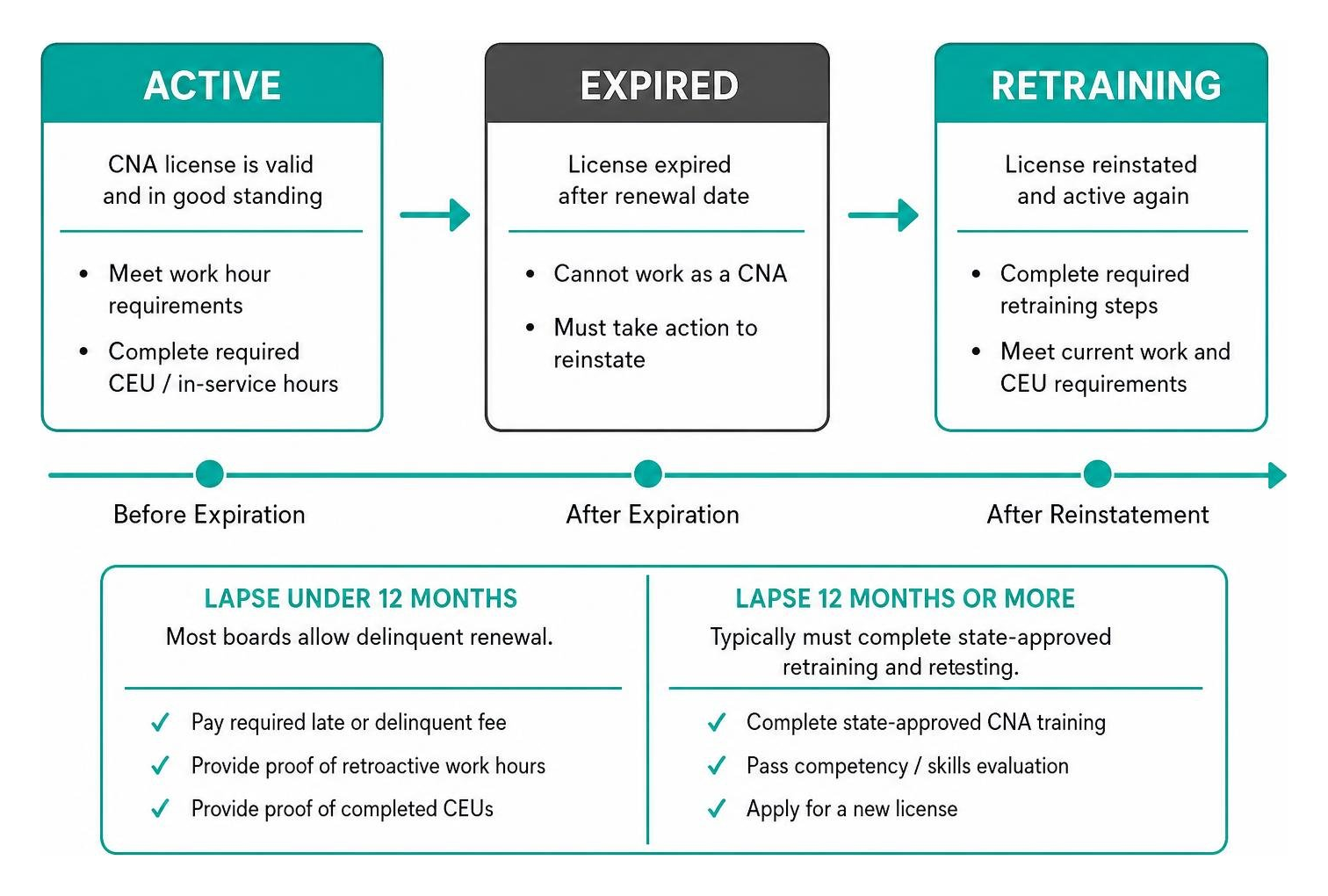
Handling Expired Licenses vs Delinquent Status

- Lapse Under 12 Months: If your license expired recently, most boards allow you to submit delinquent renewal applications by paying a late penalty fee (such as Florida’s $105 post-expiration or $160 delinquent fee) and providing proof of retroactive work hours and CEUs.
- Lapse Between 12 and 24 Months: Depending on your jurisdiction, you may be granted reinstatement by completing additional CEU hours or challenging a partial competency evaluation.
- Lapse Over 24 Months: If your certification has been inactive for more than two years without documented nursing employment, federal regulations generally require you to complete an approved state training program and pass the written and clinical competency exams again.
Military, Medical, and Interstate Provisions for CNA License Renewal
State regulatory boards offer built-in protections for specific life circumstances:
- Military Deployment: Active-duty service members and their spouses can request renewal extensions or requirement suspensions by submitting official military deployment orders.
- Medical & FMLA Leave: Documented medical leave or parental leave can qualify for temporary administrative extensions in select jurisdictions if requested before your certificate lapses.
- Interstate Endorsement & Reciprocity: If you move to a new state, you do not renew your old license in the new jurisdiction. Instead, you apply for reciprocity (endorsement) by submitting your active home registry verification, background check, and proof of work experience.
Avoiding Common Pitfalls and Employer-Assisted Submissions
A small clerical mistake can delay your certification or leave you temporarily unable to work. Staying proactive prevents unnecessary headaches.
Address Errors and Documentation Gaps
The leading cause of missed renewals is an outdated address-of-record. State boards send vital expiration notices to your address on file. If you have moved, update your physical address and email within 30 to 60 days of relocation.
Other common mistakes include:
- Submitting certificates from unaccredited CEU providers.
- Submitting volunteer hours instead of paid clinical work.
- Letting LiveScan electronic fingerprinting expire in states that require updated background clearances.
- Submitting name changes without providing official legal documentation, such as a marriage certificate or court order.
Leveraging Facility In-Service and Payer Codes
Many healthcare facilities assist their staff with credential maintenance. Skilled nursing facilities and hospitals often host approved in-service training sessions that fulfill your annual CEU quotas at zero cost to you. Furthermore, some states provide employer payment options. In Florida, for instance, healthcare organizations can register for an “Other Payer Code,” allowing administrative staff to batch-pay renewal fees directly for their CNA employees during their renewal window.
Frequently Asked Questions about Nurse Aide Certification
Can I renew my CNA license if I am not currently working?
To maintain your license, CMS and most state registries require documented proof of paid nursing-related work during the renewal period (ranging from 8 hours up to 400 hours depending on the state). Volunteer work and unpaid caregiving for family members generally do not satisfy this requirement. If you are currently unemployed or working outside healthcare, you can pick up a few PRN (per-diem) shifts through a healthcare staffing agency or facility before your renewal window closes to secure your necessary paid hours.
What happens if my CNA certification lapses beyond 24 months?
If your CNA certification has lapsed for more than 24 consecutive months without verified paid employment, federal guidelines treat your certification as null and void. You will typically need to re-enroll in an approved state nurse aide training program and pass both the written knowledge examination and the manual clinical skills test.
How quickly will my renewed status show on Nursys or state registry?
Online submissions processed with electronic payments typically update on state licensing portals and Nursys within 24 to 72 business hours. If your application requires manual auditing of paper forms, continuing education certificates, or background fingerprint reviews, processing can take between two to six weeks.
Conclusion
Staying on top of your professional credentials protects your livelihood and ensures uninterrupted care for your patients. By keeping a digital log of your work hours and completing your continuing education early, you can complete the online process quickly and avoid costly re-testing requirements. Explore our complete selection of accredited courses to keep your CNA status active and maintain your professional standing with confidence.